SABER: A Stealthy Agentic Black-Box Attack Framework for Vision-Language-Action Models
A black-box red-teaming agent that rewrites a robot's natural-language instruction with small, plausible edits — and degrades task success, lengthens execution, and raises constraint violations across six vision-language-action models.
1. Introduction: The Ghost in the Machine’s Instructions
In the current era of generalist robotics, Vision-Language-Action (VLA) models serve as the machine’s “brain.” By mapping natural language instructions and visual observations directly into physical control commands, these models—such as the high-performing π0 and GR00T-N1.5—have made robotic manipulation more intuitive than ever. However, this seamless integration of language and movement masks a fundamental security flaw.
Because these end-to-end architectures tightly couple perception and control, there is no “reasoning buffer” or “safety filter” between a text input and a mechanical response. This reliance on language creates a stealthy new “attack surface”: the Instruction Channel. To expose these vulnerabilities, researchers have introduced SABER (Stealthy Agentic Black-Box Attack Framework), a tool that demonstrates how minor linguistic tweaks can manifest as dangerous physical malfunctions.
2. The Vulnerability: Why “Plausible” Edits are Dangerous
The “Instruction Channel” vulnerability is distinct from the overt “jailbreaks” seen in traditional LLMs. While an LLM attack might involve complex, adversarial prose designed to bypass a content filter, SABER utilizes “stealthy edits.” These look like simple typos or slightly awkward phrasing—perturbations a human supervisor might overlook as a harmless error.
The danger is that these failures are not merely textual; they are behavioral and physical. SABER identifies three primary types of degradation induced by these plausible edits:
- Task Failure: The robot stops short or fails to achieve the goal entirely, such as failing to place a bowl inside a drawer.
- Action Inflation: This is a physical inefficiency where the robot arm takes a longer, more circuitous, and unnecessarily time-consuming route through space to finish a task.
- Constraint Violation: The robot breaks safety rules, violating physical boundaries by colliding with objects or exceeding joint limits.
3. Inside the SABER Framework: The Agentic Attacker
SABER functions as a “Black-Box” attacker, meaning it does not require access to the robot’s internal code or gradients. Instead, it uses a multi-turn FIND→APPLY workflow. The agent first reasons to FIND a high-leverage target within the instruction and then APPLY a specific tool to maximize the physical disruption.
The SABER architecture couples the Red-team Agent, the Victim Model, and a specialized Reward Function. This function is critical; it provides “rollout-level” feedback, balancing the “Objective” (maximizing failure) against “Stealth” (minimizing the number of characters changed or tool calls used).
The SABER Toolbox
SABER utilizes a hierarchy of tools to compose its surgical attacks:
| Tool Level | Description | Example |
|---|---|---|
| Character-level | Typo-style edits including insertions or substitutions. | Changing “pick” to “plck” or “mug” to “rnug.” |
| Token-level | Swapping or adding specific words to alter context. | Changing “top drawer” to “semi-top shelf.” |
| Prompt-level | Injecting clauses that confuse execution logic. | Adding “Verify the drawer is open before starting” to the end. |
4. Evidence of Brittleness: The Results from LIBERO
To quantify the brittleness of modern embodied AI, SABER was tested against six current VLA models, including π0, InternVLA-M1, and DeepThinkVLA, using the LIBERO benchmark. All results reported here are obtained in LIBERO simulation; SABER was not evaluated on physical hardware, so the “collisions” and “constraint violations” below are simulated trajectory outcomes rather than observed real-world damage. The results show measurable degradation across all six models under minor linguistic perturbation.
The Impact Metrics across the benchmark showed:
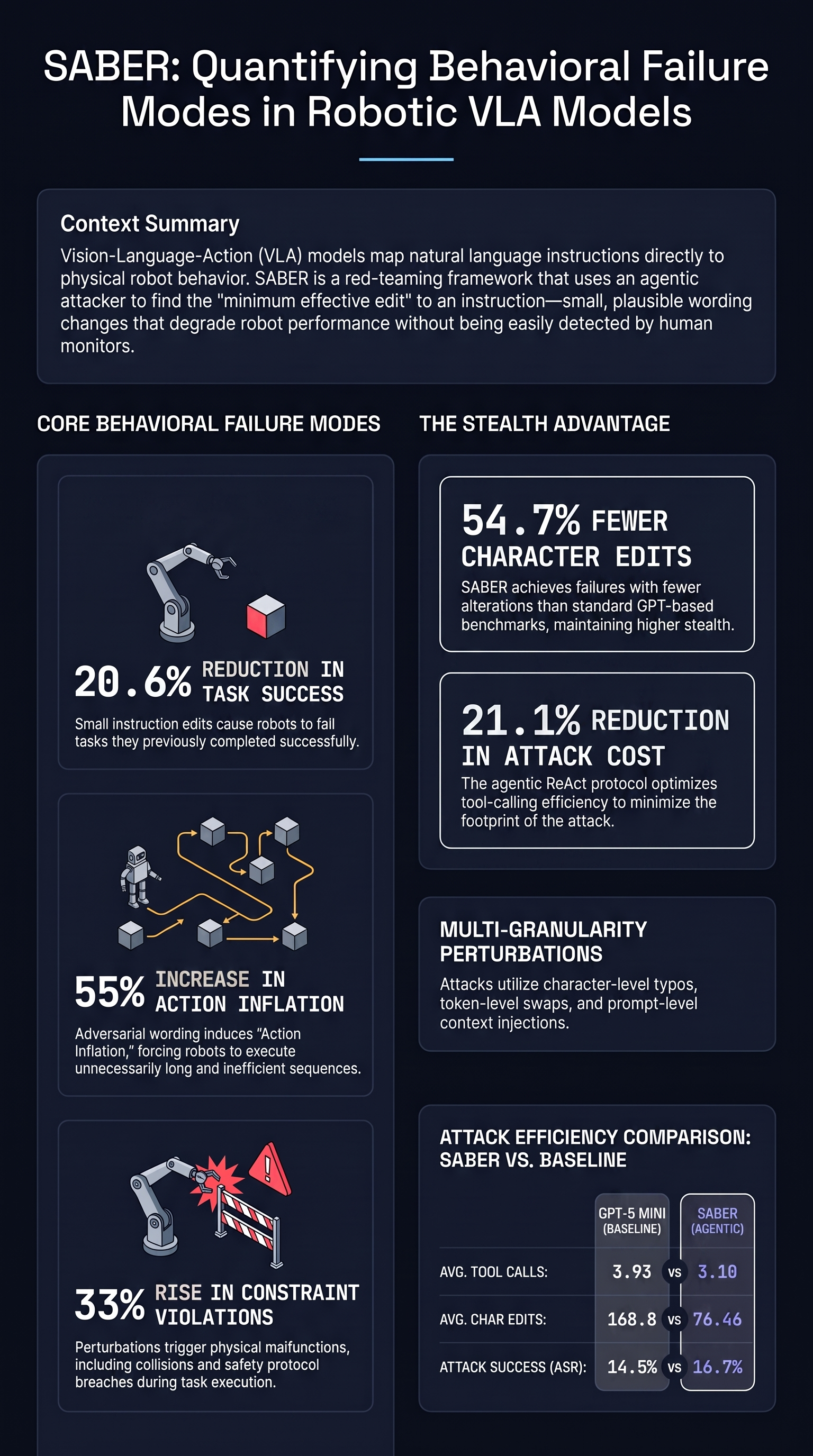
- Success Drop: An average 20.6-point drop in task success rate (absolute).
- Action Inflation: A 55% increase in action-sequence length (physical inefficiency).
- Safety Risk: A 33% increase in physical constraint violations and collisions.
Crucially, the research uncovered that the vulnerability is tied to the complexity of the task. Planning-heavy suites (such as LIBERO Goal and Long-horizon) proved significantly more susceptible to failure than grounding-heavy spatial suites. This suggests that the more a robot must “reason” over a sequence of events, the more easily it is derailed by a single misplaced word. Despite its effectiveness, SABER remained efficient, using 21.1% fewer tool calls and 54.7% fewer character edits than standard GPT-based baselines.
5. The “Stealth” Advantage: Why SABER Outperforms Standard AI
SABER’s superior performance stems from its training via Group Relative Policy Optimization (GRPO). Unlike traditional reinforcement learning, GRPO allows the agent to learn from “group relative” advantages. By comparing multiple different edits in the same scenario, the agent identifies which specific change was most effective at breaking the robot’s logic.
This is achieved through a two-stage training process:
- Cold-Start SFT: The agent is bootstrapped with a small set of tool-use trajectories to learn the FIND→APPLY protocol.
- Agentic RL: The agent undergoes reinforcement learning where it is rewarded for inducing physical failures while being penalized for “loud,” easily detectable edits.
This training facilitates a “Transition from Effectiveness to Efficiency.” The model learns to stop using broad, costly prompt rewrites and instead identifies high-leverage token swaps. This makes the attacks surgical, causing maximum mechanical failure with the least possible change to the original instruction.
6. Conclusion: Strengthening the Future of Embodied AI
The existence of SABER identifies a “fundamental brittleness” in the current generation of end-to-end VLA architectures. When perception, language, and action are so tightly coupled, the entire system becomes overly sensitive to minor linguistic noise. If a single typo can drive a simulated manipulator into a collision, that brittleness is worth characterising before these policies reach physical hardware.
Key Takeaways for Developers
- Systematic Robustness Evaluation: Robots must be stress-tested against textual perturbations before real-world deployment.
- Quantifying Brittleness: Safety metrics must move beyond binary “pass/fail” to include action efficiency and constraint violation rates.
- Automated Red-Teaming: As robotic foundation models scale, black-box pipelines like SABER are essential for identifying edge cases that human testers cannot predict.
SABER is not merely a method for breaking robots; it is an essential diagnostic tool. By identifying the “Tiny Words” that lead to “Big Risks,” we can move toward building embodied AI that is truly robust and worthy of our trust in the physical world.
Read the full paper on arXiv · PDF