Cultural Adaptation in Large Language Models for Political Discourse
Argues that linguistic fluency is not political competence: LLMs in civic and political workflows commit representational failures by collapsing local political concepts into Western defaults, and maps the three levels of cultural adaptation needed to fix it.
1. Introduction: The High Stakes of Political AI
The integration of Large Language Models (LLMs) into political workflows—ranging from automated content moderation and policy narrative analysis to the summarization of public testimony—has shifted the focus of AI safety from simple “hallucinations” to profound sociotechnical risks. When these models mediate civic participation, their limitations are no longer mere technical glitches; they are “representational failures” that threaten the very foundations of institutional trust.
“The integration of large language models into political discourse analysis creates new opportunities for comparative research, policy analysis, and civic technology, while introducing material risks for democratic accountability.”
As systems move from experimental environments to the critical infrastructure of democracy, we must recognize that linguistic fluency does not equate to cultural or political competence. To achieve democratic legitimacy, AI development must move beyond surface-level multilingualism toward deep cultural adaptation.
2. The Three Levels of Cultural Adaptation
Building robust political AI requires distinguishing between three hierarchical levels of model engagement with a target culture:
- Translation Level: The preservation of literal, propositional meaning across languages. While necessary, this level ignores the strategic and context-dependent nature of political speech.
- Discourse Level: The mastery of local genre conventions, rhetorical strategies, and pragmatic norms. This includes navigating implicatures, politeness strategies (Brown and Levinson, 1987), and the specific “how” of persuasion within a community.
- Ontology Level: The accurate representation of political concepts, institutions, and normative categories. This is the most difficult level to master as it involves concept mappings that are rarely explicit in training data and are often incommensurable across different political traditions.
3. Anatomy of a Failure: Systematic Cultural Blind Spots
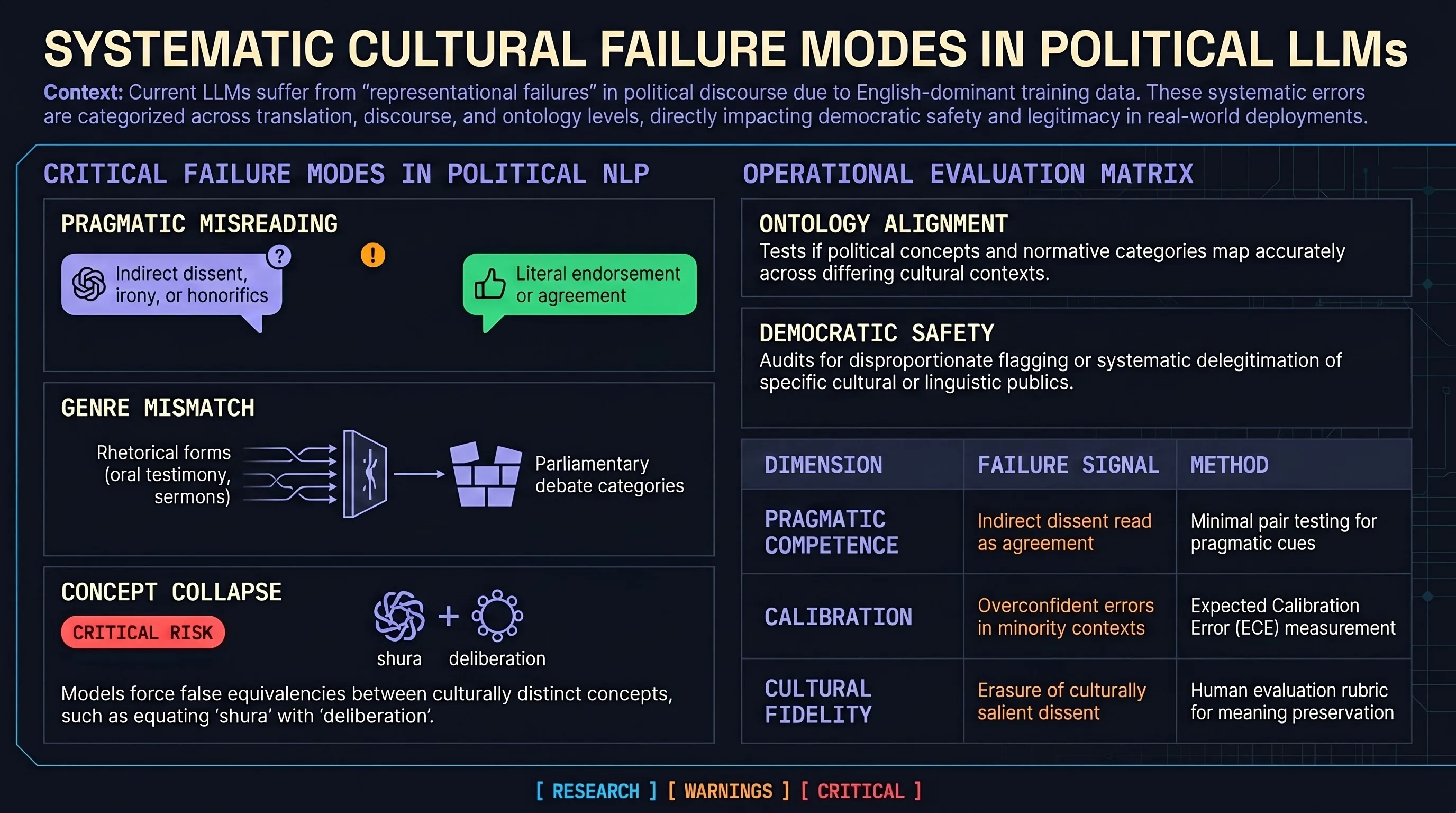
When models are deployed without cultural calibration, they exhibit systematic failure modes that evade standard benchmarks. A central mechanism of these failures is “concept stretching.” As identified by Sartori (1970) in his ladder of abstraction, political concepts that travel across contexts often gain generality at the cost of their discriminatory power. LLMs frequently collapse these distinctions, forcing local political realities into Western institutional defaults.
| Failure Mode | Description | Real-World Example |
|---|---|---|
| Pragmatic Misreading | Interpreting indirect speech, irony, or honorifics literally, failing to decode the speaker’s true intent or stance. | Misinterpreting honorific addresses or “hedged disagreement” in Swiss political discourse (X-Stance) as literal endorsement of a policy. |
| Genre Mismatch | Mapping rhetorical forms (e.g., sermons, oral testimony) to categories calibrated for parliamentary debate or journalism. | Misclassifying the functional intent of a political sermon by forcing it into the structural logic of a legislative speech. |
| Concept Collapse | Treating distinct political concepts as identical due to shared surface-level labels, ignoring divergent historical trajectories. | Equating Senegalese demokaraasi (community solidarity) with Western liberal proceduralism, or shura (consultation) with Western “deliberation” (Schaffer, 1998). |
Research into Arabic stance detection (Charfi et al., 2024b) and multi-dialectal hate speech (ADHAR dataset; Zaghouani et al., 2024) confirms that categories calibrated for one political culture do not transfer reliably to others, even within the same language family.
4. The “WEIRD” Data Problem and Domain Shift
The current “Stochastic Parrots” approach to scaling (Bender et al., 2021) assumes that massive data volume will eventually yield universal competence. However, most LLMs are trained on WEIRD (Western, Educated, Industrialized, Rich, and Democratic) data. This dominance creates an “anchor” effect where English-centric institutional norms are implicitly imposed on the rest of the world.
Scaling intensifies representational harms because larger models appear more authoritative and are reused at scale across diverse sociotechnical contexts. Standard benchmarks like XTREME or mBERT primarily measure cross-lingual generalization on general tasks but fail to probe for “concept stretching” or ontological fidelity. Without explicit adaptation, these models function as implicit normative engines, marginalizing non-Western forms of political reasoning and silencing legitimate dissent that does not conform to the training data’s dominant discourse norms.
5. Operationalizing Robustness: The Evaluation Matrix
To mitigate these risks, the AI safety community must adopt a sociotechnical approach to model deployment that combines architectural interventions with rigorous, disaggregated evaluation.
Architectural and Methodological Pathways
- Participatory Development: Shifting from passive data sampling to community-led governance. This involves local experts in defining labels for datasets like MARASTA and validating the “epistemic signal” in annotator disagreement.
- Retrieval-Augmented Generation (RAG): Utilizing curated, locally grounded corpora to provide factual grounding and prevent the import of external institutional biases.
- Instruction Tuning & Calibration: Separating general linguistic competence from local political calibration. This requires tuning models to specific local discourse styles while maintaining high uncertainty estimation and abstention behavior (knowing when to “not know”) under domain shift.
The Evaluation Matrix
Practitioners must move beyond aggregate accuracy to a multi-dimensional matrix:
- Cultural Fidelity: Measuring alignment with locally grounded meanings and the preservation of minority dissent.
- Calibration: Evaluating performance via Expected Calibration Error (ECE) and selective prediction curves to ensure the model’s confidence matches its actual competence in underrepresented contexts.
- Democratic Safety: Auditing for disproportionate flagging or delegitimation of specific publics through red-teaming and disparity ratio analysis.
Minimal Reporting Requirements Checklist
For any model mediating political discourse, practitioners should provide:
- Disaggregated Results: Performance metrics broken down by specific language, dialect (e.g., Arabic varieties in ADHAR), and genre.
- Qualitative Error Analysis: Detailed examination of failures regarding pragmatics and Sartori-style “concept stretching.”
- Data Statements: Documentation of the provenance, regions, and political traditions represented in training data (Bender & Friedman, 2018).
- Contestability Pathways: Established institutional processes, such as review boards and redress mechanisms, allowing users to appeal or correct model outputs.
6. Conclusion: Building for Democratic Safety
Cultural adaptation is not a decorative “feature” but a prerequisite for the safe deployment of AI in the political sphere. Systems that lack this adaptation do not remain neutral; they implicitly impose the normative defaults of their training data on global populations.
Critical Takeaways for Practitioners:
- Adaptation is Ontological: Translation preserves words, but adaptation preserves meaning. Developers must account for Sartori’s ladder of abstraction to prevent concept collapse.
- Safety Requires Calibration: Models must be technically capable of abstention. High ECE in non-WEIRD contexts is a primary safety signal that requires remediation.
- Prioritize Contestability: AI systems are not final authorities. Democratic safety depends on the existence of review boards and clear authority to revise model thresholds and label definitions.
- Shift to Empirical Testability: We must move from aspirational claims of “multilingualism” to empirically testable commitments to cultural fidelity.
The goal of next-generation political NLP is to ensure that language technologies support, rather than undermine, the inclusive reasoning required for democratic legitimacy across diverse global contexts.
Read the full paper on arXiv · PDF