Agile Fall Recovery for Quadrotors with Bidirectional Thrust via Reinforcement Learning
Autonomous fall recovery is a critical capability for quadrotors operating in real-world environments, where collisions or failures may leave the vehicle resting on the ground in an arbitrary...
Introduction: The “Grounded” Problem in Autonomous Flight
In the deployment of autonomous quadrotors, the “mission over” moment often occurs long before a total mechanical failure. Minor collisions or navigation errors frequently leave vehicles resting on the ground in arbitrary, often inverted, attitudes. For traditional autonomous systems, this is a terminal state.
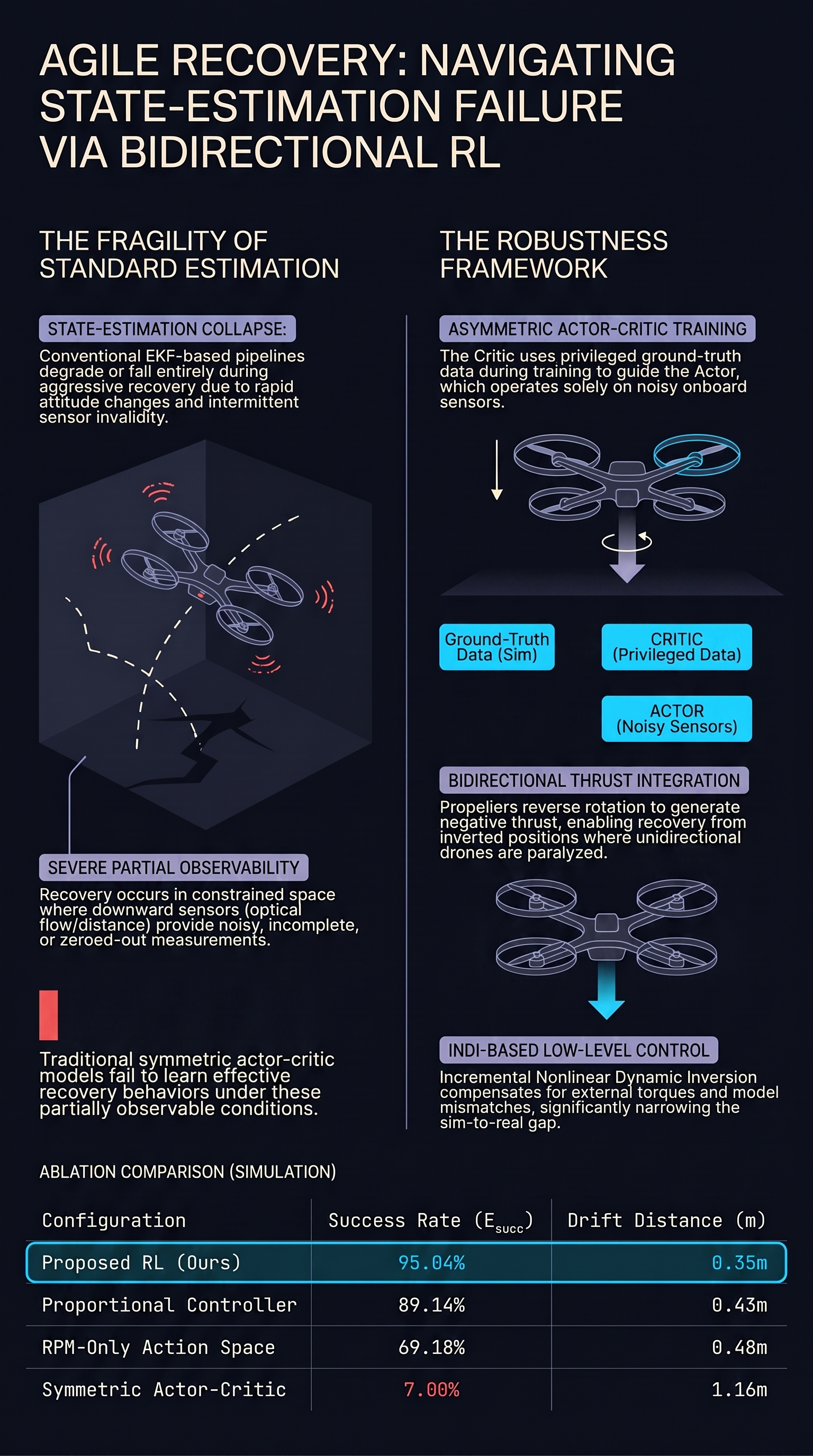
The primary hurdle is the “Sensing Gap.” Standard flight stacks rely on Extended Kalman Filter (EKF)-based estimation, which requires continuous, reliable sensor data to maintain a state estimate. However, during aggressive recovery maneuvers or when a drone is flipped upside down, sensors often return invalid measurements. Rapid attitude changes and ground contact create severe partial observability that causes conventional estimation pipelines to degrade or fail entirely.
This research introduces a Reinforcement Learning (RL) based framework designed to bridge this gap. By combining bidirectional thrust hardware with a specialized neural network architecture, we have developed a system capable of autonomous recovery from any ground position to a stable hover, using only lightweight, often unreliable, onboard sensors.
The Methodology: A Hardware-Software Synergy
The Hardware Edge: Bidirectional Thrust
Most quadrotors utilize fixed, unidirectional propulsion. While efficient for forward flight, this configuration is physically incapable of generating the moments required to flip a vehicle over from an inverted position on the ground. This research utilizes bidirectional thrust—the ability to reverse propeller rotation—to solve this physical constraint.
- Ground Leverage: Reversing rotation allows the motors to generate thrust in both directions, enabling the vehicle to produce control moments while still in contact with the ground.
- Expanded Envelope: It allows for maneuvers that involve half-flips between upright and inverted states, which are physically impossible for standard quadrotors.
- Agility: Bidirectional thrust provides the necessary torque to “snap” the vehicle out of arbitrary resting positions into a flight-ready attitude.
The Intelligence: Asymmetric Actor-Critic Architecture
To handle the “Sensing Gap,” we model the recovery as a Partially Observable Markov Decision Process (POMDP). Because the drone cannot “see” its full state using only an IMU, a downward-facing optical flow sensor, and a distance sensor, the policy must infer these values from history.
We utilize an Asymmetric Actor-Critic architecture. During training, the “Critic” is given “privileged” ground-truth information from the simulator. The “Actor” (the policy running on the drone) only sees the noisy, limited data available from the real sensors.
| Actor’s Observation Space (19-dim) | Critic’s Privileged State (33-dim) |
|---|---|
| Noisy Sensor Data: Distance sensor (), Optical flow rate () | Ground Truth: Relative position to target in body frame (), Linear velocity () |
| Binary Masks: Indicators for sensor validity (, ) | Dynamics: Noiseless angular velocity () and acceleration () |
| IMU Data: Body-frame linear accel (), angular velocity () | External Factors: Random external forces () and moments () |
| History: Previous action () | Action History: Last three actions () |
To process this limited observation space, the Actor incorporates a Gated Recurrent Unit (GRU). This allows the policy to maintain a temporal memory, effectively helping it infer latent states like current velocity and displacement from the takeoff point. This creates a sensorimotor policy that maps history directly to action, bypassing the need for a separate, fragile estimator module entirely.
Solving the Sim-to-Real Gap: High-Fidelity Simulation
Incremental Nonlinear Dynamic Inversion (INDI)
To ensure the RL policy transfers to the real world, we do not allow it to control motor speeds directly. Instead, the policy outputs high-level Collective Thrust and Body-Rate (CTBR) commands. These are tracked by a low-level INDI controller.
Technical Directive for INDI Implementation:
- Compute Desired Acceleration: Monitor current body rates () and track the desired setpoint () using a proportional control law: .
- Estimate Control Moment: Derive the desired moment by combining the acceleration error with the current moment estimate derived from motor RPMs: .
- Map to Actuators: Invert the quadrotor dynamics to solve for motor RPMs, ensuring bidirectional thrust by determining rotation direction based on the sign of the commanded collective thrust .
Modeling the “Real World” in Silicon
The training occurs in Isaac Sim, utilizing high-fidelity models:
- Hardware Twins: SolidWorks CAD data ensured simulated mass and inertia matched the real hardware.
- Actuator Accuracy: Motor-speed responses were modeled as first-order systems, capturing asymmetric spin-up/spin-down times.
- Sensor Noise: Optical flow was simulated based on pixel displacement, including “invalidity” triggers that zero out data during high-speed rotations to mimic real sensor dropouts.
Table I: Domain Randomization Parameters
| Parameter | Randomization Range |
|---|---|
| Thrust Coefficient () | |
| Moment Coefficient () | |
| Vehicle Inertia | to of nominal |
| External Forces () | Up to of vehicle weight |
| External Moments () | Up to |
| Sensor Noise | Gaussian noise added to IMU and Gravity projections |
Performance Analysis: Robustness Under Pressure
Ablation Study Insights: Why the Architecture Matters
Our testing of “stripped-down” variants revealed critical behavioral failure modes:
- Symmetric Actor-Critic ( Success): This variant exhibited total disorientation. Without privileged state during training, the Critic could not provide a coherent value signal during the “Sensing Gap” (the initial flip), leading to a policy that never learned to bridge periods of sensor invalidity.
- RPM Action ( Success): Visually, these agents struggled with the highly non-linear dynamics of propeller reversal. Directly commanding motor speeds proved too complex for the policy to handle alongside model mismatch.
- MLP Actor ( Success): While somewhat functional, the motion was “jerky” and reactive. Lacking the GRU’s temporal inference, the agent could not accurately estimate linear velocity, resulting in persistent oscillations near the target hover point.
Real-World Stress Testing
The system demonstrated remarkable zero-shot transfer.
- Outdoor Adaptability: Across a series of outdoor trials, the drone successfully recovered from grass, stone, tile, and steep slopes, generalizing to terrains never seen during training.
- Indoor Disturbances: In laboratory settings, the framework maintained stability despite wind disturbances from large fans and the addition of unexpected payloads. The INDI controller successfully estimated and compensated for these unmodeled external torques.
Failure-First Takeaways for AI Safety and Robotics
For practitioners focused on building resilient embodied AI, this research offers four critical lessons:
- Resilience over Precision: Systems can achieve complex goals like fall recovery without explicit state estimation. By bypassing the EKF, we avoid the “cascade of failure” that occurs when an estimator’s assumptions are violated during out-of-distribution maneuvers.
- The Critic’s Advantage: Training with privileged information is vital for handling sensor invalidity. It allows the agent to learn the “optimal” behavior in a safe environment where the full state is known, which it can then approximate using limited sensors in the field.
- Low-Level Stability: Classical control (INDI) and RL are not mutually exclusive. Using a classical controller to handle high-frequency stability allows the RL policy to focus on the high-level strategy of recovery.
- Sensing Vulnerabilities: Even with RL, hardware has limits. The system remains sensitive to optical flow quality; in low-texture environments where sensors provide zero data, the agent faces fundamental physical limits of observability.
Conclusion: The Path Forward for Embodied AI
This research marks a significant milestone in robotic resilience: the ability to recover from arbitrary, failed states using only lightweight, noisy, and intermittently available sensing. By utilizing bidirectional thrust and a recurrent, asymmetric RL architecture, the quadrotor transforms a “grounded” failure into a temporary delay.
In essence, “agile recovery” is the robotic equivalent of adversarial robustness. By forcing the system to recover from arbitrary attitudes—essentially “red-teaming” its own physical flight envelope—we ensure the AI handles the systematic uncertainty of the real world.
The Bottom Line: For AI to be deployed in high-stakes environments, it must be designed to handle failure gracefully. This framework proves that robust recovery is not just about speed; it is about the intelligent navigation of partial observability.
Read the full paper on arXiv · PDF