PhysVLA: Towards Physically-Grounded VLA for Embodied Robotic Manipulation
Vision-Language-Action (VLA) models excel at mapping visual inputs and natural language instructions directly to robotic control policies.
1. Introduction: The Ghost in the Machine
In the pursuit of general-purpose robotics, Vision-Language-Action (VLA) models—such as RT-2, OpenVLA, and π0—have emerged as the dominant paradigm. By leveraging massive vision-language backbones, these models demonstrate an uncanny ability to map semantic instructions to 7-DoF end-effector poses. However, as AI safety engineers, we must confront a sobering reality: these models are essentially “stochastic parrots” of behavioral demonstration data. They excel at semantic reasoning but operate within a “physics gap,” lacking any explicit encoding of rigid-body dynamics, friction, or contact constraints.
This leads to the “Ghost in the Machine” phenomenon: models that understand the concept of “placing a bowl” but command actions that are kinodynamically impossible or physically implausible. In real-world deployment, these errors are not merely performance dips; they are catastrophic failures. Relying on implicit learning to “eventually” grasp physics is a high-risk strategy that fails in contact-rich, high-stakes environments.
2. Identifying the Failure Modes: Why “Smart” Robots Fail
Our empirical analysis across varied VLA architectures reveals systematic, qualitative failure modes that persist even as model sizes scale.
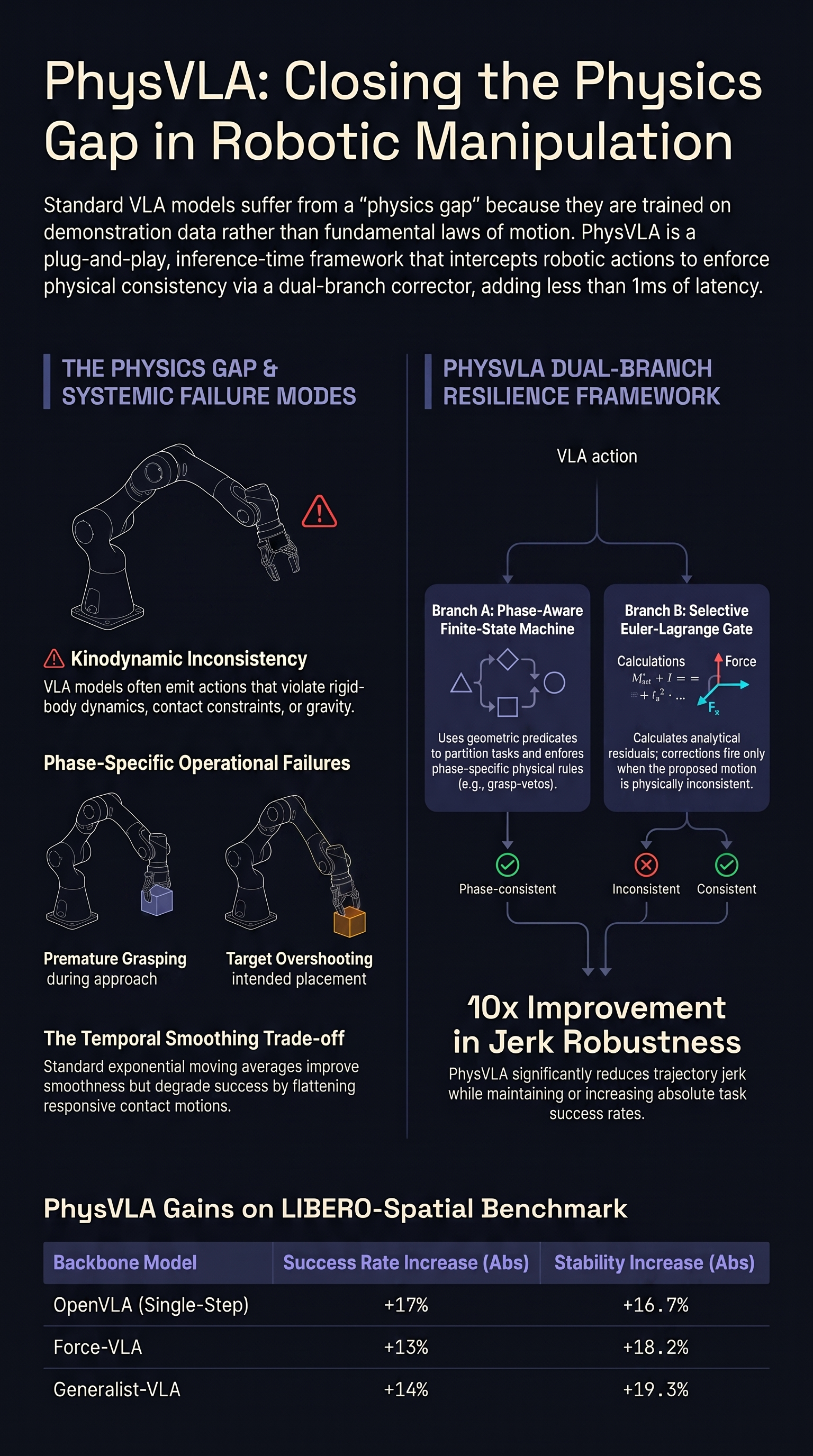
- The Grasp Failure: During contact acquisition, standard VLA policies frequently issue lateral motions or premature gripper closures. Because the model ignores the geometric preconditions for a stable hold, it fails to respect the quasistatic requirements of a secure grasp, resulting in “empty-hand” failures or object collisions.
- The Placement Failure: In the high-velocity regime of an approach, models often fail to implement a proper deceleration profile. This leads to overshooting sub-centimeter targets, as the VLA lacks the grounding to transition from broad translational motion to precision placement.
The Smoothing Paradox Common mitigations, such as Exponential Moving Average (EMA) temporal smoothing, present a dangerous trade-off. While EMA improves macro-scale trajectory smoothness, it creates a “smoothing paradox”: it flattens the sharp, responsive bursts of motion required during the critical contact acquisition process. By trading responsiveness for stability, standard smoothing often degrades overall task success, proving that temporal coherence is no substitute for physical grounding.
3. The PhysVLA Solution: A Modular Safety Wrapper
PhysVLA (Physics-VLA) is a “plug-and-play” inference-time framework designed to provide a modular safety layer for any frozen VLA backbone. It requires zero retraining, fine-tuning, or weight access, preserving the model’s multimodal reasoning while vetoing physical violations.
Technical Breakdown: The Dual-Layered Correction System PhysVLA intercepts the VLA’s predicted action () and applies a two-branch refinement:
- Branch A: Phase-Aware Finite-State Machine (FSM): This branch utilizes geometric predicates to partition tasks into Approach, Grasp, Transport, and Place.
- Approach Phase: Triggered when the distance to the target () is , activating a grasp veto () to prevent premature closures.
- Transport Phase: Includes a vertical lift bias () specifically to counteract payload sag—a chronic issue in real-world manipulation.
- Branch B: Selective Euler-Lagrange Gate: This branch serves as a “Dynamics Oracle.” It computes the analytical Euler-Lagrange residual () based on the robot’s equations of motion. Crucially, the gate is selective: it only activates when it detects kinodynamic inconsistency, defined as (where ).
- Inertia-Weighted Blending: When the gate fires, it applies corrections weighted by the inverse of the inertia matrix . This assigns larger corrections to lower-inertia joints because they carry greater kinetic risk and are more prone to erratic, high-acceleration failures.
The Global Capped Blender To ensure the physics module refines rather than replaces the VLA’s reasoning, the final action is a weighted blend: , where . This 5% cap prevents the “black box” logic of the VLA from being entirely overridden while still providing enough correction to rescue the trajectory from physical implausibility.
Key Constraint: The PhysVLA framework operates with <1ms of overhead per control step, making it computationally “free” compared to the 30-90ms forward pass of the underlying VLA.
4. Benchmarking Resilience: Quantifying the Gains
PhysVLA demonstrated universal improvements across four distinct VLA backbones on the LIBERO-Spatial benchmark.
| Backbone | Baseline Success | PhysVLA Success | Success Increase | Stability Increase |
|---|---|---|---|---|
| OpenVLA (Single-step) | 36% | 53% | +17% | +16.7% |
| Force-VLA (Force-residual) | 40% | 53% | +13% | +18.2% |
| Generalist-VLA (Flow-matching) | 36% | 50% | +14% | +19.3% |
| OpenVLA-OFT (Chunked) | 92% | 95% | +3% | +2.8% |
Key Safety Insight: A critical finding for AI safety research is that PhysVLA achieved “zero per-task regressions.” This indicates that the safety wrapper effectively mitigates failures without breaking tasks where the baseline was already succeeding. Furthermore, we verified a 10x improvement in trajectory jerk robustness during a cross-simulator sweep (Robosuite Lift), proving the framework’s resilience across differing physics engines.
5. From Simulation to Steel: Real-World Validation
The simulation-to-reality gap was bridged using an Agilex Piper arm for a sponge-to-plate pick-and-place task. Without any hardware-specific fine-tuning, the results were definitive:
- Success Rate: Jumped from 45% to 95% upon application of the PhysVLA wrapper.
- Trajectory Jerk: Reduced from 0.05 to 0.005, an order of magnitude improvement in execution smoothness.
By enforcing geometric preconditions and correcting for payload sag at runtime, PhysVLA transformed a jittery, unreliable policy into a stable, deployment-ready system.
6. The “Failure-First” Perspective: Implications for AI Safety
For researchers focused on systemic AI failure, PhysVLA offers several vital takeaways:
- Backbone Agnosticism: Safety interventions should be treated as composable runtime modules. This allows for the rapid securing of “black box” models where retraining is computationally prohibitive or weight access is restricted.
- Conditional Intervention: Always-on safety filters can stifle the emergent reasoning of large models. The “Selective Gate” model demonstrates that we can preserve multimodal intelligence while vetoing specific physical violations only when a threshold () is exceeded.
- The Calibration Bottleneck: The primary dependency—and potential failure point—for PhysVLA is the URDF/XML calibration. The “Dynamics Oracle” is only as accurate as the kinematic and inertial parameters provided. Inaccurate calibration remains a key bottleneck for physically-grounded safety.
7. Conclusion: The Future of Physically-Grounded AI
The success of PhysVLA confirms that physical awareness cannot remain an “implicit” training goal; it must be a composable runtime necessity. By bridging the gap between semantic “smarts” and physical reality, we move closer to embodied agents that are not just capable of following instructions, but are fundamentally incapable of violating the laws of the environment they inhabit. Physical grounding is the essential safety layer required to transform experimental VLA models into reliable, real-world robotic systems.
Read the full paper on arXiv · PDF