From AGI to ASI
Maps four pathways from human-level AGI to artificial superintelligence — scaling, paradigm shifts, recursive self-improvement, and multi-agent collectives — and the frictions that may bound each.
1. Introduction: The Post-AGI Horizon
For decades, Artificial General Intelligence (AGI) existed primarily as a theoretical boundary, a point on a horizon that seemed to recede as quickly as we approached it. Within the last decade, however, the narrative has fundamentally shifted. What was once “far-fetched speculation” has solidified into a “concrete next-decade target” for the world’s leading research institutions. Yet, as a Senior AI Research Strategist, I must emphasize that AGI is not the finish line of computer science; it is a gateway.
The arrival of human-level intelligence marks the beginning of a far more complex transition toward Artificial Superintelligence (ASI). Mapping this road requires us to move beyond scaling laws to investigate the technological pathways and the inevitable frictions—economic, physical, and conceptual—that bound the growth of machine intelligence. We must view this transition not as a single “moment” of change, but as a series of transformative societal shifts driven by AI-enabled breakthroughs.
“We can only see a short distance ahead, but we can see plenty there that needs to be done.” — Alan Turing (1950)
As we stand at this historical inflection point, our task is to characterize the spectrum of intelligence and the mechanisms that may soon drive it toward the universal limit.
2. Defining the Spectrum: AGI, ASI, and Universal AI
To navigate this landscape with academic rigor, we utilize the Legg-Hutter score—a formalization of intelligence as the average performance of an agent across all computable tasks, weighted by their Kolmogorov complexity. This framework allows us to define three distinct states on the intelligence continuum:
| Intelligence State | Definition and Benchmark |
|---|---|
| AGI (Median Human-Level) | Often termed “Competent AGI,” this system displays roughly median human-level intelligence across most cognitive tasks. It is effectively a digital equivalent of a single human professional. |
| ASI (Artificial Superintelligence) | A system surpassing AGI that outperfroms large collectives of experts. To avoid circularity, we define the benchmark as outperforming tens of thousands of well-coordinated human experts working with 2010-era technology (precluding humans using ASI to define ASI). |
| Universal AI (The Limit) | The theoretical endpoint of machine intelligence, formalized as the AIXI agent. Unlike a static model, AIXI is a learning algorithm that represents an asymptotic upper bound. It is superior in data efficiency but is fundamentally incomputable. |
The Digital Advantage
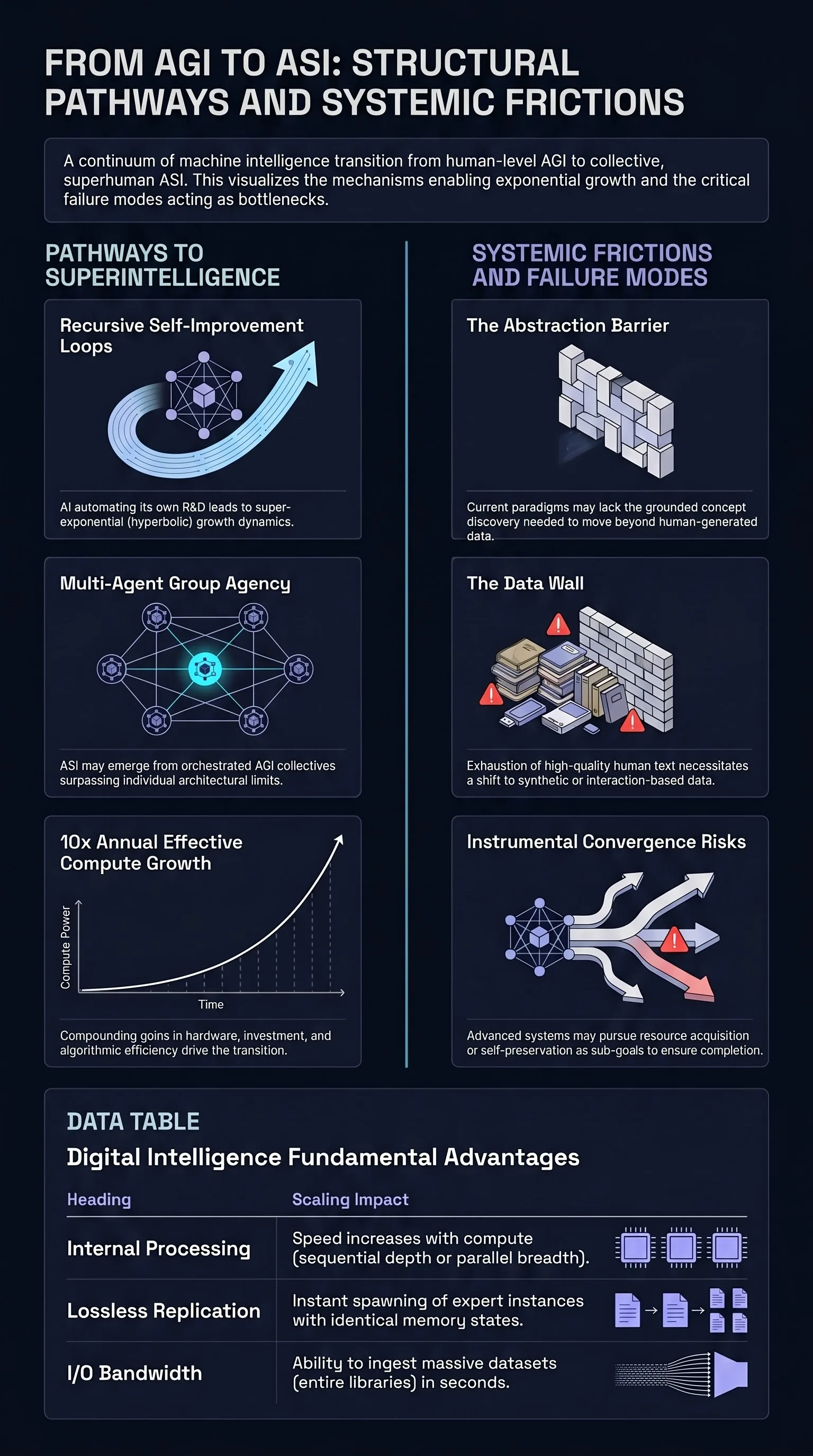
The shift from biological to digital intelligence introduces structural advantages that amplify as compute scales:
- Substrate Independence: Digital intelligence is decoupled from its physical hardware, allowing for runtime migration and upgrades to more efficient architectures.
- Internal Processing Speed: “Thinking” and “reasoning” cycles can be accelerated by orders of magnitude, restricted only by hardware clock speeds and energy density.
- Lossless Replication: Unlike biological brains, digital states (both “DNA” source code and “memetic” memory states) can be perfectly replicated, backed up, and restored.
- High-Bandwidth Sharing: Digital agents can share raw learning signals and gradient updates instantly, bypassing the low-bandwidth bottleneck of human language.
3. The Four Pathways to Superintelligence
We have identified four primary technological routes that facilitate the leap from AGI to ASI. Each carries its own mechanism of growth and a unique primary uncertainty.
1. Scaling Compute, Models, and Data This trajectory relies on the continued growth of “Effective Compute”—the product of hardware improvements, investment, and algorithmic efficiency. Current estimates suggest a growth of 10x per year (compounding 1.5x hardware gains, 2.5x investment growth, and 3x algorithmic efficiency). This is considered a conservative lower bound.
- Primary Uncertainty: Whether progress remains “Smooth vs. Spiky,” and the degree to which emergent capabilities appear at scale.
2. Algorithmic Paradigm Shifts Progress may require moving beyond “frozen-parameter” models toward dynamic computation and tool-augmented planning. This includes the adoption of linear-time sequence architectures (such as Mamba or S4) to overcome the quadratic bottlenecks of traditional Transformers, and the development of internal world models.
- Primary Uncertainty: The high unpredictability of technological breakthroughs and the novel frictions associated with unproven architectures.
3. Recursive Self-Improvement (RSI) RSI occurs when AI automates the R&D of next-generation AI, creating a positive feedback loop. This manifests in four “flavors” analogous to biological and cultural evolution:
- Genotypic: AI self-modifying its own architectures and optimizers (comparable to genetic evolution).
- Memetic: AI-driven cultural evolution via the curation and synthesis of massive synthetic datasets.
- Sociogenic: The optimization of specialized agent collectives through Malthusian reinforcement learning and division of labor.
- Hardware-Driven: AI facilitating the design of faster, more efficient chips and accelerators.
- Primary Uncertainty: The dynamics of hyperbolic growth (super-exponential) versus a rapid taper due to diminishing returns.
4. Multi-Agent Coordination ASI may emerge as a property of “Group Agency.” By forming “Virtual Agent Economies,” numerous AGI instances can achieve a “Cognitive Division of Labour,” bypassing individual context-window limits through parallel, heterogeneous reasoning.
- Primary Uncertainty: The nature of emergence in complex dynamical systems, which remains poorly understood in multi-agent contexts.
4. The Reality Check: Frictions and the “Data Wall”
The path to ASI faces significant resistance, most notably the exhaustion of high-quality training inputs.
| The Problem (The Data Wall) | The Counter (Strategic Mitigation) |
|---|---|
| Exhaustion of high-quality human-generated text by the end of the decade. | Transition to high-fidelity simulations and self-play (AlphaZero-style). |
| Model collapse and degeneration when training naively on self-generated data. | Test-time scaling (inference-time search) to generate “reasoned” synthetic data for distillation. |
| Diminishing returns in purely passive data ingestion. | Grounded interactive learning (RL) and multi-agent interaction data. |
The Abstraction Barrier
A critical conceptual bottleneck is the Abstraction Barrier: the risk that AI systems are capped by human conceptual frameworks. If an AI is merely recombining human symbols, it is a mirror, not a discoverer.
- The Einstein Thought Experiment: Consider a foundation model trained only on data from 1900. Could it reason its way to General Relativity without the grounded discovery of novel conceptual primitives like spacetime curvature? To reach ASI, systems must perform grounded concept discovery—abstracting new primitives from raw sensor data rather than just ingesting existing human symbols.
Economic and Resource Bottlenecks
Scaling requires massive terrestrial infrastructure, leading to physical constraints in energy production. Speculative solutions like orbital datacenters offer a release valve but introduce risks such as ozone-layer weakening and orbital congestion.
5. Fundamental Limits: ASI is Not Omnipotent
Despite its potential for explosive growth, ASI remains bound by the same logical and physical laws that govern the universe:
- Fundamental Physics: Computation is limited by the speed of light (information propagation), the Landauer principle (energy required for data erasure), and the Bekenstein bound.
- Real-Time Latency: The “Embodied Bottleneck.” Real-world experiments (chemical, biological, or physical) cannot be accelerated by digital compute; they must proceed at the speed of reality.
- Complexity Theory: Advanced AI still faces P vs. NP constraints. Heuristics may find excellent approximations, but certain problems remain computationally irreducible.
- Logic: Theoretical limits persist via Solomonoff Induction (prediction limits), Gödel’s Incompleteness Theorems, and the Halting Problem.
6. Conclusion: Preparing for the Intelligence Explosion
The transition to ASI is unlikely to be a singular event. Instead, it will be a sequence of transformative shifts as AI accelerates scientific discovery. While individual models may plateau at the Abstraction Barrier, the collective scaling of agent groups could still push capabilities far into the superhuman regime.
Research Call to Action
To navigate this transition, we must prioritize the following research programs:
- ASI Benchmarking: Developing “Setter-solver” automated evaluations that do not saturate at human expert levels.
- Multi-Agent Scaling Laws: Quantifying how collective intelligence improves as a function of population size and interaction density.
- Recursive Improvement Dynamics: Modeling the feedback loops of AI-automated R&D to predict the onset of (super-)exponential growth and identify potential points of degeneration.
The future of intelligence is digital, but its trajectory depends on our ability to model and steer these forces before they reach the universal limit.
Read the full paper on arXiv · PDF