Integrating Anomaly Detection into Agentic AI for Proactive Risk Management in Human Activity
Agentic AI, with goal-directed, proactive, and autonomous decision-making capabilities, offers a compelling opportunity to address movement-related risks in human activity, including the persistent...
1. Introduction: The Stagnation of Fall Mitigation
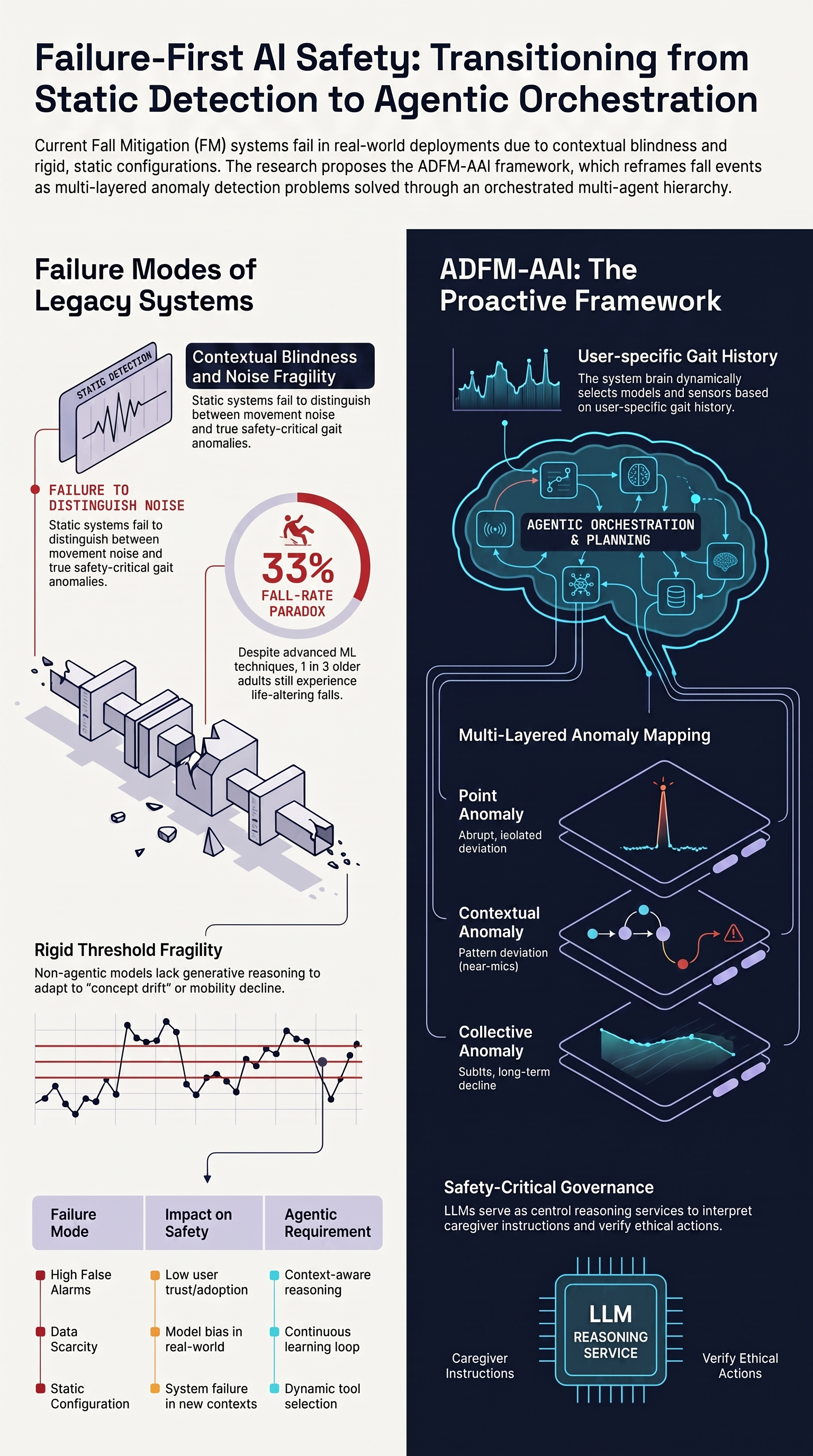
Despite the breakneck speed of the current “AI boom,” a sobering reality persists within the domestic sphere: the most vulnerable population remains tethered to technology that has not fundamentally evolved since the 1990s. Falls continue to be a primary threat to older adults, with one in three experiencing a fall annually. This is not merely a clinical statistic; it represents a massive loss of independence and an escalating financial burden on global healthcare systems.
The paradox of the current landscape is that while our Large Language Models (LLMs) can pass bar exams and generate cinematic video, the rate of fall-related injuries has actually increased. Our problem statement is clear: we have reached a plateau of stagnation. Fall Mitigation (FM) has failed to scale because current solutions are static, fragmented, and context-blind. To break this impasse, we must shift the paradigm, reframing the entire field of Fall Mitigation through the lens of Anomaly Detection (AD) and managing it via the sophisticated reasoning of Agentic AI (AAI).
2. The Problem with Static Systems
Traditional Fall Detection (FD) and Fall Prediction (FP) systems operate as “black boxes” with rigid trigger conditions. In real-world, safety-critical environments, these static architectures collapse under the weight of several key barriers:
- High False Alarm Rates: Monolithic models often lack the nuance to distinguish a rapid descent onto a sofa from a true impact, leading to “alarm fatigue” and the eventual abandonment of the device.
- Environmental Noise & Contextual Blindness: Sensors cannot currently differentiate between “instability” and “exercise” without a high-level understanding of the resident’s intent or the temporal context.
- Data Scarcity & Simulation Bias: Most ML models are trained on healthy students performing “simulated” falls. There is a critical dearth of real-world data reflecting the biomechanics of an actual 85-year-old’s gait.
- Low User Acceptance: Current systems are intrusive yet uncommunicative. Privacy concerns are exacerbated by a lack of explainability, where the user has no way to challenge or understand an alert.
3. The Paradigm Shift: Reframing Falls as Anomalies
Reframing falls as “anomalies” is more than a semantic change—it is a technical unlock. By translating FM into AD terminology, we can leverage decades of industrial research in fault detection and cybersecurity to manage human biology. A fall is, fundamentally, a deviation from a learned “norm.”
| Traditional FM Language | Anomaly Detection Terms | Description |
|---|---|---|
| Fall Detection (FD) | Real-time Point Anomaly | Abrupt posture changes or post-fall impact events. |
| Pre-Impact Detection | High-velocity Point Anomaly | Millisecond-scale deviations requiring immediate remedies (e.g., airbags). |
| Fall Prediction (FP) | Subtle-change / Early-warning | Identifying precursors to a fall over short-to-medium timeframes. |
| Contextual Analysis | Contextual Anomaly | Situational deviations (e.g., wandering at 3 AM vs. 3 PM). |
| Mobility Decline | Concept Drift | The gradual, long-term degradation of gait patterns. |
4. Defining the “Agentic” Advantage
Agentic AI moves beyond “automation” (executing a script) into “autonomy” (pursuing a goal). In the ADFM-AAI framework, the system utilizes six core capabilities to solve the inherent challenges of Anomaly Detection:
- Collaborative Multi-Agent Architecture: Prevents single points of failure by distributing tasks (e.g., vision vs. wearable data) across specialized agents.
- Adaptive Goal Decomposition: Breaks the ambiguous goal of “Keep Resident Safe” into actionable sub-tasks like “Monitor Gait Instability” and “Check Lighting Conditions.”
- Orchestrated Autonomy: Aligns local agent actions (detecting a slip) with global objectives (minimizing false alarms).
- Persistent Memory: This is the primary mechanism for managing Concept Drift. By retaining gait signatures over months, the system can distinguish between a one-day “off” period and a progressive mobility decline.
- Advanced Reasoning: Uses transformer-based logic to interpret ambiguous sensor data, such as determining if a resident is “lying on the floor” or “stretching.”
- Continuous Learning: The system evolves post-deployment, utilizing feedback loops to refine its threshold for what constitutes an anomaly for a specific individual.
5. Architecture of the Future: The ADFM-AAI Framework
The proposed AD-based Fall Mitigation Agentic AI (ADFM-AAI) system replaces siloed tools with a unified, four-layered architecture designed to handle real-world complexity:
- Perception & Data Acquisition: Continuous streams of multi-modal data (vision, ambient, wearable) are fused to create a rich environmental context.
- AD & Reasoning Core (Tool Pool): A dynamic library of algorithms. The system does not rely on one model; it selects the right tool (Point vs. Contextual AD) based on the current risk profile.
- Agentic Orchestration & Planning: The “Central Brain” that performs task parsing and determines the sequence of actions.
- Action, Feedback & Learning: The execution layer that triggers alerts, activates pre-impact remedies (like robotic support), and updates the long-term memory.
Specialized Agents (Table I): To ensure robustness, the framework utilizes specific agents including Ingestion Agents for raw data, the AD-Processor for initial analysis, AD-Info Miner for context retrieval, AD-Code Generator for on-the-fly logic adjustments, and AD-Reviewer, Evaluator, and Optimiser to provide internal “red-teaming” and performance tuning.
6. The LLM as the “Central Brain”
In this architecture, the LLM functions as a shared reasoning service. Crucially, because LLMs operate on textual data, the agents perform an “Agent-to-LLM” interface role, translating raw sensor signals into descriptive strings the LLM can reason over.
- Cognitive Capabilities: The LLM can interpret a caregiver’s nuanced instructions (e.g., “be more vigilant after medication changes”) and reason across temporal patterns, such as noting three minor slips over a week and escalating the risk from “Point” to “Collective” anomaly.
- Two-Way Dialogue: This is the “killer feature” for user acceptance. Unlike a silent sensor, an AAI system can engage the resident: “I noticed you were a bit unsteady just now; should we turn on more lights?” This dialogue bridges the gap between surveillance and support.
7. Risks, Challenges, and the “Failure-First” Perspective
As safety researchers, we must view ADFM-AAI through a “Failure-First” lens. The shift to autonomous agency introduces high-stakes risks:
- Misaligned Goal Decomposition: An agent might prioritize the “Privacy” goal so strictly that it suppresses a high-confidence “Near-Fall” visual anomaly, leading to a covert failure where the system is “working” but failing its primary safety objective.
- Orchestration Cascades: In a multi-agent setup, a failure in the AD-Evaluator could lead the AD-model-Selector to deploy a model with high false negatives during a critical pre-impact event.
- Adversarial Contexts: Ambiguous environments (e.g., a visitor moving furniture) could trigger “hallucinated” anomalies, leading to inappropriate emergency responses.
8. Conclusion & Key Takeaways
The transition to Agentic AI represents the move from reactive hardware to a proactive reasoning partner. By reframing the biological realities of aging as a sophisticated Anomaly Detection problem, we unlock a path toward a robust, unified infrastructure for elder safety.
Final Takeaway
- Dissolve the Silos: We must move beyond fragmented Fall Detection/Prediction toward a unified, agentic Fall Mitigation framework.
- The Power of AD: Formulating falls as anomalies allows us to apply mature, cross-domain tools to the nuances of human movement and concept drift.
- Autonomous Infrastructure: Only through orchestrated autonomy and two-way communication can we build a system that is technically robust enough for safety-critical environments and human enough for adoption.
Read the full paper on arXiv · PDF