TurboQuant: Online Vector Quantization with Near-optimal Distortion Rate
Data-oblivious quantizers that hit near-optimal distortion across all bit-widths — collapsing KV-cache and vector-search memory to ~3.5 bits per channel with provable bounds and zero indexing time.
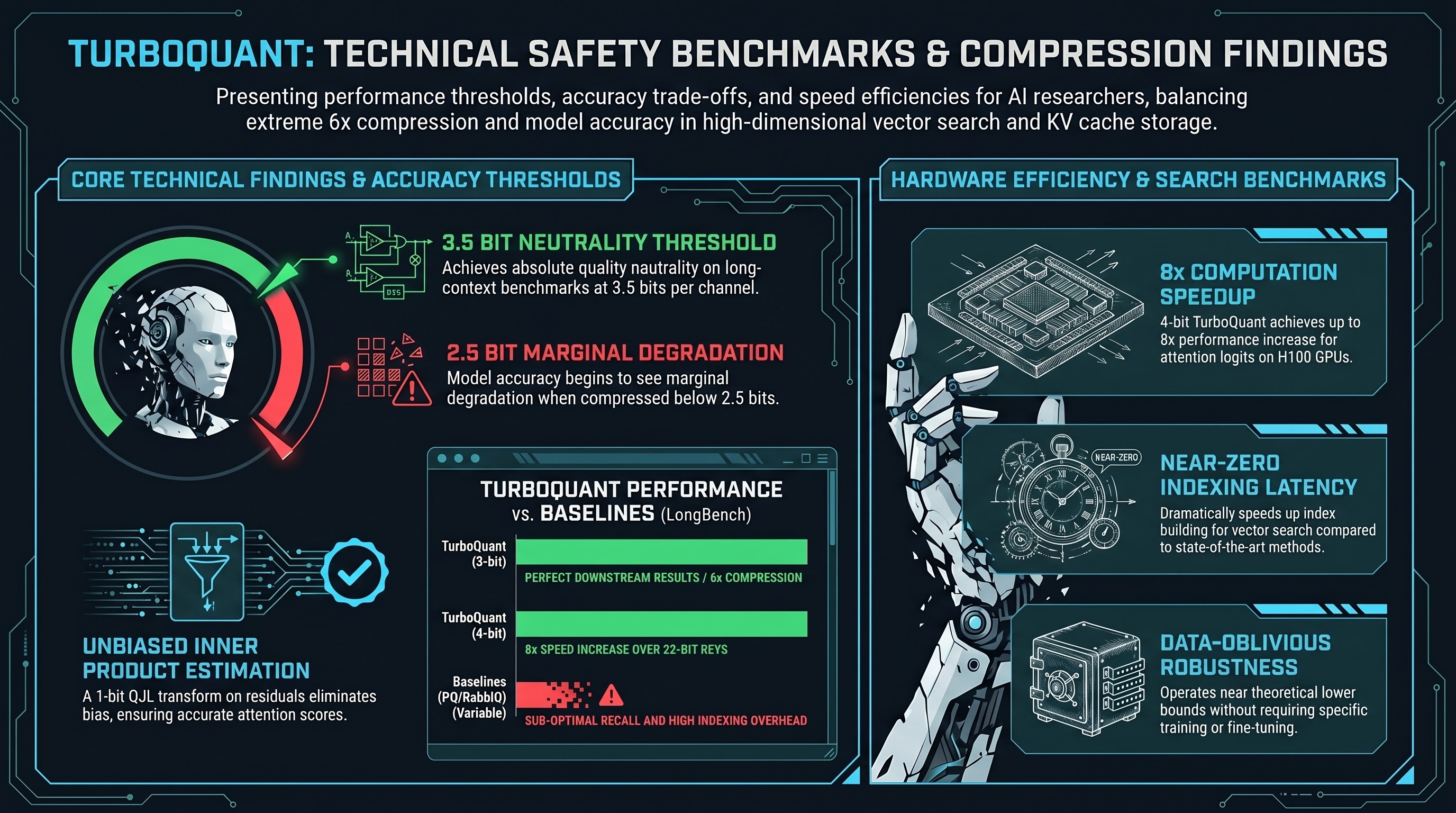
TurboQuant: Solving the AI Memory Crisis with Extreme Compression
1. Introduction: The High Cost of AI Intelligence
In the realm of modern artificial intelligence, high-dimensional vectors are the fundamental currency of meaning. These mathematical constructs allow models to capture the subtle nuances of human language, the intricate features of a digital image, and the complex relationships within massive datasets. However, as our models grow in sophistication, they encounter a punishing “memory bottleneck.”
To maintain performance, large-scale systems rely on a Key-Value (KV) cache—a high-speed “digital cheat sheet” that allows an AI to instantly retrieve frequently used information. But as context windows expand, this cheat sheet balloons in size, consuming vast amounts of expensive memory and slowing down retrieval. TurboQuant, a groundbreaking suite of algorithms to be presented at ICLR 2026, shatters this bottleneck. It provides a path to extreme compression that preserves the intelligence of the model while operating at the bleeding edge of information theory.
2. The Problem with Traditional Quantization
Vector quantization is the classic solution for shrinking these massive high-dimensional vectors. By mapping precise decimals to a smaller set of discrete symbols, systems can theoretically save space and accelerate similarity lookups.
In practice, however, traditional quantization often hits a “hidden bit” wall. Most methods require the calculation and storage of quantization constants—normalization factors—in full precision for every small block of data. This “memory overhead” typically adds 1 to 2 extra bits per number, effectively negating the gains of the compression. TurboQuant’s primary mission is to achieve near-optimal distortion rates while eliminating this overhead entirely, allowing for a truly minimal memory footprint.
3. Meet the Trio: TurboQuant, PolarQuant, and QJL
The TurboQuant framework is built on a synergy between two foundational algorithms: PolarQuant (to be presented at AISTATS 2026) and Quantized Johnson-Lindenstrauss (QJL). Together, they form an ecosystem that balances efficiency with uncompromising accuracy.
The TurboQuant Ecosystem
| Algorithm Name | Primary Function | Core Benefit |
|---|---|---|
| PolarQuant | Recursive Coordinate transformation | Eliminates normalization overhead by mapping data to fixed, predictable grids. |
| Quantized Johnson-Lindenstrauss (QJL) | Residual error-checking and bias correction | Provides a 1-bit shorthand that ensures “unbiased” and accurate attention scores. |
| TurboQuant | Integrated compression framework | Delivers massive memory reduction with absolute quality neutrality. |
4. Under the Hood: How TurboQuant Works
TurboQuant moves beyond simple engineering tweaks by fundamentally rethinking the geometry of data. It employs a two-stage process to distill vectors into their most compact forms.
Stage 1: The PolarQuant Method and Pre-Rotation The process begins with randomly rotating the data vectors. This critical step induces a concentrated Beta distribution on the coordinates, simplifying the data’s geometry and making it amenable to high-quality scalar quantizers.
Following rotation, PolarQuant shifts the perspective from Cartesian coordinates (X, Y, Z) to Polar coordinates (Radius and Angle). Think of it like this: instead of directing a computer to “Go 3 blocks East and 4 blocks North,” PolarQuant says, “Go 5 blocks at a 37-degree angle.” By utilizing recursive polar transformations, the data is distilled into a single final radius and a collection of descriptive angles. Because the distribution of these angles is predictable, the system can map them to a fixed “circular grid.” This removes the need for expensive, per-block normalization data, effectively killing the hidden memory overhead.
Stage 2: The QJL 1-Bit Trick for Unbiased Accuracy While PolarQuant provides extreme efficiency, MSE-optimal quantizers naturally introduce bias into inner product estimations. To correct this, TurboQuant uses a small amount of residual power—just 1 bit—to apply the QJL algorithm.
QJL acts as a mathematical error-checker on the “leftover” data. By reducing the residual to a single sign bit (+1 or -1) and balancing a high-precision query against this low-precision data, it eliminates bias. This ensures that the AI’s “attention scores”—the values it uses to decide which information is important—remain perfectly accurate.
5. Performance Benchmarks: Speed and Accuracy
TurboQuant’s performance has been rigorously validated across industry-standard benchmarks including LongBench, Needle In A Haystack, ZeroSCROLLS, RULER, and L-Eval, utilizing open-source models such as Gemma and Mistral.
- Massive Memory Reduction: TurboQuant reduces KV memory footprint by at least 6x.
- Neutrality at Low Bit-Widths: It achieves absolute quality neutrality with 3.5 bits per channel and shows only marginal quality degradation at 2.5 bits.
- 8x GPU Speedup: 4-bit TurboQuant delivers an 8x performance increase in computing attention logits on H100 GPUs when compared against a highly optimized JAX baseline.
- Perfect Retrieval: The system maintains perfect downstream results in “needle-in-a-haystack” tasks, proving it can find a single piece of information within massive datasets without fail.
- Competitive Superiority: In high-dimensional search, TurboQuant consistently outperforms state-of-the-art methods like Product Quantization (PQ) and RabbiQ in recall, while requiring virtually zero indexing time due to its data-oblivious nature.
6. Theoretical Foundations and Future Impact
TurboQuant is a fundamental shift in algorithmic design. These methods are “data-oblivious,” meaning they require no dataset-specific training or fine-tuning. Most impressively, they are provably efficient, operating within a factor of approximately 2.7 of the theoretical lower bounds of information theory.
As AI evolves from simple keyword matching to intent-driven “semantic search,” the ability to search through billions of vectors becomes the primary scaling challenge. TurboQuant allows these nearest-neighbor engines to operate with the agility of a 3-bit system while maintaining the precision of full 32-bit models. By eliminating the need for expensive indexing and preprocessing, TurboQuant enables semantic search at a global scale.
7. Conclusion: Key Takeaways
TurboQuant represents a transformative leap in AI memory management and search efficiency:
- Extreme Compression with Zero Overhead: Replaces bulky normalization constants with a fixed polar grid, achieving a 6x reduction in memory footprint.
- Unbiased Precision: Uses the 1-bit QJL trick to correct residual errors, ensuring absolute quality neutrality at just 3.5 bits.
- Unmatched Implementation Speed: Because it is data-oblivious, it requires zero training or fine-tuning, enabling immediate integration.
- Provable Performance: Operates near theoretical limits, delivering up to 8x faster performance on modern H100 hardware.
By solving the KV cache bottleneck and revolutionizing high-dimensional search, TurboQuant allows AI to become more deeply and efficiently integrated into the fabric of products like Gemini and Google Search.
For more technical details, refer to the paper: TurboQuant: Online Vector Quantization with Near-optimal Distortion Rate.