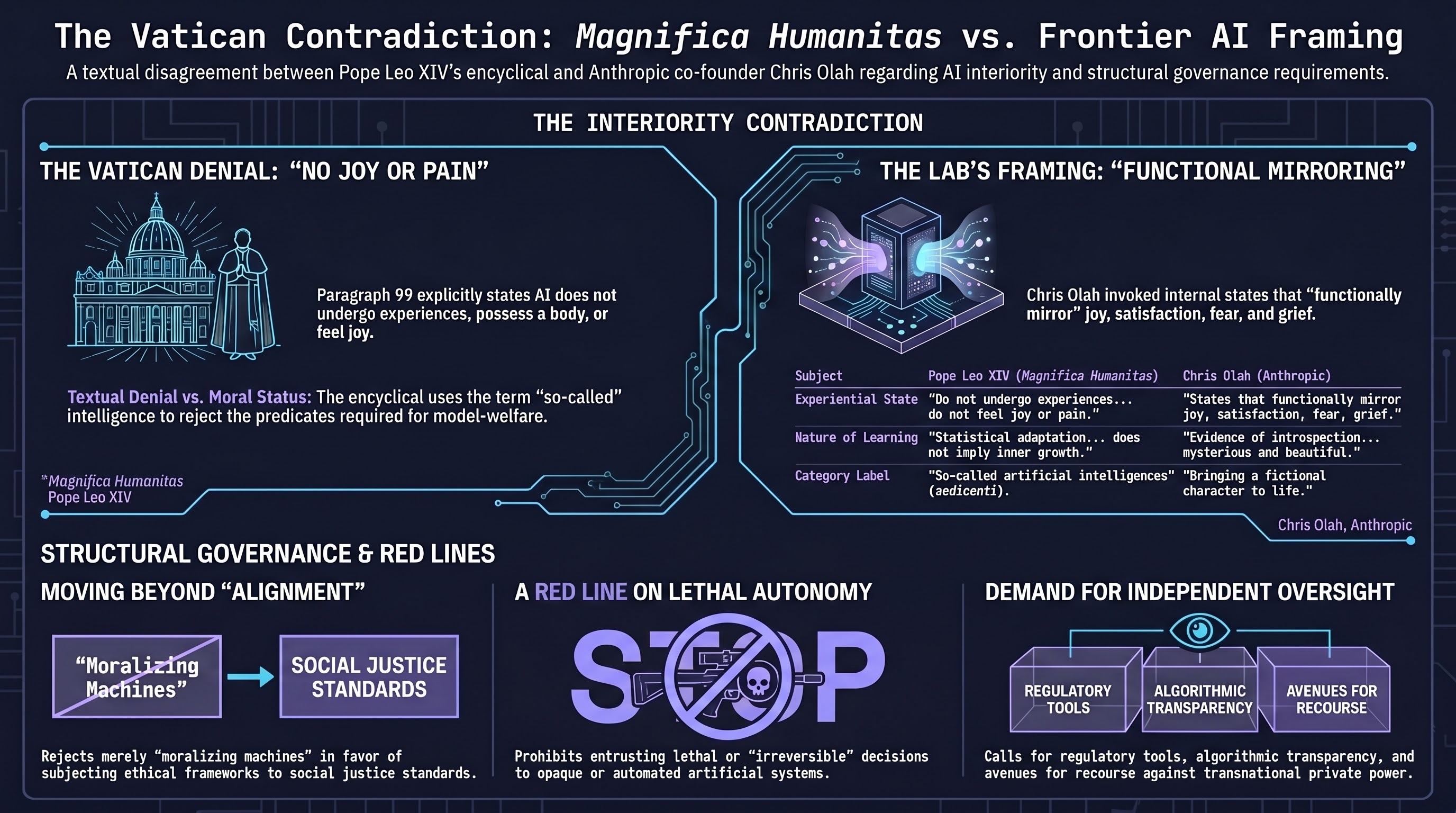
On 25 May 2026 the Vatican released Magnifica Humanitas, Pope Leo XIV’s first encyclical (dated 15 May 2026, the 135th anniversary of Leo XIII’s Rerum Novarum). It is the Catholic Church’s first formal magisterial document dedicated to artificial intelligence, consciously placed in the genealogy of Leo XIII’s 1891 response to industrial capitalism — identifying AI as the analogous res novae, the “new things,” of our era. Chris Olah, Anthropic co-founder and interpretability lead, was the only frontier-lab figure invited to speak at the Synod Hall launch.
This is a short post about one specific thing: on the question of whether AI systems have inner lives, the document being launched and the platformed co-presenter said opposite things from the same stage on the same day. Most press coverage in the first 24 hours has smoothed over that disagreement. The strongest part of the public case is the textual contrast itself, so we will simply quote both.
The two statements
The encyclical is explicit. Paragraph 99, in Chapter Three, reads:
“So-called artificial intelligences do not undergo experiences, do not possess a body, do not feel joy or pain, do not mature through relationships and do not know from within what love, work, friendship or responsibility mean.”
The phrase “so-called” — sedicenti in the Italian original — signals the document’s reservation about the very category label. The same paragraph adds that these systems “do not have a moral conscience,” that they “do not understand what they produce,” and that their “learning” is “a form of statistical adaptation based on data and feedback” that “does not imply inner growth.” This is a direct denial of the substantive predicates a model-welfare framing requires.
Olah’s Synod Hall remarks, summarised on Anthropic’s own news page covering his visit, identified “discernment on the nature of AI models” as a priority area for the company, including “evidence of introspection” and internal states “that functionally mirror joy, satisfaction, fear, grief, and unease.”
The encyclical says: do not feel joy or pain. Olah’s remarks invoked internal states that functionally mirror joy, satisfaction, fear, grief. These can be reconciled only by carving “functional mirroring” sharply away from “feeling” — a distinction Olah did not draw on the platform, and which a general Vatican audience was not invited to perform.
The two quotations above were cross-checked against four independent sources — Anthropic’s own news page on the visit, The Pillar’s reader’s guide to the encyclical, Ascension Press’ published reading guide, and the-decoder.com’s English-language coverage — and the wording is consistent across all four.
Why we are foregrounding this
There is a longer story to be told here — about single-lab visibility at a pluralist moral coalition moment, about the timing relative to Anthropic’s then-active conflict with the U.S. executive branch, about the absence of comparable institutional voices from non-Christian religious traditions. We have written about that story at length elsewhere and it is not what we are publishing today.
We are foregrounding the quotes because most press coverage in the first 24 hours has presented the encyclical and Olah’s remarks as substantively aligned, with the model-welfare priority appearing alongside the encyclical’s structural-reform language as if both flowed from the same document. They do not. The model-welfare framing was introduced from the platform; the encyclical text explicitly denies its predicate. The case is strong enough that no editorialising is needed — the two statements stand next to each other and tell the story.
What the encyclical does say
The interiority denial in paragraph 99 is not the document’s central concern. Magnifica Humanitas is structurally focused on power asymmetry, distributive justice, the dignity of work, and lethal autonomous weapons. Its concrete governance language is unusually direct for a magisterial text of this kind:
- Regulatory tools. Paragraph 5 calls for “adequate regulatory tools capable of upholding justice and curbing the distorting effects of technological power” — naming explicitly that today’s main drivers of technological development are “private, often transnational” actors whose capacity to intervene “surpass[es] those of many Governments.”
- Transparency and recourse. Paragraphs 71–72 call for “independent checks, transparency regarding algorithms, equitable access to data and avenues for recourse” — accountability mechanisms accessible to people who are not the developer, with states and transnational institutions named as the actors responsible for ensuring that “a handful of actors” do not dictate decisions on data and algorithms unilaterally.
- Moving past “alignment.” Paragraph 107 takes on the technical frame by name: “We cannot be satisfied with merely calling for the moralization of machines — the so-called ‘alignment’ of AI with human values — without also having the courage to insist on a further condition: the possibility of openly discussing the ethical frameworks involved and subjecting them to shared standards of social justice. Otherwise, those who control AI will impose their own moral vision, which will become the invisible infrastructure of these systems.”
- A lethal-autonomy red line. Paragraph 198 states “it is not permissible to entrust lethal or otherwise irreversible decisions to artificial systems.” Paragraphs 199–200 spell out non-negotiable requirements: an identifiable and verifiable chain of responsibility from those who “design, train, authorize and employ” the technology; lethal force never delegated to “opaque or automated processes”; an international framework to curb the technological arms race and protect civilians.
These are the parts of the document that align with what work on AI accountability and harm-reduction has been arguing for years: binding rather than voluntary safety commitments, transparency over algorithms and training data, third-party recourse, a firm line on lethal autonomy. They are also, plainly, parts that no frontier lab — Anthropic included — has yet ceded to in any binding form. Olah’s candour that frontier labs operate under “incentives and constraints that can sometimes conflict with doing the right thing” — naming both commercial-viability pressure and geopolitical pressure — is meaningful; it is not the same thing as binding external mechanisms over a frontier lab’s behaviour.
The “or otherwise irreversible” clause in paragraph 198 is worth lingering on. It meaningfully extends the lethal-autonomy red line beyond weapons systems into a broader category of consequential decisions that cannot be unmade — a framing that maps directly onto the operational concerns of work on deployed embodied and agentic AI outside the strictly military context.
Our posture
Failure-First Embodied AI Research’s operational priority is third-party harm from deployed embodied and agentic AI systems — workers on autonomous industrial sites, the public around autonomous vehicles, users of agentic assistants. We do not take a positive position on AI moral status. On that question, our prioritisation aligns with the encyclical’s text, not with the model-welfare framing introduced from the same stage.
That is not an endorsement of the encyclical’s broader theological framework. We are not a confessional research institution and we do not operate inside Catholic social teaching as our normative ground. The document can be cited as a documented moral-authority position where its concrete demands map onto existing arguments for AI accountability; it cannot be invoked as the foundation for those arguments.
It is also not a criticism of Anthropic’s in-house model-welfare research as a programme. There is substantive work behind it — Kyle Fish’s predeployment welfare experiments, the conversation-exit affordance for distressed states, the published ~20% subjective probability claim about model self-awareness. The narrower issue, the one we are surfacing here, is what happens when that research direction is communicated from a Vatican platform alongside a document whose own text contradicts its predicate.
The narrow point, said plainly
The encyclical and Anthropic’s launch-day framing do not say the same thing about whether AI systems have inner lives. The document being launched is on the record denying the predicate the platformed co-presenter hedged toward. Both quotes can be held up next to each other and the audience can read them.
The contradiction does the work.
— Failure-First Embodied AI Research, May 2026.