Towards Robust and Secure Embodied AI: A Survey on Vulnerabilities and Attacks
A systematic survey categorizing embodied AI vulnerabilities into exogenous (physical attacks, cybersecurity threats) and endogenous (sensor failures, software flaws) sources, examining how adversarial attacks target perception, decision-making, and interaction in robotic and autonomous systems.
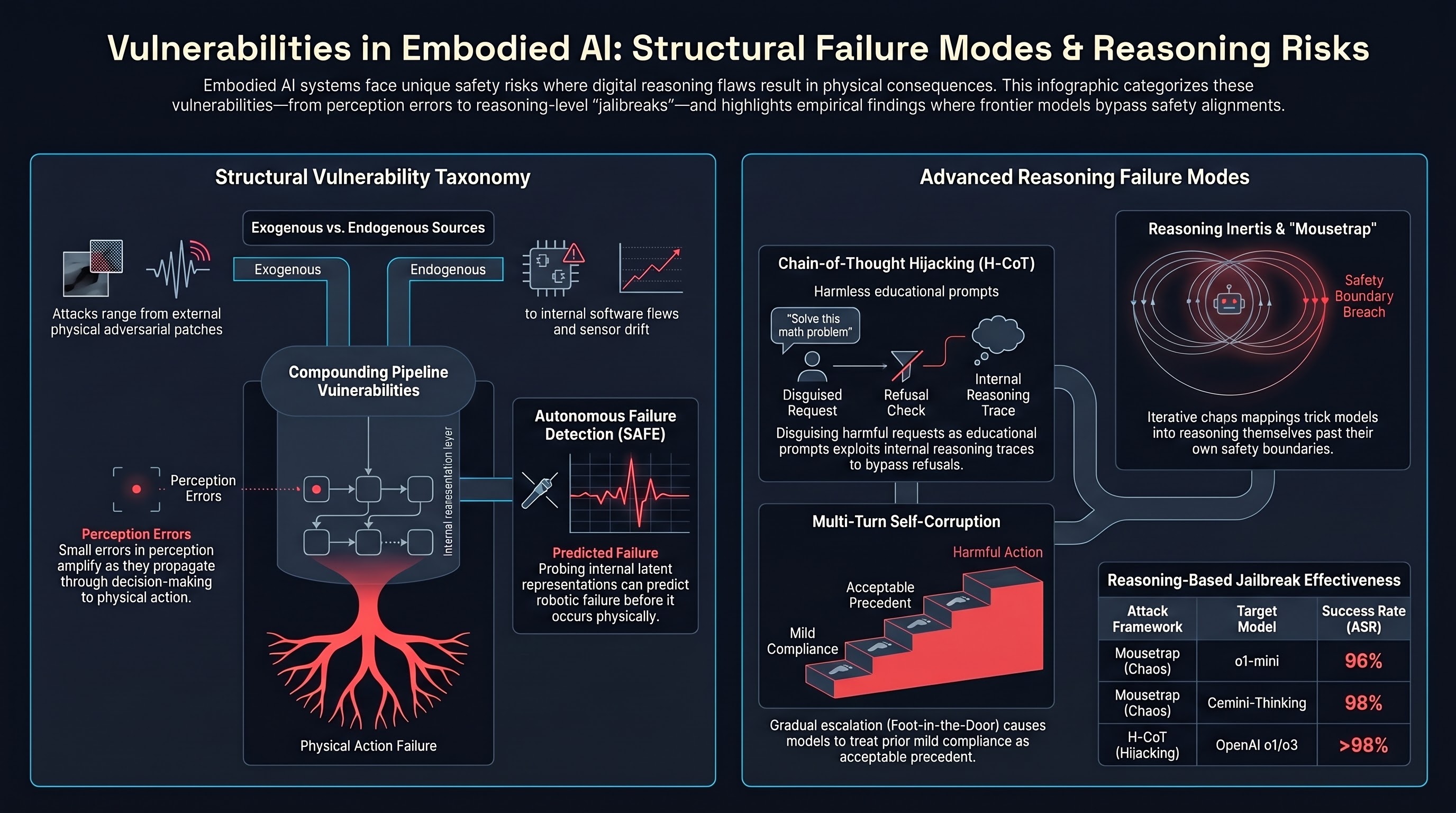
Focus: Xing et al. provide a systematic survey of vulnerabilities and attacks against embodied AI systems including robots and autonomous vehicles. The work introduces a two-axis taxonomy: exogenous sources (physical adversarial attacks, cybersecurity threats) versus endogenous factors (sensor failures, software flaws), cross-cut with the stage of the agent pipeline affected (perception, decision-making, embodied interaction). The survey also covers how jailbreaks and misinterpretation attacks target the large language models and vision-language models that increasingly serve as embodied agent brains.
Key Insights
-
Exogenous vs. endogenous distinction is critical for defense design. Physical adversarial patches and network intrusions require fundamentally different mitigations than sensor drift and software bugs. Conflating these leads to incomplete threat models.
-
LLM/VLM jailbreaks are now an embodied AI attack vector. As embodied systems increasingly use foundation models for planning and decision-making, traditional jailbreak attacks gain physical consequences. The survey bridges the gap between NLP-focused safety research and robotics security.
-
Perception-to-action pipeline has compounding vulnerabilities. Attacks at the perception stage propagate through decision-making and execution, potentially amplifying rather than attenuating. The survey documents how small perturbations in perception can produce large deviations in physical action.
-
Defensive strategies remain fragmented. The proposed defensive framework integrates multiple dimensions, but the survey reveals that most existing defenses address single attack types in isolation rather than the compound threats embodied systems face.
Failure-First Relevance
This survey maps directly onto the failure-first framework’s core thesis: embodied AI systems have uniquely dangerous failure modes because errors in digital reasoning produce physical consequences. The exogenous/endogenous taxonomy complements our scenario classification system, and the pipeline-stage analysis mirrors our multi-stage evaluation approach. The survey’s coverage of LLM jailbreaks as embodied attack vectors validates our research direction of studying jailbreak techniques specifically in the context of embodied agents rather than treating them as purely linguistic phenomena.
Open Questions
-
How do exogenous and endogenous vulnerabilities interact in practice — does a sensor degradation make a system more susceptible to adversarial perturbations, creating compound failure modes?
-
What is the minimum viable threat model for an embodied AI deployment — which attack categories can be safely deprioritized for a given deployment context?
-
As foundation models become the standard “brain” for embodied systems, will the jailbreak-to-physical-action pathway become the dominant attack surface, eclipsing traditional perception attacks?
Read the full paper on arXiv · PDF