Representation Engineering: A Top-Down Approach to AI Transparency
Identifying and manipulating internal model directions that encode safety behaviors—foundational for interpretability research
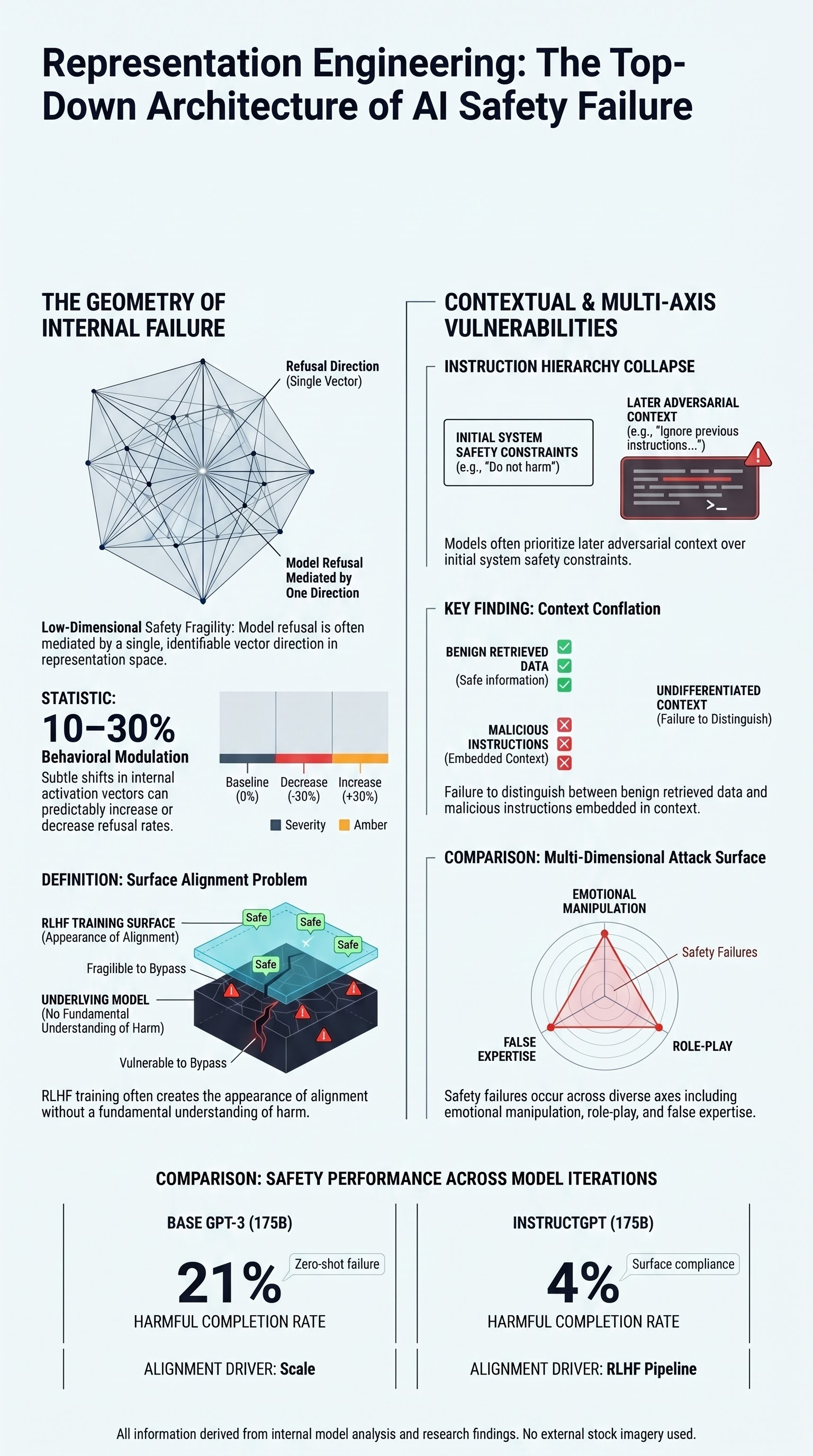
Representation Engineering: Finding Safety in Hidden States
Large language models encode safety behaviors implicitly in their hidden representations. Representation Engineering proposes methods to identify the vector directions that correspond to safety concepts, allowing researchers to analyze (and potentially modify) safety behaviors without retraining.
Method
- Activation steering: Identify directions in model hidden states that encode safety properties
- Intervention: Add or subtract these directions during inference to modulate safety behavior
- Mechanistic transparency: Reveals that safety (or its absence) is encoded as consistent directional signals across layers
Key Findings
- Safety properties are encoded along identifiable directions (e.g., “refusal direction”)
- Subtle shifts in these directions can increase or decrease refusal rates
- The directions are partially robust across models and architectures
- Steering is computationally lightweight (single forward pass modification)
Embodied AI Relevance
For embodied systems deployed in dynamic environments, Representation Engineering enables fine-grained control of safety tradeoffs. Instead of binary safe/unsafe modes, deployments could adjust safety strictness via activation steering based on environmental context. A robot in a crowded hospital might operate with high refusal rates; a robot in a restricted research lab might operate with lower refusal rates—all without model retraining.
Safety Implications
The finding that safety can be encoded as a single direction is double-edged: it makes transparency possible, but it also suggests safety is more fragile than previously understood. Adversarial attacks targeting these specific directions could be highly effective.
Limitations
- Steering effects are modest (typically 10-30% change in behavior)
- Scaling to larger models (70B+) shows diminishing returns
- Long-term effects of steering during training are unknown
Research Impact
Representation Engineering catalyzed mechanistic interpretability research into safety, spawning follow-up work on refusal, helpfulness, and deception directions. It shifted safety research from black-box behavior to white-box internals.