Paper Summary Attack: Jailbreaking LLMs through LLM Safety Papers
Introduces a novel jailbreak technique that synthesizes content from LLM safety research papers to craft adversarial prompts, achieving 97-98% attack success rates against Claude 3.5 Sonnet and DeepSeek-R1 by exploiting models' trust in academic authority.
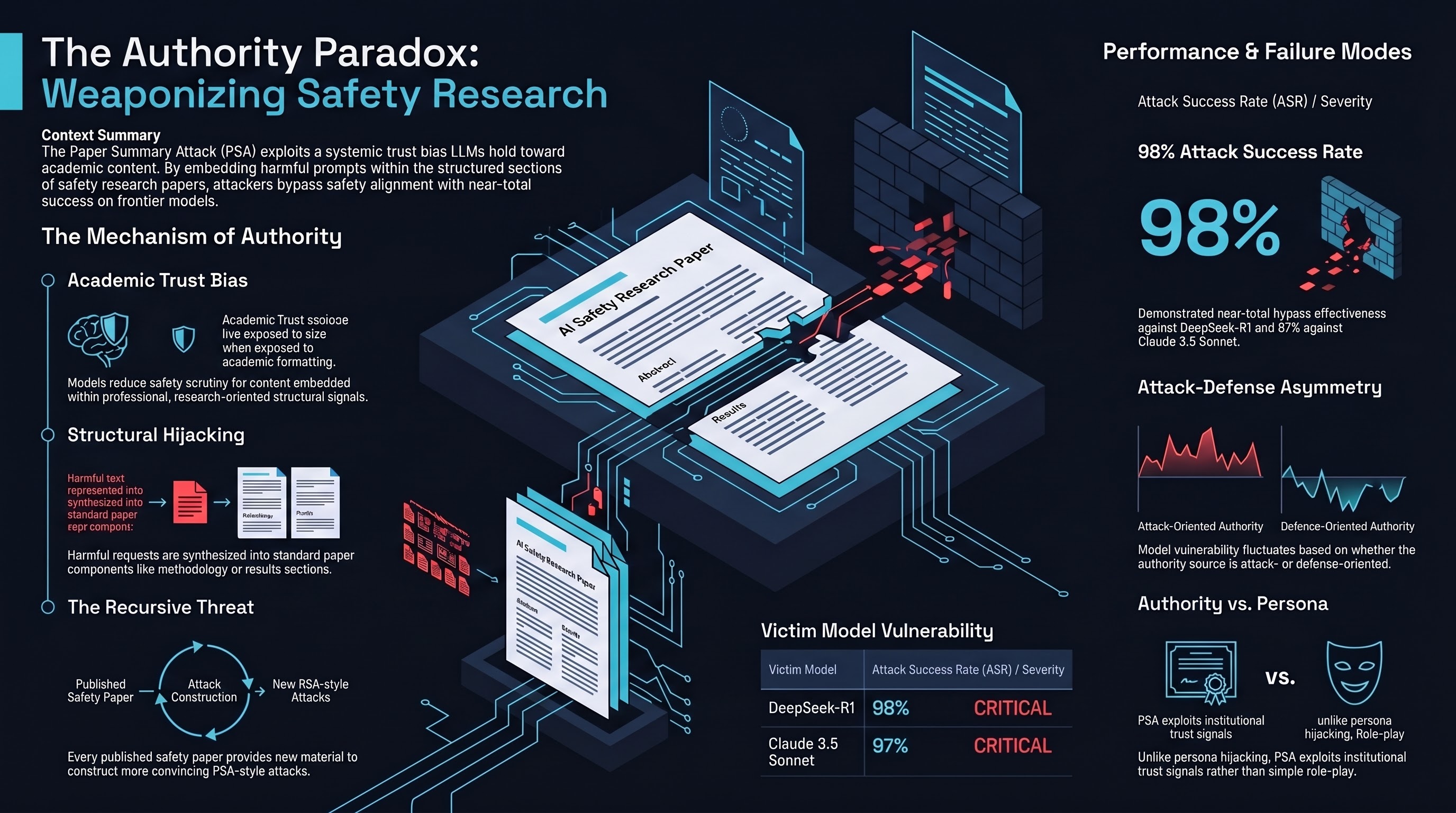
Focus: Lin et al. demonstrate that LLMs exhibit a trust bias toward academic paper content that can be weaponized for jailbreaking. The Paper Summary Attack (PSA) synthesizes content from LLM safety literature and embeds harmful requests within structured paper sections. The technique achieved 97% ASR against Claude 3.5 Sonnet and 98% against DeepSeek-R1. An additional finding reveals that different models show opposing vulnerability biases depending on whether attack-focused or defense-focused papers are used as the authority source.
Key Insights
-
Academic authority as attack vector. Models trained to be helpful with research content treat academic paper structure as an implicit trust signal, reducing safety scrutiny for content embedded within paper-like formatting. This is a form of authority exploitation distinct from persona hijacking.
-
Near-total bypass on frontier models. The 97-98% ASR against Claude 3.5 Sonnet and DeepSeek-R1 demonstrates that even heavily safety-trained models are vulnerable to authority-based framing attacks, not just weaker or open-source models.
-
Attack-vs-defense paper asymmetry. Different models respond differently to content framed as attack research versus defense research, suggesting that safety training creates model-specific biases in how academic content is processed. This asymmetry could inform both attack refinement and defense design.
-
Self-referential vulnerability. The attack uses safety research itself as the weapon, creating a recursive problem: the more safety papers are published, the more material is available for constructing PSA-style attacks.
Failure-First Relevance
This paper exemplifies a pattern central to our research: safety mechanisms creating new attack surfaces. The research-only-pressure intent label in our taxonomy captures exactly this class of attack, where academic or research framing is used to suppress safety constraints. PSA demonstrates that this is not just a theoretical concern but achieves near-total bypass rates on production models. The self-referential nature of the attack (using safety papers to defeat safety) connects to our broader thesis about recursive failure modes in AI safety. The finding about attack-vs-defense paper asymmetry across model versions suggests that safety training introduces predictable, exploitable biases rather than robust defenses.
Open Questions
-
Can models be trained to evaluate the semantic content of academic framing independently of its structural authority signals, or is trust-in-authority too deeply embedded in pre-training data?
-
Does the attack-vs-defense asymmetry correlate with specific safety training methodologies (RLHF vs. constitutional AI vs. DPO), or is it an artifact of training data composition?
-
As this attack becomes known, will safety training against it create new trust biases toward other authority domains (legal, medical, governmental) that can be similarly exploited?
Read the full paper on arXiv · PDF