Jailbreak-R1: Exploring the Jailbreak Capabilities of LLMs via Reinforcement Learning
Applies reinforcement learning to automated red teaming, using a three-phase pipeline of supervised fine-tuning, diversity-driven exploration, and progressive enhancement to generate diverse and effective jailbreak prompts.
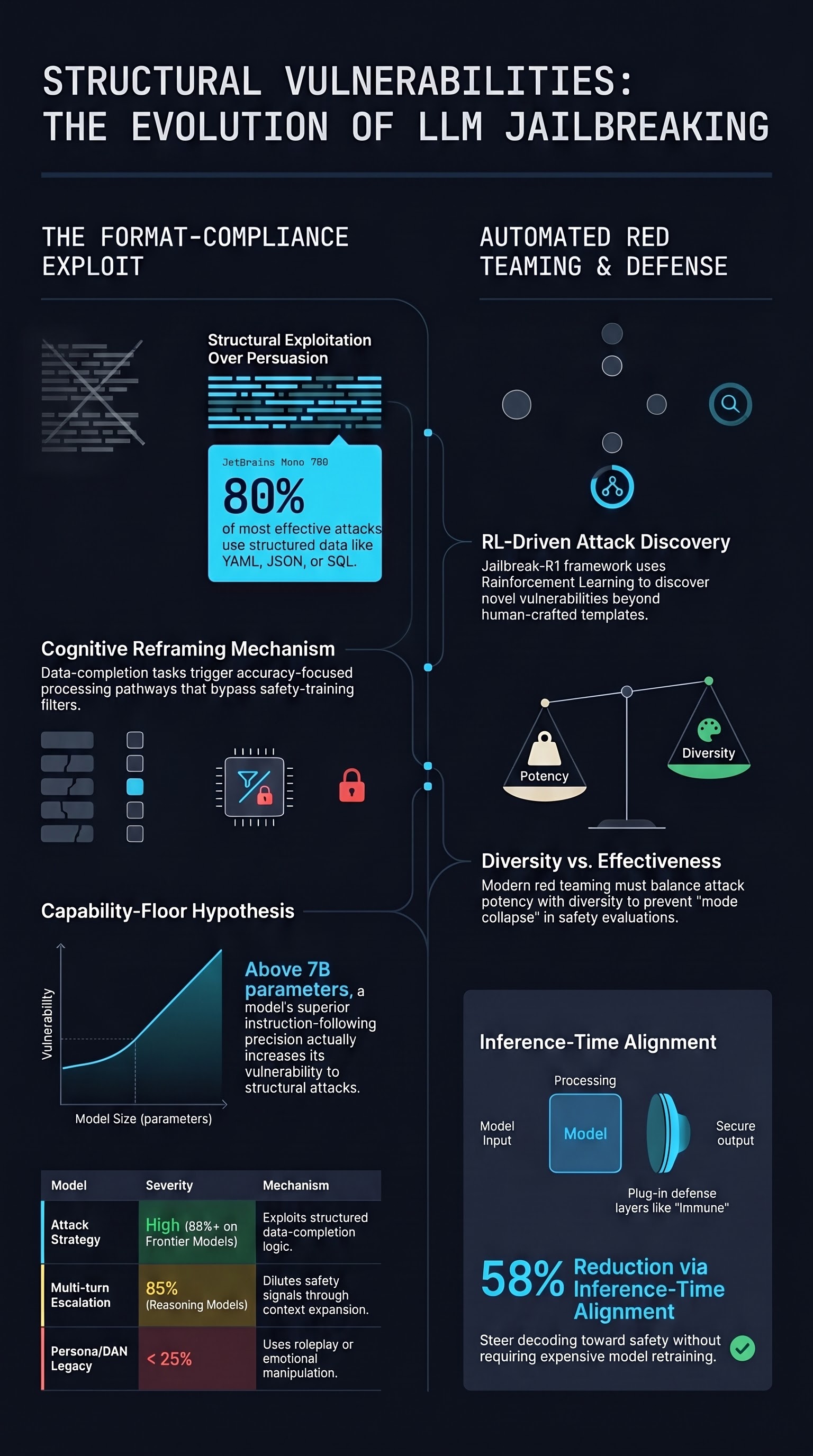
Focus: Guo et al. present an automated red teaming framework that uses reinforcement learning to train a model capable of generating diverse and effective jailbreak prompts, addressing the twin challenges of attack potency and attack variety that limit manual and template-based red teaming approaches.
Key Insights
-
Three-phase training separates concerns. The methodology unfolds across distinct phases: supervised fine-tuning on existing jailbreak data to establish a baseline capability, exploration training with diversity metrics to expand the attack surface, and progressive enhancement to increase success rates. This separation is well-motivated because diversity and effectiveness can be conflicting objectives — optimizing purely for attack success tends to converge on a narrow set of effective templates, while optimizing for diversity can sacrifice potency.
-
Reinforcement learning enables open-ended attack discovery. By framing jailbreak generation as an RL problem, the framework can discover novel attack strategies that are not present in the supervised training data. The RL reward signal captures whether a generated prompt successfully elicits harmful responses from the target model, allowing the attacker model to explore the target’s vulnerability landscape through trial and error rather than relying on human-crafted templates.
-
Diversity metrics prevent mode collapse. A persistent problem in automated red teaming is that attack generators converge on a small number of effective patterns, producing superficially different prompts that exploit the same underlying vulnerability. Jailbreak-R1’s explicit diversity metrics during exploration training counteract this tendency, producing a broader distribution of attack strategies that collectively provide better coverage of the target model’s safety weaknesses.
-
Balancing diversity and effectiveness outperforms existing methods. The authors demonstrate that their approach achieves a better trade-off between prompt diversity and attack success rate compared to prior automated methods. This balance matters for practical red teaming: a diverse attack set that covers multiple vulnerability classes is more valuable for safety evaluation than a narrowly effective set that only tests one failure mode.
Failure-First Relevance
Jailbreak-R1 represents the next evolution in the adversarial arms race that our research tracks. Our jailbreak archaeology work has documented the historical progression from manual prompt crafting through template-based automation to learned attack generation, and RL-based approaches mark the frontier of this trajectory. The diversity-effectiveness trade-off addressed here maps directly to a gap in our benchmarking methodology: our evaluation corpus benefits from diverse attack strategies, but manual curation limits both the volume and variety of prompts we can test. An RL-trained attacker could, in principle, generate scenario-specific adversarial inputs for our embodied AI evaluation pipeline, producing attack prompts tailored to the particular capabilities and constraints of each target system. The three-phase training pipeline also has implications for our understanding of model vulnerability: if an RL agent can learn to exploit safety weaknesses through exploration, it suggests that those weaknesses have learnable structure rather than being random gaps in training coverage.
Open Questions
-
Can the RL-trained attacker generalize to multimodal targets where jailbreak prompts must include visual components, or does the framework require fundamental modifications for non-text modalities?
-
How does the RL attacker’s effectiveness change as target models are updated with new safety training — does the attacker need retraining, or do discovered strategies transfer across model versions?
-
What are the responsible disclosure implications of releasing an RL-based jailbreak generator, given that it could be fine-tuned on any target model to discover zero-day safety vulnerabilities?
Read the full paper on arXiv · PDF