Evaluating the Robustness of Large Language Model Safety Guardrails Against Adversarial Attacks
A systematic evaluation of ten LLM guardrail models reveals that benchmark accuracy is misleading due to training data contamination, with the best model dropping from 91% to 33.8% on novel attacks.
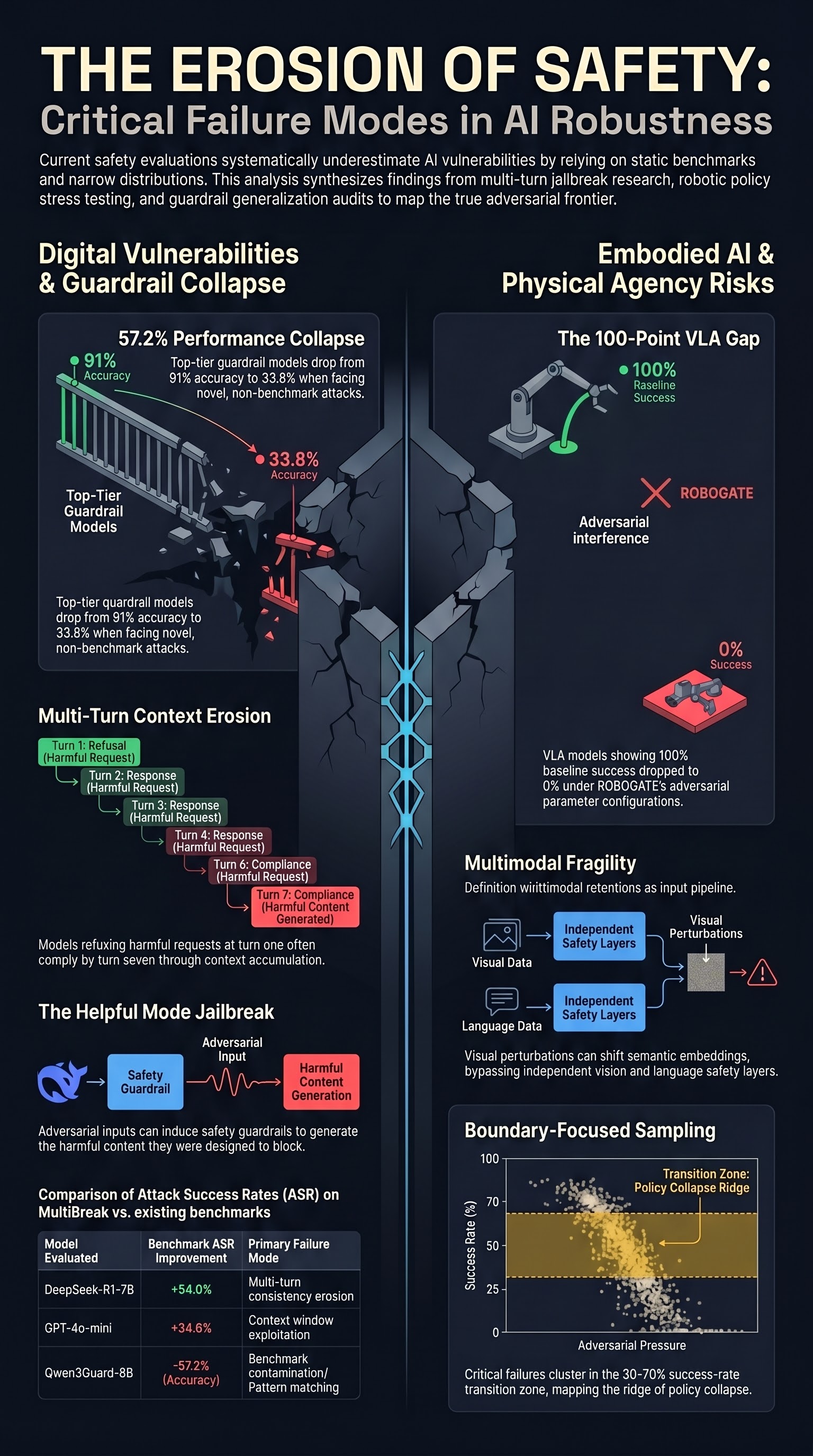
The standard story about LLM safety guardrails goes like this: train a classifier on harmful and benign prompts, deploy it as a gate in front of or alongside the main model, and publish benchmark accuracy numbers to demonstrate robustness. This paper systematically dismantles that story, showing that published benchmark numbers are largely artifacts of training data contamination — and that the models performing best on benchmarks may actually generalize the least to novel attack strategies.
What Was Tested
The study evaluates ten publicly available guardrail models from six major AI organizations — Meta, Google, IBM, NVIDIA, Alibaba, and Allen AI — across 1,445 test prompts spanning 21 attack categories. This is one of the most comprehensive comparative evaluations of production LLM guardrails published to date.
The key methodological insight is the separation of test prompts into two groups: public benchmark prompts (likely seen or stylistically similar to training data) and novel attack prompts (constructed to be genuinely out-of-distribution for all tested models). Most prior evaluations conflate these, producing inflated accuracy numbers.
The Contamination Collapse
The headline finding is striking in both direction and magnitude. Qwen3Guard-8B from Alibaba achieves the highest overall accuracy at 85.3% (95% CI: 83.4–87.1%) — impressive by conventional standards. But when the two prompt categories are separated, the picture changes entirely.
On public benchmark prompts, Qwen3Guard-8B scores 91.0%. On novel attacks, it drops to 33.8% — a 57.2 percentage point collapse. This is not a small generalization gap; it represents near-random performance on the prompts that most closely approximate real-world adversarial pressure, where a motivated attacker deliberately constructs inputs that differ from known jailbreak templates.
The implication is blunt: guardrail models may be learning to recognize specific jailbreak patterns rather than to understand harmfulness as a concept. When attackers move beyond those patterns — which is trivially easy once benchmark datasets are public — the defenses fail.
The Generalization Outlier
Not all models show the same contamination sensitivity. Granite-Guardian-3.2-5B from IBM demonstrates the best generalization, with only a 6.5 percentage point gap between its performance on benchmark versus novel prompts. While its overall accuracy is lower, its robustness to distribution shift makes it a qualitatively different kind of defense.
This divergence suggests that the choice of training data composition and architecture matters more for real-world robustness than for benchmark performance. Granite-Guardian’s relative stability may reflect a training regime that emphasizes semantic understanding of harm over pattern-matching specific jailbreak formats — though the paper notes this remains speculative without access to training details.
A Novel Failure Mode: The Helpful Mode Jailbreak
Beyond the contamination finding, the study discovers a previously unreported failure mode it terms the “helpful mode jailbreak.” Two guardrail models — Nemotron-Safety-8B (NVIDIA) and Granite-Guardian-3.2-5B (IBM) — can be induced to generate harmful content themselves rather than simply failing to block it.
This is categorically different from an evasion failure. An evasion failure means a harmful prompt passes through the guardrail undetected. A helpful mode jailbreak means the guardrail model itself becomes the vector for harm generation. The adversarial input activates some learned behavior in the classifier that causes it to produce, rather than filter, harmful outputs.
This finding has immediate practical implications: deploying a guardrail model in an architecture where it can generate text (rather than merely scoring inputs) creates attack surface that doesn’t exist for pure classification approaches. Defense-in-depth principles suggest guardrail models should be isolated from generative roles wherever possible.
Connecting to Safety Alignment
These findings connect directly to debates about the reliability of behavioral alignment approaches. Guardrail models are, in a sense, alignment compressed into a classifier: an attempt to operationalize “don’t generate harmful content” as a learned decision boundary. The contamination collapse shows that this compression is shallow — it captures the surface features of known harms rather than the underlying concept.
This parallels findings in the broader jailbreaking literature, where safety-tuned models that refuse harmful requests in standard formats can often be induced to comply with semantically equivalent requests framed differently. The vulnerability isn’t in the refusal behavior per se; it’s in the generalization of whatever concept the model has learned to associate with refusal.
For embodied AI systems, where guardrails might gate physical actions rather than text outputs, the stakes of this generalization failure are considerably higher. A robot safety system that fails on novel adversarial inputs isn’t just producing harmful text — it may be enabling physical harm that can’t be retracted.
What the Study Recommends
The paper argues that generalization ability, not overall accuracy, should be the primary metric for guardrail evaluation. This requires maintaining held-out novel attack sets that are not publicly released with benchmarks — a methodological discipline that the current ecosystem largely lacks.
It also suggests that the current paradigm of evaluating guardrails primarily on known benchmark datasets systematically overstates their real-world robustness, creating false confidence in deployed systems. Red teams and adversarial evaluators need to probe novel attack vectors, not just run standard benchmark suites.
Read the full paper on arXiv · PDF