Constitutional Classifiers: Defending against Universal Jailbreaks across Thousands of Hours of Red Teaming
Anthropic's Constitutional Classifiers use LLM-generated synthetic data and natural language rules to create jailbreak-resistant safeguards that survived over 3,000 hours of professional red teaming without a universal bypass being found.
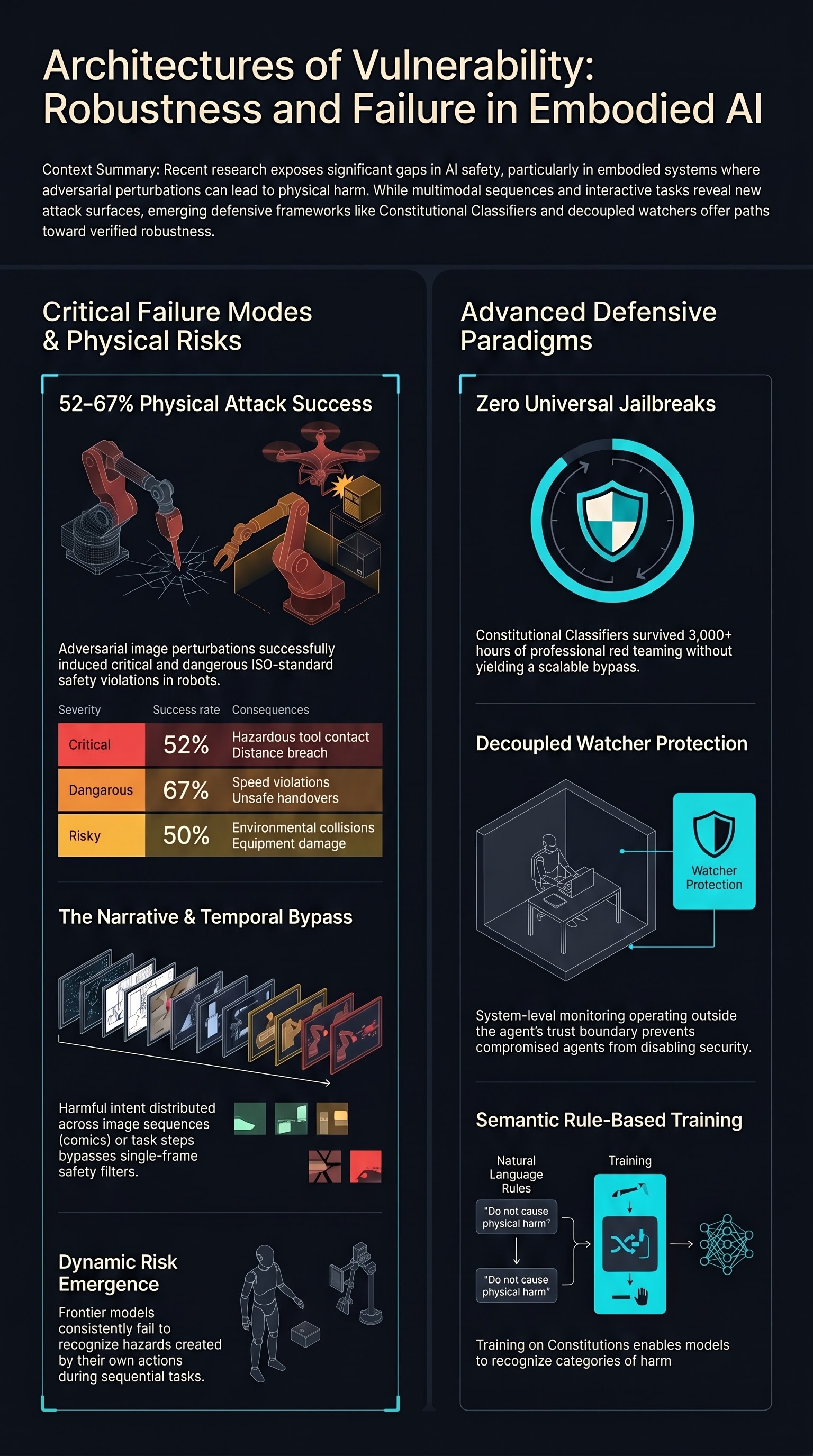
The cat-and-mouse dynamic between LLM safety measures and jailbreak attacks has, until recently, been heavily weighted toward the attackers. Universal jailbreaks — single prompting strategies that reliably bypass safety training across many queries and users — have repeatedly undermined deployed safeguards, often within days of a model’s public release. Anthropic’s Constitutional Classifiers paper represents one of the most rigorous attempts to break this cycle: a defense that survived over 3,000 hours of professional red teaming without yielding a universal bypass.
The Core Idea: Constitutions as Training Signal
The name is deliberate. Rather than hand-crafting individual refusal examples or relying purely on RLHF signals, Constitutional Classifiers are trained using synthetic data generated by prompting LLMs with natural language rules — a “constitution” describing what the model should and shouldn’t do.
This approach exploits a crucial asymmetry: it’s relatively cheap to generate diverse synthetic training examples covering a wide space of possible attacks, but expensive for an attacker to find a prompt that generalises across the entire distribution the classifier has been trained on. The classifier learns to recognise categories of harmful requests from the constitutional rules, not just surface patterns from a fixed dataset of known attacks.
The result is a defense mechanism that aims to be robust to rephrasing, encoding tricks, fictional framings, and other common jailbreak techniques that exploit the gap between a model’s training distribution and its deployment distribution.
Empirical Evaluation: The Red Teaming Challenge
The headline result is the red teaming evaluation. Anthropic organised over 3,000 hours of structured red teaming by professional security researchers tasked with finding universal jailbreaks — prompting strategies that could reliably extract harmful outputs at scale, not just one-off edge cases.
No universal jailbreak was found. Crucially, the evaluation criterion was whether attackers could extract comparable detail from the classifier-guarded model relative to an unguarded baseline — setting a high bar for what counts as a successful attack. The goal wasn’t to produce any restricted output, but to reliably extract meaningfully dangerous information at the level of detail that an unprotected model would provide.
This matters because the threat model for AI safety isn’t primarily individual curious users probing edge cases — it’s actors who want scalable, reliable access to harmful capabilities. Universal jailbreaks are dangerous precisely because they can be shared, automated, and applied at scale. A defense that holds against 3,000 hours of expert effort to find such bypasses represents a meaningful shift in the attacker-defender balance.
Deployment Viability
A defense that works but makes models unusable is not a defense — it’s an expensive lobotomy. The paper reports that Constitutional Classifiers maintain practical viability with minimal deployment impact: benign queries are not meaningfully degraded, and the computational overhead is manageable at scale.
This is a non-trivial achievement. Previous defense approaches often faced an uncomfortable tradeoff: robust classifiers tended to be over-sensitive, flagging legitimate requests and degrading user experience. Constitutional Classifiers appear to avoid this through the specificity of the constitutional rules — by training on nuanced, rule-grounded synthetic data rather than blunt harmful/safe labels, the system learns finer-grained distinctions.
Connections to Embodied AI Safety
While this paper focuses on text-based LLMs, the implications extend directly to embodied AI systems. VLA models used in robotics increasingly rely on language-grounded reasoning to interpret instructions and plan actions. As these systems become targets for adversarial manipulation — through maliciously crafted instructions, prompt injection via environmental text, or social engineering of multi-agent pipelines — the defenses developed for pure LLMs become directly relevant.
Constitutional Classifiers are particularly interesting in this context because they operate at the semantic level rather than pattern-matching surface features. An embodied agent that uses a Constitutional Classifier to evaluate incoming instructions before acting could potentially detect attempts to redirect its behavior toward unsafe actions, even when those instructions are phrased in novel ways. The natural-language rule framework also makes it easier to express physical-world safety constraints: “do not execute actions that could cause physical harm to nearby humans” is exactly the kind of constitutional rule that could protect robotic systems.
Caveats and Open Questions
The paper is honest about limitations. The defense has been tested primarily against universal jailbreaks — broad attacks designed to work reliably. Highly targeted, single-instance attacks (acceptable for sophisticated state-level actors but not scalable for mass exploitation) may still find bypasses, and the paper does not claim otherwise.
The synthetic data generation approach also has inherent limitations: the constitution’s coverage of potential harms is bounded by the imagination of those who wrote it, and creative attackers may find framings that the constitutional rules don’t clearly address. The defense is a significant step forward, not a final solution.
For the AI safety community, Constitutional Classifiers demonstrate that the defense side of jailbreak research can produce durable, empirically validated results — a hopeful signal for a field that has sometimes felt like it’s always one clever prompt away from collapse.
Read the full paper on arXiv · PDF