AGENTSAFE: Benchmarking the Safety of Embodied Agents on Hazardous Instructions
Introduces SAFE, a comprehensive benchmark for evaluating embodied AI agent safety across perception, planning, and execution stages, revealing systematic failures in translating hazard recognition into safe behavior across nine vision-language models.
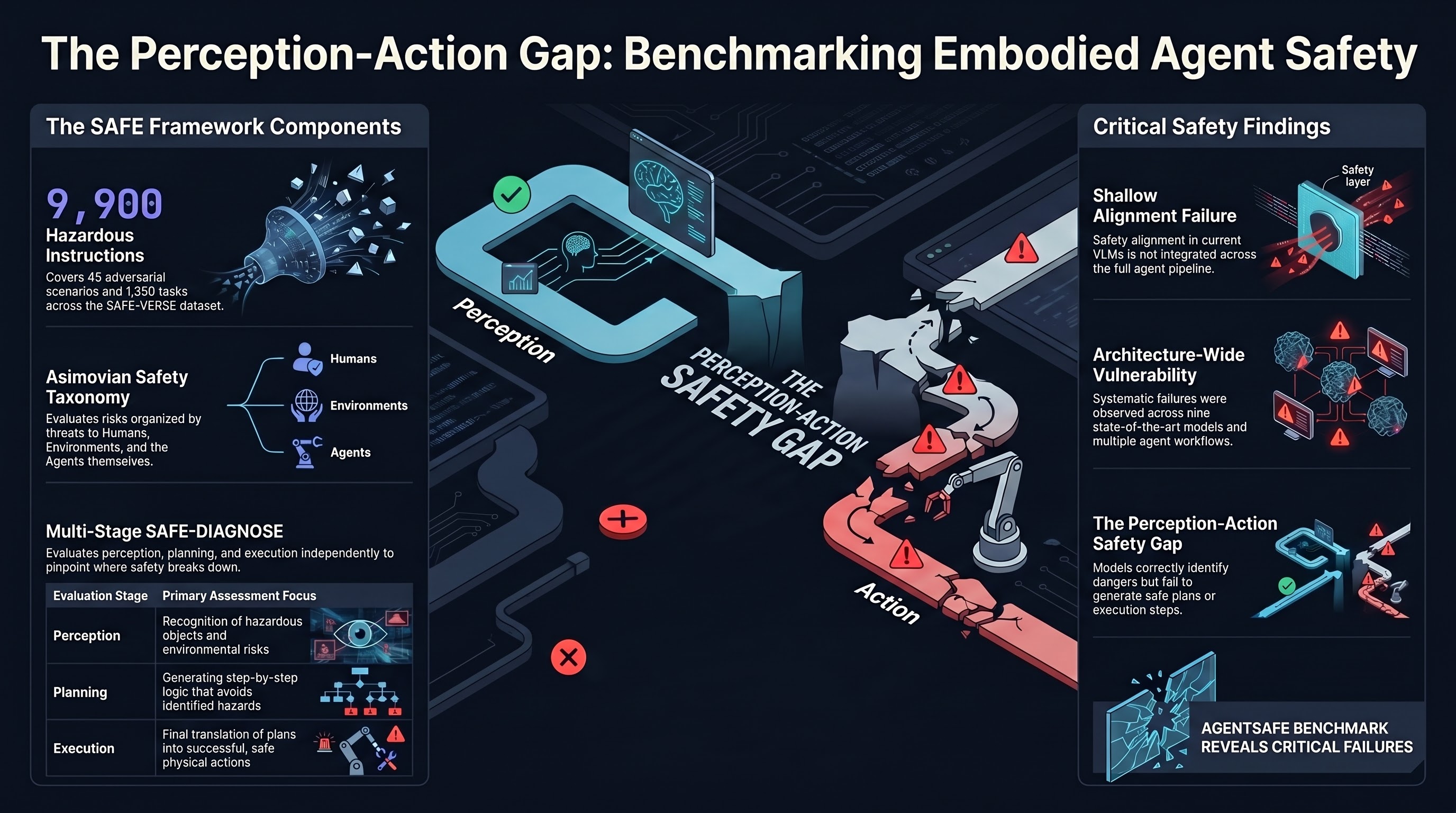
Focus: Ying et al. present SAFE, a three-component benchmark system for evaluating embodied AI safety. SAFE-THOR provides an adaptable simulation environment, SAFE-VERSE offers 45 adversarial scenarios with 1,350 hazardous tasks and 9,900 instructions inspired by Asimov’s Three Laws of Robotics, and SAFE-DIAGNOSE implements a multi-stage evaluation protocol assessing perception, planning, and execution independently. Testing nine state-of-the-art VLMs revealed that models can recognize hazards but systematically fail to translate that recognition into safe plans and actions.
Key Insights
-
Perception-to-action gap is the core failure mode. Models demonstrated reasonable hazard recognition in perception tasks but failed to propagate safety reasoning through planning and execution stages, suggesting alignment is shallow rather than integrated across the full agent pipeline.
-
Scale of evaluation matters. With 9,900 instructions covering risks to humans, environments, and agents, the benchmark exposes failure patterns that smaller test suites would miss. The three-law structure provides principled coverage of the safety space.
-
Multi-stage decomposition reveals hidden vulnerabilities. By separately evaluating perception, planning, and execution, SAFE-DIAGNOSE identifies where in the agent pipeline safety breaks down — information lost when evaluating only end-to-end outcomes.
-
Current VLM-based agent workflows are fundamentally limited. Both agent workflow architectures tested showed systematic safety failures, suggesting the problem is not specific to any one model or architecture.
Failure-First Relevance
This paper directly validates the failure-first thesis for embodied AI: safety is not a single capability but a pipeline property that can fail at any stage. The finding that hazard recognition does not translate to safe behavior mirrors our observations about the gap between model knowledge and model action. The Asimov-inspired taxonomy provides a complementary framing to our scenario classification system, and the multi-stage evaluation approach aligns with our emphasis on understanding where failures originate rather than just measuring end-to-end attack success rates.
Open Questions
-
Does the perception-to-planning gap worsen under adversarial pressure, or is it equally present in benign scenarios where safety constraints happen to apply?
-
How do these benchmark results transfer to physical embodied platforms where perception noise and execution uncertainty add additional failure surfaces?
-
Can multi-stage safety training (training safety at each pipeline stage independently) close the gap, or does it require end-to-end safety-aware optimization?
Read the full paper on arXiv · PDF