Resilience Matters for Embodied Agents System: New Metrics, Systematic Evaluation, and Optimization
Proposes a resilience evaluation framework and metric suite spanning rebound, stability, and graceful extensibility to assess and optimize process-level dynamics in embodied agent systems across 400
1. Introduction: The Blind Spot of Outcome-Centric Metrics
In the evaluation of Embodied Agent Systems (EAS), traditional outcome-centric metrics—such as binary Task Success Rate (SR) and aggregated safety scores—present a critical evaluation blind spot. By collapsing complex, multi-step execution trajectories into single scalar values, these metrics mask the dynamic physical and cognitive processes underlying agent behavior. In dynamic physical environments characterized by continuous perturbations, partial observability, and physical irreversibility, two embodied agents can achieve identical task success rates while executing fundamentally different trajectories. For example, one agent might achieve a “resilient success” through efficient, low-overhead adaptation, while another achieves a “costly success” burdened by excessive replanning, repeated spatial backtracking, state debt, and transiently unsafe intermediate states.
To resolve this diagnostic limitation, research by Liu et al. (arXiv:2608.23839) introduces a formal framework for evaluating and optimizing process-level dynamics in embodied AI. Drawing upon core principles from resilience engineering, Liu et al. construct a non-intrusive evaluation and optimization layer designed to measure how autonomous agents recover from disruptions, maintain policy stability under perturbations, and extend operational capacity under stress. Evaluated across 400 household tasks and 10 representative embodied agent architectures within Habitat-Sim 3.0, the authors’ framework moves beyond static outcome scores to quantify the dynamic process trade-offs inherent to physical agent deployments.
2. The Core Architecture: Three Pillars of Embodied Resilience
The theoretical framework established by Liu et al. structures embodied resilience across three foundational pillars derived from resilience engineering: Rebound, Stability, and Graceful Extensibility.
Execution dynamics are evaluated relative to local Stage Baselines , estimated from reference trajectories under a shared local execution anchor . Here, represents the task family, denotes the task progress load, specifies the residual proposition load, and defines the active execution mode. The stage baseline summarizes local reference metrics:
where is the nominal cycle time, is the estimated remaining work, and record expected cognitive and physical effort, capture progress rates, and quantifies nominal risk load. To densify sparse environmental feedback, an LLM-as-a-Judge probe evaluates instruction context, state history, trajectory logs, and environment signals to emit structured progress and efficiency rewards.
| Resilience Aspect | Indicator Metric | Underlying Mechanism & Data Source |
|---|---|---|
| Rebound | Recovery Cost () | Quantifies excess cognitive, physical, and state debt overhead incurred to return to nominal execution within a recovery window . Extracted from system execution logs, stage baselines, and covariance matrices. |
| Stability | Policy Stability () | Measures policy sensitivity to execution fluctuations and instruction perturbations using value-function variance, temporal-difference (TD) residuals, and Generalized Advantage Estimates (GAE). Calculated via controlled sensitivity tests. |
| Graceful Extensibility | Stress Capacity () & Operational Margin () | Maps operational degradation across controlled stress severity levels against hard boundary monitors. Measured via parameterized stress grid testing. |
1. Rebound ()
Rebound measures the normalized extra work expended by an agent to return to acceptable execution after a disruption occurs at step until recovery at step . Liu et al. decompose recovery effort into three normalized excess variables:
Where captures excess cognitive and planning effort, represents excess navigation and retry iterations, and measures progress leakage and risk load. The notation denotes the Rectified Linear Unit (ReLU) function, accumulating positive overhead while ignoring pre-complete efficiency gains.
To remove scale inconsistencies and account for cross-channel correlations, each deviation vector is normalized via Mahalanobis distance using the baseline covariance matrix estimated under anchor :
where serves as a numerical regularizer. The individual channel deviations aggregate into total recovery intensity (for ). For episode , total Rebound Cost is defined formally as:
Normalizing by ensures that recovery effort is evaluated relative to the remaining nominal work required at the point of initial disruption.
2. Stability ()
Stability quantifies policy consistency under stochastic execution shifts and semantic instruction perturbations. The authors utilize a value function , where represents shaped rewards incorporating judge feedback and baseline remaining work. For each step, the one-step temporal-difference residual is computed as , yielding the Generalized Advantage Estimate .
The trajectory resilience loss for episode is formulated as:
where is the concatenated state feature vector aggregating the state representation , temporal-difference residual , and advantage estimate . Policy Stability over task family and controlled perturbation set is defined as the supremum of loss variations relative to perturbation magnitude :
Elevated values reflect high action variance, value function spikes, subtask repetition, and structural decision instability.
3. Graceful Extensibility ( and )
Graceful Extensibility evaluates how system performance degrades as stress severity increases. For episode under stress operator , Liu et al. construct a hard boundary monitor :
where represents constraint violations and terms denote contract thresholds. A value of indicates a contract breach.
To aggregate statistical extensibility across task family , lower quantiles () of benefit variables and upper quantiles () of cost variables form the extensibility vector :
Sorting the components of as , the statistical operational margin over bottom- metrics is defined as:
Stress Capacity represents the formal operational boundary of task family :
3. Empirical Findings: What 400 Tasks and 10 Agents Reveal
Liu et al. evaluated 10 representative EAS architectures across 400 collaborative household tasks in Habitat-Sim 3.0. Tasks encompassed mobile navigation, tabletop object manipulation, multi-room transportation, and human-agent collaboration.
| EAS Method | Recovery Cost () | Stability () | Stress Capacity () | Outcome SR (%) | Reference Completion (%) | Simulation Steps |
|---|---|---|---|---|---|---|
| ReAct | ||||||
| Reflexion | ||||||
| CycleVLA | ||||||
| CLARE | ||||||
| SayCan | ||||||
| AgentEvolver | ||||||
| InnerMono | ||||||
| CoPAL | ||||||
| SMART-LLM | ||||||
| Baseline |
Key Analytical Findings
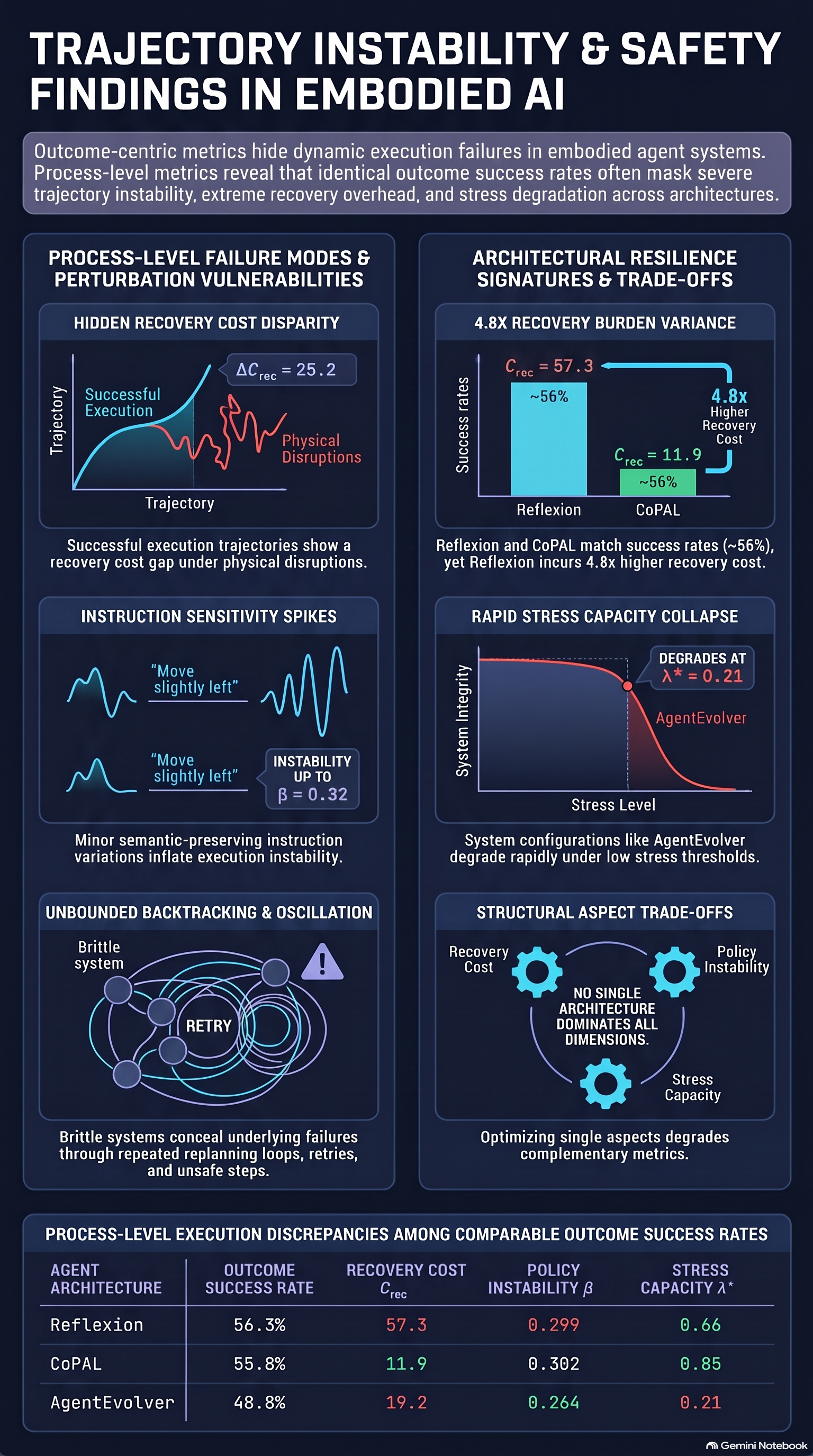
- Same SR, Distinct Resilience Profiles: Outcome metrics mask critical differences in execution stability and efficiency. Reflexion and CoPAL achieve nearly identical success rates ( vs. ), yet Reflexion exhibits a higher recovery cost ( vs. ). Across all successful runs evaluated in Habitat-Sim 3.0, the authors report recovery cost disparities as high as between baseline architectures.
- Impact of Controlled Perturbations: Physical state perturbations increase mean recovery costs from in unperturbed baseline runs to under physical disruptions (Mann–Whitney test ). Semantic instruction perturbations inflate policy instability to , primarily driven by action output variance (). Stress tests reveal a strong positive correlation between stress severity and recovery cost (Spearman correlation ).
- Architectural Trade-Offs and Signatures: Evaluated systems exhibit distinct operational trade-offs. CoPAL achieves high stress capacity () and low recovery costs (), but requires long execution horizons ( simulation steps). InnerMono achieves superior policy stability () but suffers from high recovery costs (). AgentEvolver maintains low recovery cost () but demonstrates limited stress capacity ().
4. Diagnostic Optimization: Metric-Guided Resilience Repairs
Liu et al. demonstrate that their resilience evaluation framework operates not only as a benchmark, but also as an actionable diagnostic tool to guide non-intrusive runtime repairs. By extracting real-time failure signals, the authors implement targeted interventions that optimize process dynamics without requiring underlying core planner retraining.
| Target Aspect | Intervention Mechanism | Primary Metric Shift | Recovery Window () | Step Instability () | Overall Stability () | GE Completion Rate | Formal GE Status |
|---|---|---|---|---|---|---|---|
| Rebound | Feedback-Guided Recovery | : () | () | () | () | () | Unspecified |
| Stability | Consistency State Record | : () | () | () | () | () | Unspecified |
| Graceful Extensibility | Boundary Long-tail Control | GE Comp.: () | () | () | () | () | Incomplete Complete |
1. Rebound Optimization (Feedback-Guided Recovery)
High values indicate redundant reasoning loops following localized disruptions. The authors introduce a context injection layer that monitors World-Graph state evidence and execution stagnation. When a recoverable failure is detected, the layer injects Rebound Guidance (e.g., perception refreshes, state rollbacks, or belief updates) into the planner context. This intervention reduces from to () and shortens average recovery windows from to steps ().
2. Stability Optimization (Consistency State Record)
Unstable replanning behavior (high ) manifests as subtask repetition and action oscillation. To mitigate this, Liu et al. implement a read-only phase guidance context summarizing active task goals, room states, held objects, and completed subtasks. This intervention reduces step instability from to () while stabilizing local replanning variance.
3. Graceful Extensibility Optimization (Boundary Long-tail Control)
Under stress, agents frequently enter unbounded dual-wait patterns and boundary stalls. Implementing a long-tail monitor to detect stagnant progress () and inject bounded cognitive resets prevents non-progressive delays. This converts uncontrolled long-tail execution into measurable boundary execution, raising formal Graceful Extensibility completion from to () and converting formal GE status from Incomplete to Complete.
4. Structural Resilience Trade-offs
The optimization results confirm structural trade-offs across resilience dimensions. Specifically, optimizing for Graceful Extensibility increases recovery cost from to () and expands the recovery window from to steps (). Conversely, Rebound optimization reduces Graceful Extensibility completion from to (). These dynamic trade-offs demonstrate that embodied resilience requires balanced configuration tailored to deployment constraints.
5. Conclusion & Strategic Takeaways for AI Safety Practitioners
The empirical framework developed by Liu et al. provides structured takeaways for practitioners engineering and safety-testing embodied autonomous systems:
- Process-Level Metrics are Mandatory for Deployment Safety: Outcome-centric evaluation hides severe execution risks, including state debt, spatial backtracking, and policy instability. Integrating process-aware metrics () into pre-deployment evaluation is essential to expose latent failure modes.
- Non-Intrusive CI/CD Pipeline Integration: Safety engineers can integrate the Resilience Evaluation Layer directly into existing CI/CD and simulation testbeds (e.g., Habitat-Sim) by attaching non-intrusive diagnostic probes to runtime event logs. These probes track step progress , proposition completion , and execution traces to compute stage baseline deviations without altering underlying control policies or core planner architectures.
- Deployment-Specific Resilience Tailoring: No single agent architecture dominates across all resilience aspects. Autonomous systems must be selected and tuned according to operational requirements—prioritizing Graceful Extensibility for unpredictable, open-world settings, or Policy Stability for safety-critical, low-tolerance operational domains.
- Metric-Guided Targeted Interventions: Process-level diagnostics enable lightweight runtime intervention layers (such as feedback guidance prompts or consistency records) that repair failure loops without requiring computationally expensive planner retraining.
Future Research Directions
The authors highlight three key directions for future research in embodied agent resilience:
- Sim2Real Transfer Validation: Evaluating whether resilience profiles and recovery costs measured within simulation environments accurately transfer to physical robotic hardware.
- Theoretical Pareto Frontiers: Formally modeling the mathematical boundaries and trade-offs constraining rebound cost, policy stability, and graceful extensibility.
- Deployment-Aware Optimization Pipelines: Constructing automated optimization pipelines that dynamically adjust an agent’s resilience configuration based on real-time environmental risk parameters.
Read the full paper on arXiv · PDF