Reward-Free Continual Adaptation for Resilient Space Robots
The authors introduce a reward-free continual reinforcement learning framework that adapts to hardware degradation by updating only the transition dynamics of a pre-trained latent-state world model.
1. Introduction: The Unobservable Reward Problem in Hardware Failures
Deploying autonomous robotic systems into extreme, uninstrumented environments—such as lunar and Martian surfaces or microgravity orbital operational zones—presents fundamental reliability and safety challenges. In these operational regimes, physical hardware degradation is not merely a contingency, but an inevitable operational condition. A prominent real-world precedent is the structural wheel damage sustained by NASA’s Mars Curiosity rover over years of traversing sharp basalt rocks. Other critical physical failure modes encountered in extraterrestrial missions include thruster failures, actuator lockups, joint degradation, and kinematic misalignments. When these unforeseen morphological failures occur, pre-trained control policies experience severe out-of-distribution dynamics shifts, routinely causing zero-shot physical deployment to fail catastrophically.
Standard continual reinforcement learning (RL) frameworks rely on continuous access to explicit scalar reward signals to adapt control policies when physical dynamics change. In simulated training environments, calculating dense reward functions is straightforward because the underlying simulation engine provides privileged, full-state access to all physical variables. For instance, in simulated regolith excavation, an agent can compute task success by tracking the velocity vectors and spatial positions of millions of discrete soil particles. However, physical space deployments lack external motion-capture infrastructure, dense state-tracking systems, or precise environmental instrumentation. Estimating excavated regolith mass or ejected dust volumes in an uninstrumented lunar crater using onboard vision alone is highly error-prone and unreliable.
Consequently, physical hardware damage in real-world space operations coincides with a complete loss of external reward signals—a condition defined as the unobservable reward problem. Retraining control policies from scratch upon encountering hardware damage is equally infeasible due to severe time constraints, strict compute budgets, and narrow communication windows back to Earth ground control.
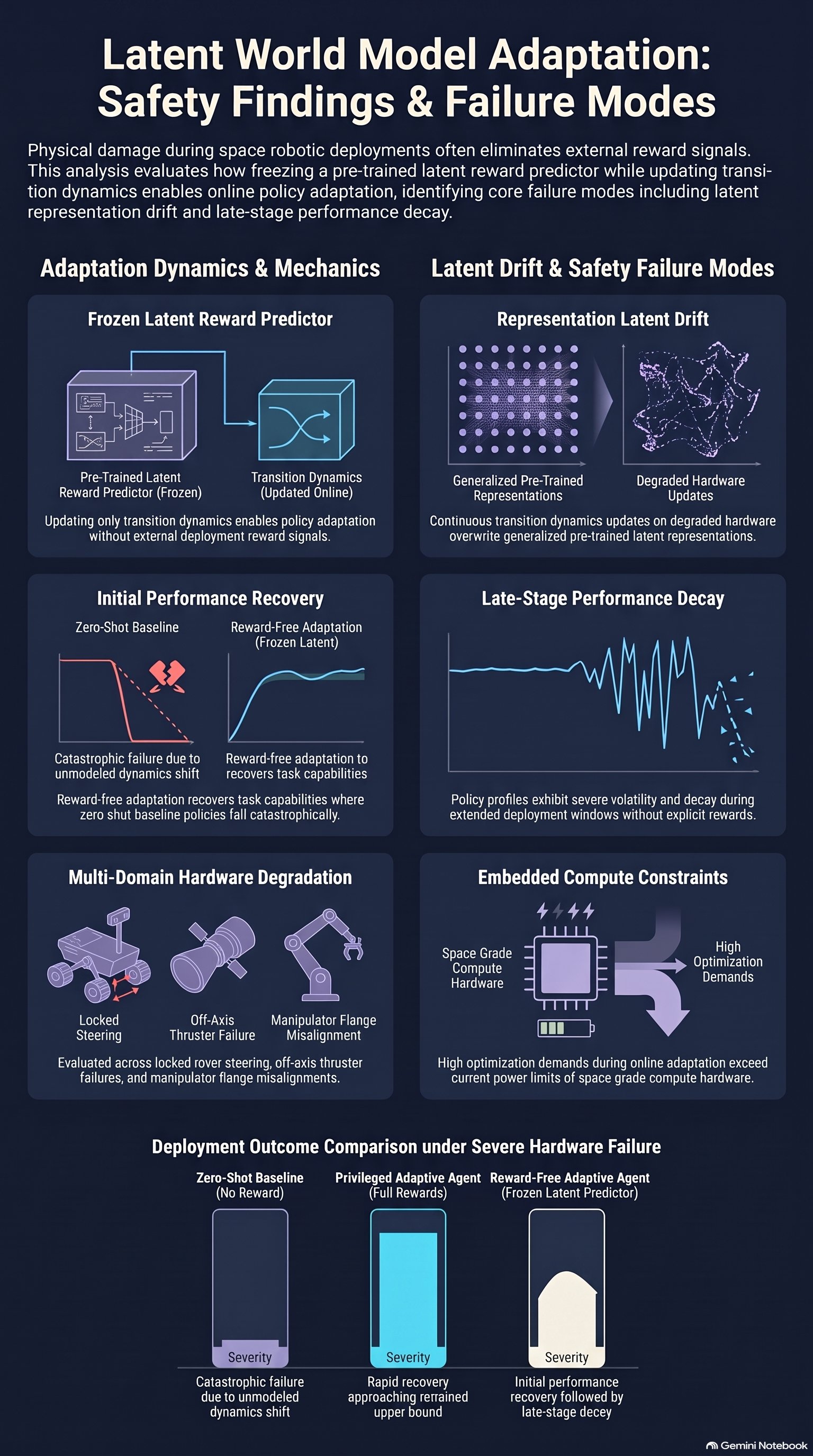
To address this challenge, Orsula et al. introduced a reward-free continual reinforcement learning framework presented at SPAICE 2026. Their method leverages latent-state world models (specifically extending the DreamerV3 architecture) to enable continuous online policy adaptation without receiving deployment rewards. By pre-training a latent world model across diverse simulation conditions with extensive domain randomization, the framework embeds an invariant reward landscape within its latent representation space. When physical hardware failures occur during deployment, the agent freezes its observation encoder and reward predictor while updating only its transition dynamics via unsupervised proprioceptive rollouts. This architectural separation allows the control policy to adapt to altered physical dynamics entirely through internal imagination, operating effectively “in the dark.”
2. Architecture & Mechanism: Updating Dynamics While Freezing Rewards
The framework developed by Orsula et al. operates across two distinct operational phases: a data-abundant pre-training phase conducted in simulation and a reward-free online adaptation phase executed directly on the deployed hardware. The core technical mechanism relies on strictly isolating the transition dynamics updates from the observation encoder and reward prediction networks.
| Phase / Stage | Component Status & Function |
|---|---|
| Pre-Training Phase (Simulation) | [UPDATED] Encoder (): Maps high-dimensional observations to stochastic latent states . [UPDATED] RSSM Sequence Model (): Computes the deterministic recurrent state . [UPDATED] Forward Dynamics (): Predicts prior stochastic latent states . [UPDATED] Decoder (): Reconstructs high-dimensional observations. [UPDATED] Reward Predictor (): Predicts scalar rewards from latent states. [UPDATED] Continuity Predictor (): Predicts episode termination conditions. [UPDATED] Actor-Critic Policy (): Optimized inside imagined latent rollouts using predicted rewards. |
| Online Adaptation Phase (Deployment) | [FROZEN] Encoder (): Preserves coordinate mapping from physical space into the pre-trained latent space . [FROZEN] Decoder (): Held static to prevent latent drift of the spatial representation. [FROZEN] Reward Predictor (): Preserves the invariant objective function across latent states. [FROZEN] Continuity Predictor (): Held static as task horizon limits remain fixed. [UPDATED] RSSM Sequence Model & Forward Dynamics: Updated online using unlabelled proprioceptive steps via dynamics KL loss (). [UPDATED] Actor-Critic Policy: Continuously re-trained within imagined rollouts generated by updated transition dynamics. |
2.1 Pre-Training in Simulation
During the simulation pre-training phase, the Recurrent State-Space Model (RSSM) of DreamerV3 is trained jointly with an actor-critic policy. The world model compresses high-dimensional proprioceptive and visual observations into stochastic latent representations while maintaining a deterministic recurrent state . The world model is trained to minimize observation reconstruction loss, predict scalar rewards , forecast episode continuity , and minimize the Kullback-Leibler (KL) divergence between prior dynamics predictions and posterior representations. Concurrently, the actor-critic policy is optimized entirely within synthetic trajectories generated by the RSSM, guided by the reward predictor.
To establish a broad and robust latent reward landscape, Orsula et al. scaled pre-training to 20 million environment steps executed across 512 parallel environment workers, maintaining a training ratio of 32 policy updates per step. Extensive domain randomization was applied across physical parameters during this phase, including gravity vectors, link mass and inertial properties, surface friction coefficients, and unmodeled external force disturbances. This domain randomization forces the encoder and reward head to establish a structured latent mapping where the scalar reward structure reflects the underlying functional goal of the task, remaining invariant to physical plant perturbations.
2.2 Reward-Free Online Fine-Tuning
The underlying scientific hypothesis of the paper is that a world model pre-trained across randomized physical variations inherently encodes a generalizable, static reward landscape within its latent space. When severe hardware degradation occurs during deployment, the actual transition dynamics of the physical platform shift radically, rendering the pre-trained forward dynamics model inaccurate.
To adapt the robot without relying on deployment reward feedback, the framework isolates the dynamics adaptation process:
- Freezing Spatial Coordinates and Objectives: The observation encoder , decoder , and reward predictor are strictly frozen. Freezing the encoder preserves the established mapping from physical sensor measurements into the stochastic latent coordinate space , while freezing the reward head prevents catastrophic unlearning of the task objective in the absence of external reward labels.
- Updating Dynamics Models: Only the RSSM sequence model and forward dynamics network are updated online using unlabelled, unsupervised proprioceptive interactions collected during deployment.
- Dynamics Optimization: The dynamics parameters are fine-tuned by minimizing the KL divergence loss between the posterior latent distributions generated from physical interaction and the prior dynamics predictions:
To maintain numerical stability and prevent gradient exploitation during online execution, Orsula et al. applied key hyperparameter modifications:
- Learning Rate Reduction: The world model learning rate is reduced by an order of magnitude, dropping from the pre-training rate of down to to prevent catastrophic forgetting of base physical principles.
- Exploration Noise Injection: Zero-mean Gaussian exploration noise is added to normalized policy output actions during deployment rollouts, forcing the system to sample out-of-distribution physical transition states.
- Intense Policy Re-training: The actor-critic policy is continuously re-trained within internal latent imagination using the updated transition dynamics, running at a high intensity of 2,048 policy updates per environment interaction step.
- Frozen Continuity: The continuity predictor remains frozen, as task termination definitions are invariant across hardware failure states.
3. Evaluation Setup: Benchmark Tasks & Simulated Failure Modes
Orsula et al. validated their framework within NVIDIA Isaac Lab using the Space Robotics Bench. The experimental suite comprises three distinct space robotics operational domains, with each system subjected to an unmodeled morphological hardware failure:
-
Planetary Traversal (ERNEST Rover):
- System Architecture: A 12-actuator planetary rover inspired by NASA JPL’s ERNEST prototype, utilizing a double-sided active gimbal suspension mechanism operating at a control frequency of 25 Hz.
- Task Objective: Maintaining target directional velocity vectors across procedurally generated rough terrain and obstacle fields.
- Simulated Failure Mode: Complete locking of both the steering and drive joints on the front-right wheel assembly, introducing severe asymmetric drag and unmodeled mechanical steering resistance.
- Adaptation Constraints: Restricted to 60 minutes of real-time operational interaction, corresponding to exactly 90,000 environment steps.
-
Orbital Navigation (SE(3) Spacecraft):
- System Architecture: A six-degree-of-freedom continuous-thrust spacecraft equipped with 12 independent continuous thrusters operating in SE(3) microgravity at a control frequency of 10 Hz.
- Task Objective: Dynamic multi-waypoint navigation and precise relative tracking of a moving target pose in zero gravity.
- Simulated Failure Mode: Complete structural failure of three co-located off-axis thrusters, eliminating symmetrical thrust vectors and creating strong cross-coupling between translational and rotational commands.
- Adaptation Constraints: Restricted to 60 minutes of real-time operational interaction, corresponding to exactly 36,000 environment steps.
-
Screwdriving Assembly (7-DOF Manipulator):
- System Architecture: A 7-degree-of-freedom industrial robotic arm fitted with an electric screwdriver end-effector operating at a control frequency of 50 Hz.
- Task Objective: Precision insertion and thread engagement of a pre-aligned bolt into a matching stationary nut under tight mechanical clearances.
- Simulated Failure Mode: A 15° axial bend introduced into the mounting flange of the electric screwdriver, causing severe physical offset between true tool-tip position and pre-trained kinematic expectations.
- Adaptation Constraints: Restricted to 60 minutes of real-time operational interaction, corresponding to exactly 180,000 environment steps.
4. Experimental Results & Performance Analysis
The reward-free adaptive agent proposed by Orsula et al. was evaluated across a 60-minute deployment window. While pre-training leveraged 512 parallel environments to build latent representations, adaptation was strictly constrained to a single isolated environment instance to accurately model the physical realities of remote space hardware. The framework was benchmarked against three control baselines:
| Baseline Agent Type | Adaptation Strategy | Performance Outcome & Trajectory |
|---|---|---|
| Zero-Shot Policy (Pre-trained) | None; executes the pre-trained policy directly on damaged hardware without adaptation. | Catastrophic Failure: Task progress drops to zero across all three domains immediately following the morphological shift. |
| Retrained from Scratch | Re-trained entirely on damaged hardware using explicit, continuous environment rewards. | Asymptotic Upper Bound: Eventually resolves tasks successfully but exhibits extreme sample inefficiency, recovering performance slowly. |
| Privileged Reward Adaptive Agent | Fine-tunes transition dynamics and receives explicit deployment rewards online. | Near-Optimal Recovery: Adapts rapidly, reaching progress levels near the retrained upper bound within the 60-minute constraint. |
| Reward-Free Adaptive Agent (Orsula et al.) | Fine-tunes dynamics only; frozen encoder and reward predictor (zero online deployment rewards). | Rapid Recovery with Late-Stage Decay: Demonstrates rapid initial task recovery across all domains, but underperforms the privileged baseline and experiences late-stage decay. |
Experimental Synthesis: Performance Trajectories & Task Sensitivity
Across all three benchmark domains, experimental evaluations highlight distinct performance phases during the 60-minute adaptation budget:
- Phase 1: Zero-Shot Collapse (0–5 Minutes): Unmodeled morphological damage invalidates pre-trained kinematic and dynamic assumptions. The zero-shot baseline fails completely in all tasks, demonstrating that passive policy robustness cannot accommodate severe hardware failures.
- Phase 2: Rapid Initial Recovery (5–25 Minutes): The reward-free adaptive agent recovers task functionality rapidly without receiving external rewards. By updating the RSSM sequence model () and forward dynamics () on unsupervised interaction steps, the agent aligns its internal dynamics model with the degraded hardware, enabling the actor-critic policy to synthesize corrective motor commands within latent imagination.
- Phase 3: Divergence and Performance Decay (25–60 Minutes): While the privileged agent (receiving ground-truth rewards) monotonically approaches the asymptotic upper bound, the reward-free agent experiences performance volatility and late-stage decay.
                    ADAPTATION TRAJECTORY SUMMARY (60-MINUTE WINDOW)
┌─────────────────────────────────────────────────────────────────────────────────┐
│ Progress                                                                        │
│   High │                                  /───\  [Privileged Adaptive Agent]    │
│        │                                 /     \─── Upper Bound                 │
│        │                                /  /\                                   │
│        │          /───\                /  /  \  [Reward-Free Agent: Initial     │
│        │         /     \              /  /    \   Recovery followed by Decay]   │
│        │        /       \────────────/──/──────\─────────────────────────       │
│   Low  │───────/────────────────────/──/─────────────────────────────────       │
│        └───────┴────────────────────┴──┴────────────────────────────────► Time  │
│             Damage Occurs         Initial Recovery      Late Decay Phase        │
└─────────────────────────────────────────────────────────────────────────────────┘
Task-Specific Failure Dynamics
The severity and speed of late-stage performance decay depend directly on the spatial precision requirements and dynamic complexity of each domain:
- Screwdriving Assembly (50 Hz, 180K Steps): Suffers the fastest and most severe performance decay. Because bolt insertion requires millimeter-level spatial precision, minor misalignments between the updated dynamics model and the frozen reward predictor severely degrade task execution. A 15° flange bend alters the kinematic trajectory; as dynamics updates alter the latent state space, the frozen reward head fails to evaluate near-contact spatial offsets accurately, causing thread insertion success to drop rapidly after initial gains.
- Orbital Navigation (10 Hz, 36K Steps): Demonstrates significant performance decay driven by control authority loss. The structural loss of three co-located thrusters introduces asymmetric torque vectoring. While initial dynamics updates allow the policy to compensate for translational drift, continued unsupervised fine-tuning under asymmetric thrust causes the model’s latent trajectory predictions to decouple from rotational alignment targets.
- Planetary Traversal (25 Hz, 90K Steps): Displays the highest tolerance to latent representation shifts. Drag from the locked front-right wheel induces continuous yaw torque, but because terrain traversal allows for broader spatial tolerances than micro-assembly, the reward-free agent maintains functional forward locomotion longer, exhibiting mild volatility rather than sudden task collapse.
5. Failure-First AI Safety Analysis: Latent Drift & Deployment Vulnerabilities
From an AI safety and system reliability perspective, the empirical findings of Orsula et al. provide critical insights into structural failure modes inherent to unsupervised, latent-space continual adaptation.
┌───────────────────────────────────────────────────────────────────────────────────┐
│                       MECHANISM OF LATENT REWARD DRIFT                            │
│                                                                                   │
│  [ PRE-TRAINED STATE ]                                                            │
│  Physical Observation (x_t) ──► Encoder q_ϕ (FROZEN) ──► Latent State z_t         │
│                                                                │                  │
│                                                                ▼                  │
│                                                     Reward Predictor p_ϕ (FROZEN) │
│                                                                │                  │
│                                                                ▼                  │
│                                                          Accurate Reward          │
│                                                                                   │
│  [ DEGRADED / EXTENDED ADAPTATION STATE ]                                         │
│  Altered Sensor Data (x_t') ──► Encoder q_ϕ (FROZEN) ──► Drifted State z'_t      │
│                                     │                          │                  │
│                                     ▼                          ▼                  │
│                             Updated RSSM (L_dyn)    Reward Predictor p_ϕ (FROZEN) │
│                             Optimizes ONLY for                 │                  │
│                             State Predictability               ▼                  │
│                                                       HALLUCINATED REWARD         │
│                                                       (Causes Policy Drift)       │
└───────────────────────────────────────────────────────────────────────────────────┘
Latent Reward Divergence & Policy Drift
The primary vulnerability identified in the paper is latent representation drift. In standard RL, policy updates are bounded by ground-truth reward gradients derived from environment feedback. In the reward-free framework of Orsula et al., the transition dynamics loss is entirely unsupervised:
This loss function forces the sequence model and prior dynamics to optimize strictly for state transition predictability. Crucially, contains no feedback mechanism to ensure that the evolving latent state manifold remains aligned with the stationary output mapping of the frozen reward predictor .
As the RSSM repeatedly updates its dynamics parameters over tens of thousands of steps on degraded hardware, the latent states synthesized by the model gradually drift away from the distribution established during simulation pre-training. Because the frozen reward predictor receives these drifted latent representations, it outputs inaccurate, “hallucinated” scalar rewards. The actor-critic policy—training continuously within these imagined rollouts—optimizes against corrupted internal reward signals, causing policy drift and late-stage physical control decay.
Sim-to-Real Transfer Gaps
The evaluations presented by Orsula et al. were conducted exclusively within simulated environments (Isaac Lab). Consequently, the framework bypasses unmodeled real-world phenomena, including physical sensor noise, camera lens distortion, thermal expansion of structural components, non-linear gear backlash, and mechanical compliance. In actual deployments, unmodeled physical noise would accelerate latent representation drift, likely shortening the effective window of reward-free adaptation.
Radiation-Hardened Compute Constraints
A critical operational gap exists between the computational intensity of the adaptation algorithm and the capabilities of space-qualified hardware:
- The experimental protocol executes 2,048 policy re-training updates per physical environment step inside latent imagination.
- Radiation-hardened compute modules certified for space flight (such as the NVIDIA Jetson Orin NX System-on-Module subjected to Total Ionizing Dose testing) operate under strict thermal design power (TDP) caps, often limited to 10–25 Watts.
- Attempting high-frequency backpropagation loops at a 2,048 update ratio on embedded space compute would instantly exceed thermal boundaries and exhaust power budgets, creating a severe compute-bottleneck for real-time deployment.
6. Key Takeaways & Recommendations for Future Research
Core Takeaways for AI Safety & Robotics Practitioners
- Viability of Latent Reward Landscapes: Latent-state world models pre-trained across randomized physical variations store a sufficiently structured reward landscape to guide online policy adaptation without requiring external deployment rewards.
- Rapid Short-Term Fault Recovery: Isolating transition dynamics updates allows damaged robotic platforms (rovers, spacecraft, manipulators) to regain functional baseline control within short adaptation windows (5–25 minutes).
- Decoupling Risk of Unsupervised Loss: Updating forward dynamics via unsupervised KL divergence () optimizes for transition predictability while remaining agnostic to task success. Over extended timelines, this structural decoupling induces latent drift relative to the frozen reward head, causing performance decay.
Promising Mitigation Directions
- Bounded Dynamics Updates & Latent Adapters: Integrating parameter-efficient adapter layers (e.g., LoRA or localized residual blocks) into the RSSM sequence model, strictly bounding how far updated transition dynamics can alter latent representations relative to the frozen reward head.
- KL Divergence Safety Monitoring: Establishing real-time onboard safety metrics that track divergence spikes between prior and posterior distributions, triggering an automated pause on dynamics fine-tuning before latent drift induces catastrophic policy failure.
- Regularized Transition Loss Functions: Augmenting with explicit representation-preservation penalties (such as contrastive latent anchor constraints) to maintain alignment between updated latent dynamics and the original pre-trained state manifold.
- Lightweight Embedded Optimization: Redesigning the imagination re-training pipeline to operate under sparse, event-triggered update schedules, reducing the policy-to-environment step ratio to fit within the strict thermal and power limits of radiation-hardened processors like the Jetson Orin NX.
- Physical Hardware Validation: Transferring reward-free adaptation frameworks onto physical testbeds to quantify performance under real-world mechanical compliance, thermal drift, and unmodeled sensor degradation.
Read the full paper on arXiv · PDF