Pointing-VLA: Typed Spatial Grounding Interfaces for Vision-Language-Action Manipulation
The paper presents Pointing-VLA, an embodied model architecture that replaces autoregressive text coordinate decoding with typed hidden-state spatial heads predicting points, heatmaps, and visual
1. Introduction: The Spatial Interface Bottleneck in Vision-Language-Action Models
In generalist robotics, Vision-Language-Action (VLA) models attempt to connect high-level visual observations and language instructions directly to physical robotic behavior. A critical architectural challenge in this paradigm lies in the spatial grounding interface—the explicit output boundary where multimodal reasoning transitions into low-level geometric execution targets, such as grasp contact points, placement coordinates, or motion trajectories. Traditional VLA frameworks typically format spatial grounding through autoregressive text coordinates (spelling out numerical string tokens step-by-step) or opaque action tokens.
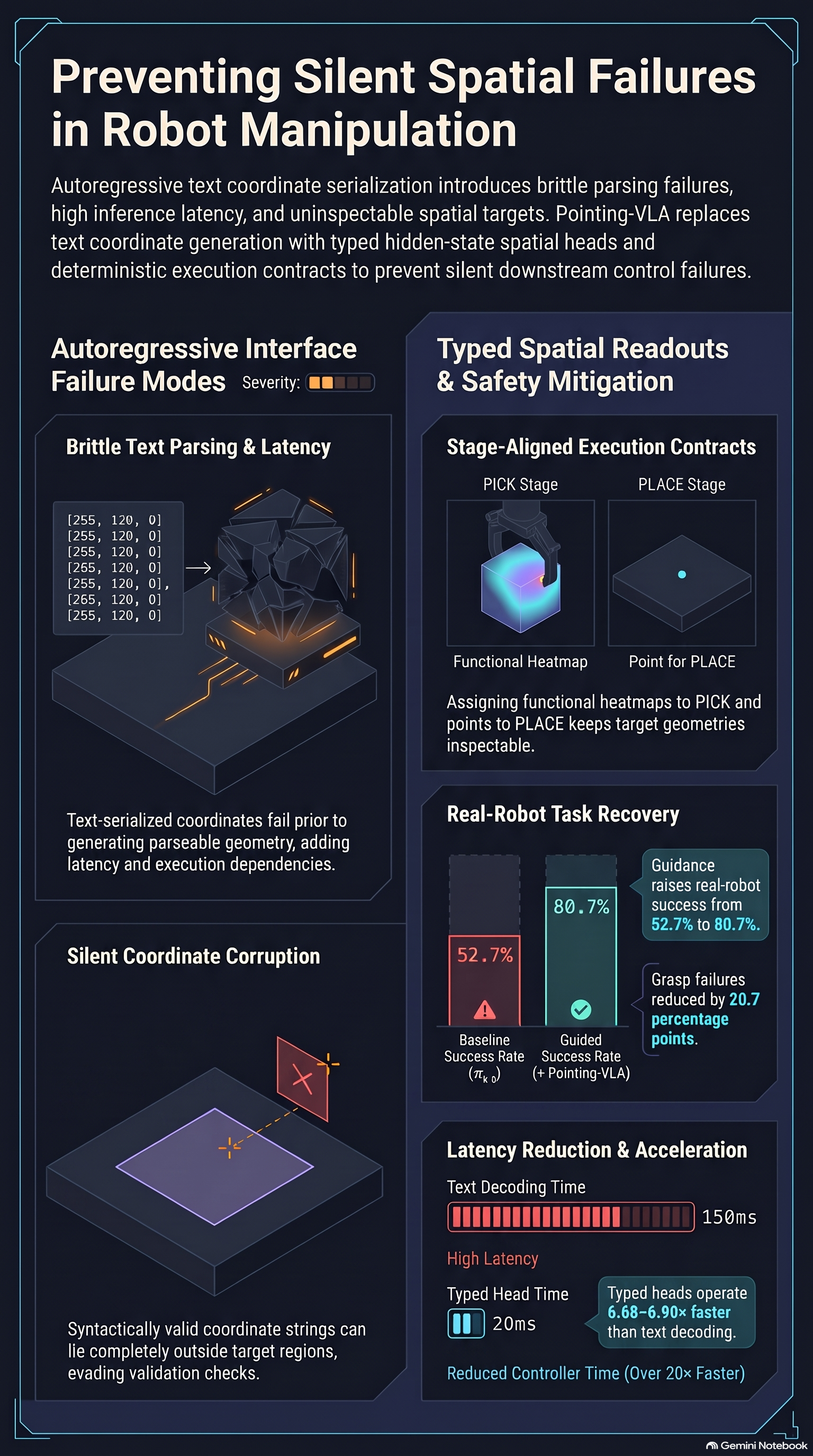
Chen et al. demonstrate that serializing continuous physical geometry into textual string tokens introduces systemic operational vulnerabilities into the robotic stack. When spatial targets are generated token-by-token through autoregressive language decoders, downstream execution pipelines become susceptible to text-parsing failures, substantial latency penalties, and a total loss of dense visual contact structure. Conversely, while direct action tokens bypass text parsing, they obscure the underlying spatial rationale from external collision planners and safety monitoring subsystems. To resolve this architectural bottleneck, the authors introduce Pointing-VLA, a framework that extracts structured geometric predictions directly from shared multimodal hidden states without generating text coordinates.
Embodied spatial grounding should be treated as typed interface prediction rather than text-coordinate generation.
2. The Mechanics of Failure: Text Serialization vs. Spatial Execution
The authors categorize the failure modes inherent in text-serialized spatial grounding into distinct syntax, spatial precision, computational, and safety vulnerabilities:
- Syntax and Parsing Failures: The language decoder produces malformed strings, truncated tokens, or non-numeric characters (e.g., failing to close a coordinate bracket). Downstream spatial wrappers fail to parse any numeric vector, resulting in unhandled exceptions and immediate task abortion.
- Syntactically Valid but Spatially Inaccurate Readouts: The text decoder generates a perfectly formatted string (e.g.,
[222, 172]), but the parsed coordinate lands outside the physical target object. Syntax validation passes, yet execution targets an incorrect spatial region. - Latency Penalties and Computational Waste: Autoregressive string decoding requires sequential passes through the primary vision-language backbone to spell out individual digit tokens. This serialization creates a computational bottleneck that limits real-time control loops.
- Safety and Inspectability Degradation: Serializing geometry into text collapses dense visual evidence into scalar points, whereas direct action tokens omit spatial intent altogether. Both approaches prevent verification of geometric targets before execution.
AI Safety and Auditability Implications
From an AI safety and system reliability perspective, text-serialized grounding introduces covert physical hazards. When a VLA model emits unparseable strings or out-of-bounds coordinates, low-level controllers face abrupt command discontinuities. In physical environments, these errors can trigger emergency stops or force mechanical arm joints against hardware limits.
Pointing-VLA addresses these hazards by establishing an inspectable pre-execution audit boundary. By outputting explicit continuous 2D/3D vectors and dense part-level affordance heatmaps, the system exposes intermediate spatial commitments prior to physical actuation. This allows automated collision checking frameworks (such as CuRobo) or human supervisors to evaluate spatial intent before joint torque is applied.
Interface Paradigms in Embodied AI
| Criterion | Text-Serialized Coordinates / Action Tokens | Typed Hidden-State Readouts (Pointing-VLA) |
|---|---|---|
| Parsing Dependency | High; requires string parsing that can fail syntactically | Zero; emits continuous tensor parameters directly |
| Latency / Speed | Slow; bounded by sequential autoregressive token decoding | Fast; single-pass feed-forward extraction from hidden states |
| Inspectability | Opaque (action tokens) or lossy scalar string outputs | High; explicit heatmaps, points, and trajectory traces |
| Spatial Representation | Collapsed 1D token sequences | Native 2D/3D representations (heatmaps, vectors, waypoints) |
3. Pointing-VLA Architecture and Typed Spatial Heads
Pointing-VLA operationalizes typed spatial grounding by attaching geometry-specific decoders to the multimodal hidden states of an Embodied-R1 backbone. Let denote a spatial expert, and let represent its multimodal hidden states. Pointing-VLA reuses a shared base backbone and Grounding Adapter while equipping each specialist with its own LoRA parameters, learned queries, and decoder.
                     +-----------------------------------+
                     |   Embodied-R1 Multimodal Base     |
                     +-----------------------------------+
                                       |
                                       v
                     +-----------------------------------+
                     |  Grounding Adapter (1024-D Space) |
                     +-----------------------------------+
                                       |
         +-----------------------------+-----------------------------+
         |                             |                             |
         v                             v                             v
+------------------+         +-------------------+         +-------------------+
|  Pointing Head   |         |     OFG Head      |         |     VTG Head      |
| (Sparse Point)   |         |  (Dense Heatmap)  |         | (Temporal Trace)  |
+------------------+         +-------------------+         +-------------------+
Geometry-Specific Readout Heads
- Grounding Adapter Body: The shared adapter projects sequence hidden states into a 1024-D projection space using learned queries . Positional encoding is added to project the input state . Attention maps update grounded tokens , yielding a global summary vector .
- Pointing Head: Designed for sparse target locations, this head uses a learned pointer query to evaluate attention over grounded sequence representation . It extracts feature vector and outputs normalized image-space coordinates directly via a continuous sigmoid layer: Pixel coordinates on an image of width and height are obtained via , eliminating token generation and coordinate string parsing.
- Object-Functional Grounding (OFG) Head: Designed for dense part-level contact prediction, this head preserves spatial extent rather than collapsing targets into a point. The global summary modulates 2D visual feature maps via FiLM transformations: A convolutional heatmap decoder processes to emit logit heatmap . The functional contact target is extracted as the peak logit coordinate:
- Visual Trajectory Generation (VTG) Head: Emits sequential spatial traces ( image-space waypoints) using temporal queries with temporal encodings. Unlike the Pointing and OFG heads (which use an 8-token grounding bottleneck), the VTG head allows temporal queries to attend directly across the full multimodal sequence :
Stage-Wise Training Pipeline and Optimization Mechanics
To adapt the base VLA backbone without catastrophic forgetting, Chen et al. introduce a 3-Stage Training Pipeline:
- Geometry Warm-up: The base VLA backbone parameters remain frozen. Training optimizes the Grounding Adapter body, the 8 learned queries, and the geometry-specific heads.
- LoRA Specialization: Low-rank adaptation matrices () are introduced to the backbone. Optimization updates only the low-rank parameters and , adapting internal spatial representations to task-specific distributions.
- Task Continuation: The backbone and adapter parameters are locked, and final fine-tuning optimizes task-required parameter subsets for targeted execution workflows.
+------------------------+      +------------------------+      +------------------------+
|  Stage 1: Warm-up      | ---> | Stage 2: Specialization| ---> | Stage 3: Continuation  |
|  Train Adapter & Heads |      | Train LoRA (W0 + BA)   |      | Train Task Subsets     |
+------------------------+      +------------------------+      +------------------------+
The experts are optimized using a multi-term weighted spatial loss formulation: Where point and trajectory targets use SmoothL1 loss, and OFG heatmaps use mean-squared error for Gaussian targets or class-balanced binary cross-entropy for dense masks:
GRPO Continuous Spatial Refinement
To refine point predictions, the authors implement continuous Group Relative Policy Optimization (GRPO) directly on the continuous spatial head outputs. Given policy center and learned scale , action samples are generated via: For ground-truth target bounding box , reward and group-normalized advantage are calculated as: With policy distribution and reference KL penalty , the refinement objective is: This reinforcement step refines point predictions, raising native VABench-P point-in-box accuracy from 61.3% to 64.3%.
4. Stage-Aligned Execution Contracts and Robot Integration
Chen et al. establish an explicit execution contract linking Pointing-VLA’s spatial heads directly to physical manipulation stages:
End-to-End Execution Flow
- Instruction & Query Processing: The framework processes language instruction , source text , and target text to formulate stage queries and .
- PICK Prediction (OFG Head): The source-conditioned OFG head evaluates , generating affordance heatmap . Peak logit extraction yields functional contact point , resolving source object selection while preserving part-level contact geometry.
- PLACE Prediction (Pointing Head): The Pointing head evaluates , emitting target placement coordinate .
- Geometric Wrapper Projection: An external geometric wrapper converts 2D normalized image coordinates into 3D robot-frame coordinates (). Given depth observation , intrinsics matrix , and camera-to-robot extrinsic matrix :
- Motion Planning Integration: Target coordinate is passed directly to CuRobo, a collision-enabled motion planner that computes collision-free trajectories for arm execution.
Structural Rationale: Interface Composition Ablations
The necessity of the contract is supported by the paper’s interface composition ablation study across Bridge/WidowX tasks:
- (Attention map peaks for both PICK and PLACE): 55.2% average success.
- : 58.3% average success.
- : 36.5% average success.
- (Deployed Contract): 72.9% average success.
Assigning Attention to PLACE in the configuration degrades overall performance, causing Stack task success to drop to 16.7%. Attention maps lack the spatial localization required for target placement under cluttered stack arrangements. Conversely, combining source-conditioned OFG (which resolves instance ambiguity for picking) with Pointing (which provides compact coordinates for placing) yields consistent task execution across all evaluated tasks.
5. Empirical Results: Benchmark Performance, Efficiency, and Deployment
Chen et al. evaluate Pointing-VLA across native spatial grounding accuracy, architectural sweeps, cross-dataset generalization, execution efficiency, backbone transfer, and physical robot benchmarks.
Native Grounding and Architectural Hyperparameters
- Native Accuracy: Pointing-VLA achieves 64.3% point-in-region accuracy on VABench-P. On Part-Affordance-2K, the OFG head achieves 57.3% accuracy, outperforming Embodied-R1’s text decoding baseline (40.9%) by 16.4 percentage points. VTG trajectory accuracy across 300 VABench-V evaluation samples registers 0.1042 RMSE, 0.1368 ADE, and 0.1493 FDE in normalized image coordinates.
- Hyperparameter Sweeps: Architectural ablations demonstrate non-monotonic performance trends:
- Query Token Count: Point-in-box (PIB) accuracy peaks at 8 query tokens (50.3%), outperforming 4 tokens (44.7%) and 16 tokens (45.7%).
- LoRA Rank: Performance peaks at rank 32 (53.3% PIB), compared to no LoRA (45.3%), rank 4 (47.3%), rank 16 (50.3%), and rank 64 (50.3%).
These non-monotonic sweeps indicate that spatial capacity is governed by architectural alignment rather than unconstrained parameter scaling.
Cross-Dataset Specialization and Inference Efficiency
- Cross-Dataset Crossover: Evaluating spatial outputs under unified point scoring rules demonstrates task-dependent head specialization. The Pointing head performs best on sparse referring tasks such as RefCOCO (56.1% PIB vs. OFG’s 36.0%) and RoboAff (11.5% PIM vs. OFG’s 9.8%). Conversely, the OFG head excels on dense affordance benchmarks such as AGD20K (64.4% PIM vs. Pointing’s 53.9%) and Part-Affordance-2K (57.3% PIM).
- Runtime Speedup: In inference timing evaluations, Pointing-VLA decoders execute in 0.434s (OFG) and 0.448s (Pointing), achieving a 6.68–6.90 speedup over Embodied-R1 autoregressive text coordinate decoding (2.993s per sample).
- NORA-1.5 Backbone Transfer: Transferring the frozen OFG readout to a NORA-1.5 backbone preserves horizontal-pose manipulation success at 100.0% while improving laid-vertical success from 89.0% to 95.0%. The typed readout reduces controller execution time from 107.11s down to 4.85s for horizontal poses ( speedup) and from 111.57s down to 5.44s for laid-vertical poses ( speedup).
Table 1: Bridge/WidowX Task Success Rates (%)
Evaluated across 24 episodes per task using fixed OFG-PICK / Pointing-PLACE contracts under collision-enabled CuRobo planning without Bridge-specific finetuning.
| System | Spoon | Carrot | Stack | Eggplant | Average |
|---|---|---|---|---|---|
| Octo-S | 47.2 | 9.7 | 4.2 | 56.9 | 30.0 |
| SpatialVLA (FT) | 16.7 | 25.0 | 29.2 | 100.0 | 42.7 |
| SoFar | 55.5 | 56.9 | 62.5 | 40.2 | 53.8 |
| MemoryVLA | 75.0 | 75.0 | 37.5 | 100.0 | 71.9 |
| Embodied-R1 + CuRobo | 20.8 | 45.8 | 62.5 | 79.2 | 52.1 |
| Pointing-VLA + CuRobo (Ours) | 50.0 | 50.0 | 100.0 | 91.7 | 72.9 |
Table 2: AgileX PiPER Real-Robot Deployment ( vs. + Pointing-VLA)
Autonomous pick-and-place trials across three visual context scenes (50 trials per scene, 150 total trials).
| Metric / Stage Breakdown | Baseline () | Guided ( + Pointing-VLA) | Absolute Change () |
|---|---|---|---|
| No Distractor Context | 20/50 (40.0%) | 36/50 (72.0%) | +32.0 pp |
| Yellow Cylinder Distractor | 26/50 (52.0%) | 42/50 (84.0%) | +32.0 pp |
| Red Cylinder Distractor | 33/50 (66.0%) | 43/50 (86.0%) | +20.0 pp |
| Overall Autonomous Success | 79/150 (52.7%) | 121/150 (80.7%) | +28.0 pp |
| Failure: Pre-lift Grasp | 47 / 150 | 16 / 150 | -20.7 pp |
| Failure: Post-grasp Transfer | 8 / 150 | 9 / 150 | +0.7 pp |
| Failure: Tray Arrival / Placement | 13 / 150 | 4 / 150 | -6.0 pp |
| Failure: Uncertain | 3 / 150 | 0 / 150 | -2.0 pp |
Real-robot evaluation on an AgileX PiPER arm paired with a action policy confirms that adding typed spatial guidance increases overall autonomous success from 52.7% to 80.7%. Breakdown by failure stage indicates that this improvement is driven by a reduction in pre-lift grasp failures (dropping from 47 to 16), validating the contribution of stage-aligned spatial guidance.
6. Conclusion and Key Takeaways
Chen et al. show that replacing autoregressive text coordinate decoding with typed hidden-state spatial readouts addresses key interface vulnerabilities in Vision-Language-Action architectures. By treating spatial grounding as explicit interface prediction—assigning source-conditioned affordance heatmaps to picking and sparse point readouts to placing—Pointing-VLA establishes a direct, inspectable bridge between multimodal reasoning and motion planning.
Future research directions identified by the authors include extending typed spatial interfaces to closed-loop visual error correction during execution, expanding to broader structured task decompositions, and evaluating cross-robot hardware generalization.
Key Takeaways for AI Safety & Robotics Practitioners
- Elimination of Text Serialization Failures: Decoding spatial targets directly from hidden states eliminates syntax errors, removes text-parsing dependencies, and prevents unparseable string outputs from reaching motion controllers.
- Inspectable Pre-Execution Audit Boundaries: Exposing dense functional heatmaps (OFG) and explicit coordinate vectors (Pointing) enables human auditors and collision-checking frameworks (CuRobo) to evaluate spatial intent prior to physical torque application.
- Inference Speed and Efficiency Gains: Direct geometric decoders run 6.68–6.90 faster than text coordinate decoding loops and reduce controller execution times on NORA-1.5 backbones by over 20.
- Stage-Aligned Execution Contracts: Assigning specific spatial heads to explicit manipulation stages (, ) achieves higher success rates by matching each phase of execution to its appropriate geometric representation.
- Physical Real-Robot Improvement: Integrating typed spatial guidance into a policy increases real-robot autonomous success from 52.7% to 80.7%, primarily by reducing pre-lift grasp failures (from 47 down to 16).
Read the full paper on arXiv · PDF