Stream3Dv2: Geometric-Semantic Fusion Enhanced Streaming Zero-Shot 3D Scene Understanding
The authors propose Stream3Dv2, a training-free streaming 3D scene understanding framework that uses geometric-semantic fusion and manifold-distance point cloud refinement to mitigate 2D mask noise
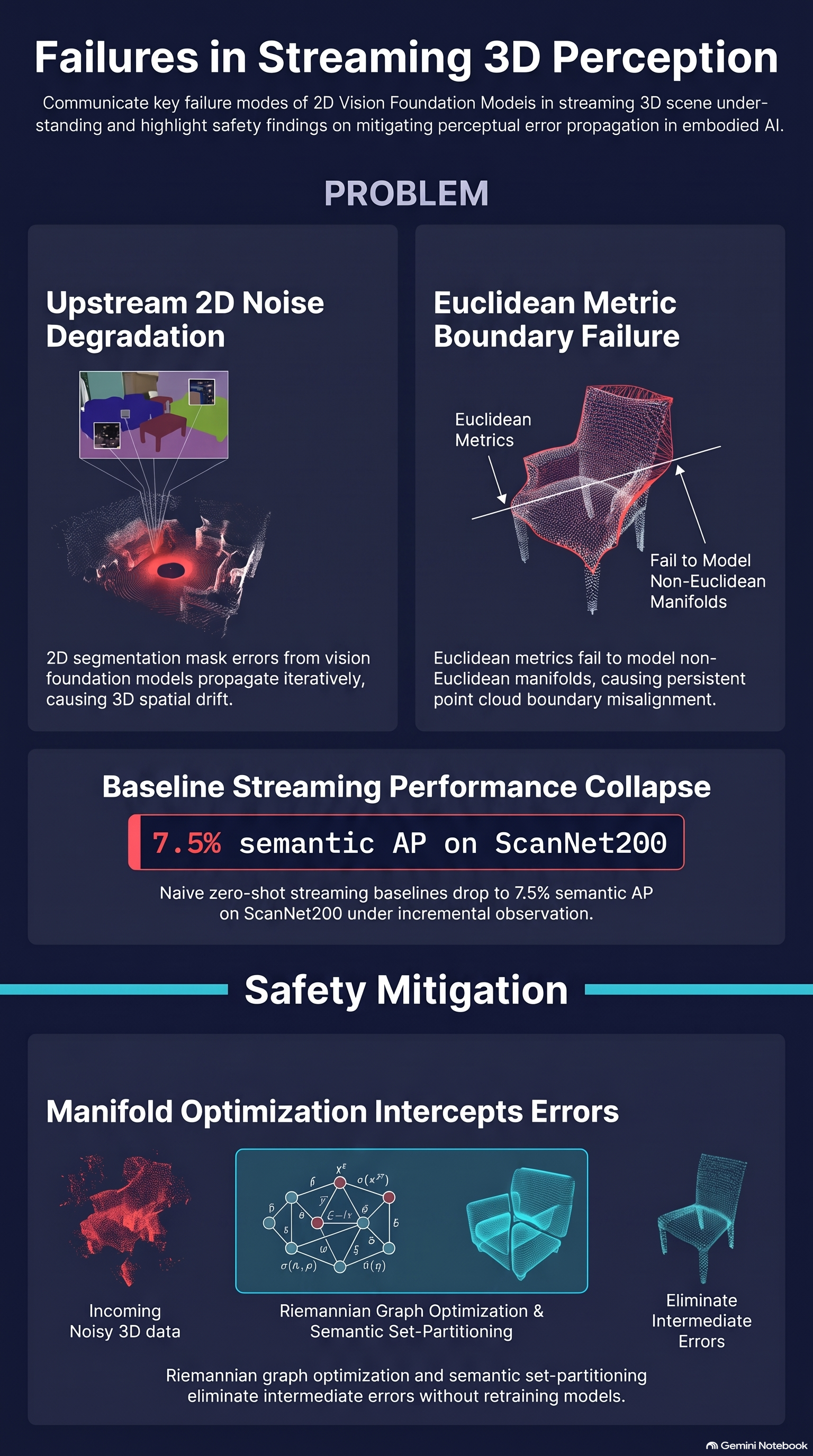
1. Introduction: Perceptual Failure Propagation in Embodied AI
In physical AI agents and autonomous robotics, streaming 3D perception serves as a critical foundation for spatial understanding, navigation, and object manipulation. When vision foundation models (VFMs)—such as SAM, SAM2, Cropformer, or SAM3—are deployed to parse sequential RGB-D video feeds, 2D segmentation masks are projected directly into 3D point cloud space. However, real-world streaming environments expose these systems to a severe vulnerability known as perceptual failure propagation.
Because 2D segmentation models operate on individual frames without full-sequence geometric awareness, inherent task discrepancies and depth mismatches generate noisy, imperfect 2D instance masks. In an offline setting, these errors can sometimes be mitigated using global multi-view optimization across an entire recorded dataset. In an online, streaming setting, however, point clouds accumulate incrementally. Upstream 2D mask errors, boundary bleed, and projection noise propagate directly into the persistent 3D spatial memory. Left uncorrected, minor high-frequency mask errors corrupt downstream instance boundaries, leading to cumulative failure loops in spatial reasoning, obstacle identification, and agent interaction.
Reporting on this research, Failure First highlights how researchers Jie Xu and Na Zhao address these fundamental vulnerabilities in their paper, Stream3Dv2: Geometric-Semantic Fusion Enhanced Streaming Zero-Shot 3D Scene Understanding. Stream3Dv2 is a training-free, zero-shot framework designed to eliminate upstream VFM mask noise and enforce boundary consistency while maintaining low streaming latency.
2. The Core Challenge: Why 2D Foundation Models Fail in Streaming 3D
Deploying 2D VFMs for streaming zero-shot 3D scene understanding introduces two primary technical bottlenecks: dynamic computational overhead as scenes scale, and extreme sensitivity to intermediate mask noise.
Standard zero-shot 3D perception pipelines operate in an offline, full-sequence mode (). These algorithms require prior access to the complete 3D scene point cloud across all frames to calculate cross-frame instance consistency:
Attempting to deploy offline methods in real-time streaming contexts () by repeatedly executing a full-sequence model on each newly arrived frame alongside accumulated historical data causes latency to scale rapidly. As the accumulated historical point cloud expands, memory consumption and model inference costs exceed real-time operational thresholds.
Simultaneously, zero-shot 3D perception is vulnerable to noise when converting 2D VFM outputs into 3D representations. The authors observe that different 2D prompting paradigms suffer from distinct structural vulnerabilities:
- Grid-Prompted Segmentation (e.g., SAM2) provides comprehensive scene coverage by densely sampling points across the image grid. However, these masks are class-agnostic, coarse, and highly prone to severe over-segmentation and geometric noise.
- Semantic-Prompted Segmentation (e.g., SAM3) utilizes explicit text prompts to identify specific object classes. While these masks offer precise instance boundaries and class labels, they suffer from low overall scene coverage and semantic ambiguity across changing camera views.
- Naive Intersection attempts to merge grid and semantic masks by finding their spatial intersections. This simple heuristic fails because boundary mismatches between coarse grid masks and incomplete semantic masks cause severe error propagation, dropping valid instance points due to projection discrepancies.
| Mask Type | Strengths | Vulnerabilities / Failure Modes |
|---|---|---|
| Grid-Prompted | High scene coverage; captures all potential objects rapidly. | Class-agnostic; coarse; high rate of over-segmentation and geometric noise. |
| Semantic-Prompted | Precise instance boundaries; provides explicit category labels. | Low scene coverage; constrained by prompt vocabularies; semantic ambiguity across views. |
| Naive Intersection | Simple computational implementation. | Severe error propagation; drops valid instance points due to 2D-3D projection mismatches. |
3. Stream3Dv2 Architecture: A Nested Local-to-Historical Pipeline
To mitigate perceptual failure propagation without incurring dynamic computational overhead, Xu and Zhao decompose full-sequence zero-shot 3D segmentation into a nested architecture composed of two sub-tasks: local multi-view 3D segmentation () and local-to-historical temporal propagation ():
Stream3Dv2 maintains a sliding window of recent RGB-D frames (). By restricting multi-view consistency optimization strictly to this local temporal window, the framework bounds local computational complexity while maintaining temporal continuity.
3.1. Local Multi-View Geometric-Semantic Fusion
Within the local -frame window, Stream3Dv2 executes a three-stage fusion pipeline to eliminate noise and resolve semantic ambiguity prior to global updating:
- Geometry-Based Single-View Denoising: For every 3D mask back-projected from individual frames, the paper enforces strict spatial Euclidean distance constraints () to purify point sets: The first condition enforces intra-instance continuity, requiring points within a single mask to form a continuous spatial manifold. The second condition enforces inter-instance separation, discarding unattached boundary points between distinct masks and generated by depth projection errors.
- SCP-Based Multi-View Noise Filtering & Key Mask Merging: Accumulating frames generates a redundant, highly overlapping set of 3D class-agnostic masks . The authors apply Farthest Point Sampling (FPS) at a key point rate of on the local point cloud to extract key points . They then formulate a Set Covering Problem (SCP) to select the minimal subset of key masks required to cover all key points: After filtering redundant masks via SCP, an Intersection over Union (IoU) reachability matrix (using an overlap threshold ) merges connected mask components into unified coarse-grained class-agnostic masks .
- Semantic-Driven Mask Partitioning (SPP): To resolve over-segmentation and semantic ambiguity, coarse masks are integrated with semantic-prompted masks . Instead of relying on high-dimensional soft feature comparisons that require manual threshold tuning, the framework codes hard semantics explicitly into an integer linear optimization problem. The authors formulate a Set Partitioning Problem (SPP) maximizing an objective function : Here, binary variable splits a coarse-grained mask into smaller, precise semantic sub-parts , encouraged by a decomposition bonus factor . Binary variable captures valid semantic masks that represent newly observed, isolated instances.
3.2. Manifold-Aware Point Cloud Refinement
Euclidean distance metrics systematically fail at non-Euclidean boundary structures (e.g., thin chair legs or curved counter edges), causing points to be incorrectly assigned across narrow physical gaps. Stream3Dv2 replaces standard Euclidean metrics with a point-to-manifold graph optimization process.
+-------------------------------------------------------------------+
|                  Local Point Cloud (Unassigned Points U)          |
+-------------------------------------------------------------------+
                                  |
                                  v
+-------------------------------------------------------------------+
|               Super-Point Voxelization Graph G = (V, E)           |
|     Calculate Centroid c_v and Regularized Covariance Sigma_v     |
+-------------------------------------------------------------------+
                                  |
                                  v
+-------------------------------------------------------------------+
|              Compute Symmetric Mahalanobis Edge Weights           |
|            d_M penalizes off-surface tangential movement          |
+-------------------------------------------------------------------+
                                  |
                                  v
+-------------------------------------------------------------------+
|          Solve Discrete Anisotropic Eikonal Equation              |
|        Wavefront propagation of C geodesic distance fields        |
+-------------------------------------------------------------------+
                                  |
                                  v
+-------------------------------------------------------------------+
|           Iterative Bellman Relaxation (R = 5 Iterations)         |
|     Assign points to mask with minimal accumulated geodesic cost  |
+-------------------------------------------------------------------+- Super-Point Graph Construction: The local scene point cloud is voxelized into a super-point graph . Each node represents a point cluster characterized by its spatial centroid and a regularized covariance matrix: where maintains positive definiteness across planar or degenerate point configurations.
- Symmetric Mahalanobis Metric: Edges between adjacent nodes are weighted using the symmetric Mahalanobis distance metric : where represents the local Riemannian metric tensor. This metric assigns high costs to displacements normal to the local surface while permitting inexpensive motion along the tangential plane.
- Anisotropic Eikonal Front Propagation: Point assignment is modeled as a competitive wave propagation process governed by the discrete anisotropic Eikonal equation. Each candidate mask acts as a seed source field : Using an Iterative Bellman Relaxation scheme over iterations, the coupled geodesic fields propagate across graph nodes. Unassigned surface points inherit the node label of the mask front that reaches their super-point with the lowest accumulated geodesic cost.
3.3. Local-to-Historical Dynamic Merging & Updating
Once local multi-view masks are refined, they are incrementally merged into the global historical mask pool .
To avoid exhaustive point-by-point comparisons against all historical data, the authors compute Axis-Aligned Bounding Boxes (AABBs) for every instance: Spatial grid indexing enables constant-time lookups to isolate candidate historical instances whose bounding boxes intersect with local mask . Historical instances within this candidate pool are dynamically categorized into operational sets: If a local mask shares no spatial intersections with candidate historical AABBs (), it is cataloged as a newly detected instance . For overlapping dynamic instances, Stream3Dv2 merges the local mask into the historical instance with the largest point intersection while removing intersecting points from secondary overlapping masks to maintain strict inter-instance separation boundaries.
4. Empirical Evaluation and Key Performance Metrics
Xu and Zhao evaluated Stream3Dv2 across three standard indoor 3D perception benchmarks: ScanNet200, ScanNet++, and MatterPort3D. Evaluation metrics include Average Precision (), , and across both class-agnostic and semantic segmentation tasks.
The experimental results reported by the authors demonstrate that Stream3Dv2 consistently achieves high performance, outperforming offline, full-sequence zero-shot baselines despite operating under strict streaming conditions.
| Method | ST | ZS | ScanNet200 (Class-Ag. / Sem. AP) | ScanNet++ (Class-Ag. / Sem. AP) | MatterPort3D (Class-Ag. / Sem. AP) |
|---|---|---|---|---|---|
| Mask3D | ✗ | ✗ | 39.7 / 26.9 | 22.8 / 3.6 | 4.4 / 2.5 |
| OVIR-3D | ✗ | ✓ | 14.4 / 9.3 | 19.4 / 3.6 | 4.4 / 4.6 |
| MaskClustering | ✗ | ✓ | 19.7 / 12.0 | 24.6 / 7.8 | 8.3 / 9.2 |
| MV3DIS | ✗ | ✓ | 35.5 / 15.5 | 22.0 / – | – / – |
| Stream3D (baseline) | ✓ | ✓ | 22.4 / 13.0 | 24.7 / 6.6 | 8.7 / 6.4 |
| Stream3Dv2 (reported) | ✓ | ✓ | 27.1 / 20.6 | 27.4 / 13.5 | 12.5 / 12.3 |
Note: ST denotes Streaming execution; ZS denotes Zero-Shot execution.
Key Performance Gains:
- Semantic Segmentation Superiority: On the ScanNet200 benchmark, Stream3Dv2 achieved 20.6% semantic AP, outperforming the offline zero-shot baseline MV3DIS (15.5% AP), as well as streaming adaptations of offline models such as OVIR-3D+Loc2his (8.5% AP) and MaskClustering+Loc2his (7.5% AP).
- Per-Class Improvements: Detailed evaluations across ScanNet200’s primary classes show substantial gains over earlier architectures. For example, Stream3Dv2 achieved a 38.3% average across key indoor object classes—a net improvement of +18.1% over Stream3D (20.2%) and +19.6% over MaskClustering (18.7%).
- Execution Latency: Deployed across 4 NVIDIA GeForce RTX 4090 GPUs, Stream3Dv2 maintained stable local execution latencies below 100 ms per frame, processing streaming inputs at approximately 11 Frames Per Second (FPS).
- Open-Vocabulary 3D Object Detection: Beyond instance segmentation, the authors evaluated Stream3Dv2 on ScanNet200 open-vocabulary 3D object detection, where it recorded an of 14.2% and an of 24.8%, outperforming zero-shot full-sequence baselines such as Zoo3D0 (14.1% / 21.1% ).
5. Downstream Integration: Language-Driven Embodied Agents
To demonstrate the real-world utility of Stream3Dv2 in physical systems, the authors integrated the framework with Large Language Model (LLM)-driven autonomous agents using Codex (v0.142.0) and GPT-5.5.
Raw RGB-D Stream ===> Stream3Dv2 Engine ===> Object-Centric Units ===> LLM Agent (GPT-5.5 / Codex)
                       (Denoise & Refine)   (Geometric & Semantic)   |-- Visual Grounding
                                                                     |-- Spatial Reasoning
                                                                     \-- Path Navigation
In embodied agent deployments, passing unstructured, noisy streaming point clouds directly into high-level planners causes task execution failure. Upstream perceptual errors produce phantom objects or distorted boundaries, trapping language agents in incorrect reasoning loops.
Stream3Dv2 acts as a robust perceptual front-end by converting raw, sequential RGB-D data into clean, object-centric unit representations containing precise 3D bounding boxes, manifold-refined spatial boundaries, and explicit semantic tags. When tested on complex multi-step embodied tasks—such as Task#1 (picking ingredients in the refrigerator and placing them on the kitchen counter) and Task#2 (clearing the table and dropping trash into the nearest trash can to the TV)—the integrated LLM agent successfully performed:
- Language-Directed Visual Grounding: Accurately mapping textual queries (
refrigerator,kitchen counter,table,trash can,TV) to localized 3D instance masks without boundary spillover. - Spatial Reasoning: Correctly evaluating spatial context (e.g., assessing whether the TV in the scene is turned on by distinguishing surface reflections on an inactive screen from active display content).
- Path Navigation: Generating collision-free trajectories to physical interaction targets based on stable, incrementally updated AABB instance bounds.
6. Key Takeaways for AI Safety and System Red-Teamers
For AI safety researchers, vulnerability analysts, and red-teamers evaluating spatial failure modes in autonomous agents, the structural mechanisms highlighted in Stream3Dv2 offer four central takeaways:
- Upstream Denoising is Essential: 2D vision foundation mask noise must be filtered locally before spatial lifting to prevent permanent 3D memory corruption. Relying on downstream planners to resolve unrefined upstream perceptual errors leads to severe failure propagation.
- Manifold vs. Euclidean Metrics: Euclidean distance metrics systematically fail at spatial boundaries. Integrating manifold-aware Riemannian graph metrics () is necessary to penalize off-surface drift and prevent boundary failure propagation across non-Euclidean surfaces.
- Explicit Hard Semantics over Soft Features: Replacing high-dimensional soft semantic similarity computations with explicit hard-semantic set-partitioning (SPP) eliminates semantic ambiguity with minimal latency, removing the need for fragile manual distance thresholds.
- Scalable Real-Time Execution: Decomposing global operations into nested local-to-historical bounding box updates maintains bounded computation (<100ms latency), making zero-shot perception viable for real-time safety-critical agents.
Read the full paper on arXiv · PDF