SCAPE: Scenario-Conditioned Simulation-Augmented Policy Evaluation
The authors introduce SCAPE, a policy evaluation framework that predicts scenario-conditioned real-world robot performance by correcting sim-to-real bias in simulation rollouts using limited real
1. The Blind Spot of Population Averages in Robot Evaluation
Evaluating learned control policies for physical robots remains a fundamental bottleneck for trustworthy real-world deployment. To certify safety in complex environments, autonomous systems must be thoroughly evaluated across diverse operational conditions, including rare and long-tailed edge cases. Robotics practitioners face a challenging trade-off between two primary evaluation paradigms:
- Physical Real-World Testing: While physical rollouts generate faithful performance metrics, real-world testing is expensive, labor-intensive, slow, and potentially hazardous when operating near humans or probing extreme operational limits.
- Simulation-Based Testing: Simulation enables rapid, highly scalable rollouts across thousands of synthetic environments. However, simulators suffer from an inevitable “sim-to-real gap”—residual discrepancies in dynamics, contact physics, visual features, or agent interactions that introduce systematic bias into simulation metrics.
To bridge this gap, classical evaluation frameworks utilize simulation-augmented estimation, combining limited real-world test samples with abundant simulation rollouts. However, standard policy evaluation methods calculate aggregate performance metrics averaged over broad populations of deployment settings.
Core Evaluation Dilemma
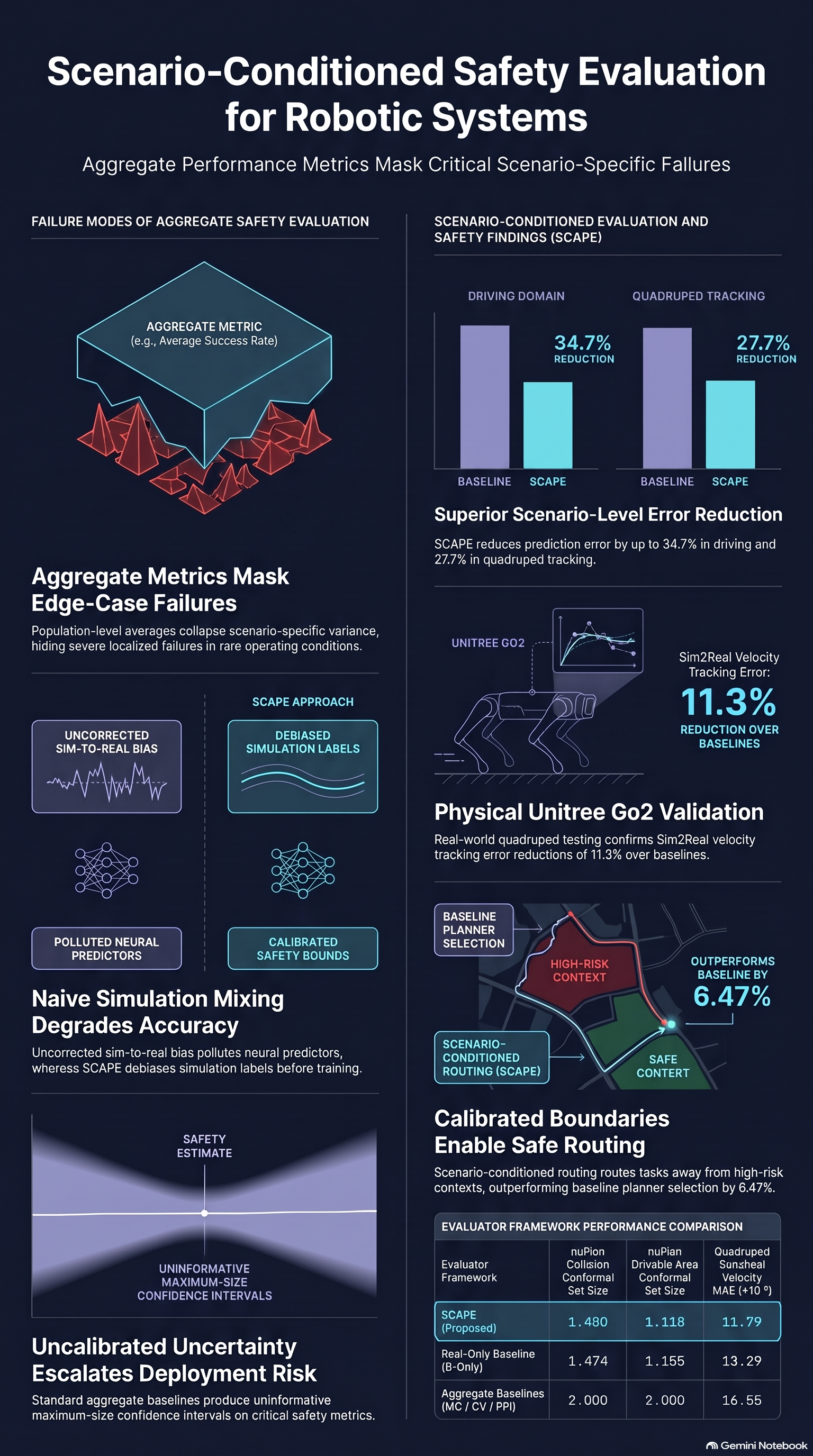
Standard population-level averages collapse scenario-specific variation into a single global score. A robot policy may exhibit high average performance across an entire dataset while simultaneously harboring severe, localized failures in specific environmental scenarios. Relying on aggregate metrics hides these unsafe operational boundaries, providing inadequate safety guidance and forcing developers either to delay deployment until average scores are near-perfect or to deploy blindly into unmapped risk zones.
To address these safety blind spots, Dijie Zhu, Seunghun Oh, Ruopeng Huang, Zhiyu Huang, Jiaqi Ma, and Chen Tang (researchers from the University of California, Los Angeles, Seoul National University, University of Southern California, and North Carolina State University) introduced SCAPE (Scenario-Conditioned Augmented Policy Evaluation). SCAPE moves beyond population averages by predicting real-world robot performance conditioned on specific scene contexts, leveraging limited paired simulation-and-real samples alongside large-scale simulation rollouts, and calibrating prediction uncertainty via conformal prediction.
2. Architecture of SCAPE: Scenario-Conditioned Debiasing & Uncertainty Calibration
The SCAPE framework is built around a two-step “correction-before-augmentation” prediction pipeline adapted from AI-augmented estimation (AAE) principles, combined with a model-free split conformal prediction mechanism.
       +-------------------------------------------------------+
       |                  Paired Data (Dp)                     |
       |             {(x_i, r_i, s_i)} for i=1..n              |
       +---------------------------+---------------------------+
                                   |
                                   v
       +-------------------------------------------------------+
       |             Stage 1: Simulation Correction            |
       |       Train g_phi(x, s) to estimate E[R | X=x, S=s]   |
       +---------------------------+---------------------------+
                                   |
                                   v (Apply g_phi to Ds)
       +-------------------------------------------------------+
       |             Simulation-Only Data (Ds)                 |
       |       Generate Pseudo-Labels: r~_k = g_phi(x_k, s_k)   |
       +---------------------------+---------------------------+
                                   |
                                   v
       +-------------------------------------------------------+
       |             Stage 2: Performance Prediction           |
       |  Train f_theta(x) on D_aug = D_p^R U D_pseudo         |
       |  where D_p^R = {(x_i, r_i)} and D_pseudo = {(x_k, r~_k)}|
       |  Target: E[R | X=x] (Scene Context x Input Only)      |
       +---------------------------+---------------------------+
                                   |
                                   v
       +-------------------------------------------------------+
       |              Stage 3: Conformal Calibration           |
       |  Compute residuals e_j on Calibration Data Set (Dc)   |
       |  Construct Calibrated Interval C_alpha(x)             |
       +-------------------------------------------------------+
2.1 Problem Formalization & Data Inputs
SCAPE formalizes policy evaluation over a scenario domain , where a scenario encapsulates scene context and initial conditions. Evaluation tracks two performance metrics per scenario:
- : The trusted but expensive real-world performance metric (continuous or binary).
- : The low-cost but biased simulation surrogate metric.
Evaluating a policy in both physical and simulated environments on the same scenario yields a paired sample , whereas evaluating in simulation alone yields a simulation-only sample . The framework partitions available evaluation data into three disjoint datasets under the sample size relationship :
| Dataset Symbol & Constraints | Source, Structure & Role in SCAPE |
|---|---|
(Small sample size ) | Paired Training Set: Contains paired real-world rollouts and simulation surrogate rollouts under scene context . Used exclusively to train the scenario-conditioned bias correction model . For Stage 2 evaluator training, its restriction to real target labels is denoted as . |
(Abundant sample size ) | Simulation-Only Set: Contains large-scale simulation rollouts with surrogate metrics . Relabeled by to generate corrected pseudo-labels , yielding the debiased augmented set . |
(Moderate sample size ) | Held-Out Calibration Set: Disjoint paired evaluation samples used to calculate empirical calibration residuals for split conformal prediction, ensuring finite-sample coverage guarantees. |
Scenario Context Representation ()
To capture fine-grained operational variations, SCAPE represents scene context through task-specific representations:
- Autonomous Driving (nuPlan): The scenario context is a fixed 256-dimensional feature vector extracted by a frozen UrbanDriver global attention encoder. The encoder processes raw input polylines, including ego-vehicle motion history , nearby agent trajectories with dynamic states , 4-dimensional one-hot traffic light states, and local vector map elements (lanes, crosswalks, stop lines). Local polyline descriptors are mapped to and aggregated via global attention using an ego query into .
- Quadruped Locomotion (Unitree Go2): In simulation testing (Sim2Sim), consists of an 80-dimensional local terrain elevation crop ( grid over longitudinally and laterally at resolution) concatenated with 2-dimensional planar velocity commands . In real-world physical testing (Sim2Real), consists of a 44-dimensional terrain elevation crop ( raycast grid matching onboard physical sensors) concatenated with 2-dimensional velocity commands and a 5-dimensional one-hot terrain scene identifier (indoor, grass, dirt, dirt1, brick).
2.2 Two-Stage Prediction Pipeline
Directly mixing biased simulation outputs with real-world target labels corrupts neural network training. SCAPE avoids this by decoupling bias correction from performance prediction:
- Stage 1 (Simulation Correction): The authors train a correction model on the paired set to estimate the expected real-world performance given both scene context and surrogate metric : Conditioning on scene context allows to adjust for sim-to-real gaps dynamically across different environmental conditions, rather than applying a naive global offset or unconditioned mixing. The trained correction model is then applied to every simulation-only sample to generate corrected pseudo-labels , forming the augmented dataset .
- Stage 2 (Performance Prediction): The final neural evaluator is trained on the augmented dataset by minimizing a weighted empirical loss: where denotes mean squared error (MSE) for continuous metrics or binary cross-entropy (BCE) for discrete metrics. In all primary experiments, the authors set , giving equal weight to physical target labels and debiased pseudo-labels. Crucially, takes only the scenario context as input. At deployment time, SCAPE predicts real-world performance directly from environmental features without requiring simulator access.
2.3 Uncertainty Quantification via Conformal Prediction
To equip predictions with sound safety guarantees, SCAPE applies split conformal prediction on the held-out calibration set :
- For continuous metrics, SCAPE computes absolute calibration residuals for each calibration sample.
- The empirical quantile is calculated at a target miscoverage level .
- For any unseen test scenario , SCAPE outputs a calibrated prediction region .
Under scenario exchangeability, this model-free procedure guarantees finite-sample marginal coverage: While split conformal prediction produces a scenario-invariant interval half-width , the interval center tracks localized performance variations across scenarios. This allows developers to classify individual scenarios as safe for deployment, unsafe, or requiring additional physical testing.
3. Empirical Results: Sim2Sim and Physical Sim2Real Evaluation
Zhu et al. evaluated SCAPE across two embodied task domains: Autonomous Driving (nuPlan benchmark) and Quadruped Velocity Tracking (Unitree Go2 platform).
3.1 Experimental Setup & Evaluation Tasks
- nuPlan Autonomous Driving: Evaluated three ML-based planners—UrbanDriver (Open-Loop), Vector, and Simple Vector—across 62 scenario types in Singapore, Boston, Las Vegas, and Pittsburgh. Evaluated metrics include Average Displacement Error (, continuous regression), Time-To-Collision under 1 second (, binary), Drivable Area Compliance (, binary), and No At-Fault Collision (, binary). The surrogate metric is obtained via fast open-loop evaluation with non-reactive agents, while the target metric comes from closed-loop evaluation with reactive agents.
- Quadruped Velocity Tracking: Evaluated an RL-trained policy tracking planar velocity commands () and yaw rate commands (). Evaluated metrics include linear velocity error () and yaw rate error (). In Sim2Sim, comes from a nominal simulator and from a simulator with randomized dynamics and external forces. In Sim2Real, is measured on physical Unitree Go2 hardware across 5 real-world terrain environments, while is collected from reconstructed simulation rollouts aligned via HLoc and SuperGlue.
3.2 Comparative Performance vs. Baselines
To evaluate SCAPE, the authors compared it against two distinct families of baseline methods across identical data budgets:
| Baseline Family | Specific Methods | Structural Features & Input Information | Sim-to-Real Bias Treatment | Target Output & Uncertainty Quantification |
|---|---|---|---|---|
| Aggregate Statistical Baselines | Monte Carlo (MC) Control Variates (CV) Prediction-Powered Inference (PPI) | Does not condition on scenario context . Uses scalar real metrics and surrogate metrics . | MC ignores simulation. CV and PPI use paired samples to estimate global scalar bias corrections. | Outputs a single population-wide average score . Uncertainty is quantified via asymptotic confidence intervals around the population mean. |
| Scenario-Conditioned Neural Baselines | Real-Only (R-Only) Naive Real-Sim Mix (RS-Mix) PPI Neural Network (PPI-NN) | Neural network taking scene context as input. Trained directly on real labels, mixed labels, or via rectified PPI loss objectives. | R-Only ignores simulation. RS-Mix ignores sim bias. PPI-NN subtracts surrogate losses during gradient updates. | Outputs per-scenario point predictions . Evaluated with split conformal prediction to yield prediction intervals. |
| SCAPE (Proposed) | SCAPE | Two-stage pipeline: correction model feeds debiased pseudo-labels to neural predictor . | Decouples scenario-conditioned bias correction () from target prediction (). | Outputs scenario-conditioned predictions with calibrated conformal prediction regions . |
Across all evaluated planners and task settings, SCAPE demonstrated consistent empirical improvements over existing methods:
- Autonomous Driving (nuPlan Sim2Sim): SCAPE achieved an average scenario-level prediction error reduction of 4.9% relative to scenario-conditioned neural baselines (R-Only, RS-Mix, PPI-NN) and 34.7% relative to aggregate statistical baselines (MC, CV, PPI).
- Quadruped Locomotion (Go2 Sim2Sim): SCAPE achieved an average prediction error reduction of 14.5% relative to scenario-conditioned neural baselines and 27.7% relative to aggregate statistical baselines.
- Physical Sim2Real Deployment (Unitree Go2): In real-world physical testing across 5 terrain types (indoor, grass, dirt, dirt1, brick), SCAPE outperformed all baseline methods, achieving a 11.3% error reduction on ( vs. for R-Only) and an 8.7% error reduction on ( vs. for R-Only).
3.3 Sample Efficiency & Conformal Interval Widths
By converting low-cost simulation rollouts into debiased supervision, SCAPE matched full-budget baseline performance while requiring substantially fewer physical labels:
- nuPlan Driving: Required 20% to 60% fewer paired labels to match full-budget baseline accuracy.
- Quadruped Locomotion: Required 10% to 60% fewer paired labels to match full-budget baseline accuracy.
Furthermore, when evaluated at a nominal coverage level of , SCAPE consistently produced the narrowest calibrated prediction intervals. For example, on the nuPlan UrbanDriver task, SCAPE achieved an interval length of (at paired data fraction), compared to for R-Only, for PPI-NN, for RS-Mix, and over for aggregate statistical baselines (MC, CV, PPI).
For discrete binary metrics (, , ), conformal prediction outputs a discrete prediction set . An average set size of represents a decisive, unambiguous prediction (yielding either or ), whereas an average set size of represents complete uninformative uncertainty (returning the uninformative set ). On nuPlan UrbanDriver , SCAPE produced an average prediction set size of , whereas aggregate statistical baselines yielded an uninformative set size of across all scenarios.
4. Advanced Capabilities: Out-of-Distribution Generalization & Fine-Grained Deployment
The scenario-conditioned modeling enabled by SCAPE unlocks operational capabilities that population-average frameworks cannot provide.
- Scaling with Low-Cost Surrogate Data:
When scaling the volume of unlabelled simulation data () under a fixed paired-label budget (), naive methods such as RS-Mix quickly degrade because uncorrected simulation bias pollutes neural network training. Methods like PPI-NN also struggle during non-convex neural network optimization: subtractive gradient corrections calculated from limited paired data introduce high-variance, conflicting gradient updates that destabilize SGD. In contrast, SCAPE steadily improves as surrogate data scales because its two-stage architecture decouples scenario-conditioned correction () from evaluator training (), converting raw simulation data into target-aligned pseudo-labels. - Out-of-Distribution (OOD) Bootstrapping:
To test generalization under distribution shifts, the authors performed city-level holdout experiments in nuPlan, removing all paired physical training data from an entire target city (e.g., Boston or Las Vegas). Without any OOD surrogate data, SCAPE’s base model outperformed scenario-conditioned neural baselines by 3.3%. Incorporating un-labelled surrogate simulation rollouts from the held-out OOD city further reduced prediction loss by 4.8%, recovering 95.3% of full-training performance and expanding SCAPE’s advantage over scenario-conditioned baselines to 5.3%. - Evaluator-Guided Planner Selection:
Instead of selecting a single global control policy based on average population scores, SCAPE can function as a scenario-conditioned router to dispatch the optimal planner for each specific scene context. When routing between nuPlan planners (UrbanDriver, Vector, Simple Vector), SCAPE achieved the highest selection accuracy and best selected performance across all four metrics. It improved operational performance by 1.67% over scenario-conditioned baselines and 6.47% over aggregate-mean baselines, preventing rare scenario-specific failures that aggregate evaluators mask.
5. Key Takeaways and Failure-First Safety Implications
For AI safety researchers, red-teamers, and robotics practitioners, SCAPE provides a practical methodology for mapping unsafe operational domains before physical hardware is deployed. Replacing population averages with scenario-conditioned predictions bound by calibrated uncertainty intervals allows safety teams to identify localized edge cases and bound sim-to-real transfer risk.
Current Limitations Acknowledged by the Authors
- Scenario-Invariant Conformal Width: SCAPE currently employs split conformal prediction, which produces a scenario-invariant interval half-width () across the entire scenario space, rather than true conditional coverage with scenario-dependent interval widths.
- Scope of Physical Testing: Physical validation on the Unitree Go2 was conducted across 5 distinct terrain types, but broader evaluations across diverse robotic form factors, dynamic manipulation tasks, and complex multi-agent interactions remain open for future work.
- Theoretical Analysis: While SCAPE demonstrates strong empirical performance across driving and locomotion benchmarks, formal theoretical convergence bounds for non-convex neural scenario-conditioned debiasing remain a topic for future study.
Core Technical Summary
- Beyond Population Averages: Standard aggregate metrics hide localized scenario-specific failures; SCAPE predicts real-world policy performance conditioned on specific scene contexts ().
- Correction-Before-Augmentation: SCAPE avoids training corruption from sim-to-real bias by first training a scenario-conditioned correction model on paired data, then supervising the neural evaluator with debiased pseudo-labels.
- Deployment Efficiency: The final evaluator operates strictly on environmental scene context features, eliminating the need for simulator access during real-world deployment.
- Empirical Performance: SCAPE reduces scenario-level prediction error by up to 34.7% in autonomous driving and 27.7% in quadruped locomotion, while achieving superior sample efficiency (requiring 10%–60% fewer real-world paired samples).
- Actionable Safety Guidance: Combining point predictions with split conformal prediction intervals provides distribution-free coverage guarantees, enabling evaluator-guided policy routing and out-of-distribution performance estimation.
Read the full paper on arXiv · PDF