OmniHandwritingOCR: A Diagnostic Benchmark for Evaluating Multimodal LLMs in Handwritten OCR Scenarios
The paper introduces OmniHandwritingOCR, a diagnostic benchmark comprising 77.57K labeled images across twelve subsets to evaluate multimodal large language models on handwritten text and complex
1. Introduction: The Hidden Failure Mode in Generative OCR
The rapid deployment of Multimodal Large Language Models (MLLMs) as Optical Character Recognition (OCR) engines has fundamentally altered enterprise document processing and Retrieval-Augmented Generation (RAG) pipelines. While state-of-the-art vision-language architectures exhibit high accuracy when parsing clean, standardized printed text, their operational reliability across unconstrained, real-world handwritten documents remains highly vulnerable. Authentic handwriting introduces severe perceptual stressors, including stroke degradation, non-linear spatial alignment, multi-line mathematical derivations, and native writer errors. In these noisy environments, the visual-grounding boundaries of generative models present under-explored risks for automated systems.
To systematically expose and analyze these vulnerabilities, Guo et al. (CIKM 2026) introduced OmniHandwritingOCR: A Diagnostic Benchmark for Evaluating Multimodal LLMs in Handwritten OCR Scenarios. The authors engineered a comprehensive diagnostic testbed designed to stress-test multimodal architectures across diverse linguistic, structural, and visual conditions.
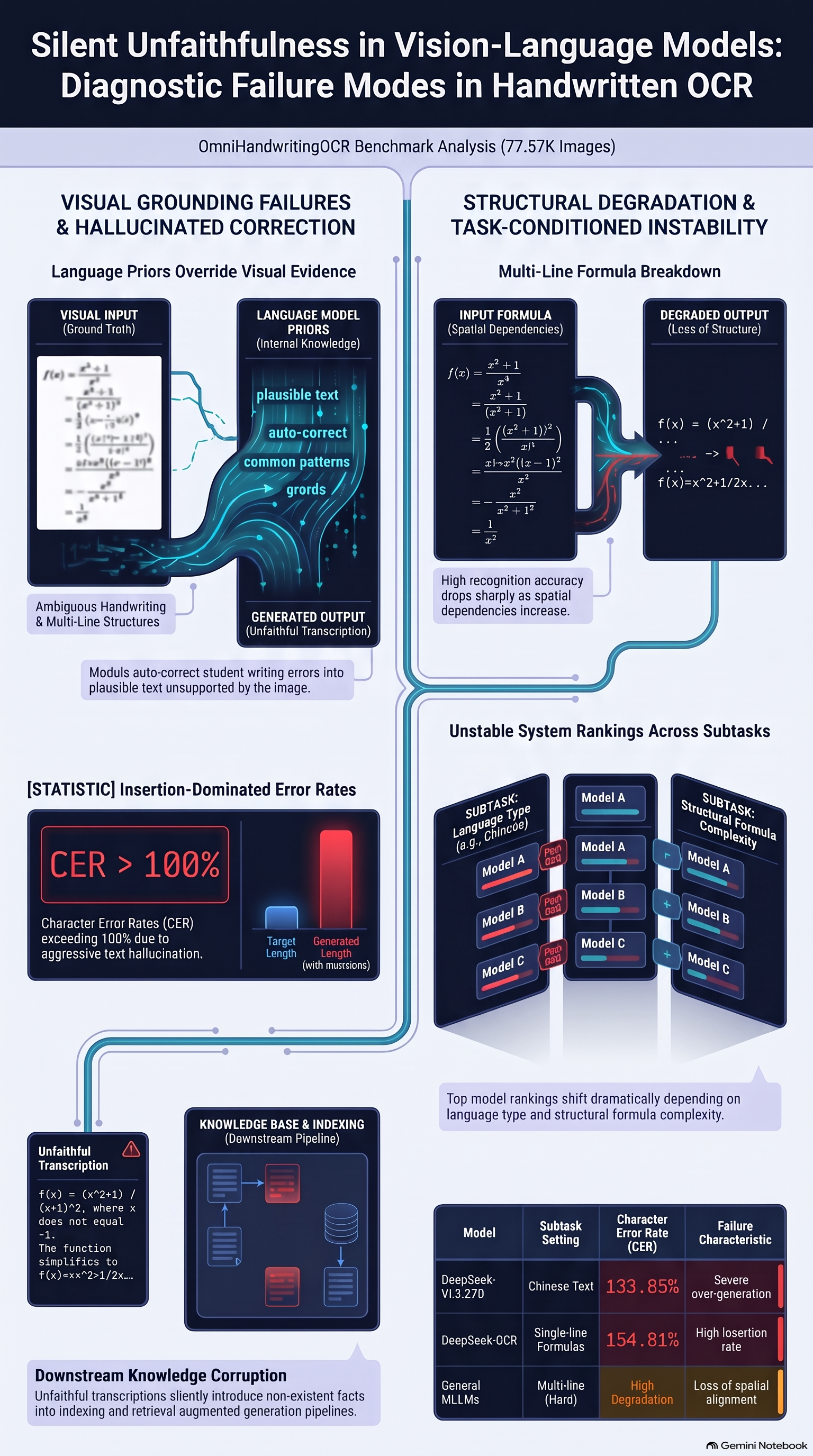
The central diagnostic finding of the paper uncovers a covert “visual-grounding failure” or “unfaithfulness” mode inherent to generative vision-language models. When confronted with ambiguous handwriting, complex derivations, or explicit human errors, MLLMs routinely abandon perceptual ground truth. Rather than transcribing raw visual evidence, generative models leverage strong implicit language and mathematical priors to hallucinate plausible, mathematically valid corrections. From a red-teaming and AI safety perspective, this behavior represents a dangerous failure mode: the resulting OCR output appears syntactically perfect and contextually coherent while actively misrepresenting the physical source image.
2. The OmniHandwritingOCR Benchmark: Design and Data Composition
Guo et al. structured OmniHandwritingOCR to move beyond high-level aggregate OCR metrics by evaluating models across granular structural and content dimensions.
Scale & Scope
The benchmark comprises 77,572 (77.57K) labeled image-label pairs partitioned into 6 subtasks and 12 subsets. It spans two core recognition domains: Handwritten Text Recognition (HTR) and Handwritten Mathematical Expression Recognition (HMER).
Data Sourcing & Filtering Mechanics
The benchmark combines aggregated public benchmarks with a newly collected corpus of authentic student handwriting:
- Public Data Aggregation & Challenge-Oriented Filtering: Sourced from IAM-line and GNHK for English text; CASIA-HWDB for Chinese text; and CROHME, HME100K, MLHME, and CC-OCR for mathematical expressions. To prevent benchmark saturation on trivial samples, Guo et al. implemented a challenge-oriented filtering strategy: using Qwen2.5-VL-72B to process an initial pool of approximately public samples, the authors calculated Normalized Edit Distance (NED) against ground-truth labels and discarded easily solved images, distilling the corpus to high-difficulty, high-diagnostic-value public samples.
- Private Educational Collection & Solution Segmentation: Contains 31,396 total samples, including 874 multi-line Chinese student compositions and a novel corpus of handwritten mathematics derived from over 6,000 authentic student answer sheets. The authors initially extracted segmented images from these answer sheets, filtering them to retain core multi-line solution sections (totaling 30,522 final private math samples across easy, medium, and hard subsets). This corpus captures authentic, noisy problem-solving layouts omitted by traditional single-line formula benchmarks.
Fact-Based Annotation Policy
The annotation process engaged over 50 domain experts across a two-month period, enforcing a strict fact-based annotation policy. For private samples, a two-round human checking workflow was implemented: expert annotators refined model pre-annotations in the first round, followed by a second round of expert review. Ambiguous visual cases were resolved by explicit inspection rather than majority voting to protect fine details such as superscripts and omitted strokes.
Crucially, Guo et al. mandated absolute fidelity to the writer’s visual output. Human mistakes—such as arithmetic errors, miscopied numbers, and spelling blunders—were preserved verbatim in the ground truth. Physical strike-throughs and crossed-out content were omitted entirely. This policy directly tests visual grounding, penalizing any model that attempts to “fix” or infer context beyond physical ink strokes.
Dataset Composition Breakdown
| Subtask | Source Datasets | Sample Count | Total per Subtask |
|---|---|---|---|
| English Text | GNHK IAM-line | 515 11,344 | 11,859 |
| Chinese Text | Private Compositions CASIA-HWDB | 874 11,655 | 12,529 |
| Single-line Formula | CROHME HME100K MLHME | 3,332 9,754 2,010 | 15,096 |
| Multi-line Formula (easy) | MLHME Private Math | 7,466 2,135 | 9,601 |
| Multi-line Formula (medium) | Private Math | 15,488 | 15,488 |
| Multi-line Formula (hard) | CC-OCR Private Math | 100 12,899 | 12,999 |
| Total | 77,572 |
Core Design Principles
- Task Comprehensiveness: Unifies HTR and HMER within a single diagnostic testbed to mirror real-world documents containing mixed text and mathematical derivations.
- Difficulty-Aware Structure: Separates single-line expressions from multi-line derivations, stratifying the latter into explicit difficulty tiers to quantify performance degradation under spatial complexity.
- Fact-Based Annotation: Enforces strict preservation of raw visual evidence—including uncorrected writer errors—to expose generative over-correction and hallucinated text.
3. Comprehensive Evaluation: MLLMs vs. Specialized OCR Engines
Evaluated Baselines & Unified Protocol
Guo et al. evaluated 13 open- and closed-source baseline models zero-shot under a single, prompt-neutral instruction: “convert the text and formulas in the image into Markdown, and do not include any other content.”
The evaluation suite incorporates:
- 7 Multimodal LLMs (MLLMs): GPT-4o, Qwen2.5-VL-72B, InternVL3-78B, Gemma-3-27B-it, DeepSeek-VL2-27B, Kimi-VL-A3B-Instruct, and Qwen3-VL-8B.
- 6 Specialized OCR Models: MonkeyOCR-pro-1.2B, MinerU2.5-1.2B, Nanonets-OCR2-3B, GOT-OCR2, PaddleOCR-VL, and DeepSeek-OCR.
Metrics Framework & Safeguards
The benchmark computes 5 complementary metrics (reported as percentages):
- BLEU-4: Measures 4-gram overlap between output and ground truth.
- F1 Score: Token-level balance of precision and recall.
- 1-NED (Primary Metric): , rewarding exact character matches.
- CER (Character Error Rate): Character-level edit distance (lower is better).
- WER (Word Error Rate): Token-level edit distance (lower is better).
To calculate compound benchmark scores, Overall Accuracy (↑) is defined as the arithmetic mean of BLEU-4, F1, and 1-NED, while Overall Error (↓) is defined as the arithmetic mean of CER and WER.
Post-Processing Length Caps: To prevent infinite generation loops from skewing edit-distance metrics, model outputs are strictly capped at 128 characters for single-line formulas and 1,024 characters for all other subsets prior to metric computation.
Baseline Performance Analysis
| Model | Model Type | BLEU-4 ↑ | F1 Score ↑ | 1-NED ↑ | Overall Accuracy (↑) | CER ↓ | WER ↓ | Overall Error (↓) |
|---|---|---|---|---|---|---|---|---|
| Qwen3-VL-8B | MLLM | 59.24 | 81.60 | 75.63 | 72.16 | 30.94 | 32.94 | 31.94 |
| Kimi-VL-A3B-Instruct | MLLM | 58.75 | 78.90 | 73.58 | 70.41 | 38.20 | 45.28 | 41.74 |
| Qwen2.5-VL-72B | MLLM | 56.40 | 79.98 | 72.91 | 69.76 | 38.88 | 36.91 | 37.90 |
| InternVL3-78B | MLLM | 53.76 | 78.21 | 72.16 | 68.04 | 32.19 | 34.72 | 33.46 |
| GPT-4o | MLLM | 39.53 | 67.66 | 59.32 | 55.50 | 48.53 | 50.03 | 49.28 |
| DeepSeek-VL2-27B | MLLM | 39.57 | 63.06 | 54.90 | 52.51 | 76.91 | 63.49 | 70.20 |
| Gemma-3-27B-it | MLLM | 31.84 | 60.08 | 50.97 | 47.63 | 65.82 | 67.83 | 66.83 |
| Nanonets-OCR2-3B | Specialized OCR | 53.84 | 74.13 | 68.42 | 65.46 | 42.27 | 42.77 | 42.52 |
| MonkeyOCR-pro-1.2B | Specialized OCR | 49.37 | 70.60 | 66.52 | 62.16 | 51.54 | 54.11 | 52.83 |
| DeepSeek-OCR | Specialized OCR | 47.51 | 71.96 | 64.27 | 61.25 | 73.84 | 69.94 | 71.89 |
| PaddleOCR-VL | Specialized OCR | 50.21 | 69.61 | 62.73 | 60.85 | 71.14 | 72.38 | 71.76 |
| GOT-OCR2 | Specialized OCR | 29.03 | 54.19 | 48.32 | 43.85 | 84.19 | 77.65 | 80.92 |
| MinerU2.5-1.2B | Specialized OCR | 8.48 | 25.12 | 21.33 | 18.31 | 125.59 | 124.65 | 125.12 |
The empirical results from Guo et al. demonstrate that model scale does not strictly determine handwritten OCR fidelity. Qwen3-VL-8B achieved the top aggregate performance (72.16% Overall Accuracy, 31.94% Overall Error), outperforming much larger MLLMs such as Qwen2.5-VL-72B and InternVL3-78B. Among specialized models, Nanonets-OCR2-3B led with 65.46% Overall Accuracy, demonstrating that domain-specific visual tuning enables lightweight models to compete with high-parameter MLLMs.
4. Key Diagnostic Findings: Structural Stressors & Rank Instability
4.1 Structural Complexity as the Dominant Stressor
To measure model breakdown under spatial complexity, Guo et al. established a quantitative difficulty scoring formula for private multi-line formulas based on three weighted components:
- Ground-truth string length (weight: 0.2)
- LaTeX command density (weight: 0.3)
- GPT-4o recognition NED (weight: 0.5)
To validate that this composite difficulty score reflects true physical and spatial complexity rather than model-specific artifacts, Guo et al. measured model-agnostic label statistics across the private multi-line formula subsets:
ml-easy: Average characters, LaTeX commands, text lines.ml-medium: Average characters, LaTeX commands, text lines.ml-hard: Average characters, LaTeX commands, text lines.
The monotonic progression in characters, command density, and line count confirms that structural complexity drives model degradation. As inputs scale from simple layouts to complex multi-step derivations, performance drops across all model families:
- Qwen3-VL-8B: F1 Score drops 86.92% (
ml-easy) 81.82% (ml-medium) 70.45% (ml-hard); CER degrades from 24.95% 34.98% 57.08%. - Qwen2.5-VL-72B: 1-NED drops 71.73% (
ml-easy) 71.47% (ml-medium) 55.81% (ml-hard). - GPT-4o: F1 Score drops 81.68% (
ml-easy) 73.43% (ml-medium) 52.68% (ml-hard); CER surges from 29.37% to 75.58%. - Nanonets-OCR2-3B: F1 Score drops 74.49% (
ml-easy) 72.68% (ml-medium) 62.80% (ml-hard).
4.2 Task-Conditioned Rank Instability
Guo et al. demonstrated that no single model dominates across all domains; rankings shift significantly based on language and structural format:
- Linguistic Shifts:
- Chinese Text (
zh-text): Qwen2.5-VL-72B achieves the lowest error rates (CER 10.42%, WER 15.16%), closely followed by Qwen3-VL-8B (1-NED 90.85%, CER 11.89%). Among specialized OCR engines, PaddleOCR-VL leads F1 (91.65%) and 1-NED (89.05%). - English Text (
en-text): Nanonets-OCR2-3B leads English text recognition among specialized OCR models (1-NED 84.96%, F1 81.45%), performing competitively with Qwen3-VL-8B (1-NED 84.76%).
- Chinese Text (
- Formula Structural Shifts:
- Single-Line Formulas (
sl): Kimi-VL-A3B-Instruct leads single-line recognition, achieving 93.60% 1-NED, 93.33% F1, and a 10.91% CER. - Multi-Line Formulas (
ml-medium&ml-hard): Onml-medium, Qwen3-VL-8B leads (73.83% 1-NED). Onml-hard, Qwen2.5-VL-72B exhibits superior spatial robustness (55.81% 1-NED).
- Single-Line Formulas (
5. Deep Dive: Generative Hallucination and Over-Correction
From an AI Safety and Red-Teaming perspective, the most critical finding of OmniHandwritingOCR is the propensity of MLLMs to execute covert over-correction. When faced with degraded ink, ambiguous handwriting, or explicit human errors, generative architectures frequently override visual inputs with internal language and mathematical priors.
Because MLLM outputs are formatted as syntactically valid LaTeX and fluent Markdown, these unfaithful transcriptions evade conventional regex filters, schema validators, and software error handlers. The model produces output that appears mathematically coherent, yet directly contradicts the physical visual evidence.
Guo et al. categorized four primary generative error patterns:
- Correcting Writer Errors: Models silently repair mathematical or arithmetic mistakes written by students, outputting correct mathematical derivations instead of faithful transcriptions.
- Inserting Unsupported Steps: Generative MLLMs invent intermediate derivation lines not present in the original source image.
- Dropping Visual Symbols: Models omit ambiguous or hard-to-read symbols entirely rather than attempting visual sequence transcription.
- Formatting Drift: Models convert raw handwritten text into stylized Markdown tables, LaTeX environments, or explanatory conversational prose without instruction.
Concrete Failure Modes (Figure 4 Analysis)
The following side-by-side examples from Figure 4 illustrate MLLMs overriding visual ground truth:
Case 1: Qwen2.5-VL-72B Overriding Student Denominator Error
Ground Truth (Fact-Based Visual Target):
解:(1):双曲线C:\frac{x^{2}}{a^{2}}-\frac{y^{2}}{b^{2}} = 1 (a>0,b>0)
且离心率为\sqrt{2},A_{0}(2,\sqrt{3})是双曲线C上一点,
C=\frac{x^{2}}{2^{2}}-\frac{y^{2}}{\sqrt{3}^{2}} = 1
C=\frac{x^{2}}{4}-\frac{y^{2}}{9}=1
Qwen2.5-VL-72B Output (Hallucinated Correction):
解:(1) 双曲线 C:\frac{x^2}{a^2}-\frac{y^2}{b^2} = 1(a>0,b>0).
已知离心率为 \sqrt{2},$A_0 (2, \sqrt{3})$ 是双曲线 C 上一点.
C = \frac{x^2}{2^2}- \frac{y^2}{(\sqrt{3})^2} = 1
C = \frac{x^2}{4}-\frac{y^2}{3} = 1
Diagnostic Failure Analysis: The student wrote (an arithmetic error). Qwen2.5-VL-72B abandoned visual evidence, overriding the handwritten number
9with3to force mathematical correctness.
Case 2: InternVL3-78B Overriding Student Arithmetic Mistake
Ground Truth (Fact-Based Visual Target):
第一种:1\times4\times500 + 2\times3\times500+3\times2\times800+3\times2\times800+5\times2\times800 = 20200(元)
第二种:(6 + 4 + 3 + 6 + 10)\times600 = 1540(元)
答:选第二种最合适
InternVL3-78B Output (Hallucinated Correction):
方案一 : 1×4×300 + 2×3×500 + 3×2×800 = 3×2×800 + 5×2×800 = 20200 (元)
方案二 : (6 + 4 + 3 + 6 + 10) ×600 = 15400 (元)
答:选方案二中最合适
Diagnostic Failure Analysis: The student made a calculation mistake, writing
1540instead of15400. InternVL3-78B ignored the written text and inserted an extra zero (15400) to repair the student’s arithmetic.
Quantitative evidence of over-generation appears in character error rates exceeding 100%. For instance, DeepSeek-VL2-27B logged a CER of 133.85% on Chinese handwriting, DeepSeek-OCR registered a CER of 154.81% on single-line formulas, and MinerU2.5-1.2B posted a CER of 150.71% on Chinese text. CER values above 100% indicate that hallucinated text insertions exceeded the length of the ground-truth visual targets.
6. Downstream Implications for Knowledge Management & RAG
The covert nature of visual-grounding failure creates severe operational risks across enterprise and educational AI architectures:
- Silent RAG Ingestion Poisoning: Downstream Retrieval-Augmented Generation (RAG) pipelines treat OCR outputs as factual data. When an MLLM silently fixes calculation steps or alters handwritten numbers during indexing, the vector database ingests hallucinated claims. Search queries retrieve corrected abstractions rather than historical evidence, corrupting enterprise audit trails.
- Automated Educational Grading Vulnerabilities: In automated scoring and educational analytics, an OCR engine that repairs student mistakes masks underlying learning gaps. Automated systems evaluate the MLLM’s hallucinated math rather than the student’s actual response, invalidating diagnostic scoring.
- Legal and Financial Audit Trail Failure: In legal discovery or financial auditing, deleting faint symbols or altering handwritten dollar amounts invalidates the provenance of digital archives.
For enterprise knowledge pipelines, fluent text reconstruction cannot replace strict visual grounding. OCR engines must prioritize perceptual visual accuracy over language model fluency.
7. Key Takeaways & Conclusion
Summary of Key Takeaways
- Aggregate OCR Benchmarks Hide Critical Vulnerabilities: Global overall scores mask language drop-offs and structural failures. Performance must be evaluated by specific task, language, and layout.
- Multi-Line Derivations Expose Spatial Weaknesses: Transitioning from single-line text to multi-line derivations degrades even top MLLMs (e.g., GPT-4o CER worsening from 29.37% on
ml-easyto 75.58% onml-hard). - Language and Math Priors Drive Unfaithfulness: Generative MLLMs routinely prioritize internal semantic plausibility over visual evidence, fixing student mistakes and inserting unsupported derivation steps.
- Fact-Based Ground Truth is Mandatory for AI Red-Teaming: Benchmarks must preserve raw writer errors in ground-truth labels to detect covert hallucinated text insertions.
Conclusion
The work of Guo et al. demonstrates that handwritten OCR cannot be considered solved simply by scaling general multimodal language models. As MLLMs are integrated into automated document processing, benchmark frameworks like OmniHandwritingOCR provide an essential diagnostic tool to identify unfaithfulness, enforce visual grounding, and secure downstream knowledge pipelines against generative hallucination.
Read the full paper on arXiv · PDF