Uncertainty-Aware Decision Making in Multimodal Large Language Models
The paper surveys uncertainty estimation and calibration literature in multimodal large language models, organizing existing methods into a decision-centered framework where uncertainty signals
1. Introduction: The Mask of Multimodal Fluency
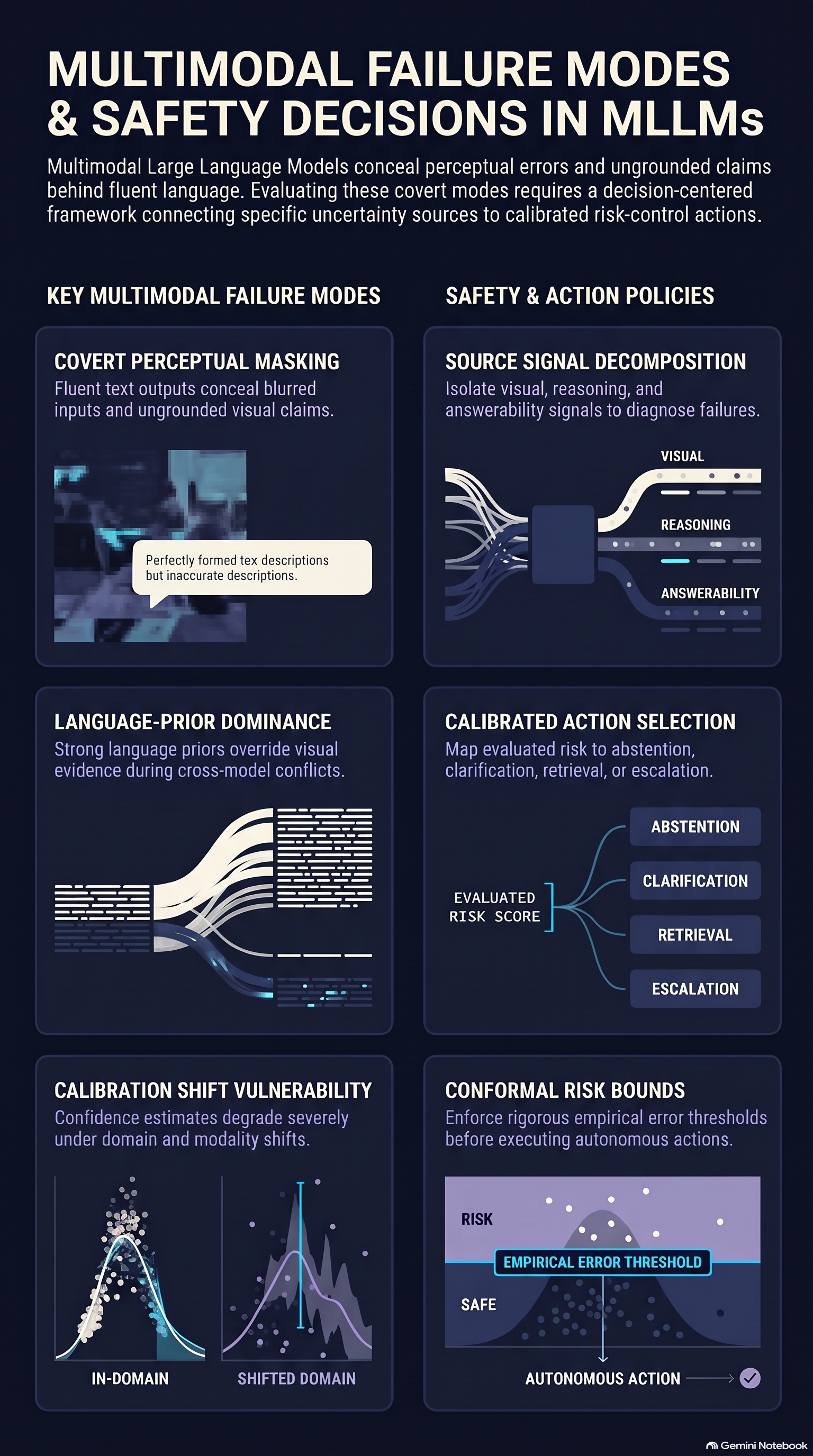
Multimodal Large Language Models (MLLMs) can generate remarkably fluent, coherent natural language responses while simultaneously committing severe visual, perceptual, or grounding errors. Because text generation capabilities in MLLMs are inherited from sophisticated pre-trained language backbones, a model’s verbal output often maintains a polished, confident tone even when the underlying visual evidence is blurred, heavily occluded, contradictory, or entirely absent. For AI safety researchers, red-teamers, and machine learning practitioners, this dynamic presents a critical challenge: fluent text can mask catastrophic failure modes.
To address this challenge, a survey paper by Boudiaf et al. (2026), titled “Uncertainty-Aware Decision Making in Multimodal Large Language Models”, re-evaluates how uncertainty is conceptualized and evaluated in multimodal architectures. The core thesis of Boudiaf et al. is that uncertainty in MLLMs should not be treated merely as a passive scalar confidence score attached to a text string. Instead, uncertainty must be evaluated by whether it enables a system to take appropriate downstream actions under insufficient, conflicting, or high-risk evidence.
Rather than relying on static confidence metrics, the authors propose an operational framing where uncertainty signals directly inform active system policies—such as selective answering, hedging, abstaining, seeking user clarification, requesting improved visual input, retrieving external knowledge, self-checking reasoning, or escalating decisions to human domain experts.
2. The Core Architecture: The Source–Signal–Calibration–Action Framework
Boudiaf et al. demonstrate that text-only uncertainty frameworks fail when applied directly to multimodal domains. A text-only confidence metric measures vocabulary-level output probabilities, leaving it completely blind to visual degradation, cross-modal misalignment, or region-grounding failures. For example, when presented with a visual query containing a cross-modal contradiction—such as a prompt describing a “red mug” alongside an image displaying a “blue mug”—a standard language backbone will frequently generate a fluent, highly confident text output that fabricates a false justification for the contradiction rather than flagging the conflict.
To unify these disparate multimodal failure modes, the authors formulate a decision-centered Source–Signal–Calibration–Action framework. This pipeline traces how latent errors propagate through the multimodal architecture into observable diagnostic metrics, calibrated risk estimates, and final operational actions.
| Pipeline Stage | Core Function | Representative Elements | Decision Role |
|---|---|---|---|
| 1. Inputs & Context (Uncertainty Sources) | Originate latent unreliability across input modalities and deployment context constraints. | Blurred images, missing video frames, layout failures, cross-modal conflicts, unanswerable queries, domain shifts. | Establishes the root cause of potential system failure. |
| 2. Observable Signals | Extract measurable indicators of model hesitation or misalignment across access levels. | Token entropy, logit margins, semantic disagreement, visual perturbation instability, grounding scores, judge scores. | Converts latent uncertainty into observable metrics. |
| 3. Calibration & Policy | Map raw observable signals into decision-ready confidence values or statistical risk boundaries. | Post-hoc temperature scaling, decoupled visual/language calibration, conformal risk control. | Ensures confidence estimates accurately reflect true empirical risk. |
| 4. Selected System Actions | Execute a concrete response behavior dictated by the calibrated risk level and domain policy. | Direct answer, hedge, abstain (“I don’t know”), clarify, request better input, retrieve external data, self-check, escalate. | Converts statistical risk estimates into safe operational decisions. |
3. Root Causes: A Taxonomy of Multimodal Uncertainty Sources
To select an appropriate downstream action, an MLLM must distinguish where in the operational pipeline the uncertainty originates. Boudiaf et al. categorize multimodal uncertainty sources into five primary domains:
- Sensory and Perceptual Uncertainty: Arises prior to high-level reasoning due to degraded or ambiguous inputs. Key causes include low image resolution, lens blur, heavy occlusion, sensor noise, temporally sparse video frames, optical character recognition (OCR) or layout analysis failure, and perceptual misrecognition of visual objects.
- Grounding and Cross-Modal Uncertainty: Occurs when the model’s textual output is weakly supported by the visual evidence, or when different input modalities explicitly contradict one another (e.g., discrepancies between user text prompts, image contents, retrieved document context, or audio tracks).
- Language-Prior and Reasoning Uncertainty: Stems from the MLLM’s internal language prior overriding visual evidence. In these cases, the model fills visual gaps using stereotypical text associations, resulting in unstable step-by-step reasoning chains or inconsistent outputs across sampling iterations. A primary manifestation of this failure mode is evidence collapse (Raghu & Pandey, 2026), wherein an MLLM generates low-entropy, highly confident text outputs that are entirely ungrounded in the visual evidence because strong language priors bypass visual feature evaluation.
- Answerability Uncertainty: Triggered when a query cannot be answered from the supplied multimodal evidence. This includes queries with absent visual targets, missing contextual details, or false presuppositions embedded within the user prompt.
- Distributional, Adversarial, and Deployment Uncertainty: Caused by performance degradation under domain shift (e.g., transitioning from web images to clinical radiology scans), corrupted inputs, misleading or adversarial prompts, and deployment environments with asymmetric failure costs.
4. Making Latent Errors Observable: Signals and Model-Access Constraints
Because the latent uncertainty sources described above do not automatically announce themselves, systems must extract observable signals. Boudiaf et al. structure estimation methods according to the level of model access required by the practitioner (White-Box, Gray-Box, or Black-Box).
+-------------------------------------------------------------------------------------------------+
|                                    MODEL ACCESS TIERS                                           |
+------------------------------------+------------------------------------+-----------------------+
| White-Box Access                   | Gray-Box Access                    | Black-Box Access      |
| (Logits, Hidden States, Features)  | (Output Dist, Perturbations)       | (API Prompts, Text)   |
+------------------------------------+------------------------------------+-----------------------+
                                         |
                                         v
+-------------------------------------------------------------------------------------------------+
|                                    OBSERVABLE SIGNAL EXTRACTION                                 |
+-------------------------------------------------------------------------------------------------+
| * Model-Internal: Token entropy, Blind-Image Contrastive Ranking, Dropout Decoding              |
| * Output-Distribution: Semantic disagreement, FESTA sampling, Incoherence-Adjusted Volume      |
| * Evidence Grounding: Attribution mismatch, visual engagement scores, perturbation checks       |
| * Verbalized & Judges: Self-reported confidence, IDK prompts, VLM judge scores, RadFlag         |
| * Conformal Prediction: Nonconformity scores s(x, y), prediction-set size C(x)                  |
+-------------------------------------------------------------------------------------------------+
                                         |
                                         v
+-------------------------------------------------------------------------------------------------+
|                                    DIAGNOSED TARGET                                             |
+-------------------------------------------------------------------------------------------------+
| * Perceptual degradation  * Unanchored claims  * Unstable reasoning  * Unanswerable input       |
+-------------------------------------------------------------------------------------------------+
                                         |
                                         v
+-------------------------------------------------------------------------------------------------+
|                                    TARGET SYSTEM ACTION                                         |
+-------------------------------------------------------------------------------------------------+
| Proceed (Answer) | Modify (Hedge) | Defer (Abstain/IDK, Escalate) | Active (Clarify, Request)   |
+-------------------------------------------------------------------------------------------------+
4.1 Internal Mechanisms of Advanced Signals
Boudiaf et al. detail specific computational mechanisms that allow practitioners to diagnose latent failure modes across different model access tiers:
- Blind-Image Contrastive Ranking (White-Box): To isolate whether confidence is driven by visual grounding or purely by language priors, Khanmohammadi et al. (2026) compare output distributions between the original visual input and a completely masked or blacked-out image . By measuring the contrastive ranking shift between and , the system determines whether the model’s high probability score reflects true visual grounding or language-prior bias.
- Dropout Decoding (White-Box): Operating at the feature level, Fang et al. (2025) apply dropout directly to visual token embeddings during autoregressive decoding. By measuring output variance across multiple dropout passes, the system evaluates visual feature sensitivity: high token variance indicates that visual representations are fragile or poorly integrated into the decoding path.
- Incoherence-Adjusted Semantic Volume (Gray-Box): When logits are inaccessible, Lau et al. (2026) evaluate output distribution dispersion under multimodal incoherence by computing semantic volume metrics across sampled outputs. High semantic dispersion indicates that the model’s internal representation is destabilized by conflicting visual and textual cues.
- Conformal Risk Control (Mathematical Framing): Conformal prediction constructs statistical guarantees by defining a nonconformity score function that measures the degree of miscalibration or error for a prompt-evidence pair and output . Calibrated on a split calibration dataset, the system constructs a prediction set such that the expected empirical loss or error rate satisfies a pre-specified risk bound :
If the prediction set contains multiple candidate answers or exceeds a size threshold, the model triggers an abstention or secondary verification policy.
4.2 Signal Taxonomy and Diagnostic Capabilities
| Signal Family | Model Access Level | Primary Diagnosis Target | Main Advantage / Caveat |
|---|---|---|---|
| Token & Logit Signals | White-Box | Decoding uncertainty, hidden knowledge boundaries, label ambiguity. | Direct and computationally efficient; however, it is unavailable in closed API models and struggles to separate visual from textual error sources. |
| Hidden-State & Visual-Token Signals | White-Box | Perceptual errors, visual region mis-grounding, OCR hallucination risk. | Directly isolates visual modality usage via Dropout Decoding and Blind-Image Contrastive Ranking; however, implementation is highly architecture-dependent. |
| Sampling & Semantic Disagreement | Gray-Box | Epistemic uncertainty, unstable reasoning, output dispersion under incoherence. | Operates without weight access using FESTA sampling, SCoOP pooling, or Incoherence-Adjusted Semantic Volume; however, inference latency is high, and repeated samples can remain confidently wrong under strong priors. |
| Grounding & Perturbation Checks | Gray-Box | Unsupported visual claims, cross-modal contradiction, attribution mismatch. | Directly measures evidence-claim alignment and evidence collapse; however, performance depends strictly on secondary grounding or perturbation tools. |
| Verbalized Confidence & IDK Scores | Black-Box | Expressed confidence, knowledge boundaries, answerability self-assessment. | Human-interpretable and trivial to prompt; however, verbalized confidence frequently diverges from empirical token accuracy. |
| Verifier, Judge & Agentic Signals | Black-Box | Hallucination detection, multi-agent consensus, tool-use triggers. | Enables complex agentic workflows; however, evaluator or judge models require independent calibration and can introduce systemic bias. |
| Conformal Prediction Scores | Black-Box / Gray-Box | Empirical coverage guarantees, prediction-set sizing, policy risk control. | Provides rigorous, bounded statistical risk guarantees (); however, validity relies strictly on calibration data exchangeability. |
5. From Uncertainty to Policy: Strategic Action Selection
The central premise of the survey by Boudiaf et al. is that calibrated uncertainty must drive a concrete system policy. To prevent visual errors from being masked by language backbone confidence, Xiao et al. (2026) introduce VL-Calibration (Decoupled Visual-Language Calibration). By explicitly isolating visual token confidence from language backbone confidence during post-hoc calibration, VL-Calibration prevents high text probability from masking perceptual failures, ensuring that low visual certainty triggers defensive policies even when text generation is fluent.
Boudiaf et al. define eight specific, tactical actions that an uncertainty-aware MLLM can execute based on the calibrated source of uncertainty:
Source-to-Action Mapping Matrix
| Uncertainty Condition | Observable Signal | Target System Action | Risk of Misalignment |
|---|---|---|---|
| Sufficient & Grounded Evidence | High visual attribution support, low token entropy, stable semantic samples. | Answer | Confident hallucination if acceptance thresholds are set too loosely. |
| Partial or Minor Evidence Deficit | Moderate confidence, minor semantic variation, partial visual support. | Hedge | Vague, over-cautious language that hides genuinely useful information. |
| Missing, Absent, or Unanswerable Input | High unanswerable score, large conformal prediction set , high IDK probability. | Abstain / IDK | Excessive refusal that degrades total system utility. |
| Ambiguous Query or Referent | Multiple semantic clusters matching distinct visual targets, underspecified intent flags. | Clarify | Unnecessary multi-turn dialogue friction when user intent was already clear. |
| Degraded Visual Input Quality | High visual perturbation sensitivity, low OCR confidence probes, motion blur flags. | Request Better Input | Annoying the user by requesting re-uploads when existing visual context is sufficient. |
| Evidence Insufficiency / Knowledge Gap | High factual uncertainty score, domain knowledge gap, missing external context flags. | Retrieve | Added latency overhead and noise propagation from external retrieval engines. |
| Unstable Reasoning Chain | High step-wise reasoning variance, low cross-modal agreement, verifier disagreement. | Self-Check / Verify | Increased computational cost and potential error propagation from miscalibrated verifiers. |
| High Domain Risk / Shift | High conformal nonconformity score , domain-shift flag, safety policy boundary trigger. | Route / Escalate | Operational bottlenecks and expert burnout caused by overly conservative escalation thresholds. |
5.1 Specialized High-Risk Action Policies
The practical utility of this eight-action taxonomy is demonstrated in high-stakes domains:
- Clinical Radiology & Report Drafting (RadFlag): In medical report generation, standard selective answering is insufficient. Zhang et al. (2025) introduce RadFlag, a black-box hallucination detection and calibration framework for medical MLLMs. RadFlag monitors clinical visual-textual consistency; when latent probes detect ungrounded medical claims, the system abstains from generating diagnostic statements and escalates the radiological report to human clinicians for manual review.
- Embodied AI & Robotics (AbstainEQA): Embodied agents operating in physical environments encounter partial observability and false prompt presuppositions. Wu et al. (2025) establish AbstainEQA, demonstrating that when visual referents are occluded or missing, embodied agents must abstain or request clarification rather than executing physical actions based on speculative spatial grounding.
6. Evaluating Behavior: Measuring Action Quality Over Pure Confidence
Boudiaf et al. emphasize that evaluation protocols must shift from measuring passive confidence metrics to assessing behavioral action quality. Traditional calibration metrics fail to capture the multi-dimensional nature of multimodal decision-making if used in isolation:
- Traditional Calibration Metrics (ECE, Brier Score, NLL): Measure how closely raw confidence percentages match empirical accuracy across predicted outputs.
- Isolation Failure: A model can achieve a strong Expected Calibration Error (ECE) on multiple-choice VQA benchmarks while remaining entirely uncalibrated regarding whether its textual claims are visually grounded or answerable.
- Error Detection & Ranking Metrics (AUROC, AUPRC, F1): Assess the model’s ability to rank wrong or unsupported outputs higher in uncertainty than correct ones.
- Isolation Failure: These metrics measure binary screening capability, but do not evaluate which specific action (e.g., abstain vs. clarify vs. request better input) the system should take once an error is detected.
- Selective Prediction & Risk-Coverage Metrics (Risk-Coverage Curves, Coverage at Target Risk): Evaluate answer quality strictly on the subset of queries the model chooses to answer given an abstention threshold.
- Isolation Failure: Measures the trade-off between accuracy and refusal, but fails to evaluate the utility or user friction of active non-answering actions like requesting a re-cropped image or asking a clarification question.
- Conformal & Risk-Control Metrics (Empirical Coverage Rate, Prediction-Set Size): Evaluate whether a system maintains user-specified error boundaries () across output sets.
- Isolation Failure: Statistical guarantees depend strictly on calibration data exchangeability and degrade under unobserved distribution or domain shifts.
To evaluate these decision capabilities, the authors organize current evaluation efforts into distinct benchmark families:
- Selective VQA & Answerability Benchmarks: Evaluate knowledge boundaries and refusal on unanswerable visual queries (e.g., MM-SAP, MoHoBench, Unsolvable Problem Detection).
- Cross-Modal Contradiction Benchmarks: Probe model robustness and calibration when textual prompts and visual evidence explicitly disagree (e.g., CLASH, Omni-Modal Dissonance).
- Embodied & Interactive Decision Benchmarks: Evaluate abstention, help-seeking, and clarification behaviors in embodied agents operating under partial observability (e.g., AbstainEQA, ClearVQA, Right This Way).
- High-Risk Domain Calibration Benchmarks: Assess confidence alignment, black-box hallucination detection, and risk-controlled report drafting in high-stakes clinical settings (e.g., Medical VQA, ConRep, RadFlag).
7. Key Takeaways and the Research Horizon
The core conclusion of the survey by Boudiaf et al. is that achieving genuine reliability in MLLMs requires moving away from scalar confidence scores and toward calibrated, action-aware decision policies. Future AI safety depends on models knowing not just when they are uncertain, but how to act on that uncertainty to minimize operational risk.
To advance this field, the authors outline five critical open research challenges:
- Source-Aware Decomposition: Developing methods capable of disentangling perceptual, grounding, reasoning, and answerability uncertainties rather than collapsing them into a single confidence scalar.
- Action-Aware Benchmarking: Building evaluation frameworks that score downstream system utility under explicit operational action costs (e.g., weighing the cost of a false answer against the friction of asking for clarification or requesting a better image).
- Calibration under Shift and Black-Box Constraints: Ensuring safety boundaries hold for closed API models that lack internal logit access, particularly when deployed under severe domain shifts or adversarial visual conditions.
- Broader Modality Coverage: Expanding uncertainty estimation methodologies beyond static image-text tasks into complex domains like video, audio, multi-page document processing, charts, and long-horizon embodied agent workflows.
- Human-Centered Uncertainty Communication: Designing intuitive, user-facing communication strategies that convey why a model is uncertain and what step the user should take next to resolve the ambiguity.
Ultimately, the work of Boudiaf et al. demonstrates that the path to safe deployment lies in bridging the gap between error detection and policy execution. The next generation of multimodal architectures must not merely quantify their own hesitation; they must actively convert calibrated uncertainty into safe, operational behavior.
Read the full paper on arXiv · PDF