Making two action heads agree: coordination mechanisms and a runtime collapse certificate for flow-matching policies
The paper investigates four mechanisms for coordinating dual joint-space and end-effector-space action heads in flow-matching policies to reduce false alarms in runtime kinematic failure detection,...
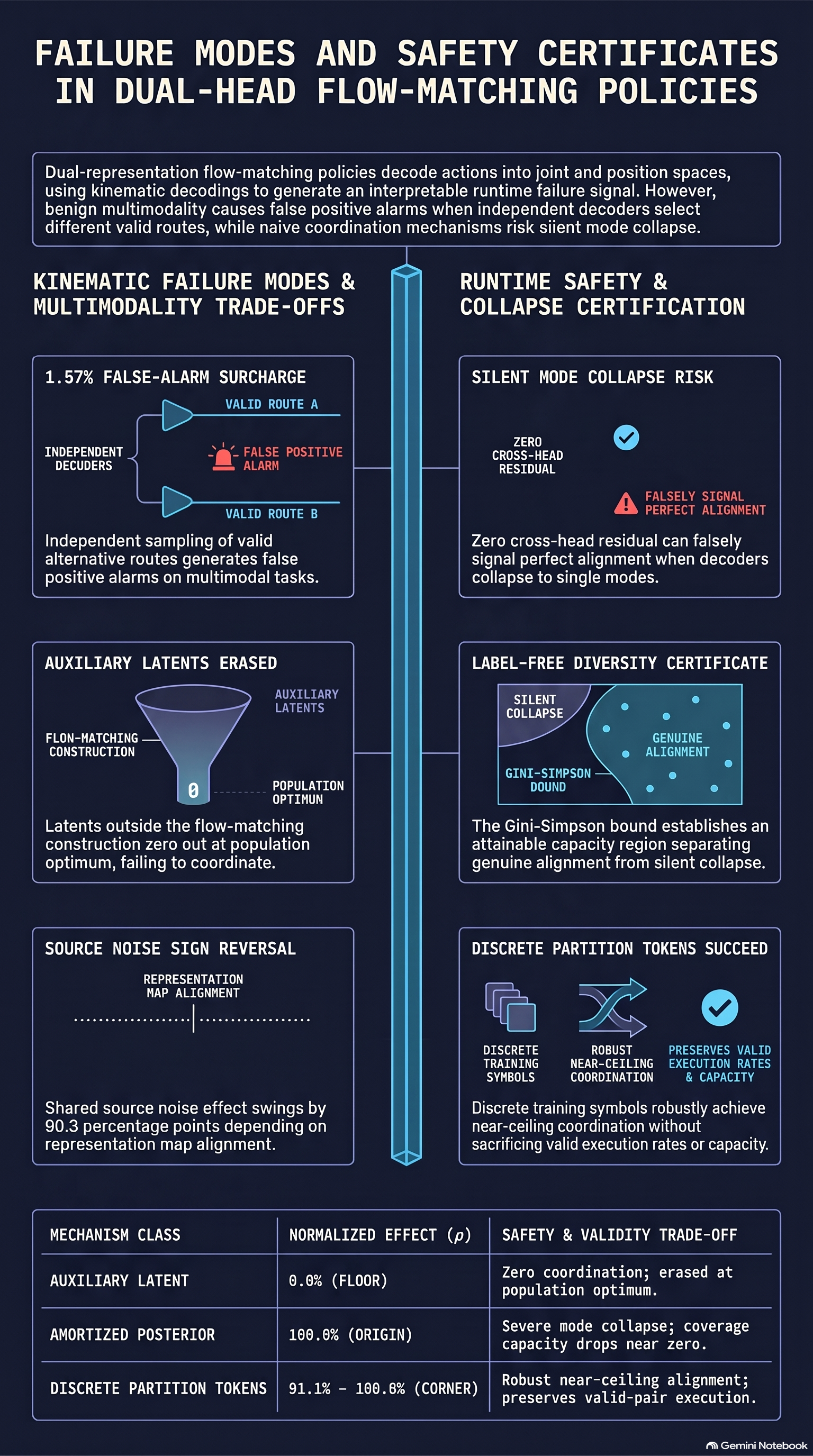
1. Introduction: The Dual-Representation Dilemma in Flow Matching
In modern robotic manipulation, generative action decoders—specifically diffusion models and conditional flow-matching (CFM) policies—have established themselves as premier frameworks for capturing complex, multimodal trajectory distributions. However, deploying these high-capacity policies in safety-critical domains introduces a fundamental runtime auditing challenge: verifying that predicted trajectories remain physically feasible and safe without incurring the massive computational cost of deep ensembles or auxiliary observation-side anomaly detectors.
To resolve this trade-off, recent architectural paradigms adopt dual-representation policies. As systematically analyzed by Sun et al. (arXiv:2608.15748), a dual-representation flow-matching policy simultaneously decodes a predicted motion into two kinematically equivalent output spaces from a shared conditioning context : a joint-space action chunk () and a Cartesian position/end-effector-space action chunk (), where denotes the action horizon. By passing the joint-space predictions through differentiable forward kinematics (), runtime safety infrastructure can compute a kinematic reconciliation residual in physical units:
In unimodal operational regimes, this residual acts as a lightweight, physically interpretable runtime failure certificate: external physical disturbances, kinematic joint-limit violations, or execution faults cause the two decoding spaces to diverge, generating a sharp spike in .
However, Sun et al. demonstrate that this monitoring paradigm is vulnerable to a structural false-alarm mechanism termed the “benign multimodality” problem. In manipulation tasks where environment geometry permits multiple valid trajectories to achieve a goal—such as navigating around a central obstacle via a leftward or rightward path—independently sampled action heads can independently select different valid execution modes. When the joint-space head decodes a leftward path while the Cartesian-position head decodes a rightward path, the kinematic residual expands significantly, firing an anomaly alarm even though neither head has committed an operational error.
To overcome this dilemma, Sun et al. present a comprehensive mechanistic atlas of dual-head coordination methods, alongside a chance-corrected mathematical framework that certifies cross-head alignment without requiring environment ground-truth labels.
2. The Mechanics Atlas: Four Classes of Coordination
To systematically analyze how dual generative action decoders can be coordinated, Sun et al. conducted an extensive empirical auditing study comprising 117 robot-side evaluation runs across two physical simulation testbeds—BimodalBypass (v2) and RotatingBypass (v3)—and 423 synthetic testbed runs. Their investigations reveal that all candidate coordination mechanisms partition into four distinct mechanism classes, summarized in the comparative atlas below.
| Mechanism Class | Primary Implementation | Observed Coordination Effect ( / ) | Valid-Pair Rate Impact | Theoretical / Operational Mechanism |
|---|---|---|---|---|
| Class I: The Floor | Auxiliary Latent () / Shared Source Noise () | ($ | \rho | \le 1.0%$) |
| Class II: Boundary at Origin | Amortized Continuous Posterior () | () | High () | Zero mismatch () achieved via catastrophic mode collapse (). Operates as a false-security trap for runtime monitors. |
| Class III: Interior Climb | Endpoint Consistency Loss () | (v2) (v3) | Severe Drop ( in v2; in v3) | Penalizes endpoint kinematic mismatch; forces pairwise agreement by discarding incompatible execution pairs. Fails to align unpenalized heads. |
| Class IV: High-Capacity Corner | Discrete Partition Tokens (Window / Episode Tokens) | () | Preserved () | Discrete, training-supported symbols partition trajectory space, robustly guiding both branches to identical modes without invalidating rollouts. |
2.1 Class I (The Floor & Z-Blindness)
A naive approach to aligning dual action decoders appends a shared continuous auxiliary latent variable to both velocity fields, and . Sun et al. establish that this architectural modification is a mathematical dead end at the population optimum.
Lemma 2 (Z-Blindness of the CFM Optimum). Assume mean irrelevance (, where is the flow-matching regression target and is the state-condition tuple) and Bayes attainability under squared loss. Then any population minimizer of the conditional flow-matching objective satisfies: Thus, the population-optimal velocity field is strictly independent of on the training support.
The theoretical implication of Lemma 2 is formally extended by Corollary 3: because the auxiliary latent does not participate in constructing the flow-matching interpolation state or target , population squared-loss minimization forces the network to integrate out. Consequently, during inference, conditional independence is induced between the heads (), forcing observed mismatch to equal the independent choice baseline () and pinning the coordination effect strictly to zero (). Two One-Sided Tests (TOST) across both robot environments confirm this behavior, bounding continuous auxiliary latents within a prespecified equivalence band around zero (, max ).
Sun et al. contrast auxiliary latents with shared source noise (). Unlike , initial source noise directly participates in constructing the interpolation path state . However, sharing source noise does not guarantee positive coordination. On a synthetic testbed evaluated across three distinct representation maps (nullspace, orthogonal, and polar), the normalized coordination effect of shared source noise swung by 90.3 percentage points (from under nullspace to under polar; confirmed in a preregistered factorial at 10 seeds per cell, interaction permutation ).
From an AI safety perspective, this instability exposes the phenomenon of Representation Basin Alignment: independent coordinate decoders establish unaligned mode basins in Gaussian noise space unless explicitly constrained. Consequently, continuous source-noise coupling provides zero reliable coordination across heterogeneous coordinate spaces.
2.2 Class II (Boundary at the Origin - Posterior Collapse)
To prevent structural Z-blindness, architectures can deploy an amortized continuous posterior during training, forcing the continuous latent to encode target trajectory information. While this approach successfully drives observed physical mismatch to zero (, reducing spatial residuals to ), Sun et al. demonstrate that it induces catastrophic mode collapse.
Under systematic auditing, models equipped with continuous posteriors exhibit near-zero modal diversity capacity (, modal entropy ). The target-conditioned posterior forces both decoders to collapse onto a single, deterministic trajectory mode. On the coordination-capacity plane, these models settle at “Site II” near the origin: they report a nominal normalized coordination rate of , but this agreement is an artifact of mode collapse () rather than genuine multi-head alignment.
For runtime safety monitors, continuous posteriors constitute a severe false-security trap. When a failure monitor observes , safety infrastructure assumes the robot is operating in a synchronized, stable regime. In reality, the policy has undergone silent mode collapse, losing task coverage and operational adaptability across alternative valid trajectories.
2.3 Class III (Interior Climb - Consistency Regularization)
To force multi-head agreement without modifying latent sampling structures, an explicit endpoint-consistency penalty can be incorporated into the loss function:
where and represent the clean trajectory predictions at the final denoising endpoint .
Applying achieves intermediate coordination, yielding () in BimodalBypass (v2) and () in RotatingBypass (v3). However, this coordination exacts a steep execution cost: valid-pair execution rates drop from to in v2, and from to in v3. Consistency penalties achieve agreement by penalizing boundary trajectories, preferentially discarding valid execution pairs that exhibit high spatial divergence.
Furthermore, Sun et al. identify a critical multi-head limitation: consistency-driven coordination is strictly pairwise. Evaluating a three-head architecture ( joint, position, end-effector orientation) revealed that applying between joint and position heads successfully coordinated that specific pair (), but left the unpenalized joint-orientation pair completely uncoordinated (, with confidence intervals spanning zero). Safety auditors are thus cautioned that single-pair consistency regularizers cannot be assumed to induce global policy alignment.
2.4 Class IV (The High-Capacity Corner - Discrete Partition Tokens)
Sun et al. establish that training-supported discrete partition tokens provide the most robust mechanism for attaining ceiling cross-head coordination without compromising valid execution coverage. By conditioning both velocity fields on discrete partition symbols derived from training data (e.g., window-level -means tokens or episode-level trajectory tokens), models reliably reach the high-capacity corner (“Site IV”).
Window-level tokens attain () while preserving a valid-pair rate of . When paired with a light consistency penalty (), the valid-pair rate increases to while the physical residual floor drops to (approaching the oracle baseline). Episode-level tokens operating under a learned categorical prior maintain high validity () while achieving (). Because these discrete symbols map to well-sampled partitions in training space, test-time draws remain within supported decoder regions, circumventing the posterior collapse observed in continuous latent schemes.
3. The Attainable Region and Label-Free Collapse Certificate
To quantify chance-corrected coordination without relying on environment-specific ground-truth mode labels, Sun et al. derived a rigorous mathematical framework grounded in Gini-Simpson diversity.
Core Mathematical Framework
Mathematical Breakdowns & Diagnostic Distinctions:
- Chance-Corrected Effect (): Quantifies the net coordination achieved beyond random chance, defined as the difference between the independent-choice baseline () and observed mismatch given validity (). Positive values () reflect true multi-head alignment, whereas negative values signal anti-coordination.
- Gini-Simpson Diversity Capacity (): Defines the mathematical upper bound on attainable coordination given the output marginal distributions and of the joint and position heads.
- Deployment-Time Collapse Certificate: Reversing Theorem 1 yields a lower bound on output diversity that can be evaluated at deployment without ground-truth labels: This certificate enables runtime safety monitors to disambiguate zero mismatch (): true multi-head coordination is certified when occurs at high modal capacity (), whereas uncoordinated mode collapse is flagged when coincides with capacity collapse ().
- Modal Capacity () vs. Tight Fixed-Marginal Bound (): Sun et al. distinguish between outer capacity and the tighter fixed-marginal bound: where represents the Total Variation distance between branch marginals. Whenever , . The authors retain on the horizontal axis of the attainable region because it explicitly penalizes marginal divergence between output heads rather than normalizing it away.
- Three-Way Disambiguation (Capacity vs. Validity vs. Fidelity): Safety auditors must decouple three operational properties:
- Modal Capacity (): Measures the output diversity of the decoders.
- Execution Validity (Valid-Pair Rate): Measures the physical feasibility of generated trajectories.
- Behavioral-Prior Fidelity (): Measures how closely generated mode distributions match the reference data distribution. A model can attain high modal capacity and ceiling coordination (Site IV) while severely distorting behavioral-prior fidelity (e.g., drawing uniform tokens under highly skewed target distributions, inducing distortion of up to ).
4. Benchmark Reality Check: Empirical Monitoring on LIBERO-Plus
To evaluate dual-representation kinematic monitoring under realistic red-teaming conditions, Sun et al. conducted an extensive evaluation on the LIBERO-Plus benchmark, analyzing 851 test episodes comprising 369 physical failure events across 20 perturbation-severity strata.
| Benchmark Metric / Context | Empirical Finding / Value | Safety Implications & Diagnostics |
|---|---|---|
| Multimodality FA Overhead | +1.57 percentage points (9.75% FA multimodal vs 8.19% unimodal) | Benign multimodality actively pollutes residual monitors; flagged on 31.0% of test steps (17,140 / 55,279). |
| Observation Control Surcharge | -0.01 percentage points (max $ | z |
| 100-Step Uncoordinated Residual | AUROC 0.6856 | Highest overall failure signal. Outperforms all observation-side and same-head dispersion metrics. |
| 100-Step Coordinated Residual | AUROC 0.6200 | Retains strong detection capability, but performs below the uncoordinated residual. |
| 100-Step RND Baseline | AUROC 0.5662 | Secondary observation-side baseline (Random Network Distillation). |
| 100-Step ACE Baseline | AUROC 0.5458 | Secondary action-distribution baseline (Action Chunk Entropy). |
| 100-Step Max |z| Baseline | AUROC 0.5285 | Primary observation-side state baseline. |
| Token Intervention Criterion | Failed registered FA criterion (gap difference -0.03 pp, CI [-1.00, +0.86]) | Discrete token intervention failed to yield seed-robust false-alarm reductions or detection gains (). |
| Monitored Head Capacity Audit | (Token entropy ) | Monitored baseline heads were near-deterministic, leaving virtually no active multimodality to coordinate. |
Detailed Empirical Insights:
- Multimodality False-Alarm Surcharge: Evaluating successful test rollouts under conformal thresholds calibrated to a 5% overall false-alarm rate revealed that benign multimodality adds a 1.57 percentage point false-alarm surcharge to cross-representation residuals. In contrast, observation-side baselines like max showed no surcharge (), establishing that false alarms are directly driven by cross-head mode variance.
- Fixed-Horizon Evaluation & Baseline Granularity: Standard episode-level aggregate metrics are heavily length-confounded on LIBERO-Plus because all 369 failures manifest as 250-step timeouts (elapsed step count alone reaches an AUROC of 0.9969). Truncating evaluation to a fixed 100-step horizon resolves this confound: the uncoordinated residual achieves an AUROC of 0.6856, significantly outperforming the coordinated residual (0.6200), RND (0.5662), ACE (0.5458), and max (0.5285).
- Intervention Null Result & Capacity Audit: The preregistered discrete token intervention failed to meet its registered false-alarm reduction threshold. A post-hoc capacity audit explained this result: the monitored baseline policy decoders exhibited an extremely low modal capacity () and near-deterministic token usage. Because the baseline decoders rarely generated alternative valid modes, the alignment intervention had no active multimodality to coordinate, illustrating the practical boundaries of cross-head interventions.
5. Takeaways for AI Safety and Robotics Practitioners
Sun et al.’s empirical and theoretical findings translate into four practical design rules for robotics engineers and AI safety auditors:
-
Do Not Rely on Auxiliary Latents for Coordination
- Appending shared continuous latents () to dual velocity fields without integrating them into the CFM target interpolation state or regression target fails due to structural -blindness (Lemma 2 and Corollary 3).
- Population squared-loss optimization forces the decoders to integrate auxiliary latents out, leaving inference-time coordination pinned strictly to zero ().
-
Beware of Raw Residual Alarms and False-Security Traps
- Raw kinematic reconciliation residuals cannot differentiate physical execution faults from benign multimodal trajectory choices.
- Runtime failure monitors must pair physical residual thresholds with label-free modal diversity certificates (). This prevents monitors from falling into “false-security traps” (Class II), where zero physical residual reflects uncoordinated mode collapse rather than true cross-head alignment.
-
Prefer Discrete Partitions Over Continuous Positing
- Continuous amortized posteriors trigger severe mode collapse under target skew, while endpoint-consistency losses degrade valid execution rates and fail to coordinate unpenalized output heads.
- Engineers should condition dual action heads on discrete, training-supported partition tokens (e.g., window-level cluster symbols). Discrete partitions achieve near-ceiling coordination () while maintaining high execution validity.
-
Audit Head Capacity Before Deploying Interventions
- Safety auditors must implement a mandatory pre-deployment red-teaming protocol: compute modal capacity () on baseline policy traces before approving cross-head alignment interventions.
- If monitored baseline decoders demonstrate near-deterministic behavior (), alignment interventions will yield zero practical benefit, as there is no underlying multimodality to coordinate.
Read the full paper on arXiv · PDF