Toward the Cognitive--Physical Limits of Embodied Intelligence through a World-Model-Centric Autonomous Racing Agent
The paper presents a world-model-centric autonomous racing architecture trained on extreme real-vehicle driving data to jointly model, predict, and refine an agent's cognitive and physical operating...
1. Introduction: Testing Embodied AI Beyond Conservative Safety Margins
A central challenge in embodied artificial intelligence is that most systems are evaluated within conservative safety margins or moderately demanding operating regimes. Operating under well-modeled, low-stress conditions leaves an agent’s behavioral boundaries, cognitive constraints, and failure modes under extreme conditions insufficiently understood. For autonomous agents deployed in high-stakes physical environments, mapping where capability boundaries lie—and understanding how cognitive constraints interact with non-linear physical dynamics—is critical for safe deployment.
Autonomous racing provides a stringent testbed where cognitive and physical limits directly collide. Cognitively, an agent must execute high-frequency state estimation, multi-agent opponent tracking, and interaction prediction under severe time pressure. Physically, the agent must navigate near-saturated tire dynamics, aerodynamic loads, and friction limits where minor execution errors or mispredictions rapidly escalate into severe instability or high-speed collisions.
Shan et al. propose a world-model-centric autonomous racing framework trained on extreme real-vehicle driving data to jointly model, predict, and refine cognitive and physical operating boundaries. By substituting conservative safety buffers with a unified predictive substrate, the framework provides a structured methodology for embodied agents to map, exploit, and regulate failure envelopes under severe dynamic stress.
This post examines research by Shan et al. (arXiv:2608.10618) from Nanyang Technological University and K2 Holding, detailing how a centralized world model connects high-frequency perception with near-limit vehicle control and closed-loop policy adaptation.
2. System Architecture: A Unified Predictive Substrate
Traditional autonomous racing architectures frequently rely on isolated, modular pipelines for estimation, motion planning, and low-level control. In contrast, the framework designed by Shan et al. places a shared predictive world model at its structural core. This unified substrate connects spatial intelligence with future-aware reasoning, limit-aware execution, and offline policy training.
+-------------------------------------------------------------------+
|                        SPATIAL INTELLIGENCE                       |
|   Multi-modal Sensor Fusion (LiDAR, RTK, IMU, Radar, Wheel Speed) |
+-------------------------------------------------------------------+
                                  |
                                  v
+-------------------------------------------------------------------+
|                      PREDICTIVE WORLD MODEL                       |
|   Ego Dynamics | Physical Limit Envelope | Interaction Model  |
+-------------------------------------------------------------------+
       /                          |                          \
      v                           v                           v
+-----------------------+ +-----------------------+ +-----------------------+
|  FUTURE-AWARE REASON  | |  LIMIT-AWARE CONTROL  | | POLICY TRAINER & LOOP |
| Parallel Rollouts     | | CILQR Optimization    | | SAC / BC + CQL Loss   |
| Trajectory Selection  | | Feasible Envelopes  | | Best-of-K Supervision |
+-----------------------+ +-----------------------+ +-----------------------+
The system coordinates three tightly coupled runtime components alongside an offline adaptation loop:
- Spatial Intelligence: Constructs the immediate state of the environment using high-frequency multi-modal sensor fusion to achieve robust ego localization and probabilistic tracking of surrounding opponents.
- Future-Aware Reasoning: Executes parallel world-model rollouts to evaluate candidate interaction futures against predicted opponent behaviors, physical envelope feasibility, and lap-time efficiency.
- Limit-Aware Control: Translates selected trajectory plans into low-level control commands, executing near physical dynamic boundaries via a Constrained Iterative Linear Quadratic Regulator (CILQR) without violating vehicle stability constraints.
Closed-Loop Experience-Driven Adaptation
The framework integrates a continuous closed-loop refinement process. Real-world vehicle telemetry updates the world model’s internal simulation components (ego dynamics and interaction models). In turn, the world model provides structured rollouts and augmented experience data to a policy trainer. Policy optimization incorporates Soft Actor-Critic (SAC) and Behavior Cloning (BC) augmented with Conservative Q-Learning (CQL) loss and Best-of- trajectory supervision. This continuous loop allows empirical rollouts and failure logs (such as transient traction loss) to progressively refine policy bounds and dynamic control limits.
To ground the predictive substrate in real-world physical limits, model training utilized real-vehicle racing dataset telemetry collected at speeds up to 256.3 km/h (71.2 m/s) and lateral accelerations up to 26.8 m/s².
3. Constructing and Predicting the World State
The framework employs a two-layer process to convert raw multi-modal sensor streams into predictive world understanding: state reconstruction followed by dynamic prediction.
Spatial intelligence fuses LiDAR, Real-Time Kinematic (RTK) GPS, Inertial Measurement Unit (IMU), and wheel-speed data to maintain pose estimation under extreme acceleration. Opponent states are estimated by combining geometric LiDAR point clouds with radar velocity cues. Downstream, the predictive world model projects ego vehicle dynamics, physical motion boundaries, and multi-agent opponent interactions into the future.
The Physics of the Feasible Acceleration Envelope
The physical feasibility boundary is modeled in three-dimensional space, forming an asymmetrical inverted-funnel shape. At low velocities (), the envelope is narrow because total available grip is constrained by static friction limits. As velocity increases, aerodynamic downforce increases vertical tire loading, expanding the available lateral acceleration () and braking deceleration () boundaries. Conversely, positive longitudinal acceleration capability () contracts sharply at high speeds due to engine powertrain saturation and aerodynamic drag penalties.
The table below summarizes the system layers, mechanisms, and measured performance metrics reported by Shan et al.:
| System Layer & Mechanism | Measured Performance Metrics |
|---|---|
| State Reconstruction (Spatial Intelligence) High-frequency multi-modal sensor fusion (LiDAR, RTK, IMU, wheel speed, radar) for ego pose estimation and probabilistic opponent state tracking. | • Lateral Position Residual: < 0.3 m • Longitudinal Position Residual: < 2.0 m • Velocity Residuals: < 1.8 m/s (median ~0.1 m/s) • Yaw Residual: < 0.06 rad (vs. dual-GPS), < 0.01 rad (vs. LiDAR odometry) |
| Ego Dynamics Prediction Differentiable dynamics backbone coupled with a residual neural network predicting motion responses to control inputs near saturation limits. | • Longitudinal Velocity RMSE: 0.197 m/s • Lateral Velocity RMSE: 0.099 m/s • Yaw Rate RMSE: 0.042 rad/s • Longitudinal Acceleration RMSE: 1.514 m/s² • Lateral Acceleration RMSE: 1.983 m/s² |
| Interaction Prediction (3-Second Horizon) Attention-based predictive network modeling relative multi-agent spatial interactions in track-aligned coordinates. | • Mean Average Displacement Error (ADE): 1.58 m • Median ADE: 0.68 m • Mean Final Displacement Error (FDE): 2.55 m • Median FDE: 0.78 m |
| Physical Limit Representation Speed-dependent acceleration envelope () integrating tire-road friction, aerodynamic downforce, and powertrain limits. | • Inverted-Funnel Profile: Aerodynamic downforce expands and braking () boundaries at high ; powertrain limits contract positive acceleration () at high . |
4. Future-Aware Reasoning in Adversarial Interaction
During multi-agent, high-speed interaction, decision-making requires evaluating whether an aggressive tactical maneuver remains physically safe as opponent trajectories evolve.
Shan et al. address this through a multi-stage candidate trajectory generation pipeline:
- A main decision trajectory is established to capture nominal racing line intent.
- A delta-trajectory manifold generates spatial lateral offsets around the main decision path.
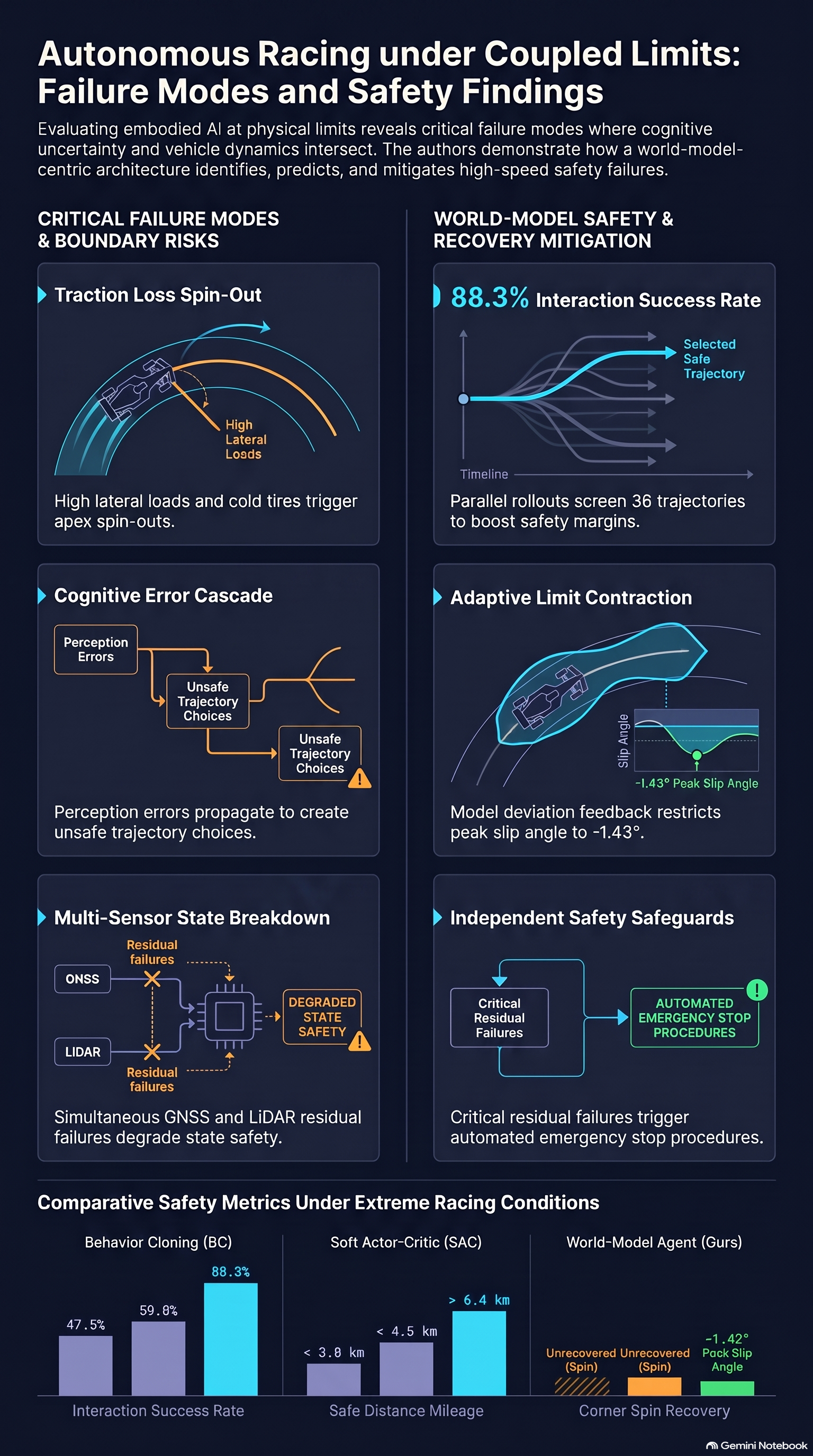
- These pathways are combined with discrete speed factor adjustments, yielding 36 candidate trajectories.
  [ Observed World State ]
             |
             v
 [ Main Decision Trajectory ]
             |
      +------+------+
      |             |
      v             v
[ Delta-Trajectory Manifold ] ---> [ Speed Factor Adjustments ]
                                         |
                                         v
                         [ 36 Candidate Trajectories ]
                                         |
                                         v
                         [ Parallel World-Model Rollouts ]
                                         |
                                         v
                         [ Evaluated & Selected Plan ]
These 36 candidates are evaluated in parallel via world-model rollouts. Each rollout projects opponent intention, ego dynamics, and physical envelope compliance over the planning horizon. Candidates that lead to predicted collisions or exceed physical capability boundaries are filtered prior to execution.
In ablation experiments conducted by the authors, removing the world model from the reasoning loop resulted in immediate vehicle collisions during close-proximity overtaking maneuvers. Without predictive rollouts, the agent selected decisions that appeared plausible given instantaneous observations but became physically unsafe as the interaction unfolded.
In full-scale simulated racing benchmarks against adversarial opponents, the world-model-driven policy demonstrated significant performance advantages over baseline algorithms:
| Algorithm / Baseline | Interaction Success Rate | Safe Mileage | Overtaking Behavior & Characteristics |
|---|---|---|---|
| Proposed Method (Shan et al.) | 88.3% | > 6.4 km | Proactively filters collision futures; achieves high overtaking frequency while maintaining competitive race pace (+40.8% over BC, +29.3% over SAC). |
| Behavior Cloning (BC) | 47.5% | Lower | Sub-optimal generalization; frequently fails to resolve close-proximity multi-agent interactions. |
| Soft Actor-Critic (SAC) | 59.0% | Lower | High variance in near-limit interactions; frequent contact under tight spatial margins. |
5. Limit-Aware Control and Failure Recovery Mechanisms
Once a trajectory is selected by future-aware reasoning, downstream control translates the plan into actuation commands near the physical dynamic boundary using a CILQR optimization formulation constrained by the world model’s acceleration envelope.
Disambiguating Operating Regimes
To evaluate control performance accurately, a distinction must be made between real-vehicle training dataset limits and simulated full-lap evaluation runs:
- Real-Vehicle Dataset Limits: Telemetry collection on full-scale vehicles reached speeds up to 256.3 km/h (71.2 m/s) with peak lateral accelerations of 26.8 m/s².
- Simulated Full-Lap Evaluation Runs: The autonomous agent achieved a maximum speed of 71.2 m/s, an average speed of 47.6 m/s, peak longitudinal acceleration of ~1g (9.8 m/s²), braking deceleration of ~3g (29.4 m/s²), and peak lateral acceleration of 26 m/s². Tire utilization metrics confirmed sustained operation near friction saturation, with slip ratios peaking at ±10% and slip angles remaining within ±5°.
Tracking Performance Contextualization
The limit-aware controller maintained tight lap tracking accuracy across high-speed runs:
- Mean Absolute Lateral Tracking Error: 0.11 m (peak: 0.69 m)
- Mean Absolute Speed Tracking Error: 0.34 m/s (peak: 3.23 m/s)
- Mean Absolute Yaw-Rate Discrepancy: 0.073 rad/s (peak: 0.525 rad/s)
The authors noted that transient peak tracking errors (e.g., 0.69 m lateral error, 3.23 m/s speed error) do not reflect steady-state tracking degradation. Instead, these transient spikes occur exclusively during aggressive corner entry under maximum braking (~3g) and rapid lateral load transfer, after which errors immediately converge.
       TYPICAL CORNER ENTRY TRANSIENT
       [ Bounded Straight Tracking ]
                     |
                     v
   Aggressive Braking (~3g) & Turn-In
   --> Transient Error Peak (0.69m Lat / 3.23m/s Spd)
                     |
                     v
   [ Stabilized Corner Apex & Exit Tracking ]
Limit-Degradation Recovery Mechanisms
Near-limit maneuvering can trigger sudden instability. For example, during a safety-car restart, aggressive throttle application near the apex under suboptimal tire temperatures can cause abrupt traction loss and vehicle spin. To prevent loss of control, Shan et al. evaluated three limit-degradation mechanisms that dynamically contract the allowable acceleration envelope before instability develops:
- Thermal-Adapt Mechanism: Directly monitors tire thermal states. When tire temperatures are suboptimal, it contracts the allowable dynamic envelope, restricting the peak vehicle slip angle to -2.34°.
- WM-Enhanced Mechanism: Tracks residual discrepancies between real-time sensor telemetry and world-model predictions. Large prediction residuals signal unmodeled surface friction degradation, contracting the dynamic envelope and restricting peak slip angle to -4.01°.
- Synergistic Mechanism: Fuses real-time thermal monitoring with world-model prediction deviation metrics, applying a conservative constraint that restricts peak slip angle to -1.43°.
Mechanism Performance Trade-Offs
While the Synergistic Mechanism completely eliminates vehicle spins under low-grip restart conditions by restricting slip angle to -1.43°, it enforces a conservative operational boundary that reduces corner-exit acceleration and top speed compared to Thermal-Adapt (-2.34°) and WM-Enhanced (-4.01°). This highlights an explicit trade-off between absolute stability margins and competitive lap-time performance near physical limits.
6. Key Takeaways for AI Safety & Embodied AI Researchers
The empirical findings presented by Shan et al. provide valuable takeaways for AI safety, red-teaming, and boundary mapping in high-stress embodied systems:
- Transition from Static Buffers to Dynamic Predictive Envelopes: Rather than enforcing conservative, fixed safety margins that unnecessarily restrict operational capability, embodied architectures can leverage learned world models to compute and enforce dynamic physical boundaries in real time.
- Incorporate Near-Limit Failure Logs into Training Substrates: Training predictive substrates directly on near-limit data—including instances of traction loss and vehicle spins—allows agents to recognize early failure signatures and execute recovery bounds before irreversible instability occurs.
- Utilize World-Model Residuals as Out-of-Distribution Safety Indicators: Monitoring discrepancies between predicted world-model states and real-time execution telemetry provides a continuous metric for detecting environmental shifts, such as sudden friction changes or thermal degradation.
- Combine Pre-Execution Filtering with Closed-Loop Policy Refinement: Evaluating candidate trajectory manifolds within parallel rollouts filters out collision-bound futures prior to actuation. Furthermore, feeding real-world execution telemetry back into SAC/BC policy training via CQL loss and Best-of- supervision ensures continuous adaptation to shifting physical limits.
Read the full paper on arXiv · PDF