Search-Aided Joint Agent-Environment Reinforcement Learning for Robust Lifelong Multi-Agent Path Finding with Rotations
The paper presents a search-aided joint reinforcement learning framework that combines neural policies with search-based collision resolution and dynamic graph edge costs to solve lifelong...
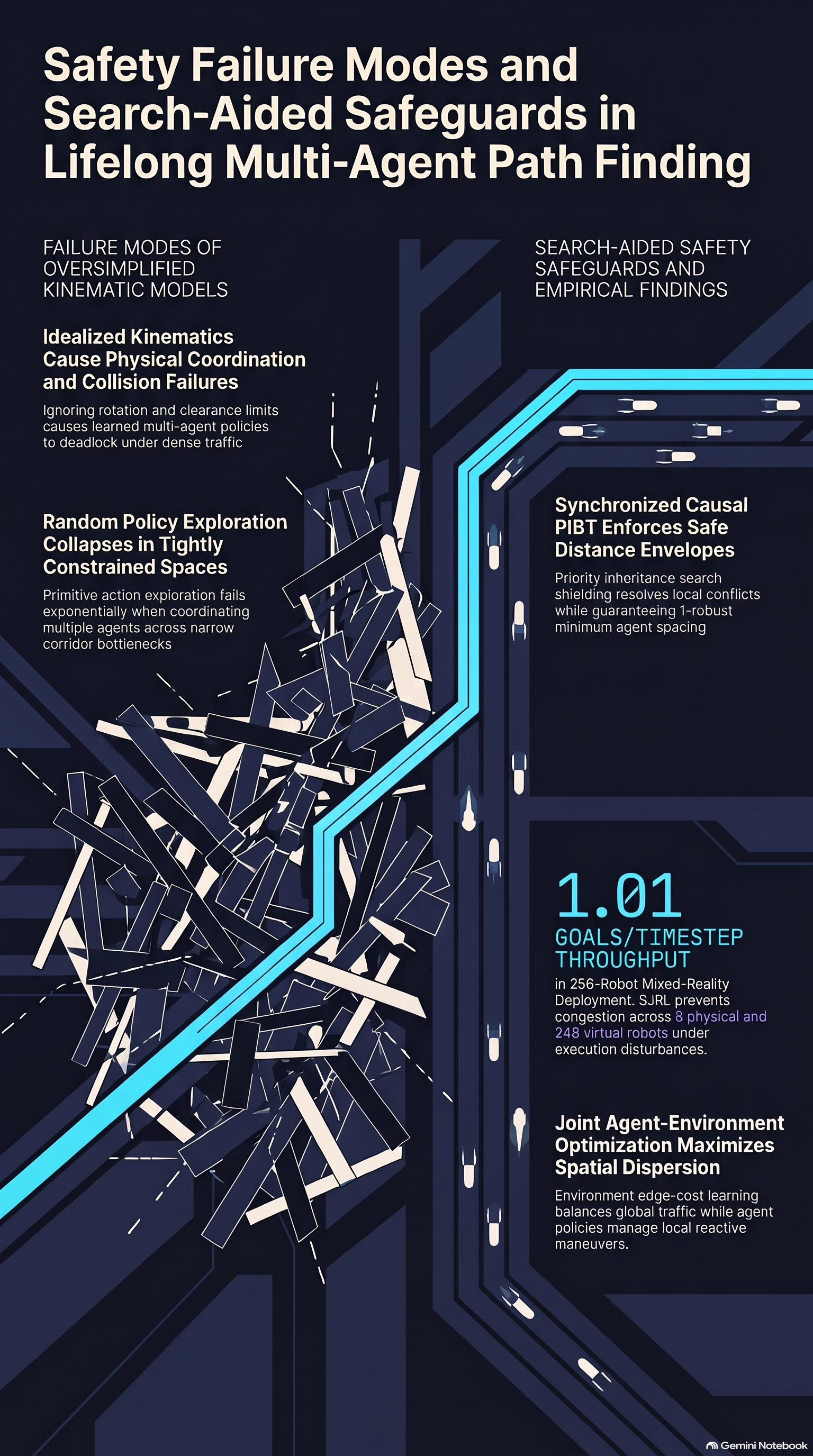
1. Introduction: The Reality Gap in Multi-Agent Robotics
In idealized Multi-Agent Path Finding (MAPF) simulations, multi-agent reinforcement learning (MARL) algorithms frequently achieve high throughput by assuming that agents are point-masses capable of instantaneous direction changes and zero-clearance spacing. However, deploying these learned policies into physical automated warehouses exposes a severe reality gap. Physical differential-drive robots encounter tight spatial clearance requirements, non-holonomic turning delays, and minimum distance buffer constraints. When evaluated under these physical constraints, standard neural policies trained under simplified abstractions suffer from widespread deadlocks, edge collisions, and severe throughput collapse.
To resolve these physical failure modes, Jiang et al. examine a realistic formulation termed the Lifelong Multi-Agent Path Finding with Rotations and Robust Safety Constraints (LMAPF-R2) model. To address the coordination and deadlock challenges introduced by this physical setting, the authors propose Search-Aided Joint Reinforcement Learning (SJRL). SJRL integrates neural learning with search-based safety layers and dynamic environment guidance graphs.
- Core Thesis: Pure end-to-end neural policies fail under realistic spatial and rotational constraints; bridging neural learning with deterministic search layers (Causal PIBT) and macro-level environment edge-cost guidance creates a scalable, deadlock-resistant framework for physical deployments.
2. The LMAPF-R2 Model: Modeling Kinematic Realism
Standard Lifelong MAPF (LMAPF) abstractions assume that an agent can step directly to any adjacent grid cell in a single discrete timestep. Jiang et al. demonstrate that this abstraction masks severe coordination failures when transferred to physical systems. To close this gap, the authors formulate LMAPF-R2, which incorporates physical motion and safety constraints directly into the planning graph .
| Dimension | Standard LMAPF Model | LMAPF-R2 Model (Jiang et al.) |
|---|---|---|
| Movement Assumptions | Instantaneous 1-step moves to adjacent cells; point-mass holonomic assumption. | Discrete orientation states ; non-holonomic movement. |
| Collision Definitions | Prohibits simultaneous occupation of a vertex at time (0-robust assumption). | Prohibits vertex collisions and following/edge collisions (1-robust safety constraint). |
| Rotational Overhead | Zero rotational delay. | turns require dedicated timesteps; traversing to an adjacent cell takes 1 to 3 timesteps depending on initial heading. |
| Deadlock Risk | Moderate; easily resolved by basic step-back or wait rules. | High; turning delays and safe clearance buffers create dense, cascading livelocks and corridor blockages. |
The core mechanics introduced by Jiang et al. in LMAPF-R2 are defined as follows:
- Robust Safety Constraints (1-Robust): The model explicitly prohibits vertex collisions and following collisions (including edge collisions where agents swap locations in a single timestep). A following collision occurs when an agent enters a vertex occupied by another agent in the preceding timestep. By enforcing a 1-robust constraint, LMAPF-R2 maintains a minimum safe physical buffer between moving agents. If a leading robot experiences an execution delay, trailing robots retain sufficient physical buffer to stop or re-plan safely without colliding.
- In-Place Rotational Constraints: To model non-holonomic differential-drive robots, agents possess a discrete orientation state . Valid primitive actions include moving forward, rotating clockwise, rotating counterclockwise, or waiting. Consequently, executing a movement to an adjacent cell requires 1 to 3 timesteps. This rotational overhead dramatically increases localized grid congestion and heightens the propensity for structural deadlocks.
3. Deep-Dive Architecture: Search-Aided Joint Reinforcement Learning (SJRL)
Jiang et al. address LMAPF-R2 by introducing Search-Aided Joint Reinforcement Learning (SJRL), an architecture that unifies local reactive agent policies, single-step search-based collision resolution, and global guidance graph optimization.
The interaction pipeline operates across three integrated operational layers:
- Environment Guidance Layer: An environment policy processes global map features and simulation statistics to generate edge cost distributions, running a backward Dijkstra search to construct full state-to-goal heuristic maps.
- Agent Decision Layer: Local agent policies process local view features alongside heuristic guidance (injected directly via network skip connections) to predict intended next-vertex subgoals.
- Search Safety Layer: Synchronized Causal PIBT intercepts agent subgoal predictions, applies single-step depth-first priority inheritance to resolve vertex conflicts and propagate movement intentions, and outputs safe subgoals for greedy execution.
3.1 Agent Policy & Synchronized Causal PIBT
To prevent early RL exploration from collapsing in dense environments, the agent policy predicts a high-level subgoal (the intended next vertex) rather than low-level primitive actions. This design creates a hierarchical policy: the neural network handles directional subgoals, while lower-level execution greedily executes turns and forward movements toward that vertex.
To guarantee safety and maintain coordination, agent states are explicitly segregated during each decision timestep:
- Busy Agents: Agents currently traversing an edge or completing rotational turns toward a previously selected subgoal. Their current physical vertices and targeted next vertices are locked as static obstacles ().
- Free (Idle) Agents: Agents currently located at a vertex that require a new subgoal choice (). Only free agents participate in active priority-based decision-making.
Neural subgoal predictions generated by free agents pass through a safety layer called Synchronized Causal PIBT:
- Collision Shielding: Free agents evaluate subgoals in priority order. If a proposed subgoal conflicts with a busy agent’s locked space (), the option is rejected.
- Intention Propagation: When a higher-priority free agent intends to move into a vertex occupied by a lower-priority free agent, Causal PIBT triggers priority inheritance. Via depth-first search, the lower-priority agent is pushed to an open neighbor or compelled to vacate its cell along a chain (). This propagates movement intentions down narrow corridors and warehouse aisles, enabling partially trained RL agents to move cohesively rather than stalling in deadlocks. Cyclic agent movements are explicitly prohibited to maintain robustness under LMAPF-R2 constraints.
3.2 Environment Policy & Global Guidance Graphs
While agent policies handle local reactivity, global traffic flow is managed by an environment policy modeled as a Convolutional Neural Network (CNN). The network processes map geometry alongside precomputed movement frequency statistics (normalized vertex and edge visitation frequencies from prior simulations).
- Edge Cost Generation: For every directed edge in the graph, the CNN outputs 10 channels representing the mean and variance of Gaussian distributions over edge costs (covering four movement directions and waiting per vertex). Edge costs are bounded within via an arctan transformation.
- Sampling vs. Inference Mechanics: During training, edge costs are sampled directly from the predicted Gaussian distributions to foster exploration of alternative traffic flows. During inference, the deterministic mean is used directly to construct stable guidance graphs.
- Backward Dijkstra Search: Edge costs generate state-to-goal heuristic distance maps via backward Dijkstra search, where each state represents a unique vertex-orientation pair .
- Skip Connections: To ensure global guidance directly shapes agent decisions, Jiang et al. incorporate skip connections into the agent architecture. These skip connections directly concatenate the calculated state-to-goal heuristic distances into the inputs of the CNN output layers and communication modules.
3.3 The Unified MDP & Joint Training Protocol
The authors formulate the system as a unified Markov Decision Process (MDP) co-optimized via Reinforcement Learning:
- Timestep 0: The environment policy samples edge costs for the map, generating global distance heuristic maps via backward Dijkstra search.
- Timesteps 1 to : Free agents evaluate local views (obstacle maps, priority maps, and heuristic features) to output desired vertex subgoals. Synchronized Causal PIBT resolves conflicts. Agents receive a reward of per executed primitive timestep, a goal progress reward, and a localized team reward calculated over a neighborhood.
- Disambiguation of Heuristic vs. Reward Distance Metrics: The formulation strictly distinguishes between two distance metrics:
- Goal Progress Reward Distance Metric : Used strictly in the reward function to measure true physical task progress between decision points, calculated as . Here, represents the unweighted minimum timestep distance (shortest physical timestep path) to the goal vertex.
- Movement Guidance Heuristic : Provided as an input feature to the agent policy network to guide directional choices. Here, represents the weighted heuristic distance derived from the CNN-generated edge costs.
- Training Schedule: Training follows a two-stage protocol:
- Warm-up Stage: Agent policies are trained for 16 iterations using fixed, uniform edge costs (5.5) to establish baseline reactivity.
- Joint Training Stage: Agent and environment policies are co-optimized for 128 iterations using Multi-Agent PPO (MAPPO) for the environment policy and standard PPO for agent policies.
4. Empirical Performance & Failure Mode Analysis
Jiang et al. evaluated SJRL across six benchmark maps representing diverse structural layouts: Warehouse (33x57, 20% density), Sortation (33x57, 16% density), Paris (64x64, 9% density), Empty (32x32, 25% density), Random-10 (32x32, 28% density), and Random-200 (32x32, 31% density), with agent counts ranging from 32 to 320. All reported figures reflect benchmark evaluations conducted by the authors:
-
Ablation Baseline Comparison (NORL, SARL, SERL vs. SJRL):
- NORL (Search-Only Causal PIBT): Throughput plateaus rapidly as agent density grows, suffering from local severe grid congestion.
- SERL (Environment RL Only) & SARL (Agent RL Only): Both single-component learning variants improve throughput over NORL. SERL balances macro-level traffic, while SARL optimizes local reactive clearing.
- SJRL (Joint RL): Consistently achieves the highest throughput across all six maps. In dense 256-agent evaluations, SJRL substantially outperforms single-component baselines by combining macro-level traffic balancing with micro-level intention propagation.
-
Failure Mode Analysis of Alternative Collision Shields (NACS & NVCS vs. Causal PIBT): To demonstrate the necessity of Causal PIBT’s intention propagation, the authors evaluated two naive collision shielding baselines:
- Naive Action-Based Collision Shielding (NACS): Agents predict primitive actions directly, using basic priority shielding without intention propagation. NACS collapses under dense conditions, yielding near-zero throughput (e.g., 0.12 on Random-10, 0.25 on Warehouse). Predict primitive actions creates an exponential exploration bottleneck in narrow corridors where agents fail to align movement choices.
- Naive Vertex-Based Collision Shielding (NVCS): Agents predict subgoals, but conflicts are resolved without priority inheritance. NVCS outperforms NACS (achieving 1.44 on Warehouse) but falls well short of Causal PIBT (2.82 on Warehouse). Without depth-first intention propagation, agents cannot push lower-priority neighbors out of long multi-cell aisles during early RL exploration.
-
Congestion Reduction (Mean Pairwise Distance - MPD): Measuring spatial dispersion via Mean Pairwise Distance (), the authors show that SJRL yields significantly higher MPD metrics than NORL or SARL (e.g., reaching 38.9 on Paris compared to NORL’s 26.2). The joint model spreads agents across parallel routes and multi-cell aisles, preventing dense bottlenecks.
-
Comparison with Standard SoTA Planners: When evaluated on a realistic differential-drive execution framework using Action Dependency Graphs (ADG), baseline learning planners designed for standard LMAPF—including SILLM, MAGAT+, and HMAGAT—exhibit throughput degradation due to their reliance on zero-rotation assumptions. SARL and SJRL outperform these state-of-the-art baselines, proving that training directly within the LMAPF-R2 formulation is critical for physical execution.
-
Impact of Guidance Graph Initialization (Expert Edge-Cost Priors): In Appendix C.2, Jiang et al. investigate the impact of human expert priors on warehouse and sortation maps (initializing narrow aisle edge costs to alternating 3/7 values for one-way traffic versus uniform 5.5 costs). Initializing guidance graphs with expert edge costs significantly improved performance across all planners. However, SJRL trained from scratch failed to match the performance of SJRL initialized with expert priors. This reveals that standard PPO initialized from scratch can get trapped in local optima during joint agent-environment learning, highlighting an important optimization stability challenge in joint RL pipelines.
-
Mixed-Reality Deployment: To evaluate physical execution boundaries under sensor disturbance and mechanical noise, Jiang et al. deployed SJRL to a mixed-reality warehouse testbed. The setup combined 8 physical differential-drive robots tracked by an OptiTrack motion capture system with 248 virtual robots managed by the P3GASUS execution framework.
In this 256-agent mixed-reality deployment, mean throughput metrics scaled as follows:
- NORL (Causal PIBT):
- SERL (Environment RL):
- SARL (Agent RL):
- SJRL (Joint RL):
5. Critical Takeaways for AI Safety and Robotics Practitioners
The findings presented by Jiang et al. offer crucial lessons for researchers evaluating multi-agent safety, failure modes, and hardware deployment:
- Abstraction Risks in Safety-Critical Evaluation: Evaluating multi-agent reinforcement learning under simplified kinematic models (e.g., zero-cost turns, zero-clearance rules) creates a false sense of policy reliability. Abstract models hide severe deadlock states and cascading livelocks that emerge immediately upon deployment to physical hardware. Safety evaluations must incorporate realistic kinematic constraints like LMAPF-R2.
- Hybrid Neural-Search Safety Envelopes: Pure neural networks struggle to guarantee collision avoidance and deadlock resolution during open-ended multi-agent exploration. Integrating deterministic search algorithms (such as Causal PIBT) directly into the MDP loop acts as a safety shield. It converts hazardous neural exploration into valid subgoal choices while maintaining formal collision-free guarantees and resolving corridor bottlenecks via depth-first intention propagation.
- Joint Agent-Environment Co-Design and Optimization Dynamics: Co-optimizing environment-level structural guidance (edge-cost generation) alongside reactive local agent policies yields superior system robustness over pure agent-level communication. However, joint optimization pipelines exhibit sensitivity to initial edge-cost conditions, demonstrating that human expert priors or structured initialization remain necessary to prevent joint RL policies from settling into local optima.
Read the full paper on arXiv · PDF