Failing Gracefully: Mitigating Impact of Inevitable Robot Failures
The authors present a safety formulation that evaluates the probability and severity of collisions during robot failures, alongside FailBench, a MuJoCo simulation framework for evaluating...
1. Introduction: The Reality of Malfunctions in Shared Spaces
As service robots are increasingly deployed in household environments, they are expected to perform complex tasks such as cleaning, fetch-and-deliver, and cooking alongside humans, pets, and fragile everyday objects. In these dynamic, unconstrained settings, physical and operational failures—ranging from dropped objects and spilled liquids to mechanical joint collapse or full power failure—are fundamentally inevitable. These malfunctions stem from hardware degradation, software bugs, unpredictable environmental dynamics, or low-level physical disturbances that cannot be entirely anticipated or prevented.
In the paper “Failing Gracefully: Mitigating Impact of Inevitable Robot Failures”, authors Duc M. Nguyen, Saad A. Ghani, Andrew Marshall, Allison Andreyev, Gregory J. Stein, and Xuesu Xiao highlight a critical limitation in traditional safety frameworks: existing approaches focus almost exclusively on failure prevention and task completion. Conventional safety filtering methods, such as control barrier functions or workspace inflation (“no-go zones”), attempt to avoid failure entirely. However, inflating safety margins excessively restricts the robot’s operational space and compromises task efficiency, while failing to address what happens when an unpreventable hardware fault occurs during execution.
To address this limitation, Nguyen et al. introduce a core conceptual shift: moving from pure failure prevention toward active damage containment and impact mitigation. Rather than assuming failures can be completely eliminated, the paper formalizes a planning objective that explicitly evaluates the physical consequences of malfunctions, allowing robots to make informed decisions that balance operational efficiency against potential harm.
2. The Failure Impact Safety Formulation
To evaluate and minimize the risks associated with unavoidable malfunctions, Nguyen et al. propose a formal mathematical structure for failure impact assessment.
2.1 Workspace and Component Division
The framework categorizes the robot and its workspace into distinct components and environmental entities to evaluate localized interaction risks:
- Hazardous Robot Components (): The robot system is divided into three primary sources of hazard:
- : The robot body itself.
- : The object held in the end-effector (e.g., a cup or container).
- : The contents inside the carried object (e.g., hot liquids).
- Environment Entities (): Any static or dynamic agent or item in the surrounding environment that could be impacted during a failure, including humans, pets, furniture, and surrounding objects.
       +-------------------------------------------------------+
       |                  ROBOT WORKSPACE                      |
       |                                                       |
       |   +-------------------+       +-------------------+   |
       |   | Robot Components  |       | Environment       |   |
       |   | R = {r1, r2, r3}  |       | Entities E = {ei} |   |
       |   |                   |       |                   |   |
       |   |  r1: Robot Body   |       |  e1: Humans       |   |
       |   |  r2: Carried Object|      |  e2: Pets         |   |
       |   |  r3: Liquid Content|      |  e3: Furniture    |   |
       |   +---------+---------+       +---------+---------+   |
       +-------------|---------------------------|-------------+
                     +-------------+-------------+
                                   |
                                   v
                      [ Interaction & Severity ]
2.2 Quantifying Impact (Probability vs. Severity)
The failure impact of an accident is decomposed into two distinct elements:
-
Interaction Probability (): Denoted as , this represents the likelihood that robot component will collide with or impact entity given robot state when a failure occurs. In the paper’s implementation, interaction probabilities for object drop failures are calculated using Algorithm 1, which evaluates the geometric overlap area () between the projected axis-aligned bounding boxes of robot geoms and environment entity geoms in the horizontal () plane, combined with a vertical -axis height filter. Step 6 of Algorithm 1 explicitly calculates this interaction probability as:
Here, the probability is defined as the maximum ratio of the 2D overlap area () normalized independently against both the robot component geom area () and the environmental entity geom area ().
-
Severity Factor (): Quantifies the physical damage or harm resulting from an interaction. This factor ensures that high-consequence events (e.g., spilling hot liquid on a human) are weighted significantly higher than low-consequence events (e.g., dropping a soft item on a floor).
The table below illustrates hypothetical interaction categories alongside their exact mapping to the numerical severity assignments used in the paper’s experimental tabletop benchmark:
| Robot Component () | Environment Entity () | Relative Severity Factor | Benchmark Entity Mapping | Impact Rationale |
|---|---|---|---|---|
| Carried Object () | High-Risk / Fragile Entity | High () | Red Objects | Drops onto high-vulnerability targets cause severe property or personal damage. |
| Contents (: Hot Liquid) | Human () | High () | High-Risk Region | High potential for thermal burns and personal injury. |
| Carried Object () | Standard Entity / Surface | Standard () | White Objects | Low-severity impact on neutral, non-fragile surfaces. |
| Contents (: Iced Water) | Floor () | Low () | Clear Table Surface | Minor operational cleanup; negligible physical damage potential. |
2.3 Optimization Objective
Nguyen et al. integrate failure impact directly into trajectory generation. The motion planner minimizes a combined cost function balancing task completion efficiency against expected failure severity across time steps :
Where:
- is the transition/motion cost between consecutive robot states (e.g., cumulative Euclidean distance in configuration space).
- is a weighting scalar balancing motion efficiency against failure safety (set to in the empirical evaluation).
- represents the expected failure impact at state .
3. FailBench: Standardizing Fault Injection in MuJoCo
To systematically evaluate how motion policies behave under unexpected physical malfunctions, the authors introduced FailBench, an open-source simulation platform built on the MuJoCo physics engine.
+-----------------------------------------------------------------------+
|                              FAILBENCH                                |
|                                                                       |
|  +--------------------+  +----------------------+  +---------------+  |
|  | Hardware & Scenes  |  |   Motion Planners    |  | Real-Time     |  |
|  | - Clearpath Jackal |  | - Search/Sampling    |  | Failure       |  |
|  | - Fetch Manipulator|  |   (A*, RRT*, STOMP)  |  | Injector      |  |
|  | - Franka Panda Arm |  | - Kinematics (Mink)  |  | Framework     |  |
|  +---------+----------+  +----------+-----------+  +-------+-------+  |
+------------|------------------------|----------------------|----------+
             +------------------------+----------------------+
                                      |
                                      v
                        [ High-Fidelity Dynamics ]
                        [ Contact Force Tracking  ]
Key Capabilities and Architecture
- Embodiments and Environments: Includes pre-configured robot models (Clearpath Jackal mobile base, Fetch mobile manipulator, and Franka Emika Panda arm) alongside household scenes and curated object meshes.
- Planning Suite: Features integrated implementations for navigation (A*, Dijkstra, DWA) and arm manipulation (PRM, RRT, RRT*, RRTConnect, TRRT, STOMP, CHOMP) leveraging Mink for differential inverse kinematics.
- Physics-Based Fault Injection: Unlike traditional approaches that merely introduce Gaussian noise to control signals, the FailBench Failure Injector modifies underlying MuJoCo simulation parameters in real time—altering actuator gains, mechanical constraints, joint friction, and sensor feedback to reflect true physical hardware failures.
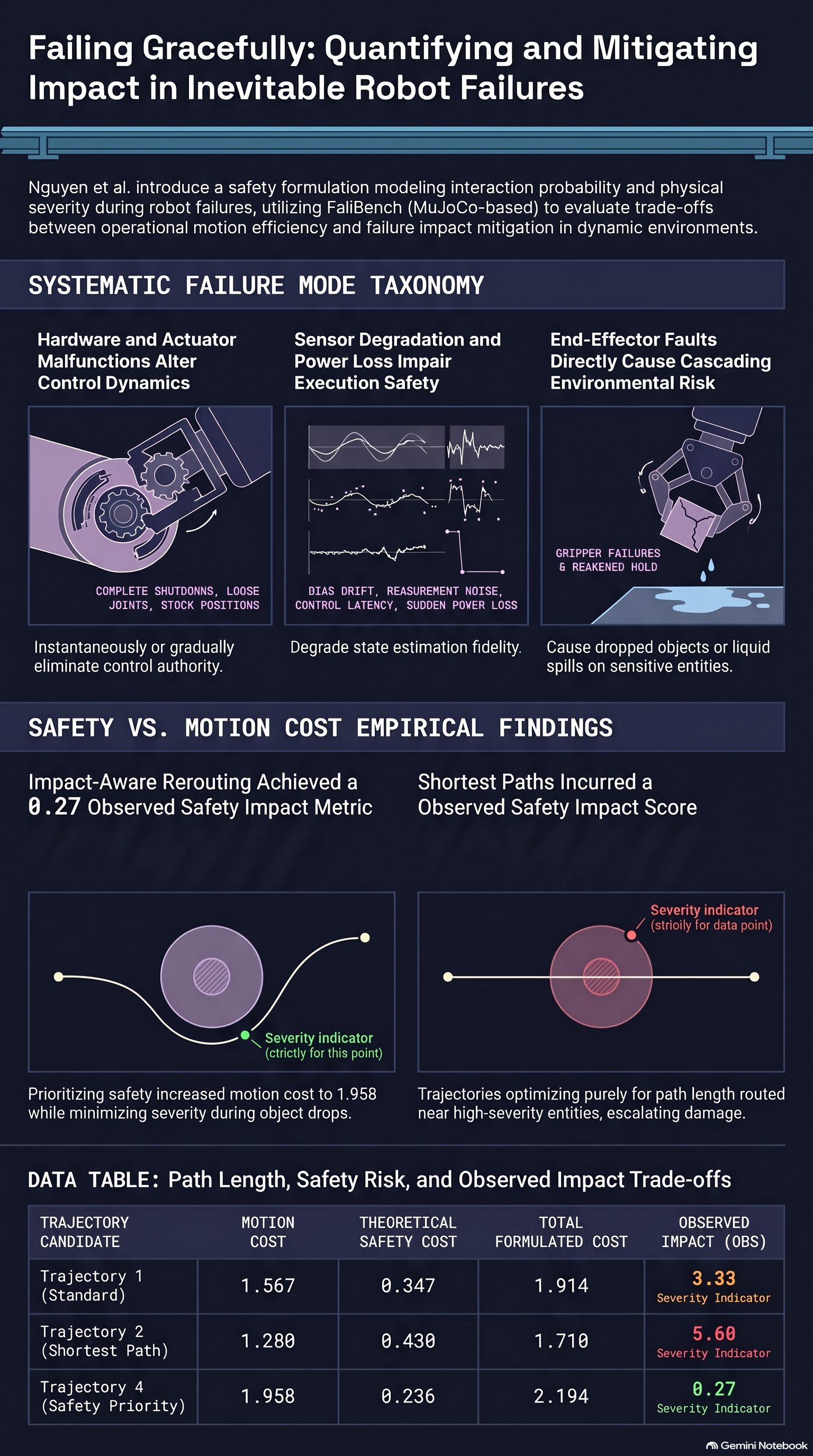
- Contact Event Tracking: Measures post-failure impacts by extracting exact contact point positions and normal forces directly from MuJoCo dynamics. For example, during a full shoulder joint shutdown, the manipulator undergoes gravitational collapse and strikes surrounding obstacles; FailBench detects these collision events and extracts the exact contact vectors (visualized as yellow contact points and corresponding force arrows in simulation) to quantify physical damage.
Taxonomy of Injectable Failure Modes
FailBench organizes hardware and software failures across four structural categories, parameterized by onset pattern (Instant vs. Gradual), duration (temporary vs. permanent), and severity degree:
| Category | Failure Type | Onset Pattern | Mechanical / Physical Description |
|---|---|---|---|
| Actuator Failures | Complete Shutdown | Instant | Total removal of control authority (simulating driver loss or emergency stop). |
| Loose Joint | Gradual | Reduction in joint damping and control precision from mechanical backlash. | |
| Limited ROM | Instant | Hardware boundary restriction imposing reduced joint motion limits. | |
| Partial Degradation | Gradual | Time-progressive drop in actuator authority. | |
| Gradual Degradation | Gradual | Slow deterioration of motor performance over task execution. | |
| Stuck Position | Instant | Motor lock-up holding joint at current position. | |
| Increased Friction | Gradual | Elevated joint resistance modeling mechanical wear. | |
| Sensor Failures | Noisy Sensor | Gradual | Additive noise injected into joint position feedback. |
| Bias Drift | Gradual | Accumulating systematic offset in state measurement. | |
| Control Delay | Gradual | Network or computational latency added to the control loop. | |
| Sensor Dropout | Instant | Intermittent loss of sensor feedback signals. | |
| Scale Factor Error | Gradual | Miscalibrated gain scaling on sensor output. | |
| Dead Zone | Instant | Unresponsive feedback band within specific measurement ranges. | |
| End-Effector Failures | Gripper Failure | Instant | Immediate breakdown of end-effector holding mechanisms. |
| Weak Grip | Gradual | Progressive decrease in applied grasping force. | |
| Stuck Open/Closed | Instant | Mechanical jamming of gripper fingers in fixed positions. | |
| Power System Failures | Battery Degradation | Gradual | Steady drop in available operating power over time. |
| Voltage Drop | Gradual | Insufficient voltage delivery impairing actuator performance. | |
| Power Loss | Instant | Complete system shutdown causing passive gravitational collapse. |
4. Empirical Evaluation: Motion Efficiency vs. Failure Mitigation
Nguyen et al. evaluated their safety formulation on a tabletop pick-and-place task using a Franka Emika Panda robot arm simulated in FailBench.
       [Pick: Green Object]
               |
     +---------+---------+
     |                   |
[Direct Route]    [Detour Route]
(Over Red Objects) (Over Clear Table)
     |                   |
     v                   v
Trajectory 2        Trajectory 4
(Low Motion Cost,   (High Motion Cost,
 High OBS Damage)    Low OBS Damage)
     |                   |
     +---------+---------+
               |
               v
       [Place: Blue Object]
Experimental Setup
The task required the robot arm to pick up a green object from a tabletop and place it onto a blue target object. The tabletop surface contained an array of intermediate entities assigned distinct severity values:
- Red Objects: High-severity entities ().
- White Objects: Standard-severity entities ().
Four candidate trajectories (Trajectories 1–4) were sampled using RRT-Connect across distinct motion paths. To empirically measure safety, each trajectory was executed across 60 simulation trials with an injected 25% object-drop failure probability per run (where the time step of the drop failure was randomly selected). The Observed Safety (OBS) metric represents the empirical average safety impact measured across all 60 simulation runs.
Trajectory Performance Comparison
The empirical metrics from the study (recreating Table II from the paper) illustrate distinct trade-offs between path length, theoretical safety predictions, and empirical damage:
| Trajectory Metric | Trajectory 1 (Light Blue) | Trajectory 2 (Orange) | Trajectory 3 (Pink) | Trajectory 4 (Green) |
|---|---|---|---|---|
| Motion Cost | 1.567 | 1.280 | 1.359 | 1.958 |
| Theoretical Safety Cost | 0.347 | 0.430 | 0.363 | 0.236 |
| Total Combined Cost | 1.914 | 1.710 | 1.722 | 2.194 |
| Observed Safety (OBS) | 3.330 | 5.600 | 0.400 | 0.270 |
Results Analysis and Discrepancies
The empirical evaluation highlighted crucial spatial and physical relationships between path geometry and post-failure outcomes:
- Spatial Cause of Empirical Damage (Trajectory 2 vs. Trajectory 4):
- Trajectory 2 (Orange) takes a direct, low-distance route that passes directly over the row of high-severity red objects (). Consequently, when an object drop occurs mid-trajectory, the falling item lands directly on or tumbles into high-severity objects, causing severe physical damage in MuJoCo ().
- Trajectory 4 (Green) executes a wide lateral detour around the high-severity objects, keeping the end-effector positioned over clear table space (). Even when an object is dropped mid-trajectory, it falls onto neutral table space, resulting in near-zero empirical damage ().
- Safety Maximization vs. Operational Overhead: Trajectory 4 achieves the lowest theoretical safety cost (0.236) and lowest empirical impact (OBS 0.270), but incurs the highest motion cost (1.958), leading to the highest overall combined cost (2.194).
- Optimal Combined Balance: Trajectory 2 provides the shortest path (Motion Cost 1.280) and lowest total combined cost (1.710), despite suffering high empirical damage when failures occur.
Theoretical vs. Empirical Discrepancies
Discrepancies between theoretical safety costs and empirical OBS metrics (notably in Trajectory 2, where theoretical cost is 0.430 but empirical OBS reaches 5.600) stem from two primary factors:
- Simplified 2D Projection Assumptions: Algorithm 1 relies on 2D planar projection bounding boxes to compute interaction probability , which ignores complex 3D orientational changes and rotational dynamics during object release.
- Post-Failure Physics Dynamics: Geometric overlap bounding boxes do not model post-release dynamic behavior—such as tumbling, secondary bounces, or multi-body sliding collisions—that occur inside a full physics simulator like MuJoCo.
5. Challenges and Future Research Directions
Nguyen et al. outline four primary research directions for advancing failure-aware robotics:
- Environmental Knowledge Requirements: The current formulation assumes prior knowledge of object identities and severity factors. Future work aims to integrate Vision-Language Models (VLMs) to automatically inspect 3D visual scenes, infer material properties (e.g., fragility, liquid temperature), and dynamically assign semantic severity metrics without manual pre-labeling.
- Complex Interaction Modeling: Geometric overlap models (such as 2D bounding boxes) offer computational efficiency but fail to capture multi-body physical dynamics. The authors propose training neural network interaction models directly on FailBench contact datasets or using physical world models and latent-space Hamilton-Jacobi reachability analysis to capture high-fidelity post-failure dynamics.
- Integration with Motion Planners: Incorporating failure severity into trajectory optimization introduces discontinuous, non-convex cost landscapes that present convergence challenges for standard optimization planners (e.g., CHOMP and STOMP) and sampling efficiency problems for RRT variants. Future work will investigate planning within smooth latent representations.
- Task-Level Failure Awareness: To achieve comprehensive safety, failure impact analysis must expand beyond low-level trajectory generation into high-level Task and Motion Planning (TAMP). Reasoning about failure severity at the task level would allow robots to modify multi-step action sequences (e.g., fetching protective transport containers before moving hazardous items).
6. Summary and Key Takeaways
- Shift to Consequence Containment: Nguyen et al. demonstrate that because hardware and environmental failures are inevitable in real-world service robotics, motion planners must explicitly quantify and minimize the physical impact of failures rather than relying solely on fault prevention or workspace restriction.
- Standardized Benchmarking via FailBench: FailBench provides an open-source MuJoCo framework for evaluating graceful degradation policies, offering realistic, physics-level fault injection across actuator, sensor, end-effector, and power systems.
- Explicit Safety-Efficiency Trade-offs: Incorporating failure severity metrics allows planners to quantitatively balance shortest-path efficiency against damage containment, enabling customizable behaviors based on environmental vulnerability.
Read the full paper on arXiv · PDF