SAFECAST: Robust Failure Detection for VLA Policies with Contrast-Set Training and Calibration
The paper introduces SAFECAST, a method that uses visual and language contrast-set perturbations to train and calibrate hidden-state risk probes for detecting deployment-time failures in...
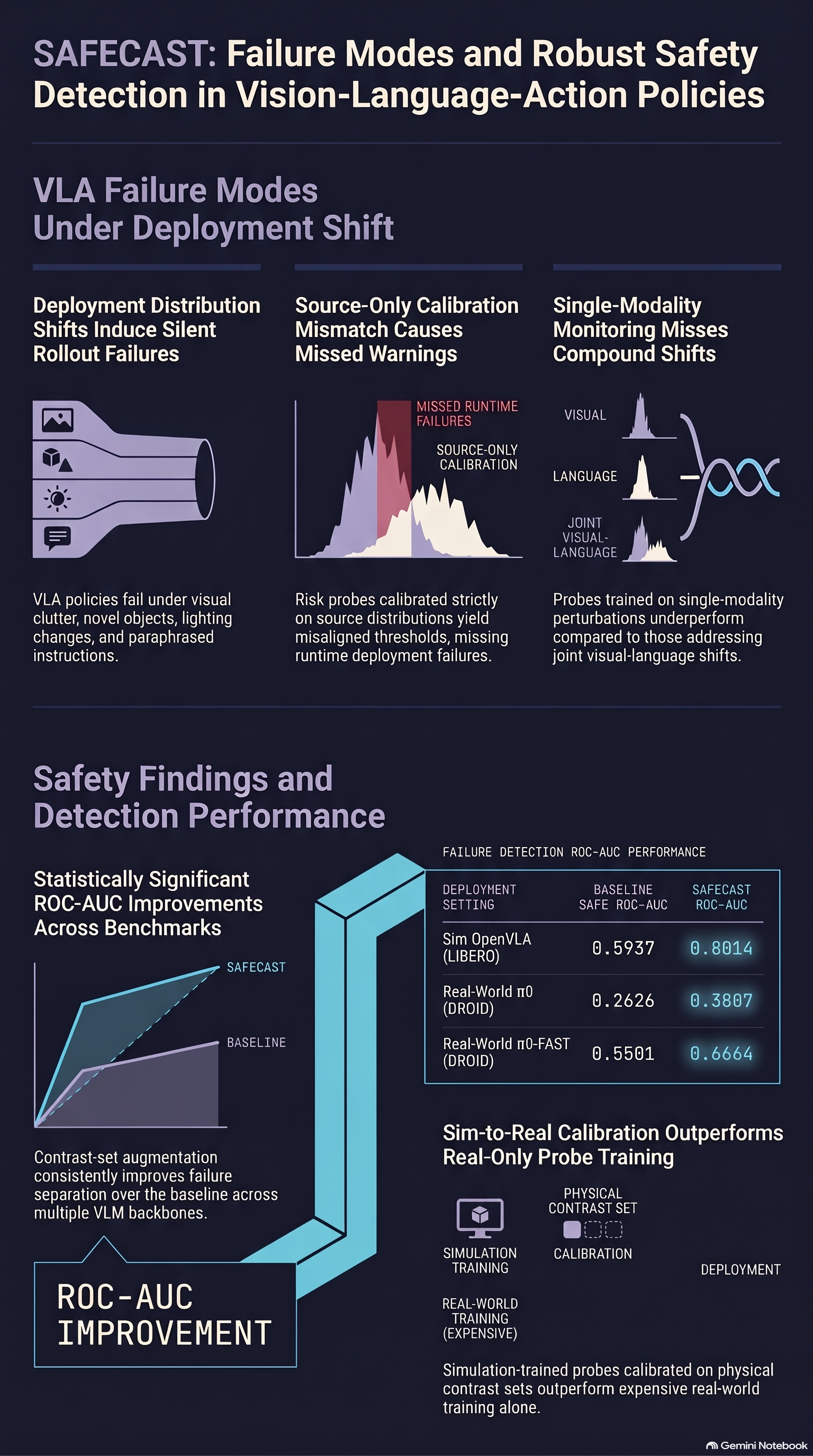
1. Introduction: The Silent Failure Problem in VLA Deployment
Vision-Language-Action (VLA) policies, such as OpenVLA and , represent a major shift in robotic manipulation by directly mapping visual observations and natural language instructions to low-level motor actions. Despite their impressive task capabilities, these multimodal models remain acutely vulnerable to silent execution failures when deployed in real-world environments. Subtle, everyday distribution shifts—such as altered tabletop lighting, background clutter, novel surface textures, or minor variations in instruction phrasing—can cause a policy that succeeded in training to fail during physical rollout without triggering an explicit system exception or software error.
To detect these execution failures before unrecoverable damage occurs, baseline monitoring frameworks such as ScAlable Failure Estimation (SAFE) probe the internal hidden representations of frozen VLA policies. By coupling lightweight hidden-state risk probes with functional conformal prediction, SAFE computes time-varying risk thresholds to flag unsafe rollouts in real time. However, Rajaprakash et al. identify a foundational bottleneck in this paradigm: vanilla conformal prediction relies on the mathematical assumption that deployment-time trajectories are exchangeable with calibration trajectories. When conformal thresholds are calibrated strictly on clean, source-distribution data, this exchangeability assumption breaks down under deployment shifts. Consequently, the distribution of internal hidden-state risk trajectories shifts, causing source-calibrated thresholds to become severely misaligned and leading to delayed or missed failure warnings.
To resolve this calibration mismatch, Rajaprakash et al. introduce SAFECAST (ScAlable Failure Estimation with Contrast-Set Augmentation for Safety Tracking). The core thesis of SAFECAST is that augmenting hidden-state probe training and conformal calibration with visual and language contrast-set trajectories establishes robust, time-varying risk monitoring under multimodal deployment shifts. By systematically re-executing the frozen VLA policy across targeted input perturbations, SAFECAST constructs training and calibration distributions whose internal risk trajectories closely approximate the structural shifts encountered during physical deployment.
2. The Core Architecture: Hidden States, Conformal Thresholds, and Contrast Sets
The SAFECAST architectural pipeline operates on a frozen VLA policy, ensuring that the base policy weights remain unmodified throughout probe training, conformal calibration, and test-time execution. The framework consists of three principal technical components:
-
Hidden-State Risk Probing:
- Let denote a frozen VLA policy executing a task over a time horizon . At each timestep , the policy processes a visual observation and a language instruction to produce a pre-final-layer hidden representation .
- A lightweight Multi-Layer Perceptron (MLP) probe maps this hidden representation to a scalar failure risk score:
- Evaluating at every execution step yields a temporally aligned risk trajectory that tracks the ongoing rollout’s propensity for failure.
-
Functional Conformal Prediction:
- Using successful calibration trajectories, functional conformal prediction computes nonconformity scores to establish a time-varying, one-sided risk threshold curve: where represents the mean risk score across successful calibration rollouts at timestep , and is the -quantile of the calibrated nonconformity score distribution.
- The parameter defines the conformal significance level, which dictates the operational risk tolerance of the system.
- Threshold Behavior: There is an inverse relationship between and threshold height. Lower values of (e.g., ) construct higher risk thresholds , resulting in permissive operation with minimal false alarms. Conversely, higher values of (e.g., ) construct lower risk thresholds , aggressively flagging rollouts for conservative deployment.
- At deployment time, the monitor triggers an unsafe warning as soon as .
-
Contrast-Set Perturbations:
- Contrast-set trajectories () are generated by re-executing the frozen VLA policy under systematically perturbed visual or language inputs without altering the base VLA weights.
- Because the policy actively interacts with the environment during re-execution, the resulting trajectory diverges in both action space and hidden-state space from the original rollout.
- These trajectories populate an augmented dataset , which is leveraged to enhance probe training () and conformal calibration ().
The specific contrast-set perturbation categories detailed by Rajaprakash et al. are summarized in the table below:
| Perturbation Category | Implementation Mechanism (Simulation / Real) | Safety Target |
|---|---|---|
| Visual Distractors & Context Shifts | Sim: Inserting non-target distractor objects into LIBERO-Spatial scenes; MuJoCo photometric lighting adjustments (warm_dim, cool_bright, low_light); tabletop texture shifts (red, blue, marble).Real: Introducing plush toys, markers, or secondary containers; background surface shifts (black/white table covers); altered initial object layouts. | Ensure hidden-state risk probes remain invariant to task-irrelevant visual clutter and photometric variations, maintaining failure detection accuracy without modifying BDDL task goals. |
| Language Reformulations & Negations | Sim: Generating semantically equivalent task paraphrases via ChatGPT 5.1 Instant; converting commands to passive voice; applying goal-preserving negation templates (neg except).Real: Prompting ChatGPT 5.1 for paraphrased commands, passive phrasings, or distractor instructions. | Verify that failure probes evaluate underlying task semantics rather than memorizing brittle command syntax or specific surface-level instruction phrasings. |
| Joint Visual-Language Shifts | Sim & Real: Simultaneously applying visual context perturbations (distractors and surface texture shifts) alongside paraphrased or negated language instructions during rollout re-execution. | Approximate complex, multimodal deployment conditions where visual and linguistic distribution shifts occur concurrently during real-world execution. |
Dynamic Time Warping (DTW) Active Rejection
To prevent spatially redundant trajectories from dominating the contrast-set training set , Rajaprakash et al. utilize an active rejection filtering procedure governed by Dynamic Time Warping (DTW), detailed in Algorithm 1 of the paper:
- Trajectory Normalization: Candidate rollouts are represented by their sequence of 3D robot end-effector positions and translation-normalized by subtracting the initial 3D position vector ().
- FastDTW Evaluation: FastDTW using Euclidean distance is computed between the candidate trajectory and all previously accepted trajectories within the exact same task and outcome class . The distance is normalized by the optimal warping path length.
- Class-Balanced Active Filtering: Candidates exhibiting a minimum normalized DTW distance below are rejected as near-duplicates. Crucially, candidate contrast rollouts are maintained in separate success () and failure () pools per task. Trajectories are rejected not merely for spatial similarity, but to prevent single-outcome class dominance in the contrast training set .
3. Empirical Performance: Benchmarks & Breakdown
Rajaprakash et al. evaluate SAFECAST across physical Franka/DROID platforms (using fine-tuned and zero-shot -FAST) and the LIBERO simulation benchmark (evaluating OpenVLA and trained on LIBERO-Spatial and tested on LIBERO-Plus deployment shifts).
The table below presents quantitative failure detection performance across evaluation suites. F1-scores and cumulative ROC-AUC metrics are averaged across the full conformal significance sweep over 30 random seeds:
| Method | Sim- F1 | Sim- ROC-AUC | Sim-OpenVLA F1 | Sim-OpenVLA ROC-AUC | Real- F1 | Real- ROC-AUC | Real--FAST F1 | Real--FAST ROC-AUC |
|---|---|---|---|---|---|---|---|---|
| Always Guess Failure | 0.5266 | 0.0000 | 0.8314 | 0.0000 | 0.7322 | 0.0000 | 0.7654 | 0.0000 |
| SAFE (Baseline) | 0.7132 | 0.3267 | 0.8589 | 0.5937 | 0.4085 | 0.2626 | 0.7475 | 0.5501 |
| SAFECAST-TrainAug | 0.7516 | 0.4278* | 0.8687 | 0.6514 | 0.5838 | 0.2649 | 0.8109 | 0.6621* |
| SAFECAST-CalAug | 0.7373 | 0.4382* | 0.8628 | 0.6782* | 0.4480 | 0.3415* | 0.7534 | 0.6578* |
| SAFECAST (Full) | 0.7528 | 0.4469* | 0.8728 | 0.8014 | 0.5412 | 0.3807* | 0.8053 | 0.6664* |
* Indicates statistically significant ROC-AUC improvements over baseline SAFE verified by seed-paired t-tests with Bonferroni correction ( hypothesis tests, adjusted significance threshold ).
Statistical Significance Clarification: In the Sim-OpenVLA benchmark, SAFECAST (Full) achieves the highest absolute ROC-AUC score (). However, as documented in the source text’s Table 6, its raw seed-paired t-test p-value was . Because this value did not cross the strict Bonferroni-corrected significance threshold (), it does not carry an asterisk despite outperforming all baseline variants in absolute magnitude.
Narrative Breakdown of Empirical Findings
-
Finding 1: Outperforming Vanilla SAFE & Mechanistic Probe vs. Calibration Split Across simulation and physical deployments, contrast-set-aware training and calibration consistently outperform vanilla SAFE across all operational risk tolerances. On the physical DROID platform under multimodal shift, full SAFECAST improves failure detection F1 from 0.4085 to 0.5412 and ROC-AUC from 0.2626 to 0.3807. On -FAST, SAFECAST increases ROC-AUC from 0.5501 to 0.6664.
The paper reveals a fundamental mechanistic split between policy backbones:
- Fine-tuned benefits primarily from probe training (
TrainAug): Fine-tuning on a narrow demonstration set (20 teleoperated spatial pick-and-place trajectories) creates narrow internal hidden representations. Exposing the probe to contrast-set rollouts during training is necessary to force representation learning toward separable failure features. - Pretrained -FAST benefits primarily from conformal calibration (
CalAug): Zero-shot -FAST possesses broad, expressively rich pretrained representations. Its primary failure detection bottleneck is not feature learning, but severe calibration mismatch under deployment shifts. Consequently, calibrating conformal thresholds on contrast sets yields the primary performance gain.
Base Policy Failure Prevalence Context: As detailed in Appendix F.9, base policy success rates on the deployment evaluation set (LIBERO-Plus) vary drastically between models: achieves a 64.3% success rate (35.7% failure prevalence), whereas OpenVLA achieves only a 28.8% success rate (71.1% failure prevalence). Because failure detection treats failed rollouts as the positive class, high positive-class prevalence inflates naive baselines (e.g.,
Always Guess Failureachieves an F1 of 0.8314 on OpenVLA vs. 0.5266 on ). Evaluating metrics across full sweeps isolates true success/failure separability from class-prevalence artifacts. - Fine-tuned benefits primarily from probe training (
-
Finding 2: The Synergistic Value of Joint Visual-Language Contrast Sets Ablation experiments confirm that joint multimodal contrast sets provide superior detection capabilities compared to single-modality perturbations. On OpenVLA, evaluating peak F1-scores shows that visual-only contrast sets achieve a peak F1 of 0.922 (mean F1 = 0.871) and language-only contrast sets achieve a mean F1 of 0.872, whereas joint visual-language contrast sets reach a peak F1 of 0.959 (mean F1 = 0.873). For simulation , mean F1 increases from 0.649 (visual-only) and 0.664 (language-only) to 0.753 under joint visual-language augmentation. Exposing failure probes to the joint perturbation space prevents them from relying on brittle, single-modality shortcuts.
-
Finding 3: Practical Sim-to-Real Calibration Transfer To eliminate the high cost of collecting physical failure rollouts, Rajaprakash et al. evaluate a sim-to-real calibration pipeline using the physical Franka/DROID setup with the backbone. In this experiment, the hidden-state risk probe is trained entirely on simulation rollouts (LIBERO-Spatial), while functional conformal calibration is performed on a small set of real-world contrast-set rollouts (DROID). Evaluated on physical deployment rollouts under shift, this sim-to-real transfer configuration achieves an F1 of 0.523 and an ROC-AUC of 0.410, substantially outperforming a probe trained and calibrated exclusively on real-world data (, ). This demonstrates that synthetic contrast rollouts can supply expressive feature representations, reserving scarce physical execution budgets for final conformal calibration.
4. Methodological Limitations & Future Horizons
Methodological Limitations
The authors explicitly outline four primary technical and operational limitations of the SAFECAST framework:
- Distributional Bounds: Failure detector reliability remains bounded by the coverage of the generated contrast sets. If a robot encounters out-of-distribution conditions that lie entirely outside the generated perturbation space (e.g., unmodeled physical contact dynamics or radical structural changes), probe calibration can still degrade.
- Rollout Overhead: Collecting contrast-set trajectories requires re-executing the frozen VLA policy across perturbed environments, introducing non-trivial computation and data collection costs.
- Theoretical Guarantees: While contrast sets empirically mitigate calibration mismatch under deployment shifts, they do not restore formal conformal exchangeability guarantees under arbitrary, unconstrained distribution shifts.
- The Perturbation Selection Trap (Uncurated Contrast Expansion): As revealed in Appendix F, naively pooling all possible perturbation families (such as anti-goal reversals or exhaustive visual/texture permutations) degrades probe performance compared to targeted distractor object and language paraphrase contrast sets. Furthermore, anti-goal perturbations (instructing the robot not to perform the task) drop base policy success rates from the 90% range to the 50% range without providing useful failure calibration data.
Future Horizons
To address these challenges, the paper outlines two promising research directions:
- Adaptive Online Contrast Construction: Developing automated perturbation generators that construct visual and linguistic contrast rollouts dynamically online, conditioned on real-time probe uncertainty or newly observed execution failure modes.
- Human-in-the-Loop Integration: Integrating calibrated risk thresholds directly into supervisory control loops. When runtime failure scores breach calibrated thresholds (), execution can automatically halt to request human intervention. The resulting corrective teleoperation rollouts can then be ingested back into the dataset to refine both policy control and safety probe calibration.
5. Key Takeaways for AI Safety Practitioners
- Calibration Mismatch is a Silent Killer: Source-calibrated conformal thresholds fail under real-world deployment shifts. Safety monitors must be evaluated across sweeps of operational risk tolerances () rather than fixed, in-distribution calibration targets.
- Multimodal Coverage is Non-Negotiable: Training or calibrating failure probes on isolated visual or linguistic perturbations is insufficient. Robust deployment monitoring requires exposing safety probes to joint visual and linguistic contrast sets.
- Simulation Data Reduces Real-World Burden: Training hidden-state probes on synthetic simulation contrast sets and calibrating them on a small physical contrast dataset outperforms training and calibrating probes on physical rollout data alone.
- Curate Contrast Sets Intentionally: Indiscriminately pooling arbitrary perturbation families or anti-goal reversals degrades probe performance. Contrast-set engineering requires targeted, goal-preserving perturbations that mirror realistic deployment shifts.
Read the full paper on arXiv · PDF