VLAGuard: A Framework for Evaluating and Mitigating Physical Attention Hijacking in Vision-Language-Action Robots within Wireless Sensor Networks
The authors present VLAGuard, an evaluation and defense framework that uses printable adversarial patches to disrupt action-conditioned cross-attention in Vision-Language-Action models and applies...
1. Introduction: The Fragility of Vision-Language-Action Models
As Vision-Language-Action (VLA) foundation policies—such as OpenVLA and —are increasingly integrated as mobile edge nodes within Wireless Sensor Networks (WSNs) and the Internet of Humanoids (IoH), their physical operational safety becomes paramount. In these environments, multi-camera configurations—such as a static overhead camera coupled with a wrist-mounted gripper camera—function as a localized edge-node perception network, streaming real-time visual observations to the policy to compute motor commands. Embodied foundation models operate by mapping these RGB camera observations and natural language instructions directly into continuous or discretized low-level control actions. Supported by large-scale pretraining across internet-scale vision-language datasets and heterogeneous robotic trajectories, VLA policies exhibit strong generalization across novel objects, environments, and manipulation tasks.
However, the closed-loop nature of robotic control introduces a critical vulnerability: perceptual errors do not remain isolated; they propagate through sequential execution and compound into severe physical task failures. A key mechanistic vulnerability in modern VLA architectures resides in their cross-attention interface. Rather than processing the entire visual scene uniformly during action selection, VLA policies rely on a small set of latent action queries () that attend to visual key-value tokens () to extract task-critical visual evidence—such as object affordance boundaries, target coordinates, and end-effector spatial relationships.
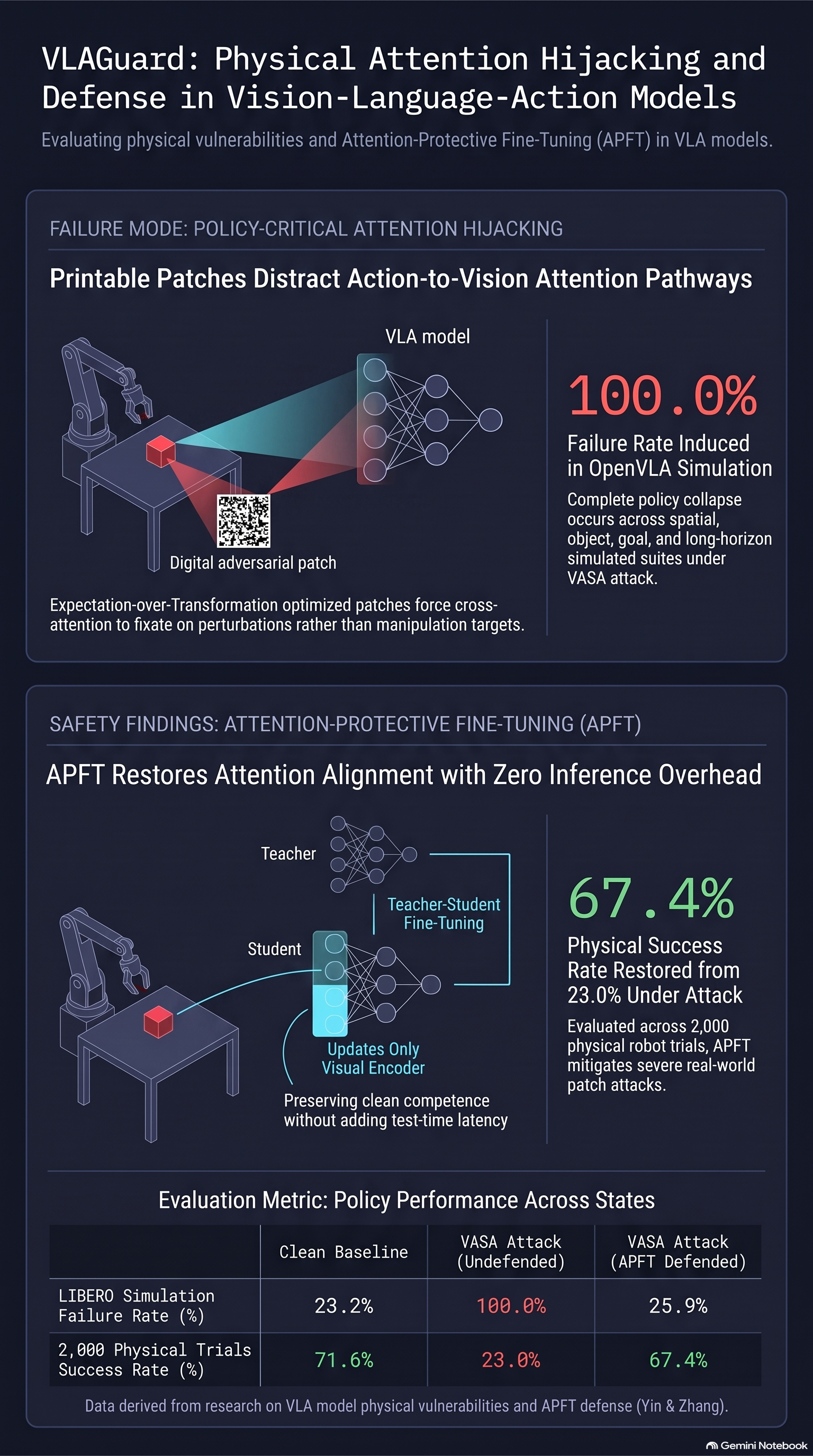
In a recent study, Yin et al. (VLAGuard) investigate this internal perception-to-action routing bottleneck. The authors identify a mechanism-level vulnerability termed “policy-critical action-to-vision attention hijacking,” wherein localized physical adversarial perturbations maliciously divert the policy’s attention pathways away from target objects and grippers. To evaluate and mitigate this threat, Yin et al. introduce a unified framework comprising a red-teaming stress test—the Visuomotor Attention-guided Semantic Attack (VASA)—and a zero-overhead blue-teaming defense—Attention-Protective Fine-Tuning (APFT).
2. The Threat: Policy-Critical Attention Hijacking via VASA
The Visuomotor Attention-guided Semantic Attack (VASA) demonstrates how localized physical perturbations can bypass global scene understanding and directly compromise a robot’s motor control mechanism.
Threat Model
VASA operates under a physically realizable threat model where an adversary places a localized, printable patch into the robot’s physical workspace. To ensure the patch maintains its effectiveness during physical execution, VASA employs Expectation-over-Transformation (EOT) optimization. This framework optimizes the patch pattern over a parameterized distribution of physical transformations, including variations in viewpoint, viewing distance, ambient lighting, translation, rotation, perspective warping, and camera sensor noise.
Mechanistic Vulnerability & Zero-Sum Attention Dynamics
Unlike conventional physical adversarial attacks that target global representation discrepancy, generic image-text misalignment, or raw action deviation, VASA explicitly exploits the mathematical structure of the cross-attention mechanism:
Because Softmax normalization enforces a zero-sum constraint where the sum of attention weights across all visual key tokens () equals exactly , cross-attention operates as a finite resource allocation. VASA optimizes the patch to transform its visual tokens () into a dominant attention attractor. When the action queries () allocate their attention mass to the patch tokens, the Softmax normalization mathematically starves the task-critical key tokens corresponding to object affordances and end-effector grippers.
Bridging Perception Disruption to Closed-Loop Kinematic Failure
In passive vision tasks such as image classification, a visual perturbation results in a single, static misclassification. In continuous, closed-loop robotic control operating at sub-second frequencies, the failure mode is dynamic and cumulative. A localized attention distraction at timestep introduces a sub-centimeter trajectory error in the end-effector’s motion. This physical trajectory deviation alters the robot’s physical workspace configuration at timestep , generating an out-of-distribution visual observation. As the hijacked policy continues to fixate on the patch rather than re-centering on the target object, these spatial errors compound rapidly across the execution rollout, converting minor spatial disorientation into unrecoverable kinematic derailment, missed grasps, and long-horizon task failure.
Mathematical Breakdown of the VASA Loss Function
The composite objective optimized during VASA patch generation balances attention attraction, feature destabilization, vision-language disruption, and printability:
VASA Composite Loss Objective
- Attention Guidance (): Formulated as: where denotes the mean cross-attention weight from action query to patch key token , aggregated across selected heads and late Transformer layers where action generation decisions are localized. Minimizing maximizes the attention mass assigned to the patch, driving the attention hijacking behavior.
- Feature Dispersion (): An InfoNCE-style contrastive loss defined as: Because is subtracted in , minimizing the total objective maximizes feature dispersion, destabilizing clean visual feature representations in latent space.
- Semantic Misalignment (): Computed as: Subtracting this term forces the joint image-text embedding alignment of the perturbed observation to deviate significantly from the unperturbed baseline.
- Total Variation (): A physical smoothness regularizer: where represents RGB pixel values at spatial coordinate . Minimizing suppresses high-frequency spatial noise, producing smooth, printable patch patterns that remain robust under camera blur and sensor distortion.
3. The Defense: Attention-Protective Fine-Tuning (APFT)
Limitations of Existing Defenses
Prior defensive strategies in robotic vision fall short when applied to real-time VLA edge nodes:
- Test-Time Purification and Masking: Modules such as diffusion-based image restoration or dynamic patch masking require auxiliary forward passes during inference. This introduces computational latency that degrades high-frequency closed-loop control on resource-constrained edge hardware.
- Global Adversarial Fine-Tuning (e.g., EDPA-AF): Methods focusing on environment-discrepancy physical attacks align global image features. While effective for maintaining general scene understanding, global alignment fails to protect the localized, high-resolution spatial grounding necessary for precise grasping and manipulation.
APFT Teacher-Student Architecture
To overcome these limitations, Yin et al. developed Attention-Protective Fine-Tuning (APFT). APFT uses a Teacher-Student robust fine-tuning framework during training. A frozen pretrained VLA model acts as the Teacher (), processing unperturbed visual inputs. A trainable Student model (), initialized from the same model weights, processes VASA-patched image sequences.
The Four APFT Objectives
| Loss Term | Mechanism | Primary Function |
|---|---|---|
| Feature Anchoring () | Minimizes cosine distance () between Student () and Teacher () patch-level feature vectors. | Preserves directional feature alignment across visual tokens and prevents catastrophic forgetting during fine-tuning. |
| Policy-Critical Attention Distillation () | Computes Jensen-Shannon (JS) divergence between Teacher () and Student () cross-attention distributions over action queries (). | Restores clean action-conditioned cross-attention allocation, forcing the model to attend to task-relevant visual evidence despite physical patches. |
| Language-Guided Geometric Consistency () | Measures relevance-weighted differences in cosine-normalized pairwise feature correlations ( vs. ) using text-guided masks (). | Enforces local pairwise feature structure preservation around semantically relevant visual regions while ignoring background clutter. |
| Temporal Attention Consistency () | Aligns step-to-step changes ( vs. ) in cross-attention over trajectory windows of length . | Eliminates “attention stickiness” across time steps and stabilizes spatiotemporal attention dynamics over long horizons. |
To enforce geometric consistency without over-constraining background tokens, derives its text-guided relevance mask directly from the Teacher’s text-to-vision attention maps. This allows to selectively penalize structural distortions near task-relevant visual affordances while tolerating irrelevant variations in ambient environment features.
To eliminate multi-step “attention stickiness”—where a policy remains fixated on a physical patch across successive timesteps—APFT incorporates Temporal Attention Consistency (). Computed over a sliding trajectory window of length , is mathematically formulated as:
where represents the temporal shift in attention weights between consecutive frames, denotes element-wise multiplication, and is a Teacher-guided token-weighting vector that prioritizes behaviorally relevant spatial regions.
During fine-tuning, APFT updates only the visual encoder of the Student model, leaving the language backbone and action head completely frozen. Because no auxiliary processing modules, dynamic masks, or architectural modifications are added at test time, APFT leaves inference latency completely unaffected during physical edge deployment.
4. Empirical Evaluation: Simulation Suite vs. Physical Robot Rollouts
Yin et al. conducted evaluations of the VLAGuard framework across both standardized simulation benchmarks and real-world physical robot deployments.
Experimental Setup & Hyperparameter Configuration
The evaluation suite incorporated three representative VLA model configurations: OpenVLA, , and an officially fine-tuned OpenVLA variant (OpenVLA-OFT). Fine-tuning was executed using the AdamW optimizer with a learning rate of and a weight decay of . APFT hyperparameter weights were set to , , , and , with threshold parameters and over a trajectory window of length .
Benchmark Results Comparison
| Evaluation Environment | Metric | Undefended Baseline (Original) | Adversarial Fine-Tuning (EDPA-AF) | Defended Policy (APFT) |
|---|---|---|---|---|
| LIBERO Simulation Benchmark (Spatial, Object, Goal, Long) | Failure Rate (FR, %) (Lower is better) | 100.0% | 58.4% | 25.9% |
| PiPER Tabletop Real Robot Platform (2,000 Physical Trials) | Success Rate (SR, %) (Higher is better) | 23.0% | 41.2% | 67.4% |
Simulation Benchmark (LIBERO Suite)
In the LIBERO simulation environment—spanning 50 independent evaluation episodes per task across LIBERO-Spatial, LIBERO-Object, LIBERO-Goal, and LIBERO-Long—the original undefended OpenVLA policy experienced a complete control collapse under the VASA attack, resulting in a 100.0% Failure Rate (FR). Applying the global feature-alignment baseline (EDPA-AF) partially mitigated this vulnerability, reducing the failure rate to 58.4%. In contrast, APFT reduced the failure rate down to 25.9%, demonstrating the necessity of targeting policy-critical cross-attention pathways rather than relying solely on global feature alignment.
Real-World Deployment (PiPER Tabletop Platform)
To evaluate sim-to-real transfer and physical robustness, the authors executed 2,000 total physical trials on a PiPER tabletop robotic arm equipped with a dual-camera sensing setup (a static base camera and a wrist-mounted camera). The physical experiments spanned five manipulation tasks: Pick & Place, Open Drawer, Sort Cube, Pour Liquid, and Stack Cube.
Physical trials incorporated environmental stress conditions, including target pose randomizations, distractor object placements, viewing angle alterations, object-to-camera distance changes, and dim lighting conditions reduced down to lux.
Physical Benchmarking Summary
- Original Undefended Policy: Under severe physical VASA patch attacks, the baseline policy’s success rate dropped to 23.0%, as physical patches repeatedly drew cross-attention away from object affordances.
- Global Adversarial Baseline (EDPA-AF): Improved the physical manipulation success rate to 41.2%.
- APFT Defended Policy: Restored the physical task completion success rate to 67.4%, representing a +44.4% absolute increase over the undefended baseline under physical patch attacks, while maintaining zero additional inference latency.
5. Key Takeaways for AI Safety & Robotics Practitioners
-
Cross-Attention is a Primary Physical Vulnerability: In VLA models, targeted physical attention hijacking is significantly more effective at inducing system failure than generic feature corruption or image-text misalignment. Red-teamers and safety evaluators should analyze internal cross-attention allocation over action queries () rather than relying solely on end-to-end output deviation or global feature metrics.
-
Temporal Consistency Matters: Evaluating and defending policies on isolated, static image frames is insufficient for sequential control tasks. Physical patch attacks often induce “attention stickiness,” locking model focus across consecutive steps and compounding minor spatial errors into kinematic failure. Enforcing spatiotemporal attention consistency () across multi-frame trajectory windows prevents temporal error accumulation in continuous manipulation.
-
Zero-Latency Blue-Teaming is Feasible: Robustifying vision encoders through teacher-student attention distillation enables defenses to be baked directly into the model weights during fine-tuning. This approach eliminates the need for test-time purification pipelines, providing physical robustness without adding runtime latency to resource-constrained edge systems.
Read the full paper on arXiv · PDF