RF-HOI: Recognize Human-Object Interaction with Radio Frequency Signals
The authors propose RF-HOI, a framework that combines mmWave radar and RFID sensors with a multimodal RF simulator to recognize human-object interactions without visual cameras.
1. Introduction: The Frontier of Non-Visual Action Recognition
Recognizing Human-Object Interaction (HOI) is a foundational capability for intelligent ambient systems operating across smart environments, virtual and augmented reality (VR/AR), context-aware healthcare, and assistive robotics. Unlike standard Human Activity Recognition (HAR), which classifies only the user’s action dynamics (e.g., predicting <pick up>), HOI recognition simultaneously identifies the action verb and the specific target object being manipulated, outputting a structured tuple such as <pick up, book>. This joint prediction provides richer contextual understanding, allowing autonomous agents to infer user intent and deliver proactive assistance, such as fetching related items or preparing downstream automation.
While computer vision approaches have traditionally dominated HOI research, camera-based perception introduces severe operational bottlenecks in real-world deployments. Optical systems degrade significantly under low-light or fluctuating illumination, struggle to differentiate visually identical or occluded items, and pose invasive privacy risks that preclude deployment in sensitive spaces like bedrooms, bathrooms, or clinical care units.
To overcome these optical vulnerabilities, Wang et al. from Johns Hopkins University introduced RF-HOI, the first framework designed to achieve complete Human-Object Interaction recognition exclusively through Radio Frequency (RF) signals. By synthesizing privacy-preserving, non-visual RF modalities, the system operates reliably through physical occlusions and lighting shifts without capturing optical frames.
Key Takeaway: Camera-based action recognition introduces severe privacy risks and fails in low-light or occluded environments. RF-HOI demonstrates that fusing mmWave radar and RFID signals enables non-visual, privacy-preserving Human-Object Interaction recognition—capturing both the human action verb and the target object identity without optical imagery.
2. The Single-Modality Bottleneck: Why mmWave and RFID Fail Alone
Wang et al. established that single-modality RF sensing cannot successfully execute complete HOI recognition because neither millimeter-wave (mmWave) radar nor Radio-Frequency Identification (RFID) can fulfill all functional requirements independently:
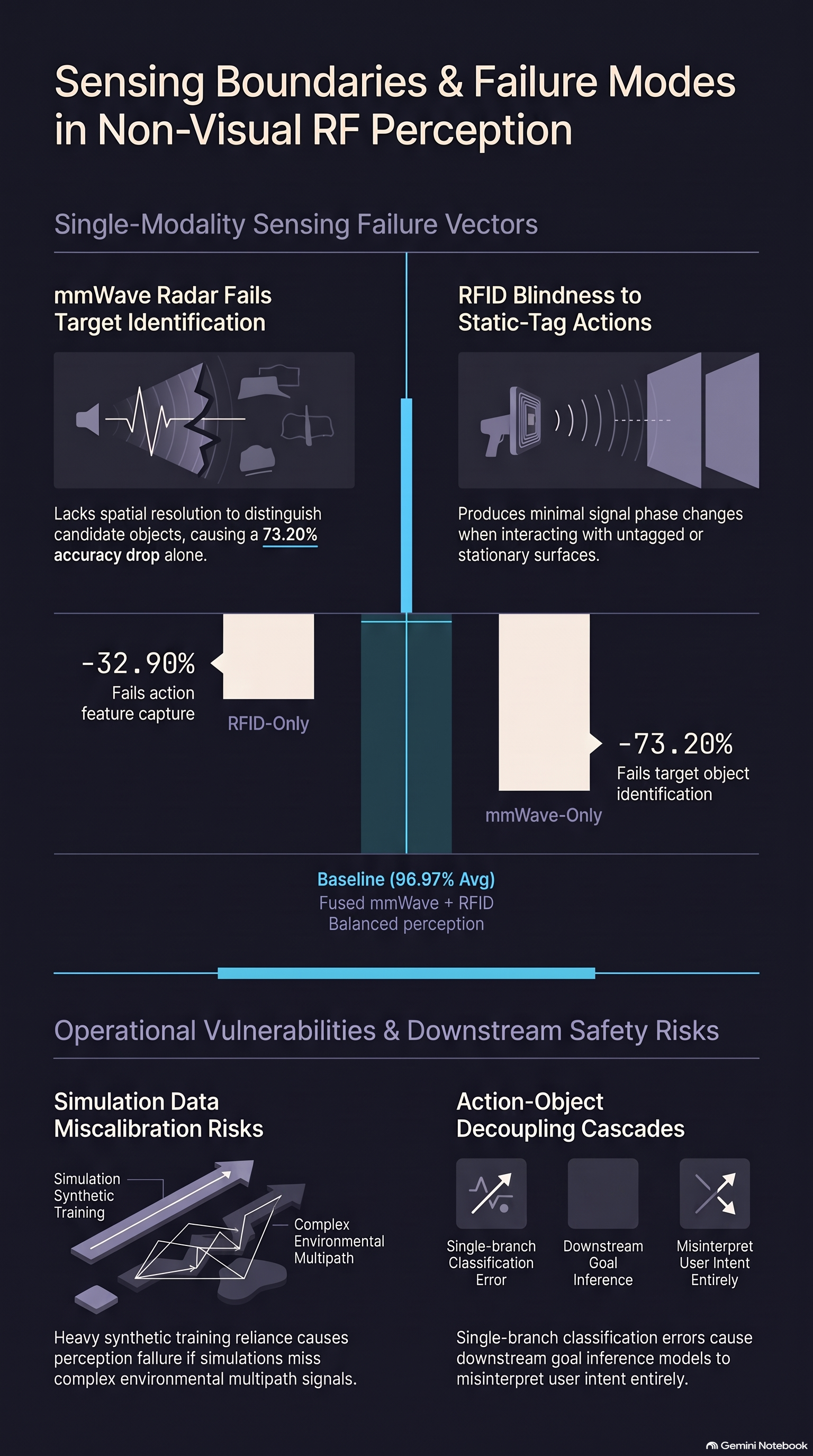
- mmWave Radar Limitations: mmWave radar excels at device-free sensing, capturing fine-grained human kinetic dynamics as radio signals scatter off the human body. However, commercial mmWave radar units lack the spatial resolution necessary to pinpoint and identify specific target objects among multiple candidate items in a room. While advanced hardware modifications—such as large-scale radar arrays or reconfigurable metasurfaces—can capture object contours, they remain limited to tracking single isolated objects and require expensive, non-standard hardware that prevents scalable deployment.
- RFID Limitations: Affixing passive RFID tags to daily household or industrial objects provides instantaneous, unambiguous target identification via unique tag identifiers. However, RFID sensing fails to capture action features when an object remains stationary during an interaction. For example, during a
<wipe, table>interaction, an RFID tag attached to the table surface experiences minimal phase variation because the object itself is not translated through space. Without discernible signal fluctuations, RFID-only classifiers cannot recognize the human action. Conversely, while placing dense RFID tag arrays across background walls or attaching tags directly to the user’s body can capture kinetic movement, these configurations incur high deployment overhead or severely impair user convenience.
To resolve these complementary trade-offs, Wang et al. combined device-free mmWave radar with object-attached passive RFID tags. The comparative trade-offs across sensing configurations analyzed by Wang et al. are summarized below:
| Sensing Modality | Device Assistance | Fine-Grained Action Capture | Target Identification | User Convenience | HOI Recognition |
|---|---|---|---|---|---|
| mmWave (Device-free) | Yes | High | Low | High | Low |
| mmWave (Tags on objects) | No | Medium | High | Low | Low |
| RFID (Tags as background) | No | Low | High | Low | Low |
| RFID (Tags on objects) | No | Medium | High | Low | Low |
| RFID (Tags on humans) | Yes | Low | Low | Low | Low |
| RF-HOI (Fused mmWave + RFID) | Yes | High | High | High | High |
Note on Terminology: In the taxonomy established by Wang et al., “Device Assistance” indicates whether specialized hardware infrastructure or wearable setups are required for the sensing modality. “HOI Recognition” evaluates whether the sensing configuration can simultaneously capture human actions and identify target objects.
3. Inside the RF-HOI Architecture: Fusing Radar and Tag Signals
The physical architecture designed by Wang et al. utilizes off-the-shelf commercial hardware: a Texas Instruments mmWave radar board captures device-free human motion reflections, while an Impinj Speedway RFID reader connected to an antenna array reads passive Ultra-High Frequency (UHF) RFID tags attached to candidate interaction objects.
+-------------------------------------------------------+
|  Texas Instruments mmWave Radar   Impinj RFID Reader  |
|      (Body Reflections)           (Tag Phase Signals) |
+---------------------------+---------------------------+
                            |
                            v
+-------------------------------------------------------+
|              Signal Preprocessing Module              |
|  - Range/Doppler Spectrograms (mmWave ADC IQ samples) |
|  - Unwrapped Differential Phase Series (RFID)         |
+---------------------------+---------------------------+
                            |
                            v
+-------------------------------------------------------+
|              Modality-Specific Encoders               |
|      (CNN-Based Spatiotemporal Feature Extraction)    |
+---------------------------+---------------------------+
                            |
                            v
+-------------------------------------------------------+
|          Transformer-Based Temporal Blocks            |
|       (Variable-Length Sequence Context Modeling)     |
+---------------------------+---------------------------+
                            |
                            v
+-------------------------------------------------------+
|       Cross-Modal Temporal Attention Fusion Layer     |
|   (Correlates Doppler Peaks with Tag Phase Windows)   |
+---------------------------+---------------------------+
                            |
              +-------------+-------------+
              |                           |
              v                           v
+---------------------------+ +---------------------------+
|   Action Head (Decoupled) | |   Target Head (Decoupled) |
|    Predicts Human Verb    | |   Identifies Object ID    |
|       (e.g., wipe)        | |       (e.g., table)       |
+---------------------------+ +---------------------------+
The RF-HOI neural pipeline processes raw electromagnetic reflections through five sequential signal processing and deep learning modules:
- Low-Level Signal Preprocessing:
- mmWave Stream: Raw analog-to-digital converter (ADC) in-phase and quadrature (IQ) samples collected from the radar board undergo Fast Fourier Transforms (Range FFT and Doppler FFT) across chirp chirps and frames. This generates Range-Doppler maps and Doppler-Time Spectrograms, isolating body velocity profiles and motion trajectories over time.
- RFID Stream: Raw phase readings received by the multi-antenna reader undergo temporal phase unwrapping to eliminate phase ambiguity. Differential phase time-series are computed across reader antennas to cancel static background multipath interference and highlight fine perturbations induced by hand movement or object displacement.
- Modality-Specific Spatiotemporal Encoding: Distinct Convolutional Neural Network (CNN) backbone encoders independently extract localized spatiotemporal features from the radar Doppler spectrograms and RFID phase difference matrices, mapping raw RF representations into continuous feature spaces.
- Transformer Temporal Sequence Modeling: Because interaction durations vary across different activities, the extracted feature streams pass through Transformer-based temporal blocks equipped with positional encodings. This stage captures long-range temporal dependencies and context across variable sequence lengths.
- Cross-Modal Attention Fusion: Naively concatenating radar and RFID features fails to establish explicit association between specific movement bursts and specific target objects in multi-object environments. To resolve this unbinding problem, the cross-modal fusion layer uses temporal cross-attention mechanisms. The module correlates mmWave Doppler motion peaks directly with RFID phase perturbation windows in time, aligning kinetic velocity profiles with specific tag signal distortions.
- Decoupled Classification Output Heads: The fused cross-modal embedding is fed into two separate output prediction heads: an Action Branch that outputs a probability distribution over verb classes (e.g.,
<wipe>), and a Target Branch that outputs a probability distribution over object categories (e.g.,<table >). Decoupling these classification heads prevents negative transfer during optimization and enhances model interpretability.
4. Overcoming the Data Bottleneck: Synthetic RF Data Generation
Deploying empirical learning models for RF-based HOI recognition is constrained by a severe combinatorial data explosion. To maintain accuracy across physical environments, training datasets must reflect variations across user orientations, distance to hardware, background multipath conditions, body geometries, action types, and candidate target objects.
Wang et al. calculated that a minimal benchmark covering 3 environments, 5 users, 4 distances, 7 orientations, 7 actions, and 3 candidate target objects (evaluated across 5 trials per setup) requires 44,100 annotated real-world samples—a volume exceeding most established HAR benchmarks.
In a preliminary evaluation, Wang et al. quantified the exact accuracy degradation when an empirical model encounters unobserved operational setups during testing:
- Unseen User Orientation: -49.41% performance drop
- Unseen User Body Shape: -44.06% performance drop
- Unseen Background Environment: -29.69% performance drop
- Unseen Distance to Hardware: -25.32% performance drop
To overcome this data collection bottleneck, Wang et al. engineered a physical multimodal RF signal simulator. The simulator ingests high-fidelity 3D human pose mesh kinematics from computer vision interaction traces and models radio wave scattering. Electromagnetic ray-tracing simulates backscattered mmWave radar reflections off human body meshes, while near-field electromagnetic propagation models compute synthetic RFID tag phase variations based on hand proximity, body occlusion, and object trajectory.
Using this simulation engine, Wang et al. synthesized 7,518 multimodal training samples spanning diverse virtual setups. Pre-training the RF-HOI framework on synthetic data allows the model to learn fundamental electromagnetic interaction patterns. When fine-tuned on a small real-world dataset of 3,615 samples (collected across 78 physical setups), the model successfully bridges the sim-to-real gap.
Furthermore, this synthetic pre-training enables zero-shot kinematic transfer: the model generalizes to unseen object categories that share physical interaction profiles with trained categories (e.g., manipulating an unobserved tool with a similar hand trajectory), even when those objects are completely absent from real-world fine-tuning datasets.
5. Empirical Benchmarks and Performance Gains
Extensive physical experiments conducted by Wang et al. validate the efficacy of multimodal fusion and synthetic data pre-training:
- Overall Performance & Vision Comparison: RF-HOI achieved a peak real-world interaction recognition accuracy of 96.97%. This performance trails vision-based baseline models by a narrow margin of only 1.96%, demonstrating that radio frequency signals can approximate optical recognition accuracy without capturing visual images.
- Ablation Gains over Baselines:
- Fused RF-HOI outperformed its non-fusion variant by +21.29%.
- Fused RF-HOI outperformed an RFID-only baseline by +32.90%.
- Fused RF-HOI outperformed an mmWave-only baseline by +73.20%.
- Synthetic Data Impact:
- Pre-training on synthetic simulator data provided an average +12.00% accuracy boost across varying real-world training set sizes.
- Synthetic pre-training improved model generalizability across unobserved physical deployment setups by an average of +12.09%.
6. Conclusion and Strategic Takeaways
The RF-HOI framework developed by Wang et al. demonstrates that camera-free Human-Object Interaction recognition can be achieved by fusing commercial mmWave radar with passive RFID tag infrastructure. By coupling cross-modal neural attention networks with synthetic data generation derived from 3D computer vision traces, the framework resolves physical sensing ambiguities and mitigates empirical data scarcity. This research provides a scalable framework for privacy-preserving, non-visual perception in smart environments, healthcare monitoring, and interactive robotics.
Key Takeaways for AI Researchers
- Complementary Modality Synergy: Fusing device-free mmWave radar with passive UHF RFID tags overcomes the fundamental limitations of single-modality RF sensing, pairing high-resolution motion tracking with unambiguous target identification.
- Cross-Modal Attention Alignment: Temporal cross-attention solves the unbinding association problem, mapping continuous Doppler motion peaks directly to discrete RFID phase perturbation windows in multi-object spaces.
- Sim-to-Real Kinematic Scaling: Synthesizing multimodal RF reflections from computer vision 3D-mesh pose traces bypasses the dataset combinatorial explosion, delivering an average +12.09% boost across unseen physical setups.
- Decoupled Task Heads: Structuring the output layer into independent action prediction and target identification branches improves model interpretability and enables zero-shot generalization to unseen object categories sharing similar interaction dynamics.
Read the full paper on arXiv · PDF