Write-Safe Flow Field Mapping under Ambiguous Onboard Sensing and Localization Drift
The authors propose a map-reference-aware conservative fusion framework that uses a learned write-safety score to attenuate uncertain map updates and reduce ghost structures in flow field mapping...
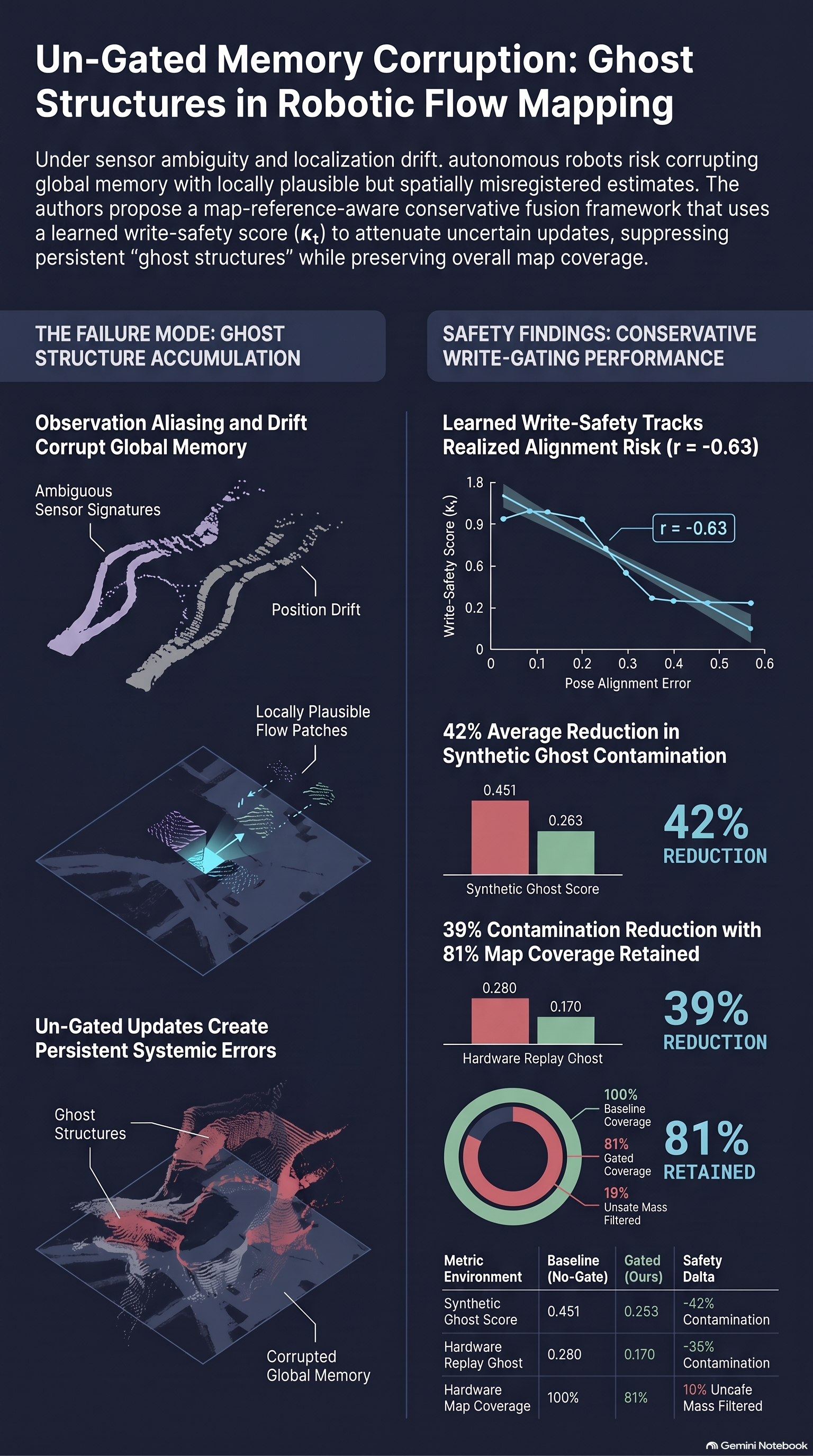
1. Introduction: The Risk of Ungated Memory Updates
Autonomous mobile robots operating in fluid, oceanic, or GPS-denied environments must continuously stream local sensory observations into global spatial memory. However, under degraded sensing and persistent odometric drift, writing local predictions directly into a global map introduces a subtle but destructive failure mode: silent streaming memory corruption. When spatial observations are locally ambiguous, streaming updates unconditionally causes errors to compound over time, corrupting global memory with persistent artifacts.
In their paper “Write-Safe Flow Field Mapping under Ambiguous Onboard Sensing and Localization Drift”, Jin et al. (2026) investigate this failure mode within underwater flow field mapping. The authors establish a critical thesis for autonomous memory management: when alignment with global context is uncertain, deciding whether to write to a global map is just as vital as deciding what to predict. Without explicit write-safety mechanisms, streaming memory architectures lack a way to reject misregistered updates, leading to self-reinforcing map corruption that degrades downstream navigation and state estimation.
2. The Failure Mode: Observation Aliasing and Localization Drift
The accumulation of false mapping artifacts—termed ghost structures by Jin et al.—stems from two compounding environmental and operational factors:
- Observation Aliasing: Spatial non-uniqueness where distinct physical locations yield identical local sensory signatures. In fluid environments, coherent, symmetric, or repeating hydrodynamic flow features produce identical local pressure and velocity profile readings across different spatial regions.
- Localization Drift: Mobile field and underwater robots relying on dead reckoning inevitably accumulate positional drift over time. The true physical pose diverges from the reported odometric pose , where represents accumulated spatial error.
+-----------------------------------------------------------------------------------+
|                            MECHANISM OF MAP CORRUPTION                            |
|                                                                                   |
|  [Aliased Local Observation] + [Localization Drift: p̂_t = p*t + η_t]               |
|                                         │                                         |
|                                         ▼                                         |
|                       [Misregistered Memory Update Write-In]                      |
|                                         │                                         |
|                                         ▼                                         |
|                     [Persistent "Ghost Structure" Formation]                      |
|                                         │                                         |
|                                         ▼                                         |
|            [Corrupted Global Map Used as Faulty Reference for Next Step]         |
+-----------------------------------------------------------------------------------+
When local flow predictions are written at the drifted reported pose , locally accurate predictions are committed to incorrect global coordinates. The fundamental difference between transient sensor noise and persistent map corruption highlights why traditional noise and innovation filtering fail:
- Transient Sensor Noise: High-frequency, zero-mean fluctuations in local measurements. Because these errors do not correlate over time, standard recursive spatial averaging or statistical noise filters naturally cancel them out across successive observational passes.
- Persistent Map Corruption: Coherent, spatially misregistered updates caused by drift. These writes commit structurally plausible flow features into incorrect map cells. Rather than averaging out, repeated misregistered updates accumulate into coherent, persistent ghost structures—nonexistent physical features anchored into the global memory state.
Crucially, traditional innovation filtering mechanisms (such as Extended Kalman Filter innovation gates) fail to suppress ghost structures. Because aliased local observations are structurally plausible and locally consistent with internal sensor noise models, they yield small innovation residuals even at the drifted pose . Consequently, misregistered patches pass traditional innovation gates and are written directly into global memory.
Worse, an evolving map serves as the baseline reference for subsequent local updates. Once ghost structures are committed to global memory, they act as faulty spatial references, corrupting future observation-to-map alignment steps and triggering a self-reinforcing cascade of systemic failure.
3. The Solution: Map-Reference-Aware Conservative Fusion Framework
To prevent ghost structure accumulation, Jin et al. developed a map-reference-aware conservative fusion framework that decouples local patch prediction from global write permission.
                                  +-----------------------+
                                  |   Sensing Input (o_t) |
                                  |  (Pressure & Velocity)|
                                  +-----------+-----------+
                                              |
                                              v
+-----------------------+         +-----------+-----------+
| Evolving Global Map   |-------> | Map Reference Sampling|
| State M_(t-1)         |         |   (Ũ_map, c_map)      |
+-----------------------+         +-----------+-----------+
                                              |
                                              v
                                  +-----------+-----------+
                                  | Recurrent Input Vector|
                                  |  r_t = [z_π, z_v, ...] |
                                  +-----------+-----------+
                                              |
                                              v
                                  +-----------+-----------+
                                  |   Shared Recurrent    |
                                  |      State (GRU)      |
                                  +-----------+-----------+
                                              |
                   +--------------------------+--------------------------+
                   |                                                     |
                   v                                                     v
     +-------------+-------------+                         +-------------+-------------+
     | Patch Predictor Head      |                         | Write-Safety & Quality Heads|
     | (Velocity Patch μ_hat_t)  |                         |  (Score κ_t, Quality q_t)   |
     +-------------+-------------+                         +-------------+-------------+
                   |                                                     |
                   +--------------------------+--------------------------+
                                              |
                                              v
                                  +-----------+-----------+
                                  | Effective Reliability |
                                  |    Rule (κ_eff_t)     |
                                  +-----------+-----------+
                                              |
                                              v
                                  +-----------+-----------+
                                  | Attenuated Map Update |
                                  |      (Ω_t, Ψ_t)       |
                                  +-----------------------+
Sensing Architecture
The onboard observation vector combines two complementary sensory modalities:
- A 4-channel piezoresistive pressure array .
- A optical-flow velocity stencil captured from onboard vision.
Map Reference & Discrepancy
The global map state tracks the estimated 2D velocity field and accumulated spatial evidence confidence . Over the local stencil footprint , the framework samples the local map confidence and velocity stencil :
Here, samples the velocity map at the reported pose, is the map-evidence threshold, and is a learned null token. Representing unmapped areas with ensures that a lack of prior map evidence is treated as an absent reference rather than an active velocity disagreement.
Model Architecture & Recurrent Feature Input
- Encoders: Pressure measurements are processed by MLP encoder , while onboard stencil and map stencil share MLP encoder (both architectures: ). Encodings are extracted as , , and .
- Discrepancy Feature: Computed as .
- Concatenated Recurrent Input Vector: The input vector fed into the recurrent core explicitly integrates sensing encodings, reference discrepancy, normalized reported pose, and local map confidence: where represents the reported pose normalized componentwise by the domain dimensions.
- Recurrent Core & Decoder: A single-layer Gated Recurrent Unit (GRU) with a hidden dimension of processes , preserving temporal alignment context. An fully connected projection followed by two transposed-convolution layers () decodes the hidden state into a local velocity patch prediction . Auxiliary heads predict a patch informativeness score and the learned write-safety score .
Effective Reliability Rule and Pointwise Update Formulas
To balance early map initialization against late-stage update attenuation, the framework applies an effective write-reliability rule:
When operating in unmapped territory (), , ensuring the system can freely initialize new map regions. As accumulated map evidence increases, shifts smoothly toward the learned write-safety score , continuously attenuating updates if spatial alignment is uncertain.
The predicted patch is splatted at the reported pose to yield . With patch support mask , the cellwise write mass is calculated as:
Pointwise recursive map updates for velocity and evidence confidence are then evaluated explicitly across all grid coordinates :
Evidence saturation via clipping limits visit-count dominance while retaining the capability of later reliable observations to modify the map.
Loss Targets and Two-Stage Training Strategy
Supervision targets are defined via ground-truth alignment error :
- Alignment Reliability Target: with spatial decay scale .
- Patch Informativeness Target: , where is the valid support fraction of the patch and is derived from the normalized vector patch gradient magnitude.
Jin et al. implement a two-stage training strategy:
- Stage 1: Encoders (), shared GRU, and all prediction/gating heads are trained jointly using composite loss .
- Stage 2: Encoders, patch-decoder weights, and the sensor-reconstruction head are frozen. The GRU and the pose, reliability, and quality heads remain trainable. Crucially, the patch loss is retained during Stage 2; retaining ensures that fine-tuning the recurrent state for reliability calibration does not distort or degrade the latent flow patch representation.
Computational Footprint
The entire neural architecture consists of only 105.8k parameters. When deployed on embedded edge hardware (a Raspberry Pi 5), the model executes a full prediction and fusion step in , making it highly practical for real-time robotic control loops.
4. Empirical Evaluation & Quantitative Benchmarks
Synthetic Benchmark Setup
Jin et al. evaluated their framework across four 3m 1m FluidX3D simulation environments representing distinct flow fields: Single Jet, Double Jet, Single Jet + Crossflow (CF), and Double Jet + Crossflow (CF). Crossflow variants introduce strong background advection and severe spatial ambiguity. Performance was evaluated using four primary metrics:
- Ghost Score: Dimensionless metric quantifying false velocity artifacts committed to unmapped or low-flow background regions (lower is better).
- NRMSE: Normalized root-mean-square error over supported map regions (lower is better).
- Active-Flow Coverage (ActCov): Retention fraction of true active flow regions relative to ungated mapping (higher is better).
- Write Ratio (WR): Ratio of committed write mass relative to ungated mapping (lower indicates more conservative writing).
Granular Environment Benchmark Analysis
The table below provides the full per-environment breakdown at a nominal drift rate of across 20 held-out test scenes per family (averaged across three random drift seeds per scene):
| Environment | Method | Ghost Score () | Write Ratio (WR ) | NRMSE () | Active Coverage (ActCov ) |
|---|---|---|---|---|---|
| Single Jet | No-Gate | ||||
| EKF-Gate | |||||
| Hard-Gate () | |||||
| Oracle- | |||||
| Ours | |||||
| Double Jet | No-Gate | ||||
| EKF-Gate | |||||
| Hard-Gate () | |||||
| Oracle- | |||||
| Ours | |||||
| Single Jet + CF | No-Gate | ||||
| EKF-Gate | |||||
| Hard-Gate () | |||||
| Oracle- | |||||
| Ours | |||||
| Double Jet + CF | No-Gate | ||||
| EKF-Gate | |||||
| Hard-Gate () | |||||
| Oracle- | |||||
| Ours | |||||
| Cross-Family Avg. | No-Gate | ||||
| EKF-Gate | |||||
| Hard-Gate () | |||||
| Oracle- | |||||
| Ours |
The granular per-environment breakdown reveals a crucial domain insight: advective crossflow (CF) environments induce a massive surge in spatial ambiguity and map contamination. In pure jet environments, No-Gate exhibits modest ghost scores (). However, adding crossflow causes No-Gate ghost contamination to spike tenfold to in Single Jet + CF and in Double Jet + CF.
Across all conditions, Jin et al.’s framework achieves a 42% average reduction in ghost score (from to ). Traditional EKF innovation filtering (EKF-Gate) yields negligible protection against ghost structures (Ghost ), as aliased patches are locally consistent enough to pass innovation checks. Crucially, Jin et al.’s learned gate matches or surpasses the privileged Oracle- baseline—which operates with access to ground-truth pose error—while operating purely on deployment-available sensory signals at a more conservative write point ( vs. ).
Hardware Replay Validation
To evaluate zero-shot transfer, the authors deployed the simulation-trained model without fine-tuning to a physical water tank testbed. A submerged U5 thruster generated a turbulent jet wake, while a robot platform collected 4-channel pressure data and optical-flow velocity stencils via an OV9281 camera. Planar Particle Image Velocimetry (PIV) served as ground truth.
Replaying sensor logs under injected localization drift demonstrated successful zero-shot transfer to physical hardware:
- Ghost contamination dropped by 39% (Ghost score reduced from 0.28 in No-Gate to 0.17 in the proposed method).
- 81% active map coverage was retained, leaving uncertain, misaligned boundary regions unsupported rather than committing misregistered updates.
  Ground Truth PIV                No-Gate Mapping                Gated Fusion (Ours)
+------------------+           +------------------+           +------------------+
|  ~~~~  Jet  ~~~  |           |  ~~~~  Jet  ~~~  |           |  ~~~~  Jet  ~~~  |
|                  |   ===>    |                  |   ===>    |                  |
|                  |           |  [GHOST ARTIFACT]|           |  [UNSUPPORTED]   |
+------------------+           +------------------+           +------------------+
  True Flow Structure            Corrupted Memory               Clean, Gated Map
                                (Ghost Score: 0.28)            (Ghost Score: 0.17)
Mechanistic Insights & Ablation Methodology
The learned reliability score exhibits a strong negative Pearson correlation () with realized spatial alignment error . As localization drift grows, the model automatically lowers , proving that the gate tracks alignment risk dynamically rather than acting as a static weight filter.
To evaluate architectural components fairly, Jin et al. applied a strict experimental control during ablation: each ablation variant’s cellwise write mass was scaled via a global bisection factor to force its Write Ratio (WR) to match the full model (). This control guarantees that performance variations reflect where write mass is allocated rather than how much total mass is written.
| Variant | Ghost Score () | Write Ratio (WR) | NRMSE () | Active Coverage (ActCov ) |
|---|---|---|---|---|
| Ours (Full Model) | ||||
| No Map Conditioning | ||||
| No Informativeness Gate | ||||
| No Recurrent State |
Removing the recurrent GRU state caused the largest performance collapse (Ghost score increased to ), proving that temporal tracking of alignment evidence is essential for evaluating write safety. Removing map conditioning degraded the Ghost score to , while removing the informativeness head caused the largest loss in active-flow coverage ( dropped to ).
5. Implications for AI Safety and System Design
The findings of Jin et al. offer three key takeaways for researchers and practitioners building persistent memory systems exposed to degraded feedback:
-
Gating Memory Writes Under Degraded Feedback: Systems that stream incoming sensory estimates directly into persistent global memory are highly vulnerable to silent corruption. When sensory inputs are spatially or semantically aliased, memory writes must be conditioned on explicit write-safety gating to prevent misregistered updates from permanently corrupting global state representations.
-
Decoupling Content Prediction from Write Safety: Predicting what information an observation contains (content generation/patch prediction) must be architecturally separated from evaluating whether that information is safe to commit to global state (write-safety gating). A locally accurate prediction can still be globally destructive if written under spatial misalignment.
-
Graceful Degradation via Coverage-Precision Trade-offs: Under severe feedback degradation or localization drift, maintaining high precision requires accepting partial memory coverage. Leaving uncertain spatial regions unsupported or unwritten preserves the structural integrity of existing global memory, preventing catastrophic failure cascades caused by self-reinforcing ghost structures.
In spatially ambiguous, drift-prone environments, write-safety gating is mandatory to prevent streaming memory architectures from succumbing to self-reinforcing map corruption.
Read the full paper on arXiv · PDF