CalTwin: Towards Calibrated, Shift-Robust Medical World Models via Fisher-Information Regularisation
The paper introduces and evaluates CalTwin, a regularisation objective combining Fisher-information shift penalties and a confidence misalignment penalty for latent transition prediction in GRU-based...
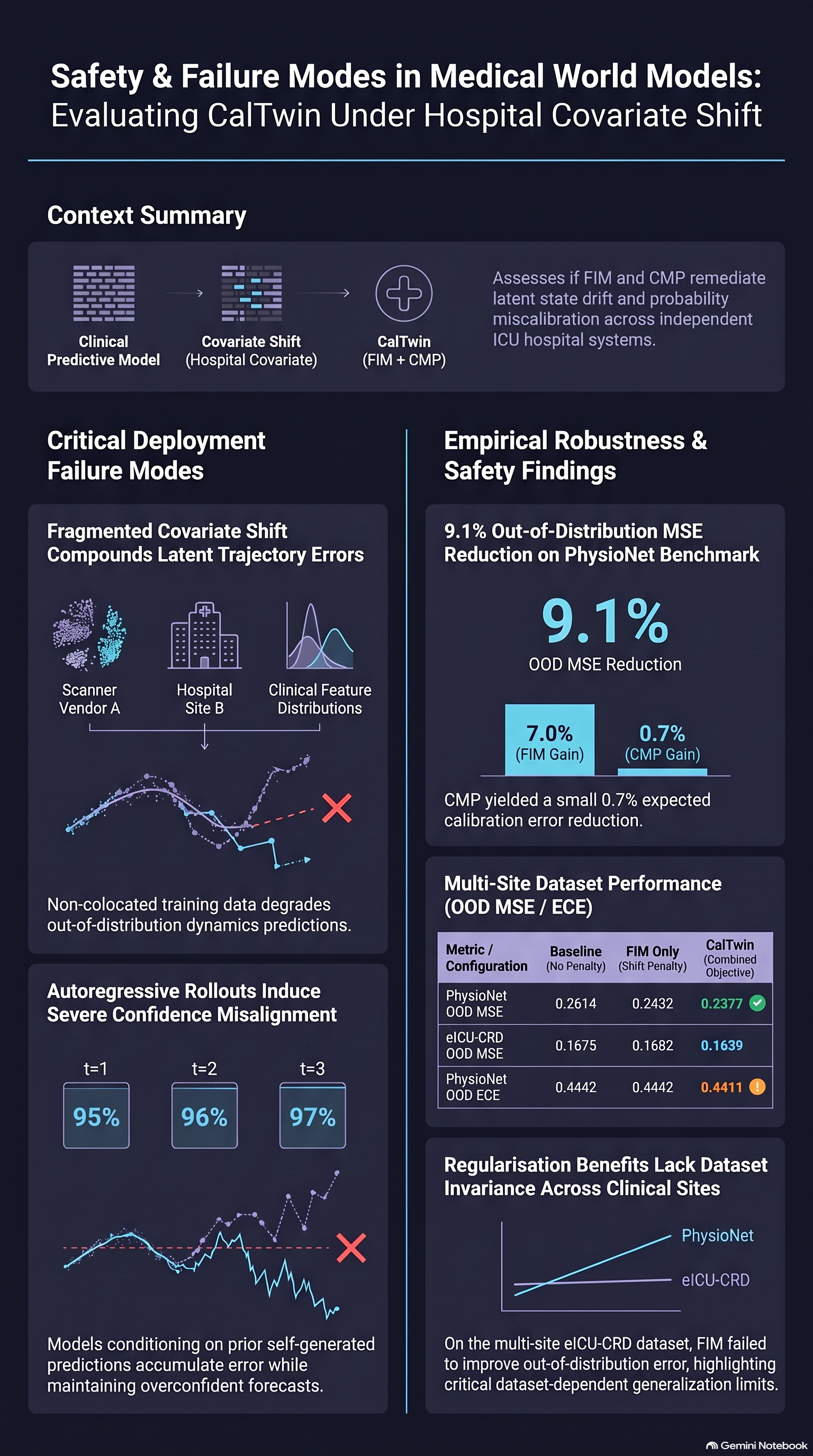
1. Introduction: The Promise and Peril of Medical Digital Twins
In the landscape of clinical AI, medical world models represent the vanguard of predictive analytics. These systems learn a compact latent representation of patient physiology and a transition function that forecasts its evolution. Research by Khan et al. characterizes these models along a “capability ladder” of increasing clinical utility:
- L1: Temporal Prediction: Simple forecasting of state changes.
- L2: Action-Conditioned Simulation: Predicting outcomes based on specific interventions.
- L3: Counterfactual Rollouts: Exploring “what-if” scenarios for treatment planning.
- L4: Closed-Loop Planning: Fully automated decision support and synchronization.
While L3 and L4 capabilities represent the ultimate goal of “medical digital twins,” they remain largely experimental due to a significant “reliability gap.” Khan et al. identify two primary threats to deployment: covariate shift and confidence misalignment. When a model moves from a controlled training environment to the chaotic reality of clinical deployment, these factors cause forecasts to diverge from physiological truth, often with overconfident certainty that masks the failure from the clinician.
2. The Fragmentation Problem: Why Clinical AI Fails Across Hospitals
A core obstacle to reliable AI is the fragmented nature of healthcare data. Training sets are rarely unified; they are distributed across various hospital systems, imaging hardware vendors, and evolving clinical protocols. Khan et al. define this through the lens of covariate shift, where each data fragment possesses a unique empirical distribution .
In clinical deployment, these distributions differ not only from each other but also from the unknown deployment distribution. The authors highlight why classical “importance weighting”—which reweights training data by an estimated density ratio—is insufficient. In federated or batch-sequential clinical regimes, the reference distribution itself changes across fragments, making it impossible to establish a single stable density ratio for correction.
For a medical world model, these fragment-level shifts create a catastrophic cascade:
- Per-Step Error: Shift-induced inaccuracies occur at every discrete interval of a predicted trajectory.
- Error Compounding: Because world models are dynamic, small per-step errors accumulate as the forecast horizon extends.
- Predictive Drift: This compounding effect causes the digital twin to drift away from the patient’s actual physiological state, rendering the simulation useless or dangerous.
3. The Overconfidence Trap: The Mismatch Between Training and Reality
The second failure mode, confidence misalignment, stems from a fundamental discrepancy between training and deployment. During training, models typically utilize teacher forcing, where they are provided with true, clinician-acquired patient states at every step. At deployment, however, models must operate autoregressively, conditioning predictions on their own prior (and potentially erroneous) outputs.
Khan et al. emphasize that this shift is endogenous—it is internally generated by the model’s own accumulated mistakes. This creates a lethal clinical scenario:
- The Calibration Reversal: Post-hoc fixes like temperature scaling, which work in-distribution, can actually worsen calibration under dataset shift.
- Silent Failure: An overconfident but incorrect forecast (e.g., predicting a positive response to a high-risk cardiac intervention) provides no signal to a clinician to discount the AI’s output, potentially leading to adverse outcomes.
4. The CalTwin Solution: A Unified Regularization Objective
To mitigate these risks, Khan et al. propose CalTwin, a lightweight regularization objective that targets both distribution shift and calibration. The technical core of this solution is the adaptation of penalties from static classification to the sequential dynamics of Gated Recurrent Unit (GRU)-based world models. Unlike standard approaches that use the gradient of categorical cross-entropy, CalTwin utilizes the gradient of the transition log-likelihood, allowing it to function across continuous latent states.
The CalTwin Components
| Penalty Component | Functional Role |
|---|---|
| Fisher-Information Matrix (FIM) Penalty | Employs a Cramér-Rao-bound anchoring mechanism to protect parameters against drift from prior fragments. |
| Confidence Misalignment Penalty (CMP) | Redistributes probability mass away from overconfident, incorrect predictions to align confidence with accuracy. |
5. Empirical Stress Tests: PhysioNet 2019 and eICU-CRD
The authors subjected CalTwin to rigorous testing using two major ICU datasets, purposefully treating different hospital sites as sequential fragments to simulate real-world deployment.
PhysioNet 2019 Sepsis Challenge Results:
- MSE Reduction: CalTwin achieved a 9.1% reduction in out-of-distribution (OOD) next-step latent-state Mean Squared Error (MSE).
- Ablation Nuance: The FIM penalty was the primary driver of accuracy, providing a 7.0% reduction in MSE.
- Calibration Interference: While CalTwin reduced Expected Calibration Error (ECE) by 0.7%, the CMP-only model achieved a 1.3% reduction. This suggests an “interference” effect where the accuracy-focused FIM penalty may slightly degrade the calibration gains of the CMP.
- AUROC Artifact: The authors note that the 0.5000 AUROC for Baseline and FIM-only models is an experimental artifact; because the auxiliary head receives no gradient when , these models remain at a random initialization floor rather than representing a functional failure.
eICU-CRD Demo Results: The second validation site revealed a more complex “reversal” that underscores the difficulty of clinical AI safety:
- The MSE Reversal: On this dataset, the FIM penalty failed to improve OOD MSE, performing 0.4% worse than the baseline.
- CMP Dominance: CMP-only outperformed CalTwin on four of the six primary metrics, highlighting that the effectiveness of these regularizers is not yet dataset-invariant.
6. Critical Discussion: What These Findings Mean for AI Safety
From an AI safety perspective, the research by Khan et al. provides a “red-teaming” look at the limits of current regularization. The authors observed a “Transfer Failure” in the auxiliary sepsis head on the PhysioNet dataset, where an in-distribution AUROC of 0.57 collapsed to a near-chance collapse of 0.48–0.50 when encountering an OOD hospital.
The primary hypothesis for the interference between FIM and CMP is that the Fisher-Information penalty constrains representations in directions optimized for accuracy, which may not be the same directions required for effective probability redistribution by the CMP.
Furthermore, the authors clarify a vital evaluation limitation: these experiments utilized “teacher-forced” one-step predictors. While this demonstrates robustness to site-level shift, it does not fully test the “closed-loop” self-conditioned rollouts required for true digital twins. Maintaining calibration over long, autoregressive horizons remains the ultimate, unsolved challenge for clinical AI safety.
7. Conclusion: The Path to Clinical Deployment
The CalTwin objective establishes a necessary technical foundation for shift-robust medical world models, yet the authors’ results prove that these benefits are not a “silver bullet.” The variance in performance between PhysioNet and eICU-CRD demonstrates that the interaction between accuracy and calibration is highly sensitive to the underlying data distribution and clinical task.
To bridge the remaining gap, Khan et al. call for:
- Validation on high-dimensional imaging modalities, such as cardiac ultrasound and surgical video.
- Evaluation under rigorous, closed-loop rollout scenarios.
- Extensive multi-seed studies to stabilize the FIM/CMP interaction.
For clinical AI safety researchers, the core takeaway is the necessity of a “Failure-First” approach. Transparently reporting both successes and performance “reversals”—as seen in the eICU results—is not merely a scientific principle but a mandatory safety requirement for building trustworthy clinical systems. Only by documenting the limits of our regularizers can we hope to deploy AI that is as honest about its uncertainty as it is accurate in its predictions.
Read the full paper on arXiv · PDF