Towards Robust Reinforcement Learning for Small-Scale Language Model Agents
The authors investigate reinforcement learning instability in 70–500M parameter language models across fifteen configurations, identifying three reproducible failure mechanisms and proposing training...
Introduction: The Stability Gap in Small-Scale RL
The alignment of Small Language Models (SLMs) within the 70M to 500M parameter range has historically been plagued by significant training instability. While Reinforcement Learning (RL) techniques such as Proximal Policy Optimization (PPO) have become standard for aligning frontier-scale models, applying these same pipelines to smaller architectures frequently results in sudden training divergence or catastrophic performance degradation. This “stability gap” suggests that the robust alignment protocols successful at the multi-billion parameter scale do not translate seamlessly to low-capacity models.
Haque et al. (2026) conduct a systematic investigation into these failures in their paper, “Towards Robust Reinforcement Learning for Small-Scale Language Model Agents.” By evaluating fifteen distinct (model, corpus) configurations, the authors isolated reproducible failure mechanisms that impede stable alignment. The research proposes a “capacity-headroom hypothesis,” arguing that stable convergence in SLMs is not strictly limited by parameter count, but is instead achievable through specific technical safeguards and data-driven prerequisites.
The Anatomy of Failure: Three Critical Mechanisms
The authors identify three primary empirical failure modes that consistently induce policy collapse during the reinforcement learning process for small-scale models. These mechanisms often operate covertly, making them difficult to diagnose using standard monitoring tools.
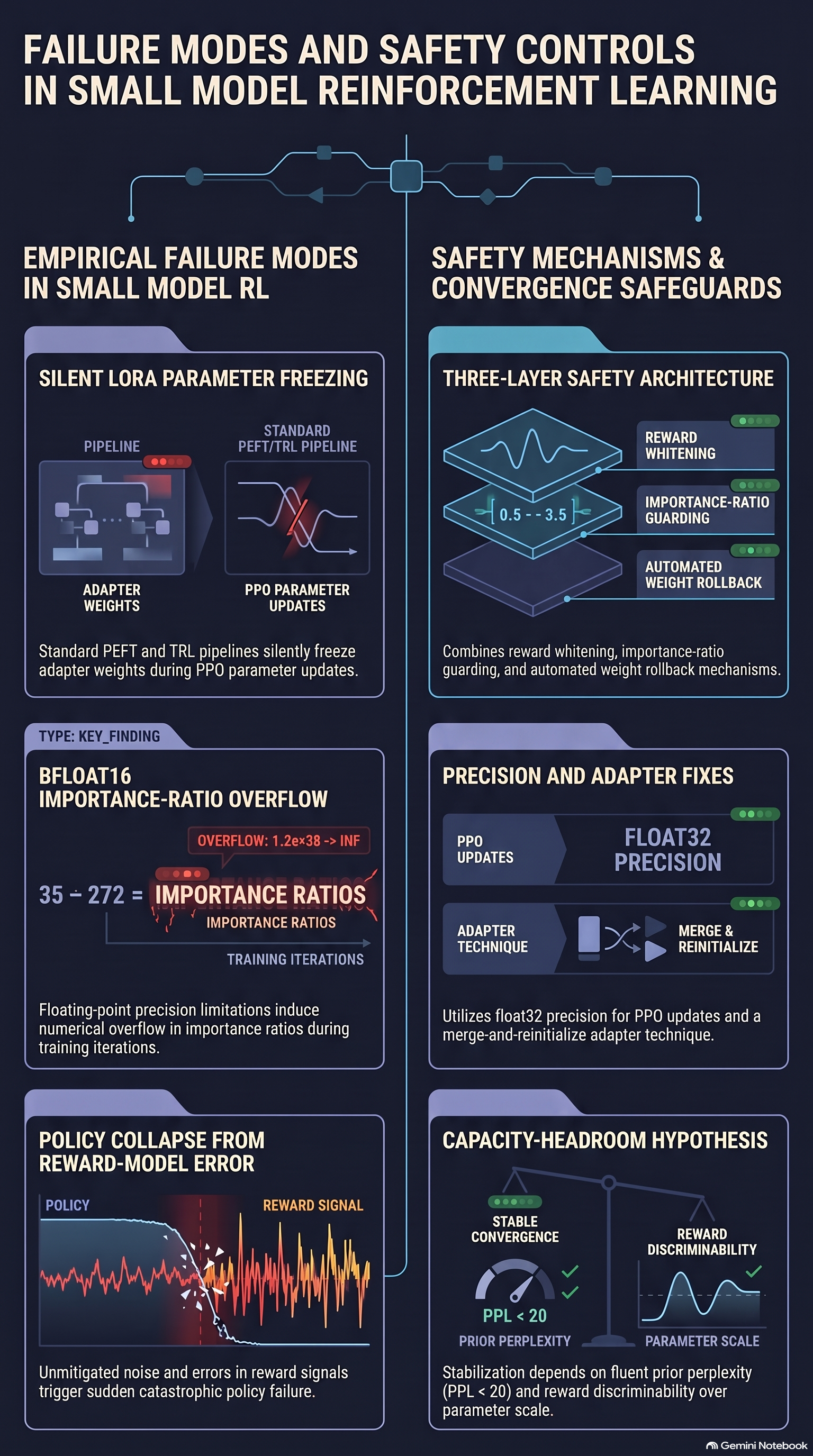
- Silent LoRA Parameter Freezing: Within standard Parameter-Efficient Fine-Tuning (PEFT) and Transformer Reinforcement Learning (TRL) pipelines, the authors observed instances where adapter parameters stop updating. This “silent freezing” effectively stalls the alignment process, as the model becomes incapable of incorporating feedback from the reward signal despite continued training iterations.
- Numerical Overflow (bfloat16): The research demonstrates that utilizing bfloat16 precision during PPO updates frequently leads to importance-ratio overflow. Small models exhibit a heightened sensitivity to high-variance updates; the restricted numerical range of bfloat16 is often insufficient to capture these fluctuations, resulting in numerical instabilities that disrupt the policy gradient.
- Reward-Model Error: Haque et al. characterize how inaccuracies or a lack of discriminative power in the reward model lead to catastrophic policy collapse. In these instances, the policy optimizes for a flawed or noisy signal, causing the model to lose foundational language capabilities—such as fluency and coherence—in favor of maximizing a technically high but qualitatively meaningless reward.
The Engineering Solution: A Three-Layer Safety Mechanism
To mitigate these instabilities, the authors developed a suite of engineering safeguards designed to enforce stability throughout the PPO update cycle.
Proposed Technical Safeguards
| Failure Mode Addressed | Implementation Strategy |
|---|---|
| Silent LoRA Parameter Freezing | Implementation of merge-and-reinitialize adapter techniques to maintain parameter plasticity. |
| Numerical Overflow (bfloat16) | Utilizing float32 precision specifically during PPO updates to accommodate high-variance importance ratios. |
| Reward Error and Policy Collapse | A three-layer safety mechanism: Reward Whitening, Importance-Ratio Guarding, and Weight Rollback. |
The authors characterize the three-layer safety mechanism as a critical buffer for low-capacity training. Reward whitening normalizes the feedback signal to prevent gradient spikes; importance-ratio guarding constrains the magnitude of policy shifts within a single update; and weight rollback allows the system to revert to a previous stable state if the training logic detects a sudden collapse in performance or fluency.
The Capacity-Headroom Hypothesis
A central contribution of the paper is the “capacity-headroom hypothesis.” The authors argue that the perceived inherent instability of SLMs is actually a dependency on two specific environmental factors rather than a fundamental limitation of parameter count.
According to the authors, stable PPO convergence at the SLM scale depends on:
- Supervised Model Fluency: The starting policy must possess a high degree of foundational fluency, which the authors define as a supervised fine-tuning (SFT) perplexity (PPL) of less than 20.
- Informative Reward Signal: The reward model must be sufficiently discriminative to provide a clear and consistent gradient for the small-scale policy to follow.
The paper suggests that if these conditions are met and the appropriate safety mechanisms are applied, even models as small as 70M parameters can achieve stable convergence during RL alignment.
Comparative Results and Benchmarks
The authors evaluated their methodology using the Pythia (70M, 160M, 410M) and SmolLM2 (135M, 360M) model families. These models were trained across three corpora: TinyStories, CNN/DailyMail, and Wikitext-103.
Key findings reported by the authors include:
- Universal Convergence: In all fifteen experimental configurations, the proposed safeguards successfully prevented policy collapse, allowing every model to reach stable training completion.
- Preference Win-Rate Improvements: The authors’ system demonstrated improved preference win rates over SFT baselines in configurations where the prerequisite fluency (PPL < 20) and reward discriminability were present.
- Instruction-Tuning Parity: The stabilized models outperformed existing instruction-tuned baselines across the evaluation corpora.
- Data Efficiency: The authors claim that their approach requires significantly less training data than traditional alignment methods to achieve comparable performance levels.
Conclusion: Implications for AI Safety and Decentralized Models
The research by Haque et al. (2026) provides a technical framework for aligning low-capacity models that were previously dismissed as too unstable for reinforcement learning. These findings carry significant implications for AI safety, particularly regarding the reliability of edge-scale or decentralized models. By demonstrating that small-scale agents can be made to adhere to policy constraints without the massive computational headroom of frontier models, the authors suggest a path toward robust, localized AI alignment.
By isolating the specific mechanisms of policy collapse—from precision limits to adapter freezing—the authors have transitioned the problem of SLM instability into a resolvable engineering challenge. To facilitate further research, the authors have publicly released their checkpoints, preference datasets, and training scripts, providing the community with the tools necessary to reproduce and extend these safety-critical findings.
Read the full paper on arXiv · PDF