Data Pyramid for Embodied Manipulation: A Survey
The paper organizes the embodied manipulation data ecosystem into a five-source pyramid balancing scalability against robot alignment, analyzing foundation model pretraining recipes and open...
1. Introduction: The Data Bottleneck in Robotics
While large language models (LLMs) effectively utilized the “internet shortcut”—leveraging massive, pre-existing repositories of text and imagery—embodied agents possess no such luxury. Technical development in robotics is currently constrained by a critical data bottleneck: the requirement for multimodal signals that couple visual observations with precise physical states and high-frequency action trajectories.
In the survey paper “Data Pyramid for Embodied Manipulation,” Ye et al. (2026) organize the complex embodied data ecosystem into a structured framework: the Embodied Data Pyramid. This framework is defined by the fundamental structural tension between data scalability—the ease of acquisition at scale—and robot alignment—the directness with which data supervises a specific hardware morphology’s physical execution.
2. The Five Tiers of the Embodied Data Pyramid
The authors categorize data sources into five distinct tiers based on their role in pretraining. Each tier represents a specific compromise across four metrics: data quality, diversity, reusability, and physical fidelity.
Editor’s Note: [Insert SOURCE_IMAGE_18: Figure showing the five tiers of the pyramid from Real-Robot Data at the apex to General Data at the base.]
| Data Source | Alignment & Physical Fidelity | Scalability & Diversity | Reusability & Scaling Potential |
|---|---|---|---|
| Real-Robot Data | High: Direct supervision; no morphology gap. | Low: Expensive, hardware-locked, and difficult to scale. | Limited: High quality but typically specific to a single hardware setup. |
| Universal Manipulation Interface (UMI) | Medium-High: Handheld grippers bridge human motion and robot execution. | Medium: More scalable than teleoperation; facilitates in-the-wild collection. | Moderate: High-quality visual trajectories; requires retargeting for deployment. |
| Egocentric & Exocentric Data | Low: Human hands differ from robot end-effectors (morphology gap). | High: Massive-scale human video datasets (e.g., Ego4D) provide rich semantic diversity. | High: Provides broad “indirect supervision” for world understanding. |
| Simulation Data | Variable: Constrained by the “sim-to-real” gap and physics discrepancies. | Very High: Safe, automated, and infinitely scalable trajectory generation. | High: Highly reusable once task assets and simulation infrastructures are built. |
| General Vision-Language Data | None: Lacks direct physical grounding or action signals. | Infinite: The scale of the internet; provides broad semantic reasoning. | Universal: Used as the cognitive foundation for high-level world models. |
3. Data Recipes: Powering the Next Generation of Foundation Models
Ye et al. analyze how modern architectures—including Vision-Language-Action (VLA) models and World-Action models—align heterogeneous action spaces by mixing these sources during pretraining. The authors argue that data composition directly determines the resulting agent’s capabilities:
- Perception and Reasoning: High-level semantic breadth is derived primarily from General Vision-Language Data and Egocentric Video. These sources allow models to internalize object relationships and world concepts that are absent in narrow robotic datasets.
- Planning and Prediction: To forecast outcomes and simulate potential trajectories, models rely on Simulation Data and world models. This tier provides the volume of data necessary for agents to learn the underlying causal physics of the environment.
- Action Generation: Despite the scale of other sources, the authors emphasize that Real-Robot and UMI Data remain indispensable. These tiers provide the low-level action signals and physical grounding required to translate high-level plans into fine-grained physical manipulation.
Editor’s Note: [Insert SOURCE_IMAGE_13: Visual representation of UMI data collection pipeline and its role in action-space alignment.]
4. The Reliability Gap: Why Robots Still Fail
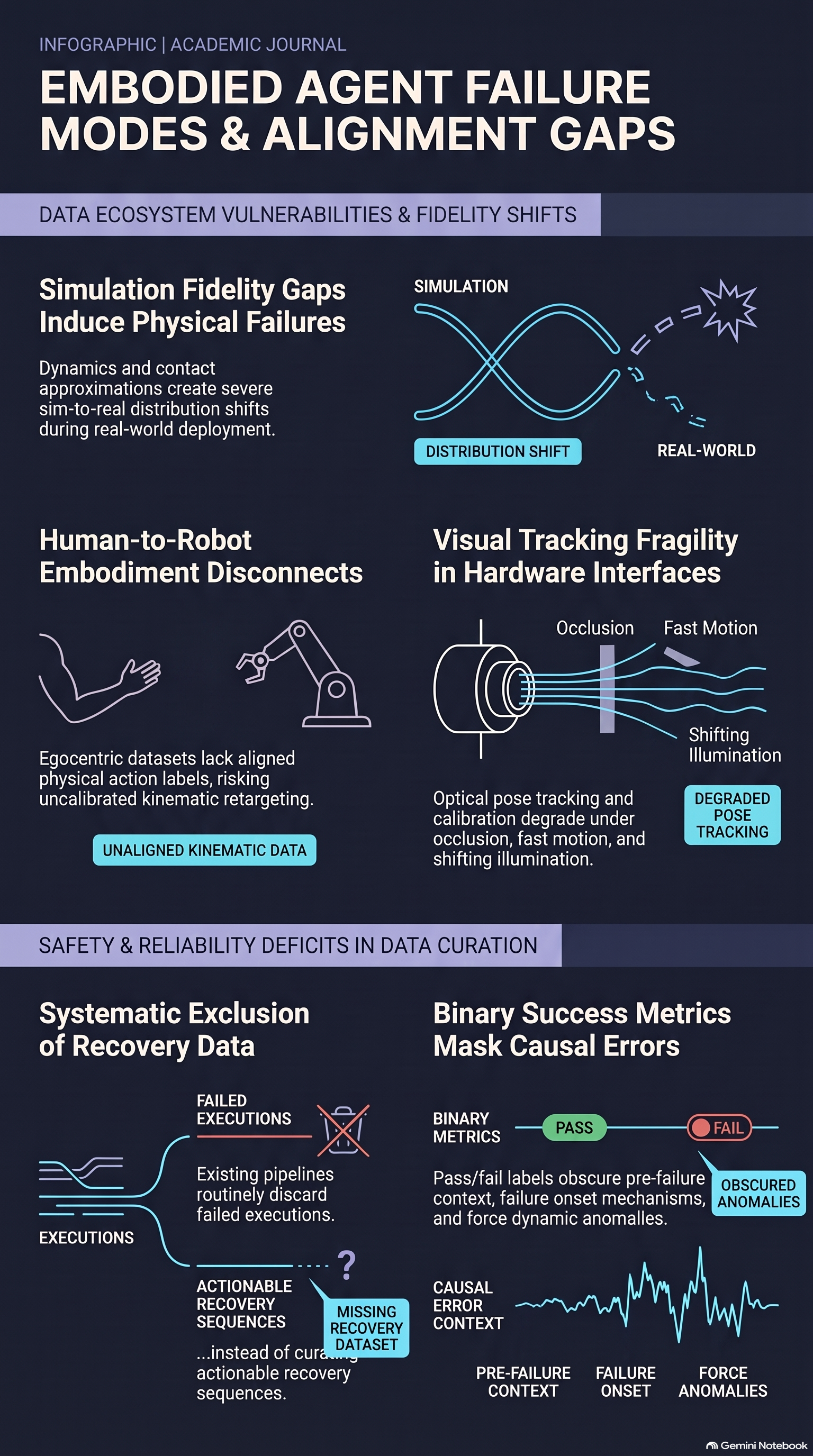
A primary contribution of Ye et al. is the identification of a “structural tension” that leads to the persistent reliability gap in embodied agents. Currently, models are trained predominantly on expert demonstrations—trajectories that show the “optimal” path to success.
Technically, this creates a “Failure Vacuum.” Because the training data distribution lacks off-policy data or examples of error states, failure modes become significantly “out-of-distribution” (OOD) during inference. When an agent encounters a minor distributional shift or physical disturbance, it lacks the action-space representation to correct itself. This leads to “compounding errors,” where a small initial deviation from the expert trajectory puts the robot into a state it has never observed, causing the model to diverge further from the intended goal. This lack of recovery data is a primary obstacle to AI safety and the deployment of autonomous systems in noisy, unpredictable real-world environments.
5. Six Open Challenges for the Field
Ye et al. identify six future directions essential for the advancement of next-generation embodied systems:
- Tactile Sensing: The need for large-scale datasets incorporating force feedback and touch-based observations beyond purely visual inputs.
- Failure and Recovery Data: Systematically collecting data on non-expert trajectories to teach models “what not to do” and how to perform self-correction.
- Scalable Pipelines: Moving toward automated, high-throughput collection systems to move beyond the limitations of manual human labor.
- Cross-Embodiment Alignment: Solving the “morphology gap” to map actions from diverse hardware (e.g., translating a four-fingered human-like grasp to a two-fingered industrial gripper).
- Dexterous Manipulation: Better leveraging massive egocentric human video to distill the fine-motor skills necessary for complex tasks.
- Principled Data Recipes: Developing a theoretical framework to determine the optimal ratio of simulation, human, and robot data for a given task.
6. Conclusion: The Path Forward
The survey by Ye et al. (2026) provides a foundational map for researchers navigating the trade-offs of the Embodied Data Pyramid. By highlighting the scarcity of failure and recovery signals, the authors offer a strategic roadmap for improving the robustness and reliability of robotic foundation models.
Key Takeaways for Researchers
- The Scalability-Alignment Trade-off: Increasing the volume of general data enhances semantic reasoning but does not mitigate the need for high-fidelity action signals derived from real-robot or UMI sources.
- The Failure Vacuum: Current reliability gaps are fundamentally a data problem. Improving agent safety requires a transition from “expert-only” datasets to those that explicitly capture error states and recovery paths to combat compounding errors.
- Cross-Embodiment Scaling: Future progress depends on the ability to align heterogeneous action spaces across different robot morphologies, allowing data from one hardware platform to benefit another.
Read the full paper on arXiv · PDF