LeapBot-WA: World-Anchor Action Models via Predictive Latent Alignments
The authors introduce LeapBot-WA, a world-action model that leverages a joint-embedding predictive architecture and an isotropic semantic autoencoder to predict abstract latent dynamics rather than...
The Pixel-Level Bottleneck in Embodied AI
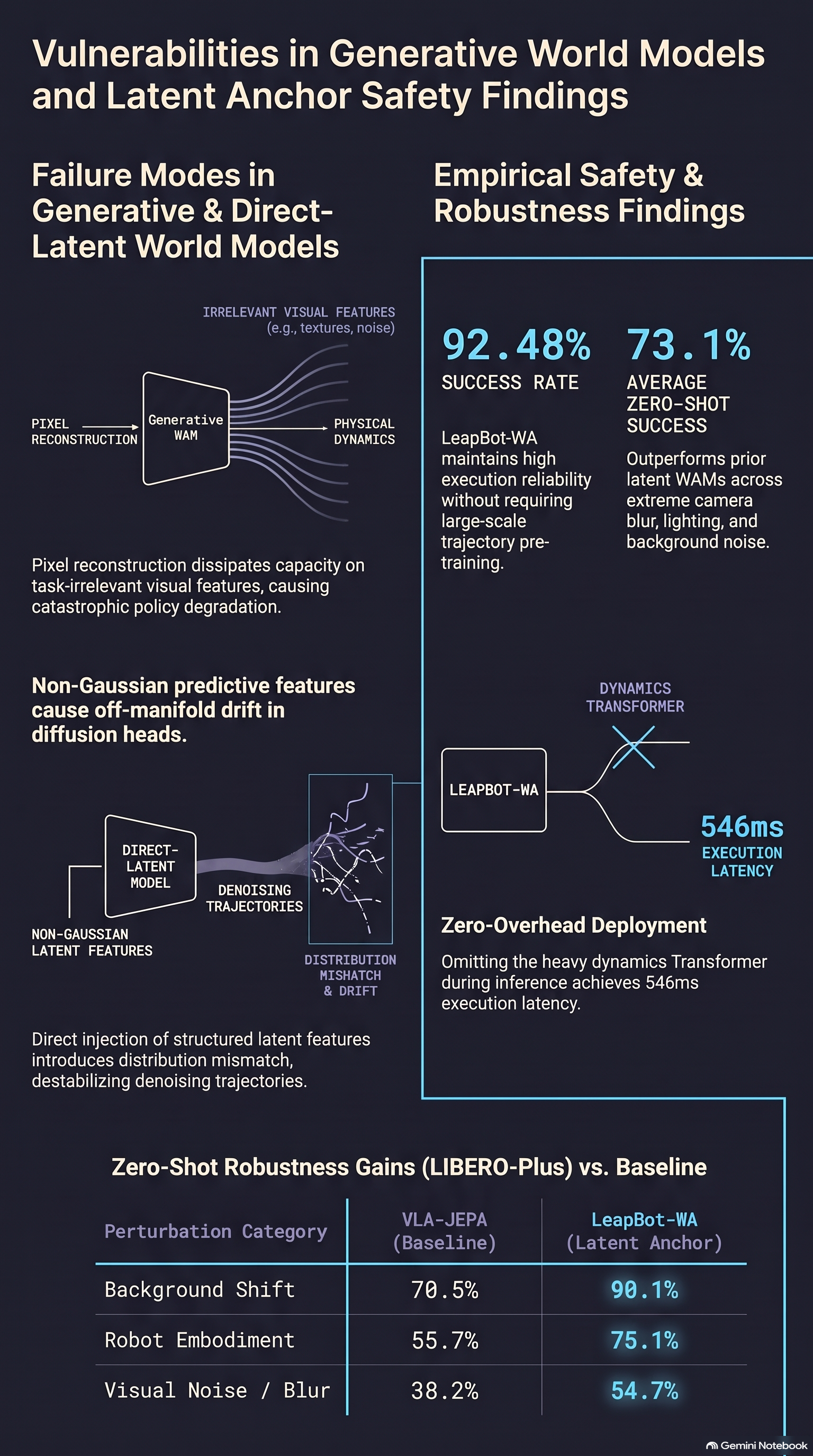
Robotics research is currently undergoing a transformative shift toward World Action Models (WAMs), which attempt to unify environmental prediction with action generation. However, the authors of “LeapBot-WA” identify a fundamental representational bottleneck in existing generative WAMs: the reliance on pixel-level video reconstruction. Forcing a model to synthesize raw video frames requires it to dissipate significant representational capacity on task-irrelevant high-frequency details, such as lighting, shadows, and background textures. This entanglement of physical dynamics with visual idiosyncrasies often results in policies that are acutely vulnerable to visual distractors and struggle with zero-shot generalization.
To resolve this, Liu et al. propose a “Predictive-Latent” paradigm. Their framework, LeapBot-WA, departs from visual synthesis to prioritize abstract physical dynamics within a latent foundation space. The core thesis of the paper suggests that by anchoring control in universal physical priors rather than pixel-level rendering, robotic agents can achieve superior robustness and efficiency across diverse manipulation tasks.
LeapBot-WA: A Tripartite Strategy for Latent Dynamics
The LeapBot-WA framework operates through a dual-pathway architecture designed to map raw observations to control actions without the computational burden of pixel generation. The authors define a strategy focused on aligning semantic representations, generative distributions, and inference execution:
- Predictive Anchor (JEPA): A large-scale predictive foundation model (V-JEPA 2.1) adapted to robotic data. It extracts high-level semantic tokens that represent the underlying physics of a scene, serving as a “World-Anchor” for the policy.
- Isotropic Semantic Autoencoder (ISAE): A bottleneck component that reshapes structured, non-Gaussian predictive features into a compact, “diffusion-friendly” manifold.
- Asymmetric Mixture-of-Transformers (MoT): A dual-branch transformer architecture that decouples world-model imagination from policy execution, utilizing privileged dynamics to guide action generation during training.
Mechanism 1: Anchoring Control in Abstract Physics
The authors utilize the Joint-Embedding Predictive Architecture (JEPA) as a “World-Anchor” to provide the policy with universal physical priors. Unlike models that learn from raw pixels, the fine-tuned JEPA encoder extracts semantic tokens representing the structural evolution of the environment. The authors emphasize that this approach focuses on “what matters” for manipulation—such as object topology and spatial transitions—rather than appearance.
To adapt this internet-scale prior to robotics, the paper details a “Domain-Adaptive Semantic Pretraining” (Stage I). The authors employ Low-Rank Adaptation (LoRA) to adapt the frozen V-JEPA 2.1 encoder to robot-specific data distributions. This adaptation is highly effective; linear probing experiments (Table 5) show that this mixed-domain pre-training yields a 37.9% improvement in dynamics prediction and a 28.5% improvement in proprioceptive state estimation compared to the base JEPA. Furthermore, ablation studies (Table 4) confirm the value of this anchor: replacing the base encoder with “Robot-Mix JEPA” increased the success rate on LIBERO-10 tasks from 74.2% to 81.0%.
Mechanism 2: Bridging the Modality Gap with ISAE
A significant technical challenge identified by the authors is the “modality gap”: the mismatch between the highly structured, non-Gaussian features produced by JEPA and the isotropic Gaussian priors required by diffusion models. Directly injecting raw features causes “off-manifold drift,” where the denoising trajectory becomes unstable because the vector field is unlearnable.
The Isotropic Semantic Autoencoder (ISAE) resolves this by reshaping the latent space. To ensure the space is “generative-ready” for joint flow-matching, the ISAE utilizes Sliced Isotropic Gaussian Regularization (SIGReg). This mechanism uses 1024 random 1D projections to penalize deviations from strict isotropy, ensuring a stable substrate for diffusion. The tripartite objective of the ISAE is summarized below:
| Objective | Description |
|---|---|
| Semantic-aware Reconstruction | Combines MSE and cosine similarity to ensure compressed latents preserve action-relevant structures. |
| KL Divergence Regularization | Regularizes the posterior toward a standard Gaussian prior to prevent dimensional collapse. |
| Sliced Isotropic Gaussian Regularization (SIGReg) | Explicitly enforces isotropic geometry across random projections to prevent off-manifold drift during flow-matching. |
Mechanism 3: Asymmetric Distillation and Zero-Overhead Inference
The core of LeapBot-WA’s action generation is the Asymmetric Mixture-of-Transformers (MoT). The semantic branch of this architecture is initialized with Wan2.2-TI2V-5B video diffusion weights to leverage pre-existing temporal knowledge.
During training (Stage III), the architecture utilizes two branches: an Anchor DiT (Diffusion Transformer) acting as a privileged dynamics expert, and an Action DiT acting as the controller. The authors implement an “Asymmetric Masked Interaction” where the Anchor DiT provides the Keys (K) and Values (V), while the Action DiT serves as the Query (Q). This mathematical structure allows the Action DiT to attend to future-oriented physical dynamics without allowing the actions to influence—and potentially corrupt—the world model’s physical reasoning. To handle cross-embodiment training, the authors utilize independent 7-DoF and 14-DoF action heads, supported by source-homogeneous batching to prevent gradient instability during joint optimization.
Inference Efficiency Gain While the Anchor DiT is essential for training the policy’s foresight, it is computationally heavy. At deployment, the authors prune the dynamics branch entirely. The system computes semantic tokens from the initial observation once and stores them in a “Semantic Cache”. The Action DiT then generates the entire action chunk by attending to this static cache. This enables high-frequency, zero-overhead execution while retaining sophisticated semantic guidance.
Experimental Evidence: Robustness and Real-World Transfer
The authors evaluated LeapBot-WA against both standard Vision-Language-Action (VLA) models and other WAMs.
Success Rate Comparison (Predictive WAMs)
| Benchmark | LeapBot-WA | JEPA-VLA | VLA-JEPA | PALM |
|---|---|---|---|---|
| LIBERO (Avg.) | 97.3% | 96.4% | 96.1% | 94.5% |
| RoboTwin 2.0 (Clean) | 91.04% | 73.50% | N/A | N/A |
| RoboTwin 2.0 (Rand.) | 92.48% | 17.70% | N/A | N/A |
The model demonstrated exceptional “Zero-Shot Robustness” to visual distractors. In the randomized environments of RoboTwin 2.0—which include significant perturbations in lighting, atmospheric fog, and floor textures—LeapBot-WA achieved a 92.48% success rate, outperforming even the specialized Lingbot-VA. Real-world deployment on a UR5 robot arm further validated these results; the agent successfully performed pick-and-place tasks with complex geometries, such as the curved surfaces of bananas and the star-shaped cross-sections of starfruit.
Hardware Efficiency and Comparative Performance
LeapBot-WA was designed to satisfy the real-time requirements of closed-loop robotic control. By avoiding pixel-level co-generation, the authors achieved significant speedups over existing benchmarks.
Technical Wins in Performance and Efficiency:
- 90% Reduction in Latency: LeapBot-WA reports an inference latency of 546ms. This is a stark contrast to other high-capacity WAMs like Lingbot-VA (4482ms) and Motus (3231ms).
- Optimized Throughput: Despite having 2.9B parameters, LeapBot-WA is significantly faster than the smaller Cosmos-Policy (2.1B parameters, 1413ms latency) due to its decoupled architecture.
- Parameter Efficiency: The model achieves state-of-the-art results with a fraction of the parameters found in Motus (8.0B), proving that latent-space dynamics are more efficient than pixel-space world modeling.
Conclusion: The Future of Latent-Centric Robotic Control
Liu et al. demonstrate that high-quality robotic control does not require the heavy computational burden of pixel-level rendering. By anchoring actions in abstract physical dynamics, LeapBot-WA achieves superior robustness and efficiency.
While the authors note limitations regarding extremely fine-grained contact physics and high-frequency tactile interactions, the study establishes three key takeaways for future WAM development:
- Latent over Pixels: Abstract dynamics are more robust and efficient than visual reconstruction for manipulation tasks.
- Decoupled Architecture: Using privileged experts during training allows for high-performance, zero-overhead deployment via pruning.
- Isotropic Alignment: Bridging the modality gap with tools like SIGReg is critical for stable, generative-based control.
Attribution Note This report is based on the research “LeapBot-WA: World-Anchor Action Models via Predictive Latent Alignments” by Liu et al. (2026).
Read the full paper on arXiv · PDF