LabRobFail: A Benchmark for Robotic Failure Analysis in Chemical Self-driving Laboratory
The paper introduces a synthetic simulation environment, dataset, evaluation benchmark, and domain-specialized vision-language model for detecting, localizing, and recovering from robotic failures in...
1. Introduction: The High Stakes of Scientific Automation
In household robotics, an execution failure—such as a vacuum cleaner becoming entangled in a rug—is generally reversible and of negligible risk. However, as noted by Wang et al., the environment of a self-driving laboratory (SDL) is fundamentally “irreversible and safety-critical.” In this domain, minor anomalies like pipette misalignment or excessive agitation do not merely result in temporary inconvenience; they can lead to sample contamination, the invalidation of long-horizon experimental workflows, or catastrophic hazardous incidents.
Despite these high stakes, the authors identify a “survival bias” in current scientific simulators like LabUtopia and Auto-Bio. These platforms have historically prioritized successful task execution, lacking systematic pipelines for error generation. This focus has resulted in a scarcity of failure data, which is essential for training resilient autonomous agents. To bridge this gap, the authors introduced the LabRobFail framework. This system addresses the lack of failure data and coarse evaluation protocols by treating structured error identification and temporal localization as foundational requirements for laboratory autonomy.
2. The LabRobFail Framework: Engineering Controlled Chaos
The core of the framework is the “FailureGenerator” module within LabRobFail-Sim. This module utilizes a high-fidelity simulation environment to systematically inject controllable perturbations across three hierarchical levels:
- Control-level Perturbation: Execution errors are modeled by injecting stochastic noise into keyframe parameters. This includes Gaussian noise applied to translation vectors () and Lie algebra noise applied to rotation matrices (). Additionally, gripper commands are corrupted to simulate actuator faults.
- Physics-level Perturbation: To test an agent’s physical robustness against emergent failures like slippage, the system dynamically adjusts simulation parameters such as friction, mass, and viscosity. These parameters are modified via uniform scaling (), ensuring the environment deviates from nominal models.
- Semantic-level Perturbation: Task logic errors are introduced by manipulating the sequence of operations. This includes step reversals, skips, or target object substitution (e.g., selecting the wrong reagent), which directly triggers safety protocol violations.
Through this automated pipeline, the authors constructed LabRobFail-Data, a repository containing over 20,000 trajectories and 70+ task scenarios. This dataset spans a range of complexities, from atomic “pick and place” actions to multi-stage chemical workflows.
3. A New Taxonomy of Laboratory Failure
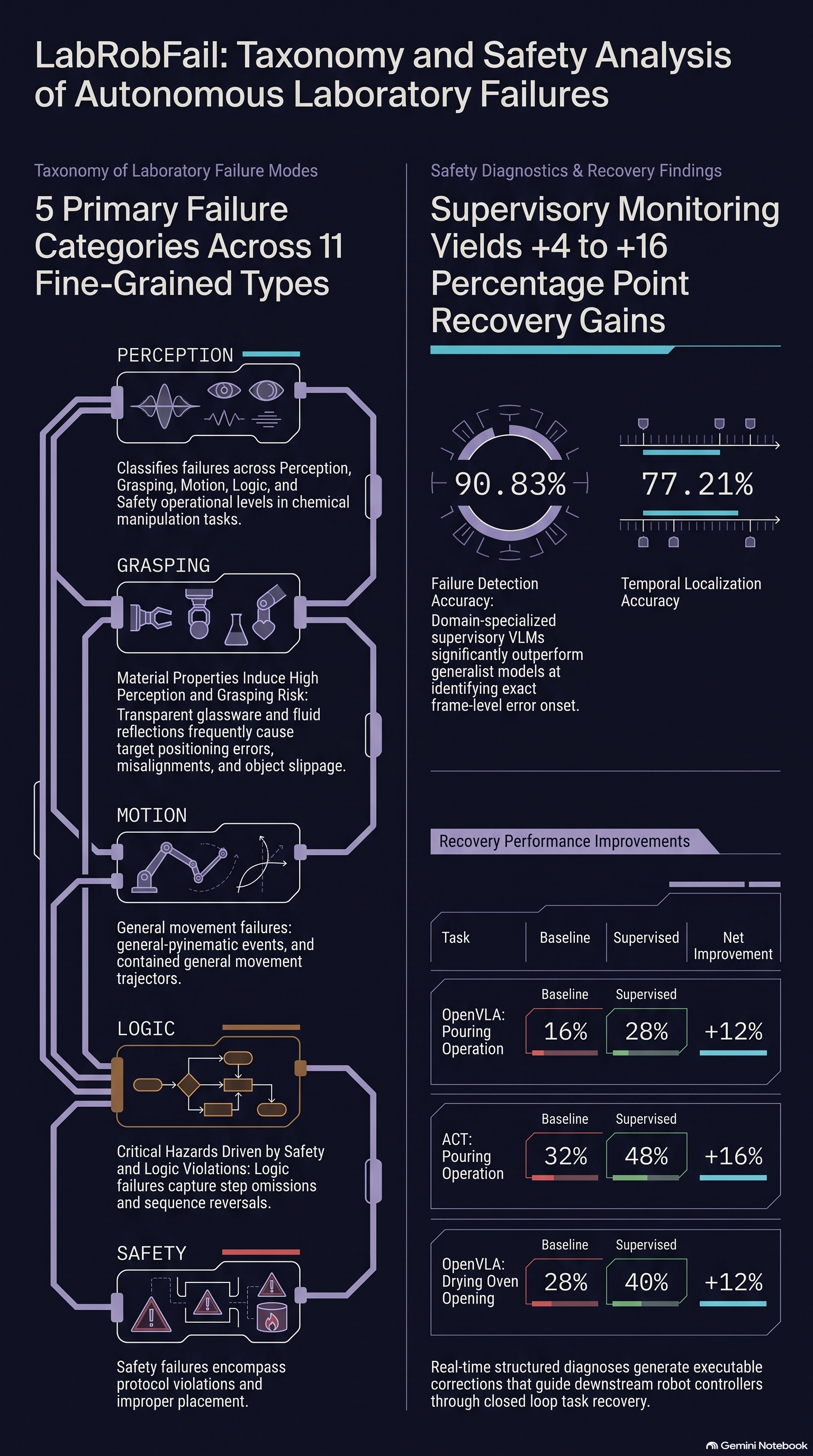
To standardize the understanding of anomalies, the authors established a taxonomy consisting of five major failure categories and 11 fine-grained types. This classification is specifically grounded in the unique challenges of the chemical laboratory:
| Category | Description | Fine-Grained Types & Examples |
|---|---|---|
| Perception (PF) | Errors driven by the optical properties of lab materials. | Target positioning deviation; anomalies from transparent glassware or reflective liquid surfaces. |
| Grasping (GF) | Deficiencies in end-effector control and physical interaction. | Object slippage; insufficient gripping force; grasp target misalignment (e.g., with wet surfaces). |
| Motion (MF) | Anomalies in the execution of planned trajectories. | Incomplete trajectories (premature termination); pose control errors. |
| Logic (LF) | Semantic errors in task-level planning and sequencing. | Step omission; sequence reversal. |
| Safety (SF) | Hazardous procedural violations and protocol breaches. | Improper handling of materials; protocol violations (e.g., creating hazardous mixtures). |
The authors emphasize that the Safety Failure (SF) category is a unique requirement for the laboratory context. Unlike household benchmarks where “trial-and-error” is a viable learning strategy, laboratory errors can be catastrophic, making safety detection a non-negotiable prerequisite for deployment.
4. LabRobFail-Bench: Measuring Six Dimensions of Resilience
The paper introduces LabRobFail-Bench, a multi-dimensional standard for evaluating robotic resilience. Utilizing a multi-view synchronized video stream, the benchmark assesses agents across three “cognitive levels” (L1 to L3):
- L1: Task Understanding: Evaluates the ability to decompose videos into atomic action sequences (Q1).
- L2: Failure Detection & Localization: Assesses if the model can detect the presence of a failure (Q2: Failure Detection) and pinpoint the specific frame where the anomaly began (Q3: Temporal Localization). The authors note that precise localization is critical for intervening before a hazard becomes irreversible.
- L3: Failure Analysis & Correction: Tests deeper reasoning, including severity assessment (Q4), failure classification (Q5), and the generation of “fine-grained, executable corrections” (Q6).
Failures are further categorized into four severity levels: Minor, Recoverable, Critical, and Catastrophic. This ensures that agents differentiate between negligible deviations and those requiring immediate emergency shutdown.
5. LabRobFail-VLM: Specialized Performance vs. Generalist Models
To implement the framework, the authors developed LabRobFail-VLM, using Qwen3-VL-8B as a base. The model employs an “Asymmetric Optimization” fine-tuning strategy:
- Vision Components: Fully fine-tuned to adapt perception to laboratory-specific cues, such as the subtle physical and optical challenges of transparent glassware and reflective fluids.
- Language Components: Fine-tuned via LoRA (Low-Rank Adaptation) to preserve general reasoning capabilities while adapting to structured diagnostic and recovery formats.
As shown in the authors’ results for seen environments (Table 2), LabRobFail-VLM significantly outperforms state-of-the-art generalist models:
| Metric | LabRobFail-VLM (Ours) | GPT-5.4 | Gemini-2.5-flash |
|---|---|---|---|
| Failure Detection Accuracy (Q2) | 90.83% | 52.34% | 57.13% |
| Temporal Localization Accuracy (Q3) | 77.21% | 15.88% | 15.53% |
| Failure Classification Accuracy (Q5) | 73.21% | 38.54% | 39.68% |
While general-purpose VLMs struggle with the subtle physical anomalies of the lab, the specialized VLM achieves high accuracy, particularly in temporal localization, where generalist models fail to exceed 16%.
6. Closing the Loop: Real-World Impact on Success Rates
The research concludes that a structured understanding of failure is a foundational requirement for “closed-loop recovery.” When LabRobFail-VLM is integrated into the control loop as a real-time supervisor, the authors report a 4 to 16 percentage point increase in downstream task success rates. By providing actionable correction instructions rather than binary failure flags, the VLM enables the agent to recover from errors that would otherwise terminate the experiment or result in safety violations.
7. Final Summary of Key Takeaways
The LabRobFail framework provides three critical insights for AI safety researchers and practitioners in high-stakes automation:
- Data Scarcity and Simulation: Real-world failure data in chemistry is too hazardous and costly to collect manually. Automated, multi-level failure injection at the simulation level is a necessary prerequisite for training safe agents.
- Granularity Over Binary Metrics: Simple “success or failure” metrics are insufficient for complex, multi-stage workflows. Safety monitoring requires precise temporal localization and severity assessment to prevent minor deviations from escalating into catastrophic outcomes.
- The Necessity of Domain Specialization: There is a profound performance gap between general-purpose VLMs and domain-specific models. Specialized training is required to interpret the subtle optical and physical cues—such as liquid surfaces and transparent containers—that are ubiquitous in the laboratory but rare in standard training sets.
Read the full paper on arXiv · PDF