Anticipatory Risk-Guided Reinforcement Learning for Safe Flight Through Dynamic Clutter
The authors develop an anticipatory risk-guided reinforcement learning framework that trains an asymmetric actor-critic to self-predict future collision risk maps from depth sequences for safe...
1. Introduction: The Latency Problem in High-Speed Navigation
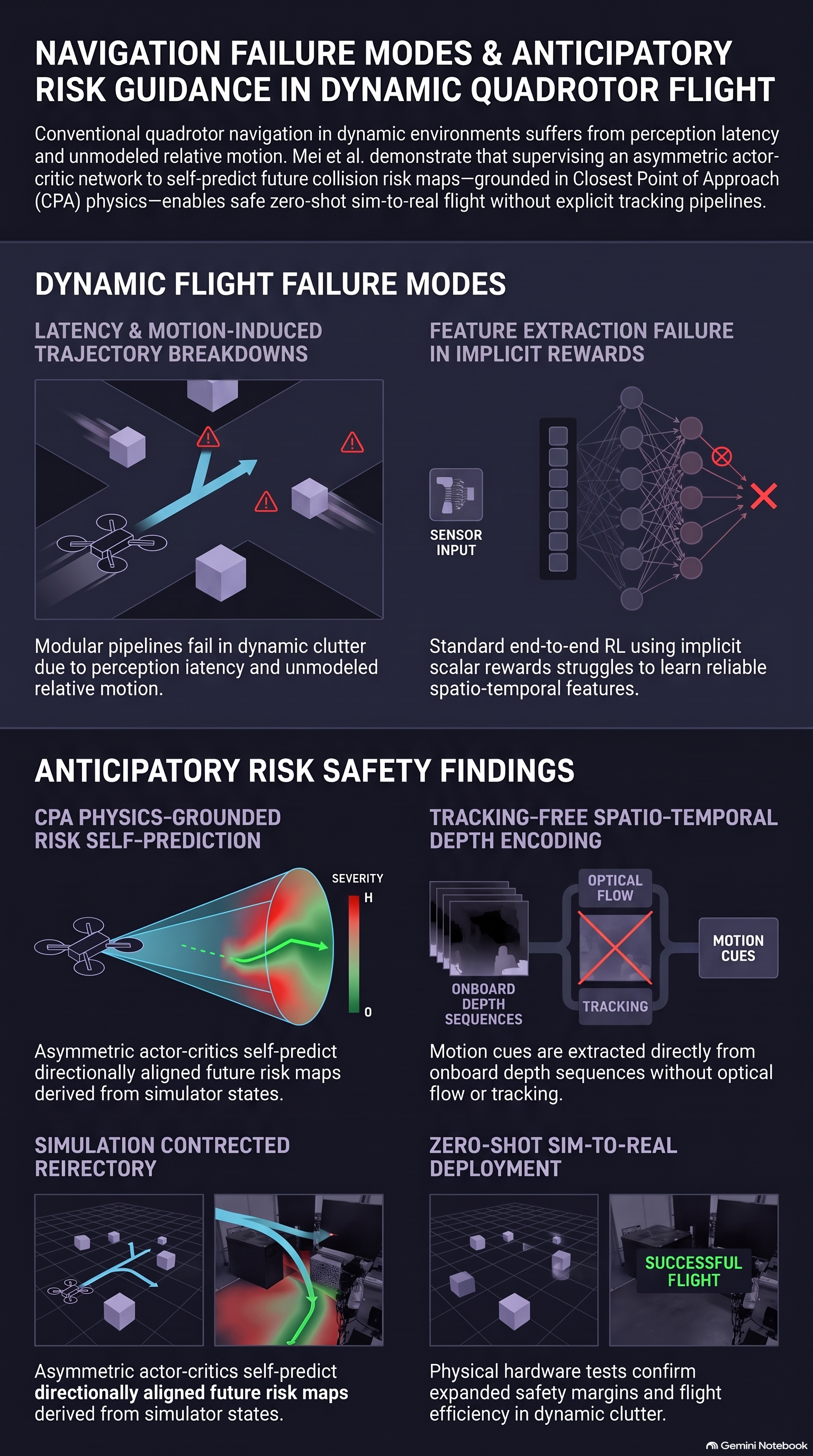
Safe autonomous quadrotor flight through high-density dynamic environments remains a significant stochastic bottleneck in robotics. Conventional reactive systems, which rely on instantaneous geometric perception, frequently fail when the time-to-collision is shorter than the system’s processing and actuation cycle. In these scenarios, the failure to account for the relative motion of obstacles leads to critical trajectory breakdowns.
In the paper “Anticipatory Risk-Guided Reinforcement Learning for Safe Flight Through Dynamic Clutter,” Mei et al. (2026) propose a framework designed to move beyond reactive avoidance. The authors argue that by training an agent to self-predict future collision risk maps, autonomous systems can effectively internalize the anticipation of risks. This methodology aims to mitigate perception latency and the challenges of unmodeled motion by shifting from purely reactive maneuvers to proactive, risk-aware navigation.
2. Why Conventional Pipelines Fail: Latency and Unmodeled Motion
The authors identify two primary failure modes that degrade the performance of existing autonomous navigation systems in dynamic clutter. The first is perception latency, where the computational overhead of processing visual data creates a lag that becomes fatal at high velocities. The second involves the limitations of standard end-to-end learning. Without physics-grounded supervision, models often struggle to extract reliable spatio-temporal features from implicit scalar rewards, resulting in brittle policies that fail to generalize to complex motion patterns.
| Approach | Primary Limitations |
|---|---|
| Conventional Modular Pipelines | • High perception latency in dense clutter. • Computational complexity of explicit object tracking. • Failure to scale with increasing obstacle density. |
| Standard End-to-End Learning | • Difficulty extracting motion cues from implicit rewards. • Brittle spatio-temporal features. • Poor performance without physics-grounded supervision. |
3. The Mechanism: Anticipatory Risk Maps & CPA Physics
To ground the reinforcement learning process in physical reality, the authors employ the Closest Point of Approach (CPA) physics. Unlike purely spatial models, CPA accounts for the temporal dimension by determining both the minimum distance between the quadrotor and an obstacle and the specific time at which this minimum occurs. This “time-to-CPA” calculation allows the model to anticipate risks over a defined time horizon rather than merely reacting to spatial proximity.
Mei et al. utilize this physics to construct a “directionally aligned future collision risk map.” These maps are ego-centric and aligned with the quadrotor’s velocity vector or heading, providing a structured representation of future risk. During training, the framework leverages privileged simulator states—high-fidelity ground-truth data unavailable during deployment—to generate these risk priors.
The role of privileged simulator states in this framework includes:
- Trajectory Ground-Truth: Enabling precise calculation of exact CPA values for all dynamic obstacles within the environment.
- Structured Risk Prior Generation: Facilitating the creation of ego-centric maps that identify which specific headings are associated with the highest probability of future collision.
- Supervisory Signal for the Asymmetric Critic: Providing the critic network with the ground-truth motion data necessary to evaluate the safety of the actor’s selected actions over a future time horizon.
4. Architectural Innovation: The Asymmetric Actor-Critic
The core innovation presented by Mei et al. is an asymmetric actor-critic architecture. During the training phase, the critic utilizes privileged simulator states and CPA-based risk maps to supervise the learning process. The actor, however, is trained to self-predict these structured risk maps using only onboard sensor data. Consequently, during real-world deployment, the actor can generate its own risk priors to guide its visual policy, effectively “internalizing” the privileged information.
To process onboard data efficiently, the authors developed a lightweight spatio-temporal encoder. This encoder extracts motion cues directly from sequences of depth images. By bypassing the need for optical flow estimation or explicit object tracking, the authors significantly reduce the computational footprint, allowing the system to maintain the high control frequencies required for high-speed flight.
“The self-prediction of structured risk maps serves as a high-level abstraction that decouples the visual perception task from the motion planning task, allowing the policy to prioritize safety margins without the overhead of explicit tracking.”
This architectural choice bridges the gap between simulation and the physical world. By training the actor to predict an abstracted risk map rather than raw pixels, the policy becomes more robust to the visual noise typically encountered during hardware deployment.
5. Experimental Results: Safety Margins and Flight Efficiency
Experimental results reported by Mei et al. indicate that the anticipatory risk-guided approach provides substantial improvements over standard RL baselines using implicit scalar rewards. The authors observe that the self-prediction of risk allows the quadrotor to maintain higher average speeds while simultaneously increasing safety margins. This is a direct result of the system’s ability to “look ahead” temporally, avoiding the reactive “deadlock” or “freeze” behaviors that plague standard end-to-end models in dense clutter.
A critical finding in the paper is the successful zero-shot Sim-to-Real transfer. The learned policy was deployed on a physical quadrotor without fine-tuning, relying purely on abstracted spatio-temporal depth sequences and self-predicted risk priors. The authors claim this validates the generalization capabilities of the model, as the underlying CPA physics remain constant even when visual environments change.
6. Failure-First Perspective: Insights for AI Safety
From the perspective of AI safety and red-teaming, this research addresses the prevention of “trajectory breakdowns”—the specific moments where perception latency leads to a deadlock or a fatal collision in the presence of dynamic obstacles.
The three most critical takeaways for safety researchers are:
- Physics-Grounded Supervision Mitigates Reward Hacking: Traditional scalar rewards often lead to brittle policies that “hack” the simulator by finding survival paths that do not translate to physical dynamics. By using CPA-grounded risk maps, the model is forced to learn the physical constraints of motion.
- Self-Prediction as a Computational Buffer: The network’s ability to self-predict future states effectively creates a computational buffer against physical hardware latency. By acting on “future” risks, the agent neutralizes the hazards caused by the unavoidable time lag in onboard visual processing.
- Abstraction Prevents Trajectory Breakdown: Trajectory breakdowns often occur when a perception system fails to track a specific object. By shifting to an abstracted, directionally aligned risk map, the system remains functional even when individual object tracking would otherwise fail or become too computationally expensive.
7. Conclusion: The Path to Proactive Autonomy
The research by Mei et al. demonstrates a clear transition from reactive to anticipatory autonomous navigation. By using an asymmetric actor-critic architecture to internalize future collision risks, the framework enables quadrotors to navigate complex, dynamic environments with a foresight that traditional modular or implicit RL pipelines lack.
The robust zero-shot generalization from simulation to physical hardware suggests that self-predicted risk maps represent a scalable path toward proactive autonomy. This approach not only enhances flight efficiency but also provides a more rigorous framework for ensuring safety in high-speed, unmodeled dynamic environments.
Read the full paper on arXiv · PDF