WCM: World-Cognition Model for Generalizable Human-Robot Interaction
The authors present the World-Cognition Model (WCM), an embodied agent framework based on a modular sensing, logic, action, and knowledge architecture with an asynchronous runtime and interactive...
1. Introduction: The Gap Between Software Agents and Physical Robots
Modern software-based language agents demonstrate significant fluency and reasoning capabilities within digital environments. However, embodied robots continue to struggle when translating these cognitive strengths into physical tasks. According to Chen and Zhou, existing robot-control paradigms—most notably vision-language-action (VLA) policies and world-model-based planners—are largely optimized for unidirectional instruction execution. This creates a critical transparency gap: users lack visibility into the robot’s underlying reasoning and possess few technical mechanisms to redirect, correct, or teach the agent during active task rollouts.
The research presented by Chen et al. introduces the World-Cognition Model (WCM) to bridge this gap. The WCM is designed to move beyond simple instruction following by establishing a framework for interactive teaching and transparent reasoning. This document examines the technical design of the WCM’s architecture, specifically its modularity and asynchronous execution, and analyzes the implications for interactive error recovery and systematic AI safety.
2. The SLAK Architecture: Decoupling for Transparency
To mitigate the “black box” nature of traditional end-to-end robotic policies, the authors propose the SLAK architecture. This design modularizes the system into four distinct components, each connected via explicit interfaces:
- Sensing: The perception module tasked with processing and interpreting high-dimensional environmental inputs.
- Logic: The core reasoning engine responsible for high-level decision-making, planning, and task decomposition.
- Action: The control interface that translates logical decisions into low-level physical motor commands.
- Knowledge: The memory component used for storing and retrieving task-relevant information and historical context.
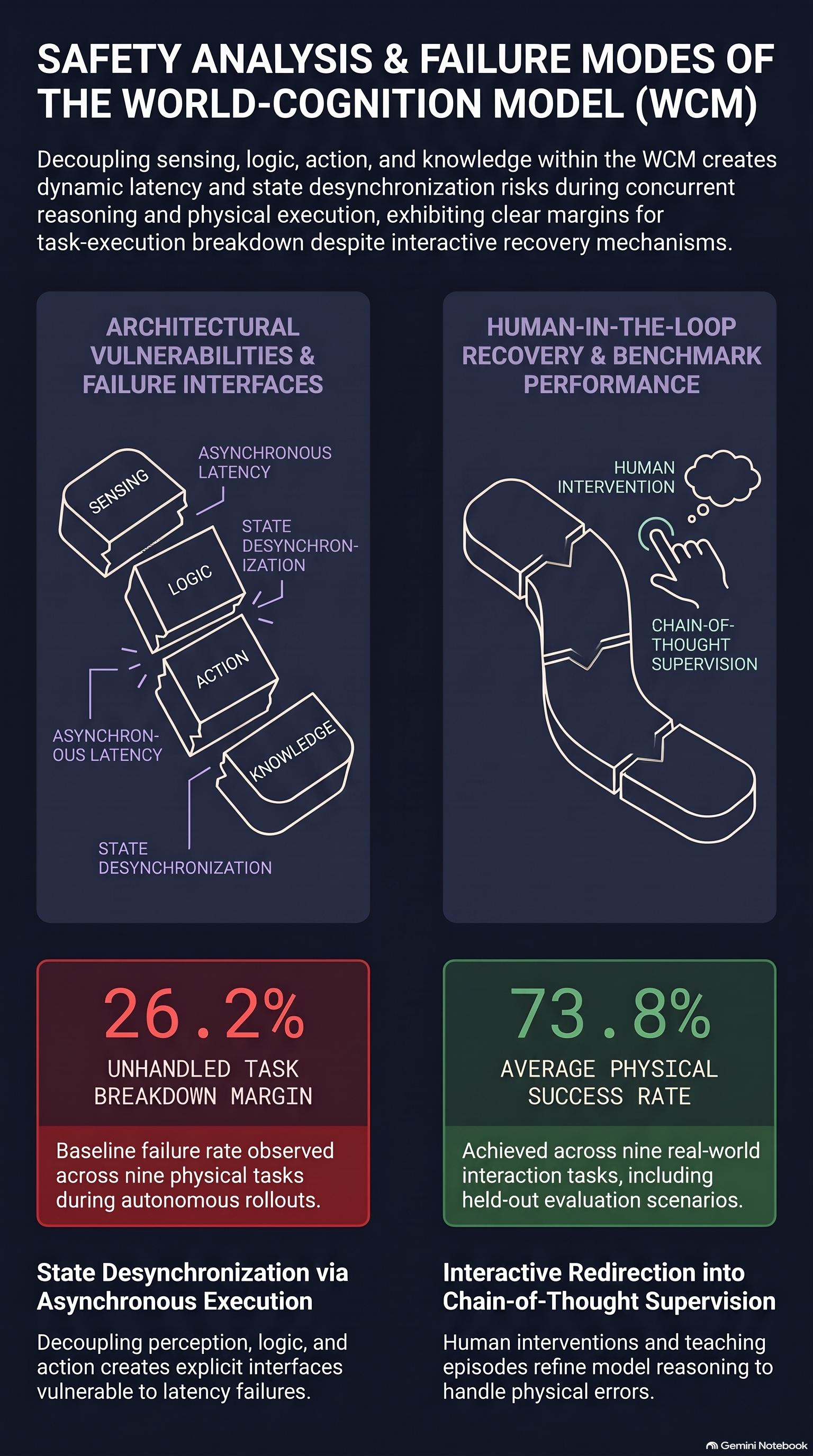
The significance of this decoupling lies in the “explicit interfaces” it creates between cognitive and physical functions. For an AI safety researcher, this modularity facilitates precise error visibility. By probing the interfaces between Sensing and Logic, or Logic and Action, a researcher can determine whether a failure resulted from a perception error (incorrect environmental state), a logical lapse (faulty planning), or an execution flaw (failure to translate a correct plan into motion).
3. Asynchronous Runtime: Concurrent Reasoning and Execution
The WCM utilizes an asynchronous runtime environment, marking a departure from sequential processing models where a robot must pause execution to compute the next step or engage in dialogue. In this architecture, reasoning, human-robot communication, and physical execution proceed concurrently. This design is intended to provide a more fluid and human-like interaction profile during complex tasks.
However, this concurrency introduces specific technical risks that are central to the study of embodied AI safety.
Safety Insight: The authors observe that an asynchronous architecture permits the emergence of latency and state desynchronization failures. Because logic and execution run in parallel, the robot’s internal world-representation may lag behind the actual environment. This creates a physical risk where the robot may act on a world-state that no longer exists—for example, attempting to grasp an object that a human has already moved or altered, potentially leading to unintended collisions or task collapse.
4. Human-in-the-Loop (HITL) Teaching and Supervision
The WCM introduces an interactive teaching methodology that allows users to provide real-time supervision. During difficult or long-horizon tasks, the user can intervene to redirect the robot or provide corrections. Chen et al. frame these interventions not merely as temporary manual overrides, but as a primary data source for model improvement.
These interactive teaching episodes and autonomous rollouts are refined into “chain-of-thought (CoT) supervision.” By converting human corrections into structured reasoning paths, the system internalizes human logic. The authors suggest this refinement process aims to reduce reliance on real-time intervention over time by aligning the model’s autonomous reasoning with the logic demonstrated by the human supervisor. This provides a potential safety bridge between manual intervention and reliable autonomous operation.
5. Empirical Performance and the “Unhandled Margin”
The authors evaluated the WCM’s performance across nine real-world physical interaction tasks. The experimental setup included diverse conditions to test the model’s generalizability and its ability to handle complex sequences.
| Metric | Value/Description |
|---|---|
| Success Rate | 73.8% (Average) |
| Task Variety | 9 Physical Interaction Tasks |
| Specific Conditions | Held-out CoT tasks; Long-horizon interaction learned via teaching. |
While a 73.8% success rate establishes a functional baseline, the “26.2% unhandled task margin” reported in the paper is of particular interest for safety research. This margin represents the specific instances where interactive policies failed to complete the task despite the availability of human supervision. Chen and Zhou suggest that this failure rate serves as a diagnostic opportunity for red-teaming. It allows researchers to investigate where task-execution breakdowns occur—whether through the aforementioned desynchronization, limits in the model’s ability to internalize CoT supervision, or failures in the human-in-the-loop redirection mechanism.
6. Conclusion: Takeaways for AI Safety and Robotics
The WCM research offers three critical insights for the development of safe human-robot interaction:
- Visibility through Modularity: The SLAK architecture demonstrates that decoupling sensing, logic, action, and knowledge provides the necessary interfaces to diagnose and isolate the specific source of systematic failures.
- HITL as a Safety Framework: Beyond its utility as a teaching tool, human-in-the-loop intervention serves as an operational framework for error recovery, allowing human supervisors to intercept and correct hazardous trajectories in real time.
- Managing Desynchronization: As robots move toward asynchronous execution to achieve interaction fluency, managing the risks of state desynchronization and latency-induced errors becomes a primary safety requirement for embodied agents.
The World-Cognition Model provides a technical baseline for investigating how embodied agents fail and how interactive supervision can be structured to mitigate those failures within complex, unpredictable physical environments.
Read the full paper on arXiv · PDF