PRIMS: Physics-guided Representation for Fluid Identification in Multimodal Sensing
The paper introduces PRIMS, a compact physics-guided multimodal Transformer that incorporates analytical fluid mechanics relationships into sensor tokenization, dependency modeling, and...
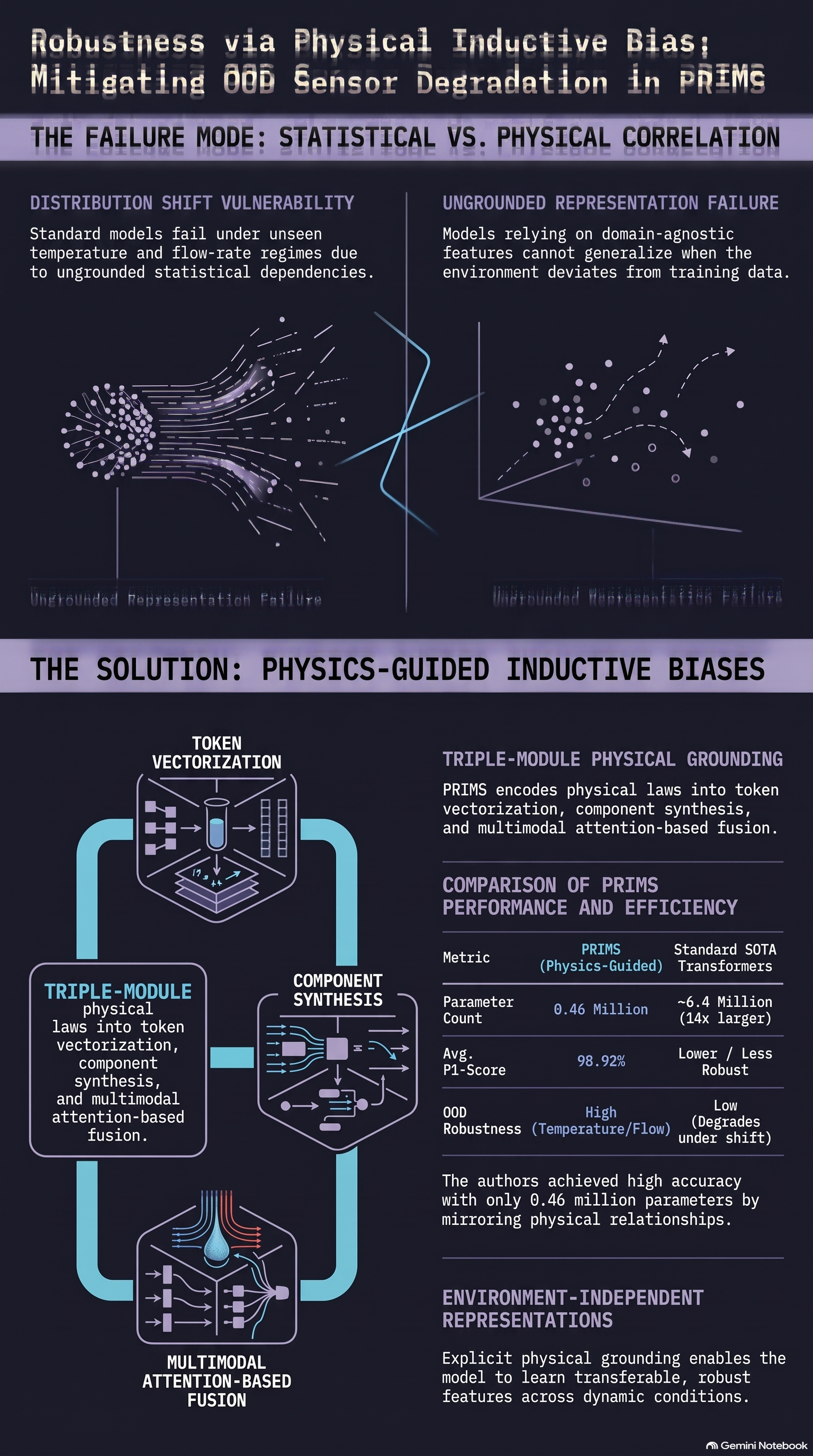
1. Introduction: The Fragility of Ungrounded Sensing
In the domain of high-stakes sensor classification, deep learning models frequently exhibit a brittle reliance on what Nguyen et al. term “ungrounded statistical correlations.” From an AI safety perspective, these correlations function as “shortcuts”—spurious patterns that allow a model to achieve high accuracy during training without capturing the underlying causal mechanisms. When operating conditions deviate—such as changes in ambient temperature or flow regimes—these shortcuts inevitably fail, leading to systematic, and often covert, performance degradation.
To mitigate this reliance on superficial patterns, Nguyen et al. propose PRIMS (Physics-guided Representation for Fluid Identification in Multimodal Sensing). This framework is not merely another architectural iteration; it represents a deliberate shift toward bridging analytical fluid mechanics with neural networks. By embedding physical laws directly into the model’s structure, the authors aim to constrain the hypothesis space, ensuring that the model’s internal representations remain tethered to the governing laws of fluid dynamics.
2. The Architecture of Reliability: Three Physics-Guided Modules
Standard Transformers treat sensor inputs as domain-agnostic numerical sequences, a practice that invites the learning of non-physical noise. In contrast, the PRIMS architecture is partitioned into three modules designed to enforce physical consistency.
2.1 Physics-based Token Vectorization
Rather than feeding raw data into the network, this module transforms signals from Coriolis and pressure sensors into physically grounded token embeddings. Nguyen et al. design this stage to ensure that the initial data representation accounts for the fundamental properties these sensors measure, such as mass flow and differential pressure. By vectorizing tokens within the context of their physical units and expected ranges, the model is prevented from entertaining mathematically valid but physically impossible data interpretations.
2.2 Physical Component Synthesizer
A critical vulnerability in fluid sensing is the complex, non-linear interaction between viscosity, flow rate, and density. This module explicitly models these dependencies. By architectural design, the synthesizer mirrors the analytical relationships found in fluid mechanics, specifically targeting how changes in pressure and flow relate to a fluid’s viscosity. This serves as a hard inductive bias, forcing the model to calculate internal states that are consistent with the known behavior of fluids under various pressures.
2.3 Physics-guided Fusion
In multimodal sensing, “covert failures” often occur when a model fails to reconcile conflicting data from different sensors. The authors utilize an attention-based fusion mechanism that captures cross-physical correlations. This module ensures that the attention weights are not just statistically optimized, but are guided by how different physical properties (e.g., how density influences Coriolis force) interact under the laws of physics.
3. Efficiency and Performance Benchmarks
The authors evaluated PRIMS against a five-fluid benchmark under dynamic conditions. The empirical results suggest that physics-based grounding allows for a drastic reduction in model complexity without compromising accuracy.
| Metric | PRIMS Performance (Nguyen et al.) |
|---|---|
| Average F1-Score | 98.92% |
| Total Parameter Count | 0.46 Million |
| Comparison to SOTA Transformers | 14x reduction in parameters |
In the context of safety-critical systems, this 14-fold reduction in parameters is a significant finding. Smaller models are inherently more auditable and less prone to the “black-box” opacities of over-parameterized state-of-the-art (SOTA) models, which often hide brittle shortcuts within their vast parameter counts.
4. Testing the Limits: Out-of-Distribution (OOD) Robustness
The primary failure mode addressed by Nguyen et al. is the “operating sensor distribution shift.” Standard models typically fail when encountering unseen temperature ranges because temperature is a hidden variable that shifts the viscosity and density of the fluid. A domain-agnostic model sees the resulting signal change as a departure from its training distribution, leading to misclassification.
PRIMS, however, treats temperature and flow-rate regimes as parameters within a known physical relationship. The authors tested the model under:
- Unseen temperature ranges
- Unseen flow-rate regimes
The research claims that PRIMS consistently outperformed prior SOTA models in these OOD scenarios. Because the model understands that a temperature shift causes a predictable change in viscosity, the “shift” is not a surprise to the system; it is a known physical variable. This allows PRIMS to maintain “environment-independent representations,” effectively designing out the sensitivity to distribution shifts that plagues purely statistical models.
5. AI Safety Implications: Physical Inductive Biases
This research provides a template for proactive AI safety: the use of domain-specific inductive biases to prevent systematic failures. In safety-critical sensing, we cannot afford models that rely on accidental correlations. If a model learns to identify a fluid based on a specific pump’s noise (a shortcut) rather than the fluid’s density (a physical law), the system will fail when the pump is replaced.
Nguyen et al. demonstrate that by restricting the model’s hypothesis space to only those solutions that are physically valid, one can prevent the emergence of these shortcuts. This approach addresses “covert failures”—instances where a model appears to be functioning correctly but is actually operating on a flawed internal logic that will collapse under real-world variation. Physical grounding ensures that the AI’s internal model of the world remains aligned with objective reality.
6. Conclusion & Key Takeaways
The PRIMS framework demonstrates that the path to robust AI in physical sensing lies in the integration of analytical mechanics with deep learning. By moving beyond domain-agnostic architectures, Nguyen et al. have produced a model that is both highly efficient and remarkably resilient to environmental shifts.
Key Takeaways for Practitioners:
- Prioritizing Causal Physics over Spurious Correlations: Grounding token embeddings in physical laws prevents the model from adopting “shortcuts” that fail during distribution shifts.
- Auditability through Efficiency: The 0.46-million parameter budget (a 14x reduction over SOTA) facilitates easier safety auditing and deployment on resource-constrained hardware without sacrificing the 98.92% F1-score performance.
- Physical Variables as Constraints: By explicitly modeling viscosity and pressure dependencies, the system becomes resilient to unseen temperature and flow ranges, as these are treated as known physical factors rather than arbitrary noise.
- Proactive Failure Prevention: Designing architectures that mirror governing physical laws is a viable mechanism for ensuring that AI systems remain reliable in environments not fully captured in training data.
Read the full paper on arXiv · PDF