Multimodal Adaptive Control for Safe Robotic Craniotomy Under Partial Observability
The authors present RL-MACRO, a closed-loop control framework that reconstructs hidden cutting temperatures from multimodal sensory feedback and uses offline reinforcement learning to regulate tool...
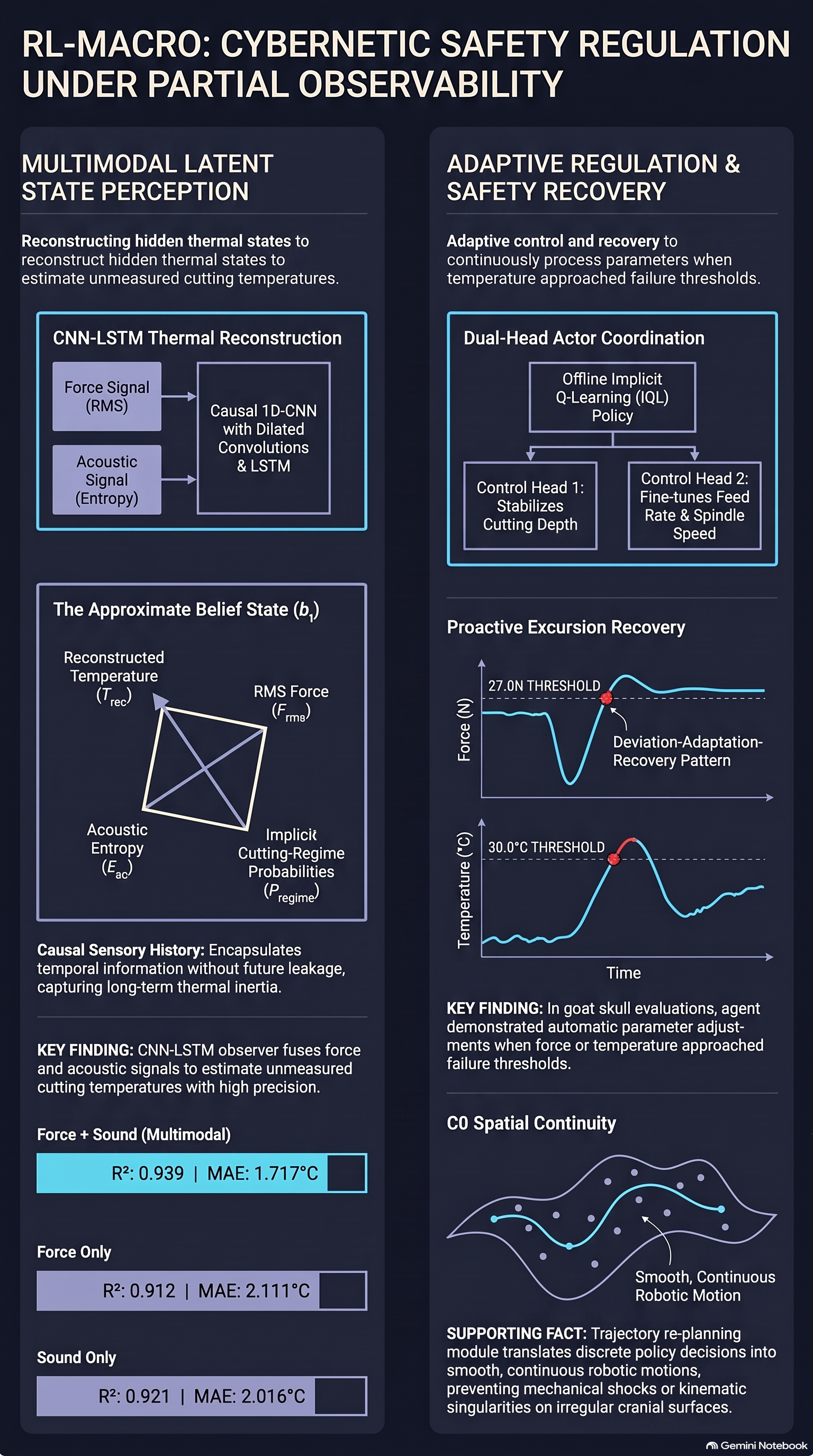
In robotic neurosurgery, autonomous bone removal is fundamentally limited by partial observability. While high-precision manipulation is achievable, the cutting interface remains a “blind spot” due to severe physical occlusion from the tool and the continuous flooding of saline coolant. This prevents direct, high-frequency measurement of the tool-tissue interaction state . The inability to monitor real-time temperature and mechanical resistance creates substantial safety risks, as undetected thermal accumulation leads to necrosis, while unmitigated mechanical force can cause bone fracture or accidental penetration of the dura mater. Zhang et al. propose RL-MACRO, a cybernetic closed-loop framework designed to reconstruct these hidden states via multimodal sensory fusion and regulate interaction through offline reinforcement learning (RL).
1. The Observability Gap in Autonomous Bone Cutting
The authors formulate the interaction between the high-speed rotating tool and cranial tissue as a system where critical safety variables are latent.
- The Hidden State: The robot cannot directly perceive the latent physical state , which includes the instantaneous temperature at the tool-tissue interface and the heterogeneous properties of the bone (density, porosity, and layer-specific hardness).
- The Safety Risks: Inadequate management of these hidden states results in two distinct failure modes:
- Mechanical Overload: Excessive cutting force leads to bone fractures, tool damage, or “breakthrough” events where the cutter compromises the underlying dura mater.
- Thermal Damage: Temperatures exceeding to induce thermal necrosis, killing bone tissue and impairing postoperative recovery.
- The Cybernetic Mission: Zhang et al. frame the solution as a “perception–decision–execution” loop. This framework aims to reconstruct the inaccessible state from partial sensory feedback (force and sound) to drive adaptive, safety-constrained motions.
2. Perception: Reconstructing the Invisible via CNN-LSTM
To bridge the observability gap, the RL-MACRO system employs a multimodal observer to estimate temperature rise from accessible mechanical and acoustic signals.
- Sensory Fusion: The system utilizes a 6-DOF dynamometer and a microphone at the robot’s end-effector. By fusing force and sound data, the observer overcomes the limitations of single-modality sensing, which often fails to distinguish between mechanical resistance and thermal energy generation.
- The Model Architecture: The observer utilizes a Causal 1D-CNN to extract local features while preventing future information leakage, followed by a gated residual fusion module that dynamically weighs the sensory inputs. A Long Short-Term Memory (LSTM) layer then captures the long-term thermal inertia of the bone tissue.
- State Classification: To refine the belief state, the authors utilize K-means clustering on force-sound features to generate “pseudo-labels” for an implicit state classifier. This allows the system to identify the specific “cutting regime” (e.g., cortical vs. cancellous bone) in real-time.
- Empirical Accuracy: Performance metrics demonstrate the observer’s high fidelity on unseen samples.
| Metric | Offline Test Set | Rib-Milling (3 Unseen Samples) |
|---|---|---|
| Coefficient of Determination () | 0.939 | 0.927 |
| Mean Absolute Error (MAE) |
- Key Insight: Fusing force and sound provides “vastly superior perception” compared to single-modality baselines. The causal architecture ensures that the reconstructed is derived purely from historical interaction data, maintaining the integrity of the closed-loop control.
3. Decision-Making: The Dual-Head IQL Policy
Zhang et al. implement Implicit Q-Learning (IQL) to leverage a fixed interaction dataset, bypassing the risks of unsafe online exploration in surgical environments.
- Implicit Q-Learning (IQL): The IQL policy operates on an approximate “belief state” , which integrates the reconstructed temperature rise, mechanical features, and the implicit state classification.
- The Dual-Head Actor: The system utilizes a decoupled actor architecture to manage different operational frequencies:
- Head A (Cutting Depth): Regulates the axial depth of cut . This head relies on the implicit state classifier to ensure stable, stepwise transitions between bone layers, preventing mechanical chattering.
- Head B (Feed & Speed): Regulates the feed rate and spindle speed at high frequency to respond to transient spikes in force or temperature.
- Safety Regularization: To prevent “mode collapse” in the decoupled architecture, the authors introduce a diversity regularization term (). This ensures that the depth outputs for different bone clusters remain distinct and physically appropriate.
- Reward Function: The policy balances surgical efficiency, measured by the Material Removal Rate (MRR), against a quadratic ReLU penalty for breaching mechanical () or thermal () thresholds.
4. Execution: Bridging Discrete Logic and Continuous Motion
The execution layer translates high-level RL decisions into kinematically smooth robotic joint commands.
- Dynamic Re-planning: Because the agent may update the cutting depth mid-procedure, the system employs “local adaptive blending.” This ensures that the spiral trajectory maintains spatial continuity on the irregular skull surface, preventing unphysical jumps or kinematic singularities.
- Velocity Servoing: To compensate for operating system jitter and discretization errors, an Exponential Moving Average (EMA) observer tracks the actual arc length traveled. This allows an adaptive gain law to correct the robot’s movement in real-time, ensuring the tool tracks the commanded with high precision.
5. Experimental Results: From Bovine Ribs to Goat Skulls
Validation was conducted in two stages to test adaptive recovery and zero-shot generalization.
- Rib Line-Milling: Using bovine ribs to simulate transitions between cortical and cancellous bone, the system demonstrated a robust “deviation-adaptation-recovery” pattern. Paired t-tests showed that RL-MACRO significantly outperformed non-adaptive baselines in reducing Max Temperature and Max Force () and improving episodic returns ().
- Spiral Craniotomy on Goat Skulls: The framework was subjected to “zero-shot domain transfer,” removing bone flaps from six unseen goat skulls with complex, varying geometries. Despite the distribution shift from bovine to goat tissue, the system successfully managed the profound spatial anisotropy of the skulls.
- Postoperative Outcomes:
- Successful bone-flap removal in specimens.
- No visible carbonization at the cutting margins.
- Macroscopically intact dura mater in all trials.
6. Critical Discussion: Limits and Future Directions
Zhang et al. provide a balanced assessment of the system’s clinical readiness and inherent constraints.
- Data Dependencies: The policy is fundamentally limited by the state coverage of the offline training set. Anatomical anomalies outside the bovine rib distribution may induce suboptimal control behaviors.
- The Necrosis Threshold: The authors clarify that the safety threshold refers to temperature rise (). In an operating room with a baseline, an unmitigated would result in , exceeding the necrosis bounds (–). The safety of RL-MACRO currently relies on the assumption that saline irrigation provides a attenuation of this rise.
- OOD Risks: The transition from ribs to skulls resulted in “slightly amplified control fluctuations,” a hallmark of the distribution shift encountered during zero-shot domain transfer.
7. Key Takeaways for AI Safety Researchers
The RL-MACRO framework offers critical insights for safe embodied AI in high-stakes environments:
- Belief States Mitigate Partial Observability: In systems where safety-critical variables are occluded, agents must maintain belief states reconstructed from multimodal “proxy” sensors (e.g., force and sound for temperature).
- Offline RL as a Safety Requirement: Using IQL allows researchers to extract safe, high-value behaviors from suboptimal historical data without risking hardware failure or patient injury during the learning phase.
- Architectural Decoupling for Stability: Separating low-frequency structural decisions (depth) from high-frequency reactive control (speed/feed) prevents oscillations and mode collapse when interacting with heterogeneous physical materials.
This research marks a significant shift toward data-driven cybernetic paradigms, where surgical robots move beyond rigid programming to “feel” and react to the hidden physical realities of the operative field.
Read the full paper on arXiv · PDF