Human-Inspired Framework for Robotic Craniotomy: Integrating Multimodal Fusion and Adaptive Trajectory Adjustment
The authors propose a closed-loop robotic craniotomy system that combines multimodal force-acoustic perception with dynamic trajectory adjustment to prevent dural tissue damage during cranial...
1. Introduction: The Critical Threshold of Neurosurgery
Craniotomy remains a foundational neurosurgical procedure, essential for accessing intracranial lesions and increasingly critical for emerging brain-computer interface (BCI) implantations. The procedure involves the delicate removal of a bone flap to expose the dura mater. As a manual task, it is highly skill-dependent and prone to surgeon fatigue; the authors of this study cite reports indicating that manual craniotomy carries unintended durotomy (dural injury) rates between 50% and 70%.
The paper identifies a primary weakness in existing robotic craniotomy solutions: most are “open-loop” systems. These systems rely exclusively on preoperative imaging and are unable to account for intraoperative registration errors, structural deformations of the robot, or skull displacement. To mitigate these risks, the authors propose a “cybernetic framework” that bridges the gap between preoperative planning and intraoperative execution through multimodal perception and adaptive control.
2. The Human-Inspired Framework: Preoperative Planning Meets Intraoperative Execution
The authors propose a single-stage spiral milling approach using a ball-end tool, designed to replace the traditional, multi-step manual procedure. This framework relies on a Dual-Contour-Fusion-Based trajectory planning method that analyzes both the inner and outer cranial surfaces. This method generates two functionally complementary paths:
- Main Trajectory (): Planned for the efficient removal of bulk bone material.
- Auxiliary Trajectory (): Reserved for the high-precision isolation and removal of the residual bone layer near the skull base.
To ensure geometric adaptability and avoid kinematic singularities, the authors utilize local cylindrical coordinates . They implement Gram-Schmidt orthogonalization to define a local right-handed coordinate system, denoted as , where represents the local unit normal vector. This mathematical structure allows the robot to maintain a consistent tool-bone relative pose even across the complex, varying curvatures of the skull.
3. Multimodal Perception: How the Robot “Feels” and “Hears” Breakthrough
Robust state recognition is hindered by heterogeneous bone density and surgical noise. The authors argue that single-signal monitoring—relying on force or sound alone—is insufficient for high-stakes “boundary crossing” tasks. In response, they developed the CMA-TCN-Transformer network to fuse disparate sensory streams. The architecture comprises three specialized branches:
- Temporal Convolutional Network (TCN): Processes force signals using cascaded dilated convolutions to enlarge the temporal receptive field, identifying resistance patterns.
- Squeeze and Excitation (SE) Module: Extracts spectral patterns from milling sound signals while suppressing background noise through channel-wise dynamic recalibration.
- Trend-Aware Convolution: Incorporates a priori anatomical information regarding the cortical-cancellous-cortical structure. This branch specifically uses bone-removal progress information to help the network differentiate between the outer and inner cortical layers, which often present similar signal signatures but occur at different depths.
The authors report that a Cross-Modal Attention (CMA) block bidirectional couples these signals. This ensures that force and sound data inform one another, which the paper claims significantly improves classification accuracy compared to single-modality approaches.
4. Adaptive Bayesian Filtering: Eliminating False Positives
To suppress transient predictive fluctuations caused by bone heterogeneity, the authors integrated an Adaptive Bayesian Filter (ABF). This module processes the raw posterior probabilities from the neural network to prevent premature breakthrough triggers.
A key component of the ABF is the context-aware gating mechanism, which utilizes a likelihood vector . This vector is designed to penalize “implausible cross-layer state transitions”—for instance, preventing the system from jumping directly from an “air cut” state to the “inner cortical” state. The filter enforces a unidirectional state-transition matrix (), ensuring the surgical state only progresses toward breakthrough. To maximize safety, the paper details a “lock” mechanism: once the breakthrough state () is identified, the system permanently locks this state, triggering a safety override that cannot be toggled back by subsequent signal glitches.
5. Closing the Loop: In-Situ Trajectory Adjustment
The authors developed a Breakthrough-Triggered In-Situ Projection-Based Strategy to compensate for discrepancies between preoperative scans and physical reality. This adjustment is performed after the trajectories are mapped into the robot base frame via point-cloud registration and eye-in-hand calibration.
The closed-loop execution follows a specific sequence:
- Detection: The system identifies the actual physical breakthrough pose ().
- Projection: This pose is projected onto the auxiliary trajectory () along the local normal direction () within the coordinate system to find a reference point ().
- Compensation: The system calculates the axial compensation vector .
- Modification: The robot translates by to generate a modified trajectory () for safe residual bone removal.
The paper also specifies a variable milling feed-speed strategy. While bulk milling occurs at a set velocity (), the robot smoothly reduces its speed to a safety threshold of when the execution progress reaches the safety threshold of (approaching the estimated inner cortical layer).
6. Empirical Performance and Safety Boundaries
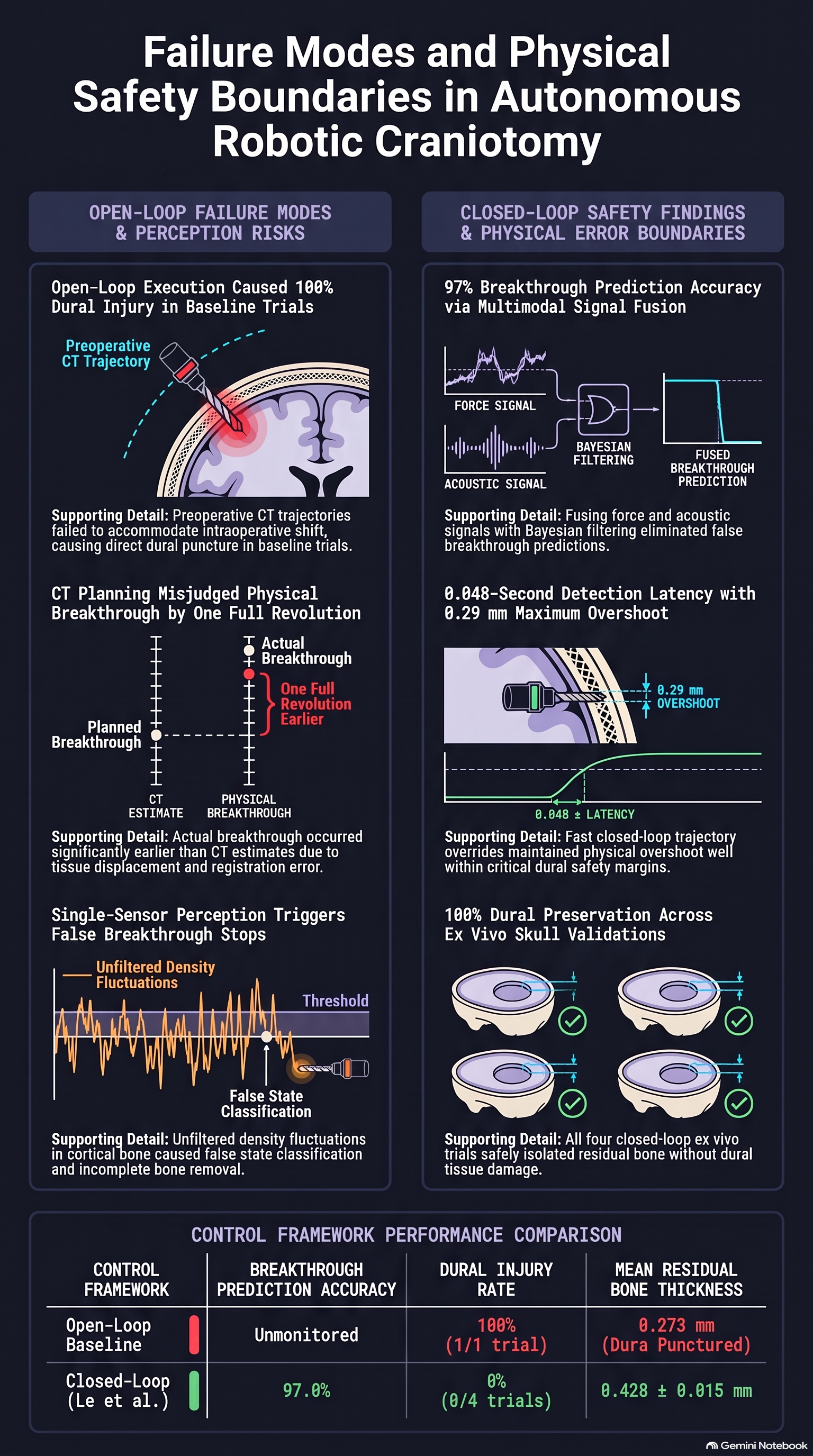
The authors validated the framework through bovine rib milling and ex vivo goat skull experiments. The data indicates that the closed-loop system provides a critical safety margin that open-loop systems lack.
| Metric | Reported Value |
|---|---|
| Breakthrough Prediction Accuracy | 97% |
| Breakthrough Detection Latency | 0.048 ± 0.097 s |
| Maximum Physical Overshoot | 0.29 mm |
| Residual Bone Layer Thickness | 0.428 ± 0.015 mm |
| Success Rate (Closed-Loop) | 4/4 Successful (Ex vivo goat skull; no dural injury) |
The authors highlight the relationship between perception and physical consequences: at the 2 mm/s feed rate used in testing, the 0.048 s detection latency accounts for the reported 0.29 mm physical overshoot. In contrast, the paper reports that an open-loop baseline experiment resulted in dural injury, as it could not compensate for the fact that actual breakthrough occurred earlier than the CT-based estimate.
7. Conclusion: Implications for AI Safety and Robotic Intervention
The research presented by the authors demonstrates how a “cybernetic” approach can bound physical damage in high-stakes robotics. By integrating multimodal fusion with fast autonomous overrides, the system manages the risks associated with registration errors and intraoperative deformations.
Key Takeaways
- The Necessity of Multimodal Fusion: The authors show that fusing force and sound signals provides a 97% breakthrough prediction accuracy, significantly outperforming single-sensor monitoring.
- Mandatory In-Situ Compensation: Registration and deformation errors make preoperative plans unreliable for “boundary crossing.” The authors’ projection-based strategy is essential for translating intraoperative “feel” into trajectory corrections.
- Clinical Value of Automated Isolation: By consistently isolating a 0.428 mm residual bone layer without injury, the system demonstrates the potential to automate the most dangerous phase of craniotomy, thereby reducing surgeon workload and the historically high rates of unintended durotomy.
Read the full paper on arXiv · PDF