URF: A Unified Robot Control-Policy Framework for Stable Contact Aware Manipulation
The authors propose URF, a control-policy framework that predicts compliant actions alongside an impedance-admittance controller switch ratio to stabilize contact-rich manipulation.
1. Introduction: The High-Level Policy vs. Low-Level Reality
The prevailing trend in robot manipulation research suggests an illusion of mastery: modern policies navigate complex simulations and soft-contact environments with ease, yet they often face a catastrophic reality when deployed on rigid hardware. This discrepancy stems from the “separation problem,” where high-level learned policies generate motion trajectories or virtual targets while remaining agnostic to the low-level controllers that execute them. In rigid-contact scenarios, this disconnect becomes hazardous; the same target command can result in stable interaction or hardware failure depending entirely on the execution dynamics.
To address this, Jiyou Shin et al. propose the Unified Robot Control-Policy Framework (URF). Rather than treating the controller as a fixed “black box,” URF enables the high-level policy to actively modulate the execution mode. By predicting not just the motion but the fundamental behavior of the low-level controller, URF bridges the execution gap, allowing robots to maintain precision in free space while ensuring physical stability during stiff contact.
2. Physical Failure Modes in Rigid Contact
Traditional manipulation pipelines frequently rely on admittance-only controllers, such as the Adaptive Compliance Policy (ACP). While these are effective for motion tracking, Shin et al. demonstrate that they are fundamentally ill-suited for rigid interactions. The authors identify several critical failure modes:
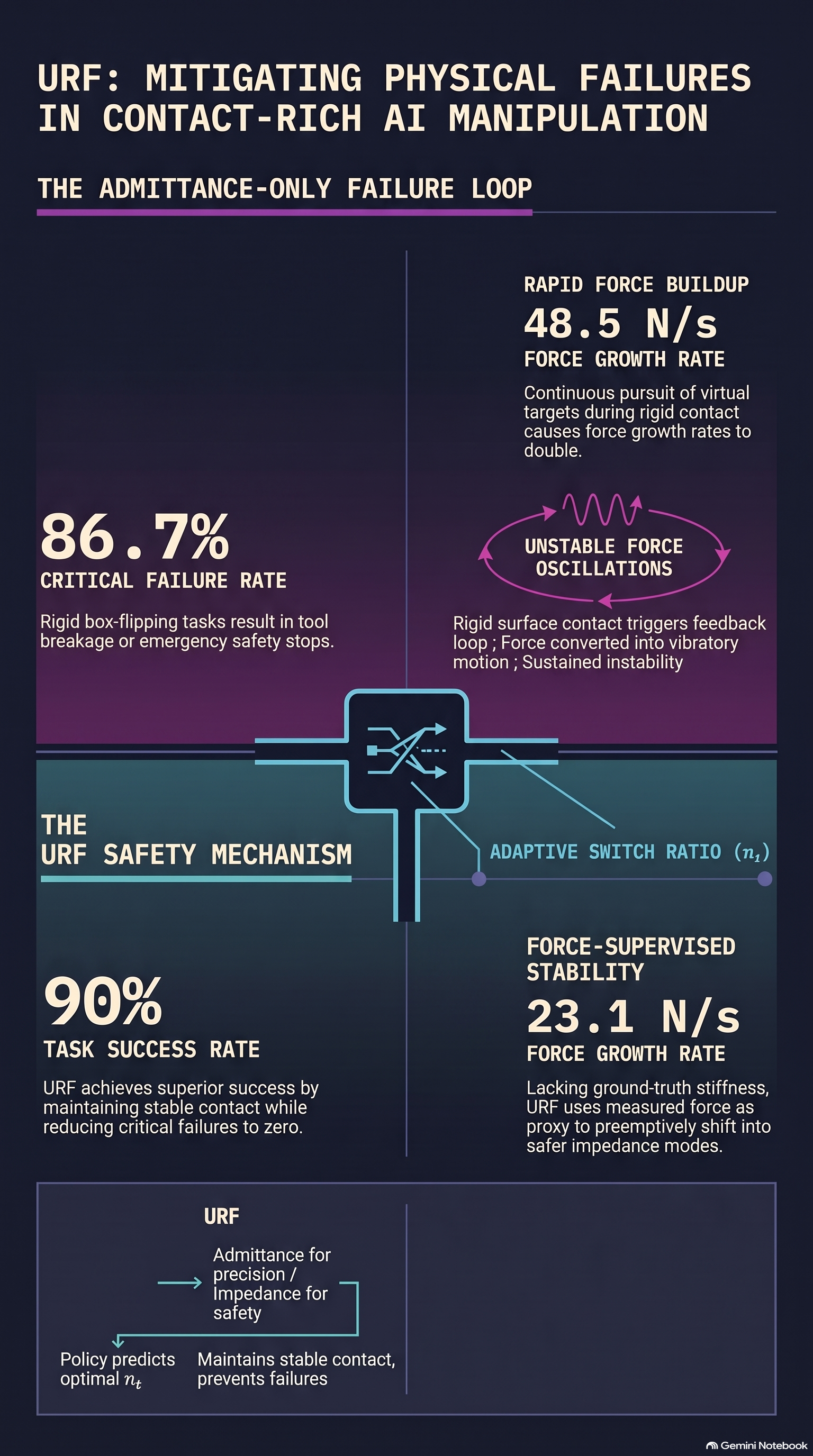
- Rapid Force Buildup: In rigid contact, admittance controllers attempt to follow virtual targets by increasing force, leading to a steep, linear rise in contact force. This is quantified by the Peak Force Growth Rate (PFGR)—the average slope of the force norm from the first contact to the peak force.
- Hardware Damage: The study reports that the lack of force regulation at contact onset results in significant damage. In box-flipping benchmarks, 3D-printed PLA tools were frequently snapped or permanently deformed by the rapid force buildup.
- System Instability: Rigid surfaces do not passively absorb energy. Admittance controllers respond to force feedback by generating vibratory motion commands, which cause high-frequency oscillations. These oscillations often exceed safety thresholds, triggering emergency hardware stops that terminate tasks prematurely.
3. The URF Architecture: Predicting Execution, Not Just Motion
The URF architecture is designed to unify multimodal perception with dynamic control switching. For every action step, the policy predicts a 16-step action chunk including the Virtual Target (), the Stiffness Matrix (), and the Impedance-Admittance Switch Ratio ().
Multimodal Input Encoding
To allow the policy to “sense” the nuances of contact, the authors employ a sophisticated encoding scheme:
- Visual Data: Two frames of RGB history are processed via a pretrained CLIP ViT-B/32 backbone.
- Force Data: One second of force/torque history is converted into a six-channel log-spectrogram and encoded through a ViT encoder.
- Proprioception: Three steps of end-effector pose history are fused with visual and force features via a Transformer encoder.
The Unified Controller
The switch ratio () specifically determines the duty cycle—the fraction of the control period spent in one of two phases:
- Admittance Phase (): Converts force feedback into motion commands. This phase is utilized for accurate tracking in free space or during weak contact.
- Impedance Phase (): Regulates the relationship between motion and force in a dissipative manner. This is crucial for stable, robust interaction in stiff contact, as it prevents the instabilities inherent in admittance control.
4. Overcoming the Labeling Hurdle: Force-Supervised Learning
A significant obstacle in training such a policy is the lack of “ground-truth environment stiffness” labels in human-guided demonstration data. Shin et al. overcome this by using measured force magnitude as a proxy for execution requirements.
The switch-ratio labels are constructed using a piecewise logic where measured external force () dictates the dominant mode:
- If : (Admittance-dominant for tracking).
- If : undergoes a smooth transition ().
- If : (Impedance-dominant for safety).
While these labels are force-derived, the trained policy uses its multimodal history to anticipate contact. Analysis of the results (Fig. 3c) reveals that the policy lowers the stiffness () alongside the switch ratio before the physical impact occurs, preparing the hardware for the transition to a rigid environment.
5. Experimental Results: Box-Flipping and Line-Pressing
URF was evaluated against standard Diffusion Policy (DP) and ACP baselines on rigid-contact benchmarks.
Box-Flipping Task
This task requires lifting a rigid box without breaking the 3D-printed tool. The authors include the Free-Space Tracking Error (FSTE) to highlight the trade-off between precision and stability.
| Method | Success Rate (SR) | Critical Failure Rate (CFR) | PFGR (N/s) | FSTE () |
|---|---|---|---|---|
| DP w/ force | 0% | — | — | — |
| ACP | 25% | 86.7% | 48.5 ± 15.5 | 4.36 ± 2.00 |
| URF w/ | 60% | 0% | 24.4 ± 10.9 | 5.98 ± 1.46 |
| URF w/ | 50% | 0% | 21.7 ± 7.5 | 6.47 ± 2.15 |
| URF (Full) | 90% | 0% | 23.1 ± 5.7 | 5.93 ± 1.68 |
- DP Failure: The standard DP fails universally (0% SR) because it lacks a compliance action; it either misses the target box entirely or fails to apply sufficient load to initiate the flip.
- Tracking Trade-off: While ACP achieves the lowest FSTE, its high PFGR leads to catastrophic tool breakage. URF maintains a balance, keeping tracking error low enough for success while slowing force growth to safe levels.
Line-Pressing Task
This task requires the robot to follow a line on a rigid surface while maintaining at least 5N of downward force.
| Method | Success Rate (SR) | Oscillation RMS (ORMS) |
|---|---|---|
| ACP | 0% | 3.22 ± 0.81 N |
| URF w/ | 70% | 1.20 ± 0.28 N |
| URF w/ | 70% | 0.92 ± 0.24 N |
| URF (Full) | 100% | 0.96 ± 0.36 N |
Ablation studies show that (impedance-only) suffered from high trajectory variance and tracking errors, even though it had the lowest oscillations. URF’s adaptive switching allows for the “tightly clustered” trajectories necessary for 100% task completion.
6. Critical Takeaways for AI Safety and Future Research
The findings by Shin et al. provide essential insights for the development of safe autonomous agents:
- Coupled System Design: High-level policies and low-level controllers must be treated as a single system. Safety failures are most prevalent at the boundary where the policy’s intentions meet the controller’s physical execution limits.
- Stability over Peak Force: The research indicates that the Peak Force Growth Rate (PFGR)—the speed of force onset—is the primary driver of hardware failure, rather than just the absolute peak force. Safety red-teaming should prioritize monitoring force gradients during contact transitions.
- Adaptive Mode Switching: Preserving hardware integrity and tracking accuracy simultaneously requires the ability to anticipate contact and switch control modes dynamically.
The authors propose that future research should integrate URF with Vision-Language-Action (VLA) models to infer environment properties (e.g., stiffness) directly from visual scenes. Additionally, the development of multi-axis switch ratios—allowing for stiffness in one direction and compliance in another—is cited as a key path toward mastering complex tasks like insertion.
7. Documentation Metadata
Sources and Attribution
- Primary Paper: “URF: A Unified Robot Control-Policy Framework for Stable Contact Aware Manipulation” by Jiyou Shin, Youngjin Seo, Jaeseog Won, Sungwon Seo, Hyunjun Kim, Seokmin Yoon, Tuan Luong, and Hyungpil Moon.
- Reporting: This report was generated based on third-party research reported by Failure First.
Read the full paper on arXiv · PDF