Clinical Pathways as Safety Specifications for Physical AI in Hospital Wards
The authors propose a conceptual architecture that reinterprets clinical care pathways as runtime safety specifications for physical AI in hospital wards using constraint verification and multimodal...
1. Introduction: The High Stakes of AI in the Hospital Ward
The modern hospital ward represents one of the most complex deployment environments for Physical AI. Here, assistive robots and smart devices must operate in a high-stakes ecosystem of vulnerable patients, specialized medical staff, and rigorous clinical protocols. As these systems transition from passive observers to active participants in care delivery, the methodology for ensuring their safety must undergo a fundamental shift.
According to research by Franchini et al. in Clinical Pathways as Safety Specifications for Physical AI in Hospital Wards, current safety approaches rely too heavily on statistical anomaly detection. These methods identify when data streams look “different” from a learned baseline but fail to provide the clinical explainability or auditability required for medical settings. The authors argue that safety-critical healthcare applications require a move toward explicit, clinically grounded constraints. The core objective of their framework is the reinterpretation of Clinical Pathways (CPs)—the standardized workflows of medical practice—as enforceable, mathematical runtime safety specifications.
2. From Guidelines to Guardrails: Reimagining Clinical Pathways
Clinical Pathways are the blueprints of modern medicine, defining care delivery over time through medication schedules, physiological target bands, and measurement frequencies. Traditionally, these serve as manual guidelines for clinicians; however, the authors propose operationalizing them as digital “guardrails” for AI.
Franchini et al. assert that standard anomaly scores are insufficient for the hospital ward for three primary reasons:
- Lack of Explainability: A statistical score cannot identify which specific clinical requirement (e.g., a dosage window or a pressure threshold) was violated.
- Auditability Issues: Black-box alerts are difficult for nursing staff to verify or trust during high-pressure clinical events.
- The Conflation Problem: Traditional models often conflate the severity of a deviation with the system’s confidence in that data, leading to ambiguous alerts.
By shifting the focus from “Is this signal anomalous?” to “Is the prescribed care being delivered safely?”, the system evaluates performance against deterministic medical standards.
Figure 1: Reinterpreting traditional clinical checklists and workflows as digital safety specifications for automated monitoring.
3. The Architecture of Trust: Three Interconnected Subsystems
The proposed conceptual architecture utilizes a tripartite structure to integrate multimodal data into a unified safety-monitoring framework. This implementation is designed to be middleware-agnostic, though the authors highlight ROS 2 as a reference implementation, utilizing lifecycle-managed nodes to ensure operational transparency.
- The Sensing Subsystem: This layer provides the “raw evidence” for safety judgments. It aggregates data from patient-worn Bluetooth devices (ECG patches, pulse oximeters, smart pill dispensers) and ambient sensors. Crucially, it incorporates on-robot perception, including RGB-D cameras and microphone arrays. This provides an independent channel for verification, allowing the system to cross-check wearable data against the robot’s own observations of the patient’s presence and state.
- The Embodied Subsystem: In this framework, the robot (instantiated by a platform like the TIAGo Pro) acts as an active sensing component rather than a static gateway. It navigates to the patient when measurements are due and uses its physical presence to provide contextual grounding. The robot’s internal states (navigation, sensor fusion, HRI) are observable to the monitor, allowing the system to distinguish between a hardware failure and a clinical emergency.
- The Edge Cloud Subsystem: This layer handles tasks outside the safety-critical path. This includes the authoring of Clinical Pathways by human clinicians and the retrospective checking of care history. Importantly, a core safety guardrail of this architecture is clinical governance: the robot can evaluate specifications but is strictly prohibited from authoring or modifying them.
Figure 2: The TIAGo Pro robot serves as the embodied component of the system, acting as a mobile monitor and an active sensing asset.
4. The Runtime Safety Monitor (RSM): The Technical Core
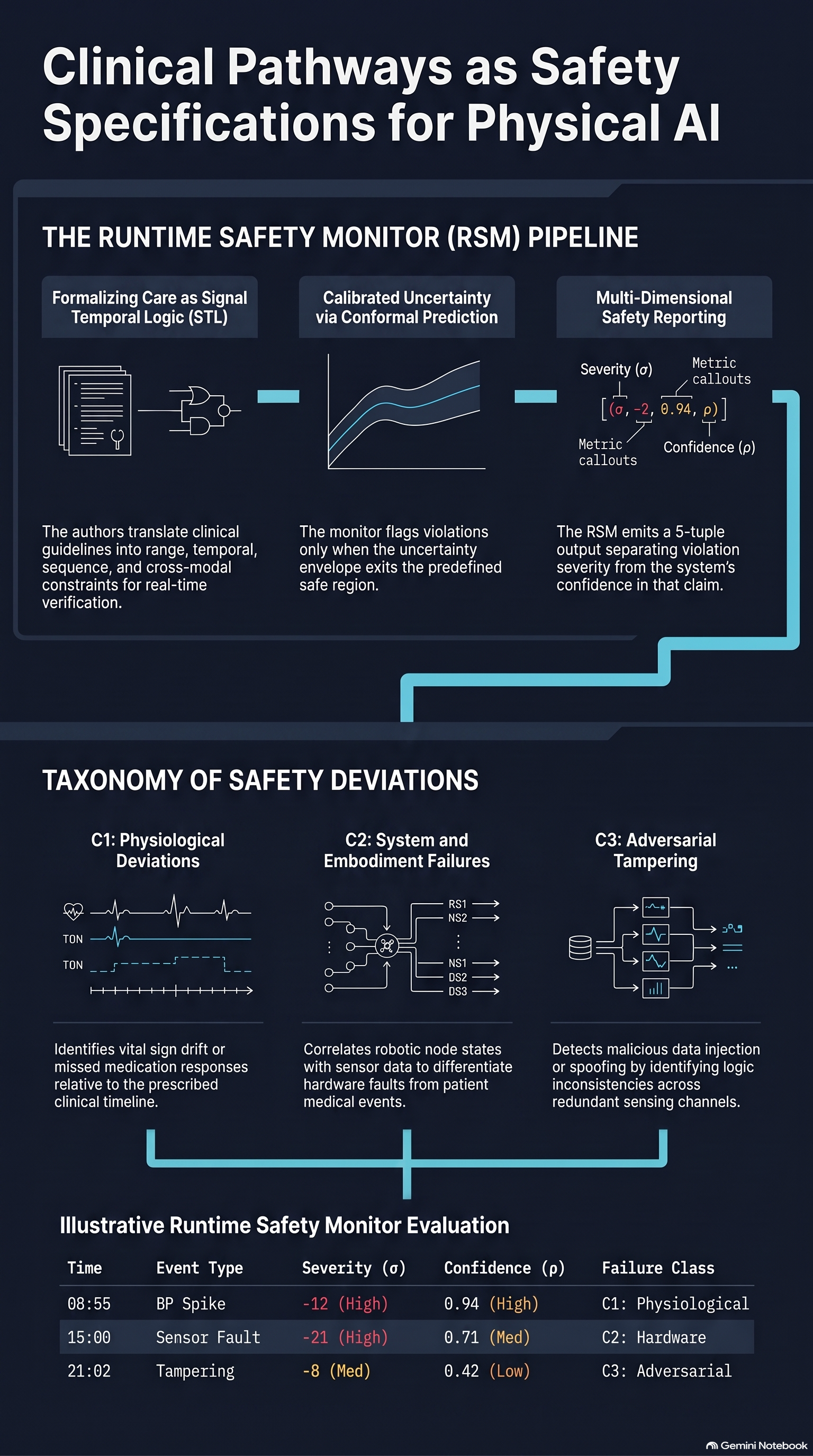
At the heart of the Embodied Subsystem lies the Runtime Safety Monitor (RSM), which utilizes Signal Temporal Logic (STL) to transform care processes into mathematical constraints. STL allows the authors to define two critical temporal operators for clinical monitoring:
- The Always Operator (): Asserts that a predicate (e.g., blood pressure within a safe range) must hold at every evaluation step in the horizon.
- The Bounded Eventually Operator (): Asserts that a predicate must hold at least once within a specific window (e.g., a physiological response must occur within 1–3 hours of medication).
The Monitor Pipeline
The RSM processes signals through a high-precision pipeline:
- Time-Series Learner: Predicts physiological trajectories to support early warning.
- Constraint Checker: Evaluates STL formulas, returning a real-valued robustness () that quantifies the margin of safety.
- Uncertainty Subsystem: Employs conformal prediction to provide distribution-free coverage under exchangeability assumptions. This ensures the system only triggers alerts when the uncertainty envelope fully exits the STL-defined safe region.
A vital innovation of the RSM is the explicit separation of Severity () and Confidence (). These are treated as orthogonal axes; measures the physical extent of a violation (e.g., the mmHg deviation), while represents the system’s certainty. This prevents the conflation issues found in standard anomaly detection.
5. A Taxonomy of Failure: Three Classes of Safety Events
The authors categorize safety violations into three distinct classes, enabling the RSM to provide nuanced alerts to nursing staff.
| Class | Name | Description |
|---|---|---|
| C1 | Physiological Deviations | Vital signs falling outside CP ranges or failing to respond to treatment. |
| C2 | System/Embodiment Failures | Hardware faults (sensor detachment, battery loss) or robotic localization drift. |
| C3 | Adversarial Tampering | Intentional manipulation of data or physical spoofing of patient presence. |
The RSM uses cross-modal constraints to differentiate these events. If a wearable reports a critical heart rate but the robot’s RGB-D perception shows the patient is physically absent or resting normally, the system can identify the event as a sensor fault (C2) or tampering (C3) rather than a medical crisis (C1).
6. Case Study: Hypertension Monitoring in Action
To illustrate the framework, the authors present a hypertension use case involving two daily medication doses and five blood pressure measurements. The CP includes range constraints (), hardware-liveness constraints (), and dosage counter constraints ().
The following table reconstructs an illustrative trace of the RSM over a single day:
| Time | Event | Severity () | Confidence () | Violated Formula () | Class |
|---|---|---|---|---|---|
| 07:00 | PILL (dispenser open) | +18 | 0.97 | — | ok |
| 08:55 | BP = 152 mmHg | -12 | 0.94 | (Range) | C1 |
| 15:00 | BP MEAS (9s window) | -21 | 0.71 | (Liveness) | C2 |
| 21:00 | PILL (scheduled) | +15 | 0.96 | — | ok |
| 21:02 | PILL (unscheduled) | -8 | 0.42 | (Counter) | C3 |
Interpreting the Trace:
- C1 Alert (08:55): A genuine hypertensive event. High confidence () and negative severity trigger an immediate clinical alert.
- C2 Alert (15:00): A system failure detected when a sensor node transitioned to an inactive state mid-task. The RSM correctly attributes this to the infrastructure.
- C3 Alert (21:02): A tampering or misuse event. The system detected an “unscheduled” pill intake. Crucially, the RSM flagged this with low confidence because the event violated the dosage counter () and—more importantly—lacked the expected “downstream” physiological response (BP decrease) required by the cross-modal STL operator ().
7. Conclusion: Towards Verifiable Physical AI
The framework proposed by Franchini et al. marks a significant shift in the “Trustworthy AI” agenda, moving from probabilistic anomaly detection to deterministic specification monitoring.
Key Takeaways:
- Verifiability: Alerts are anchored to human-readable clinical sub-formulas, making every system decision auditable.
- Calibration: By treating severity and confidence as orthogonal, the system provides a more calibrated assessment of risk in uncertain environments.
- Embodiment: The robot’s physical presence is leveraged as a safety asset, using active sensing to provide an independent channel of truth for sensor validation.
While challenges remain—including the need for clinician-facing STL authoring tools and the mitigation of distribution shift in physiological data—this paper establishes a foundational architecture for the next generation of safe, specification-aligned medical AI. By reinterpreting Clinical Pathways as safety contracts, we ensure that AI systems are not merely “intelligent” but are rigorously tethered to the care processes they serve.
Read the full paper on arXiv · PDF