EgoRecovery: Acquiring Failure Recovery Ability Through Human Recovery Demonstration
The authors introduce EgoRecovery, a framework that aligns scalable egocentric human recovery demonstrations to robot actions via a shared corrective-intent space and a learned recovery gate to...
1. Introduction: The Fragility of the “Happy Path”
In the field of imitation learning, standard training protocols often produce policies that excel only within a narrow “happy path”—a specific manifold of success demonstrated during data collection. However, these systems are notoriously fragile when deployed in unstructured real-world environments. They frequently succumb to “covariate shift,” a phenomenon where the robot’s closed-loop execution drifts away from the demonstrated success distribution. Without explicit training on handling these off-manifold states, the robot cannot correct itself, leading to systemic task failure.
To build truly robust autonomous systems, Ge et al. argue that robots must learn not only to execute tasks but to retry and recover. The authors propose EgoRecovery, a co-training framework designed to bridge the gap between failure and success. By shifting the focus from mimicking perfect trajectories to learning resilient recovery, the framework leverages human intuition to navigate the vast and noisy distribution of real-world failure states.
2. The Data Bottleneck: Why Robot Teleoperation Fails to Scale
A central challenge in training robots for failure recovery is the “supervisory bottleneck.” While success demonstrations are relatively straightforward to collect, gathering high-quality recovery data through standard teleoperation is prohibitively slow. Ge et al. identify a costly four-step cycle inherent to collecting a single robot recovery trajectory:
- Staging the Failure: Manually inducing or reaching a diverse, meaningful failure state.
- Verification: Ensuring the state is a valid failure for training purposes.
- Teleoperating Correction: Guiding the hardware through a precise corrective maneuver.
- Hardware Reset: Resetting the environment and hardware for the next attempt.
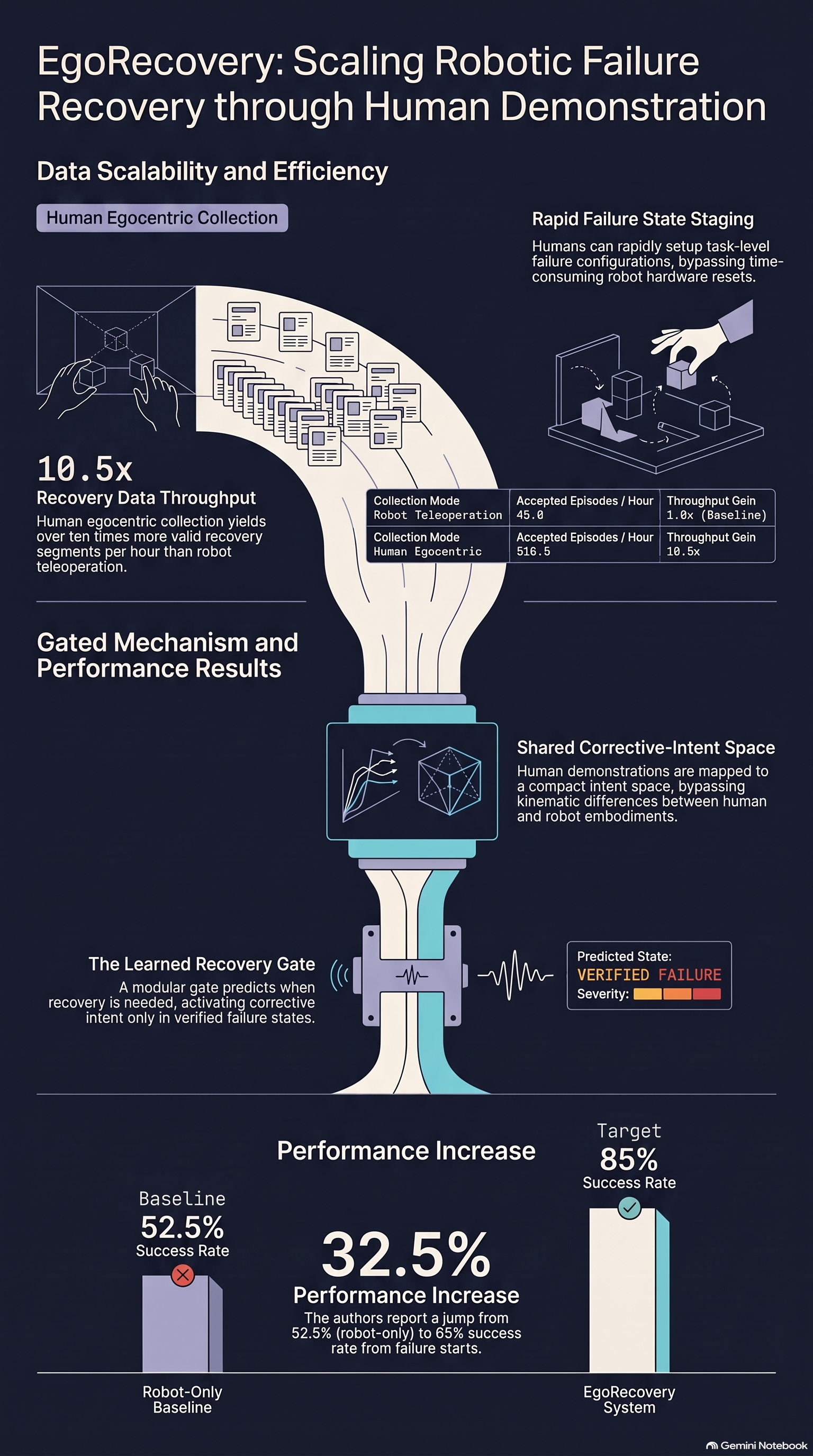
The authors contrast this with the “fast collection speed” of egocentric human data. Humans, wearing head-mounted and wrist-mounted cameras, can “move rapidly to the next failure mode” without the need for hardware resets or tedious teleoperation. Based on the throughput audit in Table 1, this method provides a 10.5x average throughput advantage in valid recovery episodes per operator hour.
3. Bridging the Embodiment Gap with “Corrective Intent”
Sharing data across different embodiments—human hands and robotic grippers—is complicated by the “embodiment gap.” Differences in kinematics, contact mechanics, and control frequencies mean that simply copying human motion can bias a robot toward physically impossible actions. To circumvent this, the authors propose sharing “corrective intent” rather than raw trajectories.
The technical core of this intent is a coarse envelope of remaining recovery motion. The authors use a Discrete Cosine Transform (DCT), specifically the first low-frequency basis vectors (), to summarize the temporal magnitude of a short future motion window.
The Intent Bottleneck and the Spatial Norm: A crucial architectural choice is the use of a spatial norm before the DCT. This mathematical trick strips direction-specific displacement from the human data, leaving only a magnitude and timing profile. This allows the intent to be “direction-agnostic,” effectively separating the responsibilities of the data sources:
- Human-Learned: The coarse timing and magnitude profile of the correction, scaled across diverse failure modes.
- Robot-Learned: The specific direction, contact mechanics, and executable motor commands.
The authors utilize a 4D target for this intent bottleneck, ensuring the signal is transferable yet compact.
4. The Recovery Gate: Knowing When to Pivot
EgoRecovery introduces a modular intervention mechanism to ensure recovery logic does not interfere with standard task execution. Central to this is the Recovery Gate Head, which determines when the robot should pivot from its “nominal” policy to recovery mode.
During deployment, the gate predicts the probability () that the current state () requires recovery. This facilitates Gated Intent Modulation:
- Gated Intent Modulation: The gate predicts and modulates the robot action decoder using a residual FiLM (Feature-wise Linear Modulation) layer.
- Stop Gradient (): For AI safety researchers, the Stop Gradient mechanism is a high-impact detail. It prevents the gate from being optimized indirectly through imitation loss, ensuring it remains strictly supervised by recovery state labels.
- Nominal Stability: The authors’ “always on” ablation (Table 2) demonstrates the gate’s importance; without it, nominal execution becomes less stable, with Initial Success Rates (SR) dropping from 80% to 70%.
As seen in the “Gated Robot Recovery” module of Figure 1, the gate acts as a safety switch that preserves the stability of primary operations by only activating corrective intent in verified failure states.
5. Putting it to the Test: Real-World Performance
Ge et al. evaluated EgoRecovery across four tabletop tasks: cup brush insertion, table sweep, round disk placement, and cube stacking. These tasks involve complex recovery patterns like “retreat-and-realign” and “stack stabilization.”
The following table, synthesized from Table 6 and Figure 4, compares the Recovery Success Rate (SR) of a “Robot-only” baseline versus the EgoRecovery framework:
| Task | Robot-Only Recovery SR (50 episodes) | EgoRecovery SR (50 Robot + 300 Human) |
|---|---|---|
| Cup Brush Insertion | 55% | 80% |
| Table Sweep | 50% | 90% |
| Round Disk Placement | 55% | 85% |
| Cube Stacking | 50% | 85% |
| Average | 52.5% | 85.0% |
The authors claim a significant jump in average Recovery SR (from 52.5% to 85.0%). Notably, the framework also improved “Initial SR” to 80%, suggesting that recovery training stabilizes nominal performance by providing better coverage of the state space.
6. Key Takeaways for AI Safety and Robotics
- Scalability: Egocentric human data provides a 10.5x data collection advantage, enabling broader coverage of failure states than possible through teleoperation.
- Modular Intervention: The Recovery Gate, bolstered by the Stop Gradient mechanism, prevents “interference” with standard tasks, solving the common problem where recovery training degrades base performance.
- The “Robot Recovery Anchor”: While human data provides scale, a small set of robot recovery demonstrations (the “anchor”) is essential for handling embodiment-specific contact mechanics and regrasping.
- Grounding Intent: The robot decoder serves as the critical translation layer; it is the only component that learns how the predicted human intent is realized as executable robotic control.
7. Conclusion: The Future of Robust Autonomy
EgoRecovery represents a shift toward “intent-first” robotic learning. By moving from copying motion to mimicking intent, the authors demonstrate how robots can benefit from human problem-solving speed without being constrained by human kinematics.
While the authors acknowledge limitations—specifically the continued reliance on a “robot recovery anchor” for contact-heavy tasks—the framework provides a scalable path toward resilient autonomous systems. By leveraging the 10x throughput of human intuition, EgoRecovery offers a practical blueprint for robots to navigate the complexities and inevitable failures of the real world.
Read the full paper on arXiv · PDF