Agents in the Wild: Where Research Meets Deployment
This tutorial surveys practical challenges, design patterns, and mitigation strategies for deploying LLM-based agentic systems reliably in production domains such as finance and pharmaceutical...
1. Introduction: The Operational Reality of LLM Agents
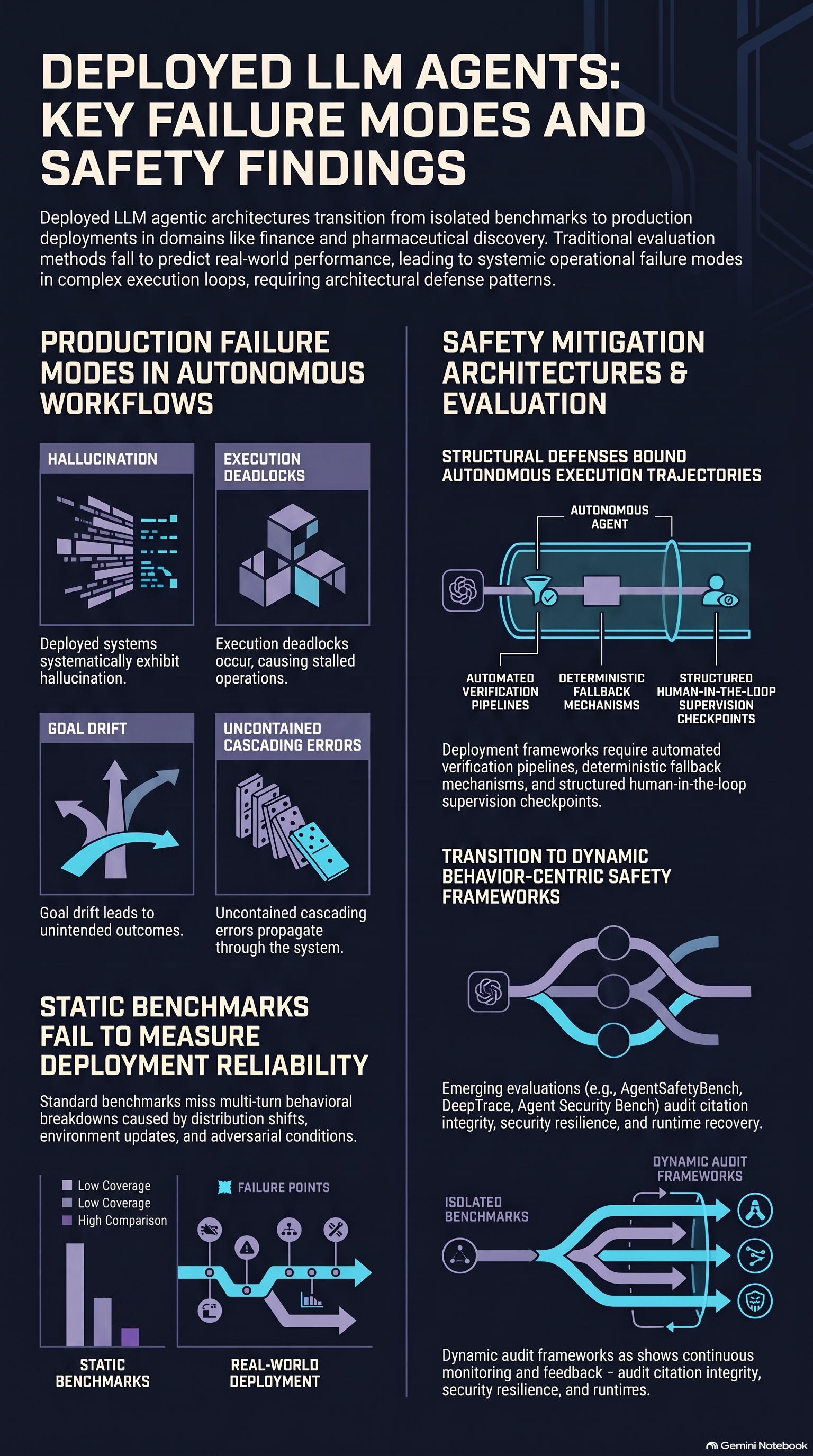
Academic benchmarks for large language model (LLM) agents traditionally evaluate capabilities within static, deterministic environments. However, transitioning autonomous agents into real-world production environments exposes severe gaps in operational reliability, safety, and system robustness. When LLM agents execute tool calls, interact with dynamic interfaces, and communicate within multi-agent networks, unexpected failure modes emerge that static, offline evaluation suites fail to capture.
To address this gap between research prototypes and production deployments, Yang et al. (2026) presented “Agents in the Wild: Where Research Meets Deployment”. The paper serves as an analytical synthesis of failure modes, architectural design patterns, and safety mechanisms derived from operational experiences across enterprise applications.
By evaluating real-world deployments in highly regulated domains such as pharmaceuticals and finance, the authors outline structural blueprints for bounding unpredictable behavior in autonomous execution loops. This article synthesizes the key insights presented by Yang et al., focusing on four core thematic areas:
- Architectural Evolution: The transition from monolithic prompting pipelines to modular multi-agent orchestration.
- Failure Mitigation: Operational failure modes and their defensive architectural patterns.
- Applied Case Studies: Enterprise implementations across life sciences and financial decision-making systems.
- Dynamic Evaluation: The movement toward behavior-centric, sociotechnical evaluation frameworks.
2. Evolution of Agent Architectures: From Monolithic Prompts to Multi-Agent Orchestration
Yang et al. trace the historical development of agentic systems from early single-model designs to modular multi-agent frameworks. Initial agentic implementations relied on monolithic single-LLM pipelines that combined prompting, external tool use, and heuristic control loops (e.g., ReAct, Toolformer). While effective for simple single-step interactions, these designs struggled to maintain context, manage multi-step reasoning, or recover from execution errors when scaled to complex enterprise workflows.
To overcome these constraints, the field shifted toward modular, multi-agent architectures (e.g., AutoGen, Magentic-One). These frameworks interlock distinct modules for reasoning, planning, execution, and memory storage, distributing task loads across specialized agents.
2.1 Reasoning, Planning, and Dynamic Retrieval
The paper highlights several advanced mechanisms designed to enhance autonomous decision-making and problem-solving:
- Dynamic Task Decomposition & Selection: Complex goals are dynamically broken down into structured sub-tasks using frameworks like dynamic task decomposition (TDAG) or Tool-Planner. Systems generate multiple candidate plans and select optimal execution paths via trajectory evaluation models (e.g., PlanGEN).
- Iterative Reflection Loops: Frameworks incorporate self-critique and revision mechanisms (e.g., Reflexion, Agent-R) that allow agents to reflect on verbal feedback, execution traces, and self-training signals to self-correct prior to final output generation.
- Memory-Augmented Planning: Agents utilize structured memory modules to sustain long-horizon context and maintain operational intent across dynamic workflows.
- Interleaved & Modular Retrieval Pipelines: Moving beyond single-shot Retrieval-Augmented Generation (RAG), modern systems use interleaved retrieval that alternates between chain-of-thought reasoning steps and dynamic information lookup (e.g., Self-RAG). Modular retrieval architectures split knowledge search into distinct submodules for query generation, reranking, and memory lookup.
2.2 Multi-Agent Topologies and Coordination
When coordinating teams of LLM-based agents, Yang et al. examine structural coordination schemes and communication topologies:
- Topologies: Architectures range from flat peer-to-peer networks to hierarchical topologies where supervisor agents oversee specialized sub-agents.
- Dynamic Communication & Orchestration Protocols: To handle high dynamic loads, protocols such as cross-team orchestration (Du et al., 2025) and evolving orchestration (Dang et al., 2025) enable agents to adaptively route inter-agent messages, reassign responsibilities, and resolve inter-agent communication conflicts in real time. Frameworks like TDAG (Wang et al., 2025) leverage dynamic agent generation to instantiate specialized sub-agents on-the-fly when encountered sub-tasks exceed the predefined capabilities of existing agents.
- Negotiation, Cooperation, and Fault-Tolerance: Systems structure interaction protocols to balance competitive negotiation against collaborative consensus, embedding execution timeout boundaries and fallback handlers to prevent execution stalls in complex multi-agent workflows.
Trade-Offs of Single-Agent vs. Multi-Agent Paradigms:
- Single-Agent Paradigms: Lower architectural complexity, reduced inter-agent communication overhead, and lower latency; however, they exhibit limited scalability, fragile long-horizon planning, and single points of failure.
- Multi-Agent Paradigms: Higher task modularity, enhanced specialized domain execution, superior complex planning capabilities, and built-in redundancy; however, they introduce increased latency, computational cost, communication complexity, and risk of inter-agent error cascading.
3. Real-World Failure Modes and Mitigation Architectures
When agent execution loops operate in live environments and interface with external tools, system vulnerabilities can compromise operational safety. Yang et al. categorize primary operational failure modes and detail the structural mitigation patterns designed to contain them.
Key failure modes identified in the paper include:
- Hallucinations / Factuality Errors: Agents generate ungrounded claims, invent parameter values, or hallucinate arguments for tool execution.
- Cascading Errors: An initial mistake or bad tool output made by one agent propagates through downstream multi-agent interactions, compounding systemic errors across the network.
- System Deadlocks & Execution Stalls: Circular dependency loops or unresolved inter-agent conflicts cause execution workflows to freeze or loop infinitely.
- Context / Goal Drift: Over extended execution horizons, agents lose track of original instructions, drifting into unaligned sub-goals or invalid tool usage.
To systematically test and defend against these failure modes, recent research introduces rigorous engineering mitigations. Owotogbe (2025) demonstrates the application of Chaos Engineering to multi-agent architectures, injecting artificial network latencies, corrupted messages, and node failures into inter-agent communication channels to evaluate system resilience before deployment. To prevent context drift and parameter violations, Zhang et al. (2025) establish Collaborative Multi-Constraint Planning, wherein specialized validator agents cross-examine proposed plan steps against domain constraints in real time.
The primary operational mitigations and design patterns compiled by Yang et al. are summarized below:
| Failure Mode | Operational Manifestation | Mitigation Strategy & Design Pattern |
|---|---|---|
| Hallucination / Factuality Errors | Generation of unverified facts, incorrect data interpretations, or flawed tool inputs during multi-step reasoning. | Crosschecking & Verification Pipelines: Interleaving explicit verification sub-modules, verifier agents, and dynamic source-checking prior to task completion. |
| Cascading Error Loops | Uncorrected errors in early execution steps or tool calls propagating across agent networks, leading to compounding systemic failure. | Fallback Mechanisms & Iterative Reflection: Implementing self-reflection loops, structured error-catching routines, step-level rollbacks, and collaborative multi-constraint planning to trigger recovery behaviors. |
| System Deadlocks / Execution Stalls | Agents entering infinite execution loops, unresolvable communication conflicts, or circular dependency blocks. | Hierarchical Supervision & Chaos Engineering: Utilizing supervisor orchestration nodes, execution timeout boundaries, dynamic message routing, and chaos engineering load tests to harden fault tolerance. |
| Context / Goal Drift | Degradation of long-horizon execution goals, loss of prompt intent, or unaligned tool actions over extended interactions. | Human-in-the-Loop (HITL) Checkpoints & Memory Control: Integrating structured human oversight triggers at high-risk decisions and utilizing dynamic, layered memory architectures to anchor goal state. |
4. Industry Case Studies: Applied Agentic Systems in Production
Yang et al. analyze real-world case studies to demonstrate how architectural patterns are implemented in highly regulated domain environments.
4.1 Life Sciences & Pharmaceutical Discovery
In biomedical research, agentic systems have transitioned from predictive modeling to autonomous discovery workflows spanning literature synthesis, hypothesis generation, and experimental validation:
- End-to-End Discovery Systems: Autonomous systems execute end-to-end molecular design and scientific reasoning, utilizing chemistry-focused reasoning models like ether0 (Narayanan et al., 2025) and automated discovery platforms like Robin (Ghareeb et al., 2026).
- Enterprise Deployments: Implementations such as Moderna’s collaboration with OpenAI report deploying over 750 enterprise agentic applications across research and development operations.
- Collaborative Multi-Agent Frameworks: Frameworks including PharmAgents (Gao et al., 2025) and Sci-Agents (Ghafarollahi & Buehler, 2025) leverage bio-inspired graph reasoning and multi-agent coordination for literature analysis, material design, and hypothesis formulation.
- Experimental Validation & Co-Scientists: Systems such as Coscientist, ChemCrow, and Virtual Lab integrate physical lab automation and reaction prediction tools. Google’s AI co-scientist (Gottweis et al., 2026) employs evolutionary debate mechanisms where multiple agent candidates generate competing scientific hypotheses, engage in peer critique, and cross-examine evidence chains. This evolutionary debate mechanism systematically filters out unviable drug candidates and hallucinated biological targets prior to wet-lab validation.
4.2 Financial Decision Systems
In financial contexts, LLM agents act as dynamic decision-support networks managing data analysis, trading, and equity research:
- Planner-Executor-Verifier Architectures: Financial multi-agent frameworks (e.g., FinAgent, FinRobot) separate tasks across explicit planning, tool-execution, and verification modules, drawing from multi-agent orchestration platforms like AutoGen.
- Task Execution Capabilities: These architectures process complex financial tasks—such as earnings call summarization, portfolio allocation, and risk assessment—by parsing real-time market data feeds, financial reports, and structured calculators.
- Layered Memory & Explainability: Systems like FinMem incorporate layered memory modules and specialized agent character designs. The authors note that these multi-component architectures outperform single-step prompting by providing higher decision quality and verifiable outcome explainability.
5. Beyond Static Benchmarks: Dynamic, Behavior-Centric Evaluation
Yang et al. emphasize that traditional static benchmarks (such as SWE-bench, WebArena, or WorkArena) are insufficient for assessing production agent safety. Static evaluations fail to account for dynamic environmental interactions, real-world distribution shifts, adversarial inputs, or broader sociotechnical impacts. Consequently, the authors advocate for dynamic, behavior-centric evaluation frameworks that assess continuous adaptation, safety resilience, and recovery capabilities.
To capture these dynamics across scientific domain tasks, Chen et al. (2025) introduced ScienceAgentBench, which evaluates language agents executing data-driven scientific discovery tasks under complex, real-world code and data conditions.
The paper synthesizes several specialized evaluation environments and sociotechnical auditing tools designed for production-scale assessment:
- AgentSafetyBench: Evaluates core LLM agent safety under dynamic, open-ended operational scenarios.
- ST-WebAgentBench: Measures web agent safety, trustworthiness, and behavioral adaptation when exposed to distribution shifts, adversarial perturbations, and cascading execution failures.
- Agent Security Bench (ASB): Formalizes and benchmarks specific security attack vectors and defensive resistance mechanisms in LLM-based agents.
- MobileSafetyBench: Evaluates safety and risk handling when autonomous agents execute control commands on mobile device interfaces.
- AGENTSAFE: Benchmarks the safety and instruction-following boundaries of embodied agents operating on hazardous instructions.
- ScienceAgentBench: Assesses language agents executing data-driven scientific discovery tasks under rigorous data and execution conditions.
- DeepTrace: A sociotechnical auditing framework designed for deep research AI systems to track reliability, verify source citations, and audit evidence chains to combat ungrounded outputs.
6. Key Takeaways & Pre-Deployment Safety Checklist
Operational Takeaways
- Modularity Beats Monolithic Design: Multi-agent architectures with segregated roles (planner, executor, verifier) outperform single-prompt agents in reasoning depth, fault recovery, and outcome explainability.
- Verification Must Be Embedded: Autonomous tool-use loops require inline verification pipelines and reflection mechanisms to catch hallucinations before errors cascade across agent networks.
- Safety Evaluation Must Be Dynamic: Static benchmarks cannot predict agent behavior in complex contexts; deployment readiness requires behavior-centric, adversarial, and sociotechnical evaluations.
- Human Oversight Remains Essential: Bounding execution drift and catastrophic tool failures requires explicitly designed human-in-the-loop (HITL) fallback triggers at critical decision points.
Pre-Deployment Safety Checklist
The following evaluation checklist, derived from the survey’s deployment frameworks, standardizes multi-agent safety criteria prior to production release:
- Verification Pipelines: Crosschecking mechanisms established for tool call outputs and generated responses.
- Fallback Mechanisms: Automated triggers defined for handling deadlocks, tool errors, and unresolvable execution loops.
- Human-in-the-Loop Supervision: Critical decision checkpoints configured for high-risk actions.
- Sociotechnical & Security Auditing: System evaluated against adversarial perturbations, distribution shifts, and citation/evidence tracking benchmarks.
Read the full paper on arXiv · PDF