Value-Aware Prediction for Robust Multi-Agent Coordination Under Communication Loss
The authors propose Value-Aware MARO, a multi-agent reinforcement learning method that weights state-prediction loss by actor-critic advantage estimates to maintain coordination during severe...
1. Introduction: The Fragility of Cooperation
In multi-agent systems, such as autonomous drone swarms or robotic rescue teams, coordination is the primary determinant of mission success. These systems typically rely on constant inter-agent communication to share localized payloads—consisting of spatial coordinates, velocities, and detected landmarks—to maintain a cohesive global state. However, in real-world environments, this connectivity is often fragile. Physical obstructions, signal interference, or bandwidth limitations can lead to communication dropouts that cause coordination to collapse.
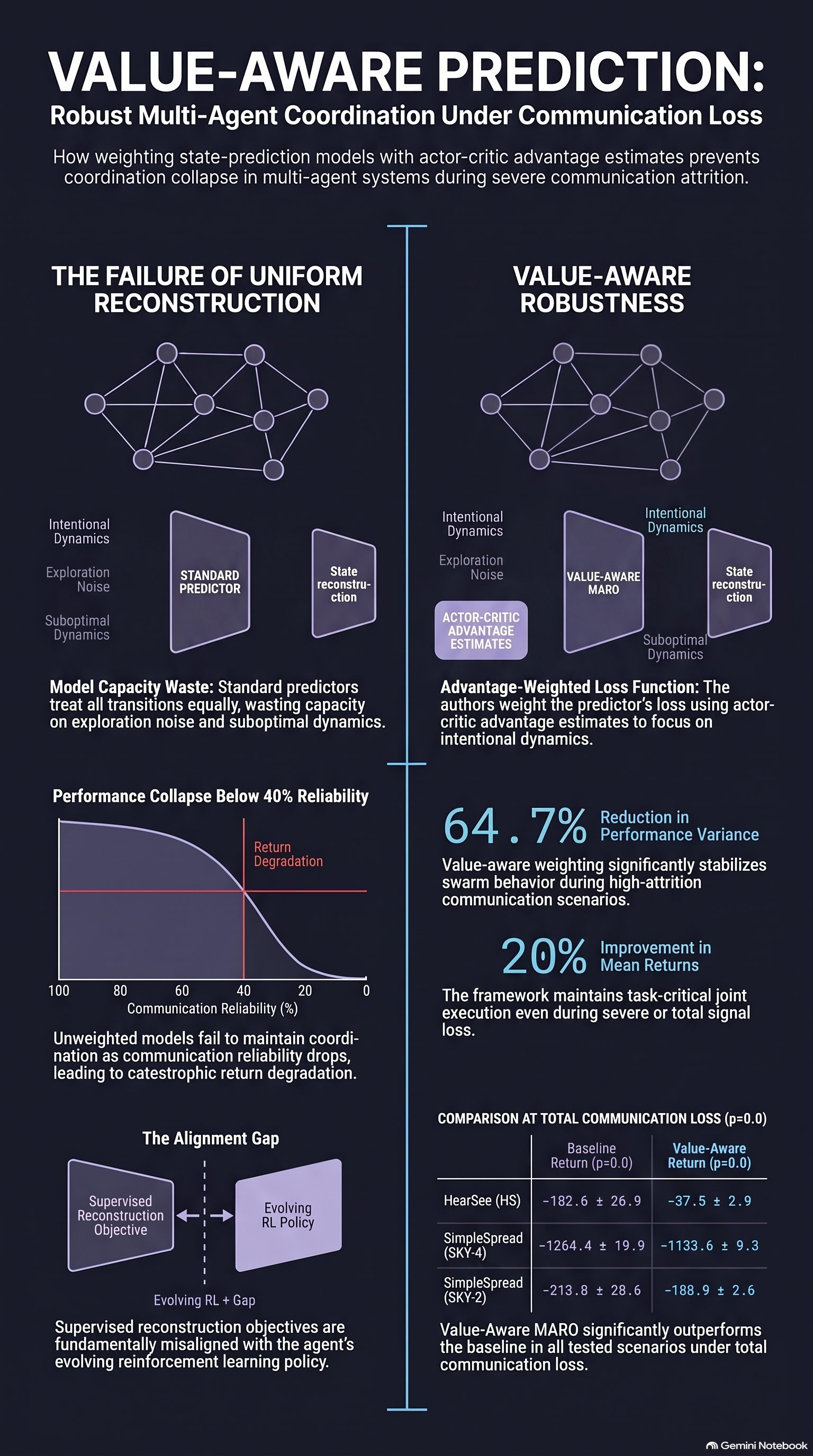
In the paper “Value-Aware Prediction for Robust Multi-Agent Coordination Under Communication Loss,” Kafadar et al. (2026) investigate this vulnerability. The authors identify a critical threshold—specifically when communication reliability falls below 40%—where standard coordination mechanisms tend to suffer catastrophic performance degradation. To address this, they introduce Value-Aware MARO, a method designed to maintain task-critical execution even when inter-agent channels are severely degraded or entirely severed.
2. The Predictor Problem: Why “Equal Importance” Fails
To mitigate signal loss, many current Multi-Agent Reinforcement Learning (MARL) architectures use internal state predictors. These models are designed to estimate missing shared information from teammates when a message fails to arrive. However, Kafadar et al. critique the standard approach to training these predictors, known as Multi-Agent Observation Sharing (MARO).
Standard MARO uses a uniform reconstruction objective, meaning the predictor attempts to learn every state transition with equal priority. The authors argue this is highly inefficient because it forces the model to waste its limited capacity on data that is irrelevant to the agent’s success. Specifically, Kafadar et al. suggest that uniform objectives are ineffective because they focus on:
- Stochastic Exploration Noise: In reinforcement learning, agents frequently take random actions to explore the environment. Standard predictors waste capacity modeling these random, non-productive fluctuations that do not contribute to the final goal.
- Outdated Dynamics of Suboptimal Policies: As agents learn, they discard ineffective strategies. A standard predictor continues to model the dynamics of these discarded behaviors, which are no longer relevant to the evolved cooperative policy.
According to the authors, this misalignment between the predictor’s learning objective and the policy’s needs leads to a performance collapse when agents are forced to rely on predicted data in high-attrition scenarios.
3. The Solution: Coupling Prediction to Value
The core innovation proposed by Kafadar et al. is the “Value-Aware” extension. Rather than treating all transitions as equal, the authors explicitly couple the predictor’s learning process to the evolution of the agent’s policy.
The mechanism utilizes the Generalized Advantage Estimation (GAE) to produce an actor-critic advantage estimate (). This signal, which quantifies how much better a specific action was compared to the policy’s average expectation, is used to dynamically weight the predictor’s loss function. This ensures the predictor prioritizes learning the “intentional, high-return dynamics” that lead to task success.
The Value-Aware Training Pipeline:
- Generating Advantage Estimates: During the reinforcement learning process, the critic network calculates advantage estimates () for agent actions using GAE.
- Weight Detachment: These estimates are detached from the policy gradient calculation to serve as independent importance weights (), preventing the predictor’s training from interfering with the policy update.
- ReLU Filtering: The weights are processed through a Rectified Linear Unit (ReLU) operator. This serves as a critical safety mechanism to prevent gradient inversion from highly negative advantages, which the authors report could otherwise destabilize the predictor.
- Prioritizing Intentional Dynamics: The predictor uses these filtered weights to focus its capacity on transitions that result in high rewards, effectively ignoring environmental noise and movements associated with suboptimal policies.
The authors incorporate a hyperparameter as a scaling factor for this weighting. This allows for tuning the influence of the advantage signal on the predictor’s loss, ensuring the model tracks the cooperative strategy as the policy evolves.
4. Evidence of Robustness: Benchmarking the Breakdown
Kafadar et al. evaluated Value-Aware MARO using the Multi-Agent Particle Environment (MPE) across five specific tasks: HearSee (HS), SpeakerListener (SL), SimpleSpreadXY-2 (SXY-2), SimpleSpreadXY-4 (SXY-4), and SpreadBlindfold (SBF). Notably, in the SXY tasks, agents are restricted to observing only one axis (x or y) and must communicate with teammates to resolve the full state.
The experiments tested varying levels of communication reliability (), where represents perfect communication and represents total blackout.
Performance Comparison: Baseline MARO vs. Value-Aware MARO
| Environment | Predictor Type | Total Blackout () | Full Communication () |
|---|---|---|---|
| HearSee (HS) | Baseline | ||
| Value-Aware | |||
| SimpleSpreadXY-4 | Baseline | ||
| Value-Aware | |||
| SimpleSpreadXY-2 | Baseline | ||
| Value-Aware |
The authors observed that Value-Aware MARO excels in environments where coordination is most complex, such as HS and SXY. In contrast, in simpler or more stable coordination tasks like SL and SBF, the method performed identically to the baseline. The most significant advantages appeared below the 40% reliability threshold, where the authors reported the following quantitative gains:
- Mean Return Improvement: An average gain of over 20% in high-attrition, low-communication scenarios compared to the unweighted baseline.
- Variance Reduction: A reported 64.7% mean reduction in performance variance, indicating that value-aware weighting leads to more consistent and predictable agent behavior during communication failures.
5. Conclusion: Toward Resilient Multi-Agent Systems
The primary takeaway from the research by Kafadar et al. is that robust coordination requires more than simple data reconstruction. By coupling a predictor’s learning process to a policy’s evolution, the authors have created a resilient fallback mechanism for AI swarms. This approach ensures that agents prioritize the most critical, high-value information when communication channels are compromised.
The authors suggest that future research should focus on scaling this framework to larger agent teams and testing the system in environments with temporally correlated losses or bandwidth limits. They also identify the deployment of these algorithms on physical drone swarms as a vital next step. This “failure-first” approach to research is essential for ensuring the reliability of autonomous systems in the unpredictable and often disconnected environments of the real world.
Read the full paper on arXiv · PDF