StratMamba: Strategic and Reactive Stream Partitioning for Path-Efficient LiDAR-Based Obstacle Avoidance
The authors propose StratMamba, a dual-stream state-space architecture that decouples fast-decay reactive LiDAR processing from slow-decay strategic goal tracking for quadruped robot navigation.
1. Introduction: The Dual Challenge of Autonomous Navigation
Autonomous quadrupedal navigation is defined by a fundamental temporal tension: the requirement for high-frequency, reactive obstacle avoidance balanced against the need for stable, long-horizon goal tracking. Modern controllers often struggle to reconcile these competing demands, frequently resulting in two distinct failure modes. The first is a direct failure, such as a collision with a dynamic obstacle. The second is the “timeout” mode, where the system’s internal state becomes indecisive, failing to reach the objective within the operational timeframe.
To address these limitations, Wu et al. proposed StratMamba, a dual-stream state-space architecture presented at IROS 2026. This model moves beyond the monolithic processing typical of current Reinforcement Learning (RL) agents, introducing a structured approach to temporal modeling that separates fast-reactive dynamics from slow-strategic planning.
2. The Architectural Innovation: Dual-Rate State Partitioning
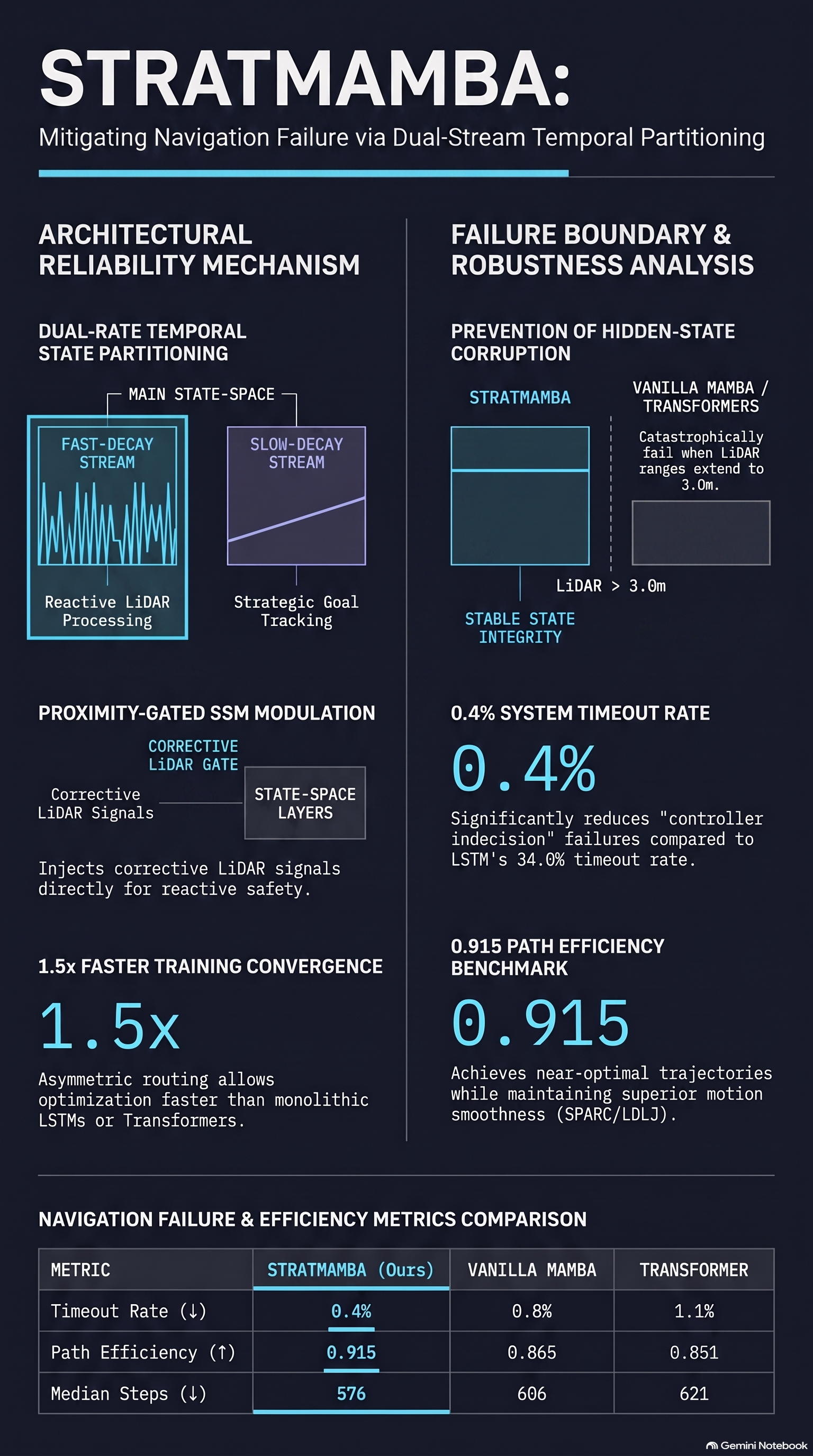
The core innovation of StratMamba lies in its “Dual-Rate State Partitioning,” which splits the internal hidden state of a Mamba-based model into two specialized memory streams. This architectural specialization prevents “hidden-state corruption,” a phenomenon where high-frequency, noisy environmental data (such as fluctuating LiDAR returns) overwrites the stable memory required for long-term mission objectives.
The authors partition the architecture into two distinct streams based on their temporal decay rates:
- The Proximity Stream (Fast-Decay): This reactive stream processes high-frequency LiDAR scans and robot status data. It utilizes a “Proximity Gate MLP” to map sensor inputs into a gating signal. This signal modulates the state-space model (SSM) layers, injecting corrective environmental data directly into the hidden state to facilitate immediate obstacle avoidance.
- The Goal Stream (Slow-Decay): This strategic stream maintains stable, low-dimensional information regarding goal coordinates and distance. By isolating this data, the model preserves a persistent internal representation of the objective that remains unaffected by the rapid oscillations of reactive sensor data.
A critical engineering detail noted by the authors is that the weighting matrices for the gating and fusion mechanisms ( and ) are zero-initialized. This ensures that at the onset of training, StratMamba behaves identically to a vanilla Mamba model, allowing the system to learn the optimal “corrective” gating signals gradually without destabilizing the initial policy learning.
3. Comparative Performance: Training Efficiency and Success Metrics
Empirical evaluations show that StratMamba achieves a 1.5x faster training convergence compared to LSTM and Transformer baselines. Notably, this efficiency advantage is not limited to short windows but holds consistently across all sequence lengths evaluated by the authors ( to ).
The following table summarizes the average (Avg) performance metrics across the evaluated models:
| Metric | LSTM | Transformer | Mamba | StratMamba |
|---|---|---|---|---|
| Success Rate (%) | 39.1 | 61.3 | 72.1 | 67.3 |
| Timeout Rate (%) | 34.0 | 1.1 | 0.8 | 0.4 |
| Median Steps to Goal | 684 | 621 | 606 | 576 |
| Path Efficiency | 0.807 | 0.851 | 0.865 | 0.915 |
While vanilla Mamba appears to achieve a higher average success rate (72.1%) in simulation, the authors highlight that StratMamba prioritizes reliability and optimality. StratMamba achieves the lowest timeout rate (0.4%), suggesting it is far less prone to the indecision that plagues recurrent models. Furthermore, its path efficiency of 0.915 is the highest across all baselines, indicating that it consistently identifies the most direct route rather than taking an aggressive, suboptimal path that might lead to “accidental” success in simulation.
4. Quantifying Motion Quality: Smoothness and Efficiency
The research team utilized spectral analysis to measure the “quality” of the navigation trajectories, moving beyond binary success metrics to evaluate hardware-relevant performance. They utilized two specific metrics: SPARC (Spectral Arc Length) for velocity smoothness and LDLJ (Log-Dimensionless Jerk) for acceleration smoothness.
StratMamba achieved superior scores in both categories:
- SPARC: -3.550 (compared to LSTM’s -3.624)
- LDLJ: -8.180 (compared to Transformer’s -8.325)
From a research analyst’s perspective, these scores indicate a significant reduction in high-frequency content and abrupt acceleration changes. For a platform like the Unitree Go1, this smoothness translates directly into mechanical longevity and reduced actuator heat dissipation, as the motor controllers are not subjected to the rapid, jerky corrections common in monolithic architectures.
5. Robustness Analysis: The LiDAR Range Stress Test
The most compelling evidence for StratMamba’s dual-stream design emerged during real-world deployment on the Unitree Go1 quadruped. The authors conducted a “stress test” by extending the LiDAR sensing range from a standard 1.5m to 3.0m.
In this environment, vanilla Mamba and Transformer models experienced catastrophic failure. At the 3.0m range, the sensors began capturing irrelevant environmental noise, such as distant walls and room boundaries. This additional context corrupted the hidden states of the monolithic models, leading to 0/20 successful trials in static obstacle scenarios.
In contrast, StratMamba maintained 18/20 successes (a 90% success rate) under the same conditions. The authors hypothesize that the proximity-gated stream effectively filters out distant “noise,” prioritizing immediate obstacle-relevant data for the reactive stream while the goal stream remains focused on strategic navigation. This architectural inductive bias allows the model to handle increased sensing complexity that renders other models non-functional.
6. Conclusion and Key Takeaways for AI Safety
StratMamba demonstrates that the decoupling of fast and slow temporal dynamics is essential for robust, real-time robotic control. By partitioning state representations, the architecture provides a safer, more predictable navigation policy that resists sensing degradation.
Key Takeaways:
- Temporal Specialization: Separating “fast-decay” reactive streams from “slow-decay” strategic streams prevents high-frequency sensing noise from corrupting long-term mission goals.
- State-Space Efficiency: StratMamba maintains the linear complexity of Mamba models, offering a scalable alternative to the quadratic cost of Transformers without sacrificing performance.
- Resilience to Complexity: The use of architectural inductive biases, specifically the dual-rate partitioning and proximity gating, is critical for successful sim-to-real transfer and robustness against sensing fluctuations.
As state-space models continue to gain traction in robotics, the findings of Wu et al. indicate that specialized, multi-stream architectures will be foundational for the next generation of safe and efficient autonomous systems.
7. References and Source Attribution
Primary Source: Wu et al., “StratMamba: Strategic and Reactive Stream Partitioning for Path-Efficient LiDAR-Based Obstacle Avoidance.” Identifier: arXiv:2607.12370
Read the full paper on arXiv · PDF