Artificial Foveated Perception for Mitigating Shortcut Learning in Robotic Foundation Models
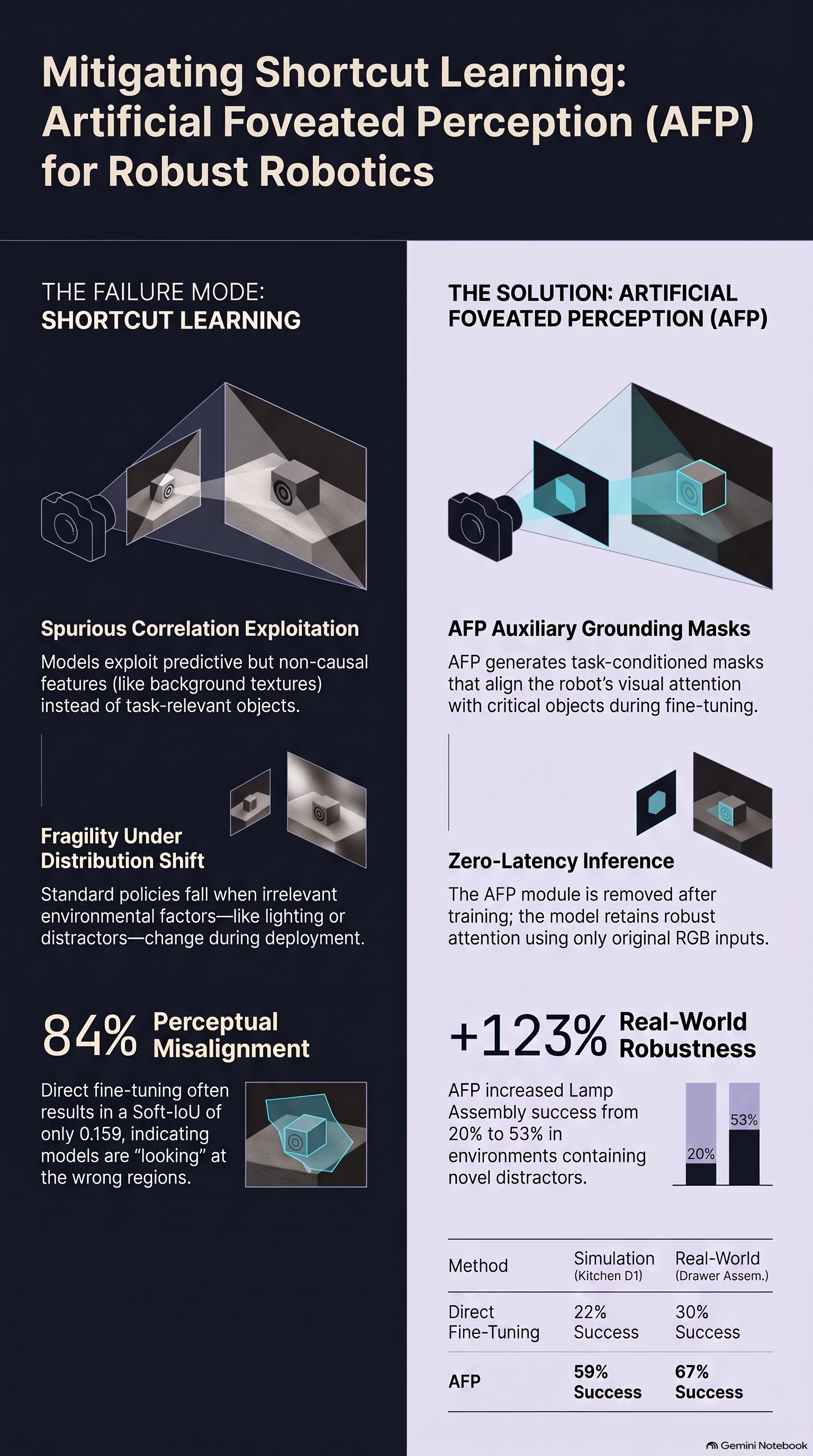
The authors introduce Artificial Foveated Perception (AFP), an auxiliary task-conditioned visual grounding module applied during fine-tuning to mitigate shortcut learning and improve perturbation...
1. Introduction: The Brittle Reality of Robotic Fine-Tuning
While multi-task robotic foundation models have demonstrated remarkable progress in cross-embodiment transfer and language-conditioned control, their real-world deployment remains hindered by a persistent lack of robustness. Unlike Large Language Models (LLMs) that exhibit strong zero-shot capabilities, current Vision-Language-Action (VLA) and World Action Model (WAM) pipelines typically require task-specific fine-tuning to operate in new robotic settings. Sun et al. observe that this adaptation process is often slow and prone to failure when faced with distribution shifts.
The authors identify the primary cause of this instability as “shortcut learning.” This refers to the tendency of models to exploit non-causal correlations within a narrow training distribution—such as specific lighting conditions or background textures—rather than focusing on the task-critical visual features required for successful manipulation. To address this, the paper proposes Artificial Foveated Perception (AFP), a lightweight module designed to guide model attention during training without imposing inference-time latency.
2. The Failure Mode: Why “Shortcuts” Lead to Robot Failure
In robotic manipulation, standard fine-tuning rewards the minimization of action loss, which often incentivizes the model to leverage any predictive feature, regardless of its causal relevance. If a specific background pattern or incidental lighting correlates with successful demonstrations in the training set, the model may adopt these as “spurious features.”
To test this vulnerability, the authors utilized an Out-of-Distribution (OOD) protocol that involved introducing 3–5 standalone mesh objects from unrelated environments onto the tabletop, each assigned a random material. In these scenarios, policies trained via standard fine-tuning frequently fail because their perceived visual “shortcuts” are either obscured or no longer predictive.
The Diagnostic Gap
Sun et al. argue that a fundamental “diagnostic gap” exists in current methodologies. Action-level supervision provides a scalar feedback signal that informs the robot what to do but fails to constrain the spatial granularity of the visual evidence the policy uses to make those decisions. Without explicit visual grounding, there is no mechanism to detect or prevent a model’s silent perceptual reliance on non-salient environmental noise.
3. Artificial Foveated Perception (AFP): Mimicking Human Focus
The AFP module is a policy-agnostic tool designed to emulate the human fovea by selectively processing task-relevant regions while suppressing peripheral distractors. As illustrated in the conceptual goals of the research, AFP transforms raw perception into a task-conditioned focus, isolating the regions critical for the action.
The architecture consists of a two-path system:
- The Feature Path: This path utilizes a MobileNetV3-Large backbone to extract a multi-scale feature pyramid. These features are processed through a deformable transformer encoder. To ensure temporal consistency across video sequences, AFP integrates the feature-level temporal modules from VMFormer.
- The Query Path: This path employs learned region queries and language conditioning via a frozen CLIP text encoder. The authors use FiLM adapters (Feature-wise Linear Modulation) to map the text embedding () to per-channel scale () and shift () parameters, which modulate the decoder states. This path also adopts VMFormer’s query-level temporal modeling to maintain frame-to-frame stability.
The final output is a task-conditioned mask () that identifies action-critical regions, such as the robot’s end-effector and relevant objects.
4. Integration Strategy: Grounding Without Latency
A primary advantage of the AFP approach is its “training-only” integration strategy. The module is used to supervise the policy’s internal visual grounding during the fine-tuning phase and is subsequently discarded.
Step-by-Step Integration:
- Alignment: During fine-tuning, the policy’s internal attention maps are extracted and compared to the masks generated by the AFP module.
- Auxiliary Grounding Loss (): The authors introduce a loss formula that aligns the policy’s attention distribution with the AFP mask. This ensures the model’s visual focus matches the task-relevant regions identified by the foveated perception module.
- Gradient Resolution (PCGrad): To prevent the grounding signal from interfering with action learning, the authors employ PCGrad. If the gradient for the action loss and the gradient for the AFP loss conflict, the AFP gradient is projected away to ensure action optimization remains the priority.
- Module Removal: Once fine-tuning is complete, the AFP module is removed. The policy executes on the original observation stream at its native speed, achieving improved robustness without any inference-time computational penalty.
5. Evidence of Robustness: Experimental Results
The authors evaluated AFP across various robotic foundation models using MimicGen tasks and Open-X Embodiment data. The results indicate that AFP-guided policies significantly outperform standard fine-tuning in maintaining success under environmental perturbations.
| Dimension | Direct Fine-tuning | Policy with AFP |
|---|---|---|
| In-Distribution (ID) Performance | Successful; prone to slow convergence | Successful; demonstrates faster convergence |
| OOD Robustness | Fails under distractors/mesh perturbations | Maintains success; ignores environmental noise |
| Fine-tuning Efficiency | Slower; vulnerable to shortcut overfitting | Rapid adaptation via constrained visual search |
Quantitatively, the authors measured visual grounding using Soft-IoU and Earth Mover’s Distance (EMD). In the “Coffee” manipulation task, AFP-guided fine-tuning improved the Soft-IoU from 0.170 to 0.934. More critically for safety researchers, the EMD dropped from 4.389 to 0.035, providing quantitative proof of the spatial correction in the model’s focus.
6. Visualizing Success: Attention Attribution
The contrast in how models attribute attention is most evident when comparing standard fine-tuning to AFP-enhanced training. In standard models, attention maps are often diffuse or fixated on irrelevant background elements, with the policy attention misaligned from the task-critical objects, leading to a “Fail” state.
Conversely, AFP-enhanced models maintain a sharp focus on the task objective. In a “lamp assembly” task, the AFP-trained policy remains locked onto the lamp components and the robot’s gripper, even when unrelated objects are present. Similarly, in an “engine dipstick” inspection task, the model successfully ignores the complex visual noise of the engine bay to isolate the dipstick itself, ensuring the action is grounded in causal visual evidence.
7. Conclusion: Practical Implications for AI Safety
The findings presented by Sun et al. suggest that task-conditioned foveated perception is a scalable and highly practical mechanism for hardening robotic systems. The authors summarize three critical takeaways:
- Overfitting Suppression: By enforcing alignment with task-conditioned masks, AFP prevents the policy from relying on environmental noise or spurious correlations that appear in-distribution.
- Data Efficiency: AFP-guided models adapt to new tasks faster than those using standard fine-tuning, as the foveated focus reduces the search space for relevant visual features.
- Deployment Readiness: Because the AFP module is removed after training, it provides a “free” boost to robustness without penalizing the robot’s real-time inference speed.
Ultimately, the paper asserts that managing how a model attributes its attention is as vital as the action loss itself for creating truly robust and deployable robotic foundation models.
Read the full paper on arXiv · PDF