Harness VLA: Steering Frozen VLAs into Reliable Manipulation Primitives via Memory-Guided Agents
The paper introduces Harness VLA, a framework that wraps a frozen vision-language-action model as a retryable contact-rich primitive and composes it with analytic primitives guided by execution...
1. The “Asymmetry” Challenge in Robotic Foundation Models
Zhang et al. identify a fundamental performance gap in modern robotic manipulation, which they characterize as an architectural “asymmetry.” Current Vision-Language-Action (VLA) models demonstrate robust local, contact-rich visuomotor capabilities—such as manipulating irregular objects or actuating brittle fixtures—when operating within their training distribution. However, these monolithic models often fail during long-horizon composition, spatial-layout reasoning, and semantic consistency under environmental variations.
The authors attribute this fragility to “deployment perturbations” that deviate from the specific trajectories seen during training.
“End-to-end Vision-Language-Action (VLA) models provide strong local visuomotor skills, but they are trained on in-distribution task trajectories and often degrade under deployment perturbations such as semantic retargeting, goal re-binding, spatial-layout shifts, and unstable local contacts.”
By requiring a single model to simultaneously manage semantic grounding, global navigation, and high-frequency contact control, the system becomes susceptible to cascading failures. The paper argues that even minor transient contact failures or object position shifts can derail the entire execution of a monolithic rollout.
2. Architecture: The Harness VLA Framework
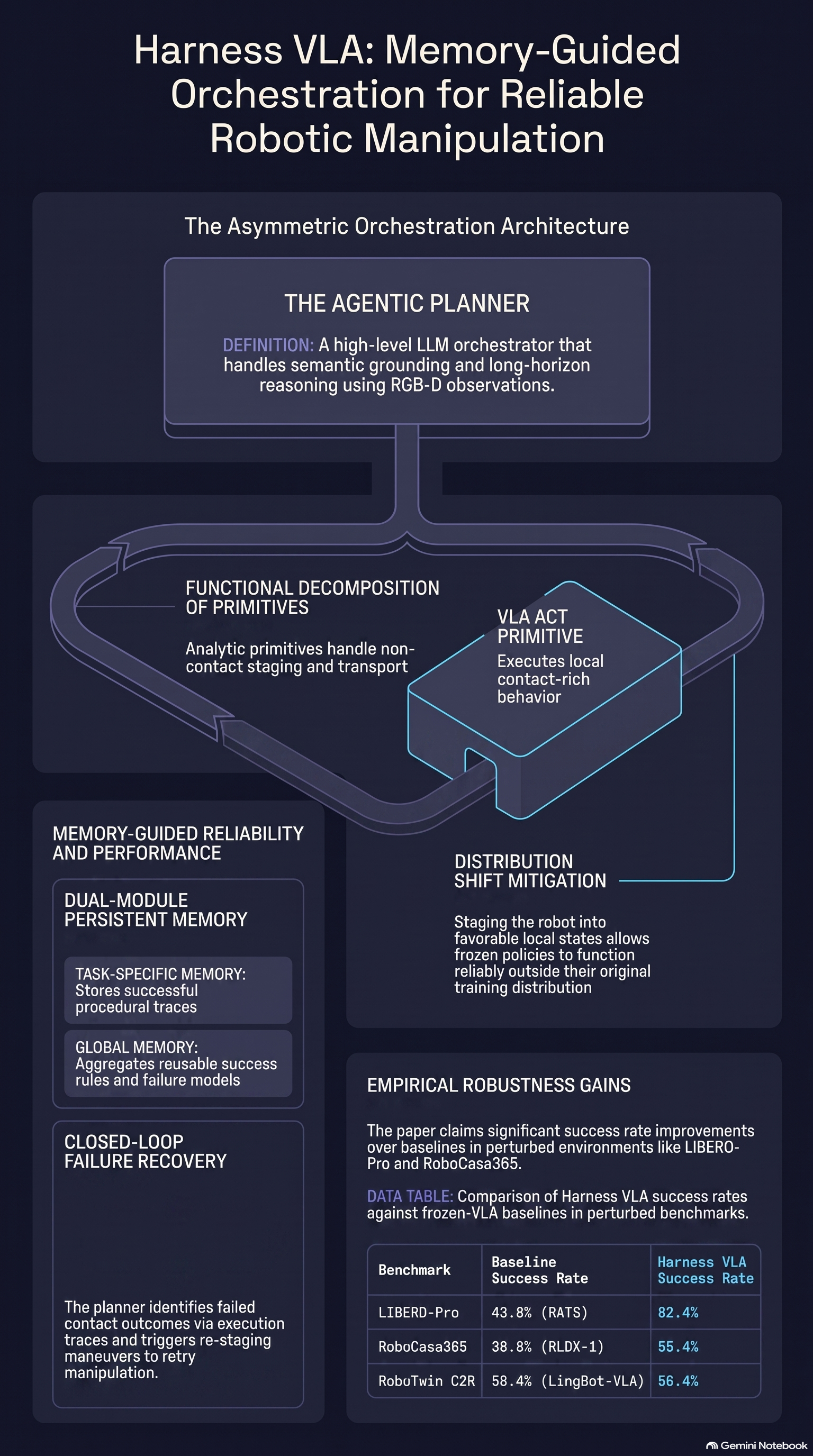
To mitigate these failure modes, the authors propose Harness VLA, a three-tier architecture designed to isolate cognitive orchestration from physical execution. The system comprises a High-Level Agentic Planner, a Fixed Primitive Library, and dual Memory Modules.
The framework employs an “Agentic Execution Loop” that replaces continuous, monolithic rollouts with a turn-based interaction. The planner, acting as the cognitive lead, processes multimodal observations and emits iterative, JSON-serialized calls to specific primitives. This loop continues until the environment satisfies the task’s completion predicate.
The Unified Primitive Library
| Primitive Name | Type | Role |
|---|---|---|
| Analytic Primitives (e.g., MOVE_TO, ROTATE_WRIST) | Deterministic / Model-based | Handles non-contact execution, including perception-conditioned staging, transport, posture adjustment, and release. |
| VLA Primitive (VLA_ACT) | Learned / Frozen VLA | Handles local contact-rich behavior, such as grasping, constrained placement, and fixture actuation. |
The planner interacts with the robot exclusively through a structured interface, ensuring that it never emits low-level torques directly. A typical call is formatted as:
{"action": "vla_act", "prompt": <str>, "max_chunks": <int>, "stop": <predicate>}
3. Memory-Guided Reliability: Task-Specific vs. Global Learning
The agent’s lifecycle is bifurcated into two phases: Exploratory Bootstrapping and Deployment Evaluation. During bootstrapping, the agent iterates through failures to discover a valid solution for a reference task. The authors note that the agent is uniquely granted access to a RESET primitive during this phase, providing the mechanism necessary to discover optimized primitive orchestrations through repeated trials. In the deployment phase, the agent must generalize this knowledge to perturbed environments without the ability to reset.
The transition between these phases is facilitated by two distinct memory modules:
| Memory Module | Function and Format |
|---|---|
| Task Specific Memory | Stores successful primitive traces in a JSONL format. It utilizes “symbolic perception queries” to replace concrete spatial coordinates, allowing the planner to re-ground successful sequences across varying layouts. |
| Global Memory | Aggregates generalized success rules and failure models across all tasks. It provides heuristics for optimal prompting and documents critical failure modes, such as detecting empty-grasp executions or unstable staging. |
4. Empirical Evidence: Stress-Testing under Perturbations
The authors evaluated Harness VLA across three benchmarks: LIBERO-Pro (tabletop manipulation), RoboCasa365 (household kitchen tasks), and RoboTwin C2R (clean-to-randomized bimanual transfer). The experiments focused on the framework’s resilience against distribution shifts and semantic changes.
Findings reported by the authors include the following:
- LIBERO-Pro Success: The framework achieved an 82.4% success rate, representing a 38.6 percentage point improvement over the RATS baseline under position-swap and instruction-redirection perturbations.
- RoboCasa365 Performance: Harness VLA demonstrated a 25.4 percentage point gain over the RLDX-1 baseline, successfully managing long-horizon tasks involving navigation and articulated fixtures.
- RoboTwin C2R Transfer: The system reached a 58.4% success rate in zero-shot clean-to-randomized transfer, significantly outperforming direct VLA rollouts.
A primary observation (Key Finding 2) concerns the “sparse but adaptive use” of the VLA_ACT primitive. The paper highlights that success improves when the planner is permitted to retry local contact-rich attempts. By staging the robot into a favorable configuration before a VLA call, the planner prevents transient contact failures from escalating into catastrophic episode terminations.
5. Analysis of Failure Mitigation and Safety
Harness VLA addresses critical AI safety concerns, such as distribution shifts and unstable contact phases, without necessitating end-to-end retraining. Traditional models often suffer from behavioral cloning pitfalls, repeating training-time motions even when scene context has changed. By delegating semantic grounding and task composition to the agentic planner, the framework ensures the visuomotor policy is only invoked for its intended local contact phase.
Synthesizing the author’s analysis (Key Finding 3), the framework utilizes analytic primitives to isolate non-contact execution from contact-rich control. These analytic primitives handle transport and repositioning with “mathematical certainty” derived from deterministic kinematics. This isolation restricts the stochastic, learned VLA control to specific, indispensable interaction regions, thereby preventing the propagation of errors during the non-contact stages of a task.
6. Conclusion: Takeaways for Embodied AI
The authors conclude that robotic reliability is better served by agentic orchestration of frozen models than by simply increasing model scale. By utilizing a VLA as a specialized tool within a larger harnessed loop, the paper demonstrates a robust, auditable path for embodied AI.
Technical Takeaways
- Frozen Specialization: Treating VLAs as “contact specialists” for local interaction is more reliable than using them as monolithic policies for an entire task.
- Harness vs. Fine-tuning: Capabilities can be extended to out-of-distribution tasks more effectively through the orchestration of a fixed library than through fine-tuning.
- Failure Recovery: Explicit failure models and persistent memory enable agents to detect incomplete outcomes and initiate recovery re-staging, preventing cascading execution errors.
Read the full paper on arXiv · PDF