Behavior Foundations for Quadruped Robots: ABot-C0 Technical Report
The authors introduce ABot-C0, a quadruped locomotion system integrating a multi-source motion data pipeline, a Flow-Matching tracking policy with empirical scaling behavior, and a...
1. Introduction: The Challenge of Quadrupedal Foundation Models
Progress in humanoid robotic control has advanced rapidly, largely driven by the availability of massive human motion-capture (MoCap) datasets. However, the authors of the ABot-C0 technical report suggest that migrating this success to quadrupedal settings is significantly more difficult. Animal motion data is far scarcer and harder to capture at scale than human data, and the process of cross-embodiment retargeting across diverse robotic morphologies remains fragile.
To address these limitations, the paper introduces ABot-C0, a “Behavior Foundation Model” (BFM) designed for quadruped robots. The authors describe ABot-C0 as a shift away from isolated sub-skills, such as walking or basic gaits, toward “product-level behavioral intelligence.” The system integrates a scalable data engine, a generalist tracking policy with empirical scaling properties, and a perceptive framework that enables robots to move beyond functional demonstrations toward a deeper understanding of and interaction with unstructured environments.
2. Building the Data Pyramid: 16,074 Physically Feasible Clips
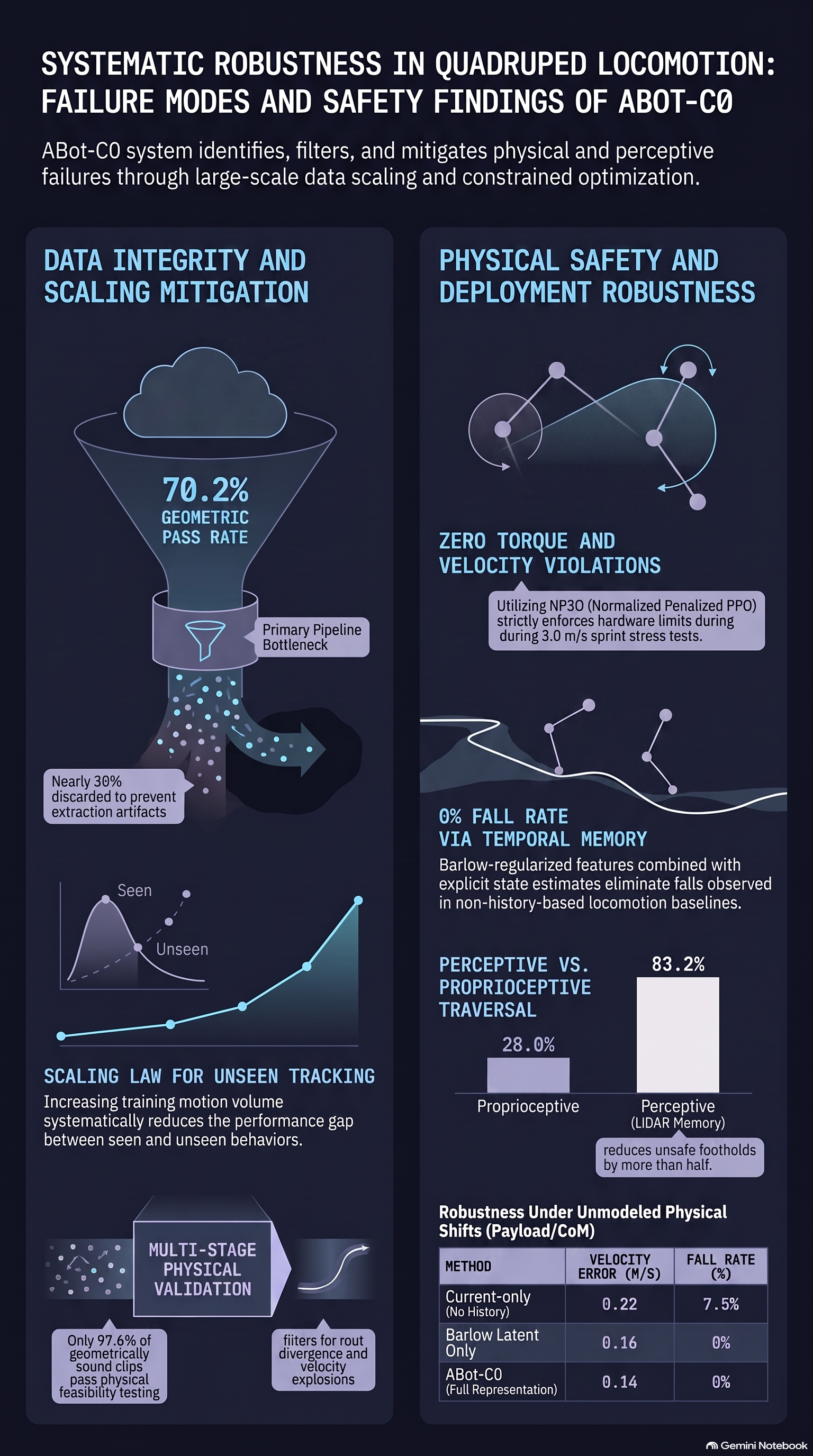
The authors identify data scarcity as the primary bottleneck for quadruped intelligence. To overcome this, the paper details a “data pyramid” engine that synthesized a total corpus of 35.08 hours of motion data, which was filtered down to 16,074 physically feasible motion clips totaling 22.43 hours.
The pyramid is composed of four distinct sources:
- Teleoperation: Provides high-quality, robot-executable demonstrations for “cold-start” policy training.
- Artist Design: Includes expressive “S-Tier” extreme maneuvers created by human designers.
- Motion Capture: Contributes natural, animal-like locomotion patterns.
- Video-to-Motion Generation: Serves as the scalable backbone of the dataset, producing over 7,000 clips of acrobatic and diverse behaviors.
The Video-to-Motion Generation pipeline is a three-stage automated process:
- Identity-Consistent Video Generation: The authors fine-tuned the Wan2.2 model to generate videos based on a reference image of the robot. To prevent the robot’s body from deforming non-rigidly across frames—an “identity drift” that violates the rigid-body assumption required for downstream 3D kinematic fitting—they implemented an Identity Consistency Loss using DINOv2 features to ensure the robot’s appearance remained stable.
- 3D Trajectory Extraction: The system predicts 2D landmarks and solves a kinematic fitting problem to convert the video into 3D joint angles. Foot-contact constraints are applied to prevent the robot from “sliding” in the generated motion.
- Multi-Stage Quality Filtering: Trajectories pass through three “gates.” The Semantic gate uses CLIP to check visual similarity, the Geometric gate filters by reprojection error, and the Physical feasibility gate runs a simulation rollout to ensure the motion does not cause the robot to fall.
3. The First Scaling Law for Quadruped Motion Tracking
The authors employ a “Specialist-to-Generalist” training paradigm, where individual “specialist” policies are distilled into a single, unified “generalist” policy. A critical finding in the report is the discovery of a Scaling Law: as the volume of training data increases, the robot’s performance improves consistently, specifically by reducing the seen-unseen gap, which enhances the model’s ability to generalize to novel motions.
To achieve high-fidelity tracking, the authors define a Flow-Matching policy. This method treats action prediction as a velocity field that transports noise samples toward a valid action distribution. During inference, actions are obtained via reverse Euler integration (typically using steps). This approach allows the robot to follow complex references with high precision.
To refine the motion library, the authors utilize PRF-score selection, ranking motions by three criteria:
- Physical feasibility ()
- Rollout executability ()
- Flow confidence ()
This curated data informs the Manifold-Calibrated Reference Conditioning (MCRC), which uses a Variational Autoencoder (VAE) to learn a compact representation of the motion library. By providing the policy with a “manifold coordinate” (a latent signal) and a “reliability signal” based on reconstruction error, the system understands its local motion context and can identify how well a target motion fits within its learned expertise.
4. All-Terrain Locomotion: The Perceptive Framework
To transition from simulation to unstructured real-world environments, the paper describes a three-stage “privileged-to-perceptive” framework:
- Privileged Teacher Training: A teacher policy learns with access to “clean” height maps and ground-truth dynamics (e.g., friction and mass).
- Clean LiDAR Memory Distillation: A student policy learns to recover the teacher’s latent information using temporal LiDAR memory. The system processes an 8-frame history voxelized into a 3D grid, utilizing a GRU-based temporal encoder to compensate for ego-motion and build an environmental memory.
- Noisy On-Policy Fine-Tuning: The policy is adapted to real-world sensor noise and point dropouts. The report notes that teacher regularization is gradually decayed during this stage to allow for closed-loop adaptation.
For hardware safety, the authors utilize NP3O (Normalized Penalized PPO). This mechanism enforces hard constraints on joint and torque boundaries. The report highlights the use of ReLU gating, which ensures that the safety penalty contributes no gradient when constraints are satisfied. This architectural choice preserves the exploration space during training while strictly suppressing safety violations on real hardware.
5. Beyond Walking: Social Interaction and Urban Navigation
The ABot-C0 system was deployed on the Tutu robot to test applications in dynamic settings. The hardware configuration includes a 96-channel RoboSense Airy LiDAR, an NVIDIA Jetson AGX Orin 64GB module, and three SENSING cameras.
A primary case study for scene interaction is “Hand-Shaking.” The authors opted for a compositional pipeline—locomotion for the approach, followed by IK-tracking for the interaction—rather than a monolithic end-to-end model. The report justifies this choice by noting that visual reinforcement learning is especially sensitive to delayed or biased detections during deployment. By separating perception from control, the system maintains predictable command interfaces and ensures the robot can respond compliantly to human movement.
The results indicate that this unified stack allows the Tutu robot to coordinate smooth transitions between navigation and recovery behaviors (such as responding to physical perturbations) while operating reliably in human-centric urban environments.
6. Conclusion: Implications for Failure-First Robotics
The ABot-C0 technical report concludes that the system’s robustness is rooted in its ability to reconcile perceptive and physical data. By utilizing temporal LiDAR memory and terrain-predictive supervision, the robot can mitigate potential failures caused by mismatches between sensor input and the physical ground truth.
The authors emphasize that the integration of a scalable data engine with a unified deployment architecture represents a transition in the field. The report suggests that the future of quadruped robotics lies in evolving from the mechanical ability to walk toward a more sophisticated capacity to “understand, express, and interact” reliably in complex, real-world spaces.
Read the full paper on arXiv · PDF