Localized LoRA-MoE: Block-wise Low-Rank Experts With Adaptive Routing
The authors propose Localized LoRA-MoE, an architectural framework that combines spatial blocking with dynamic routing to mitigate optimization interference during parameter-efficient fine-tuning.
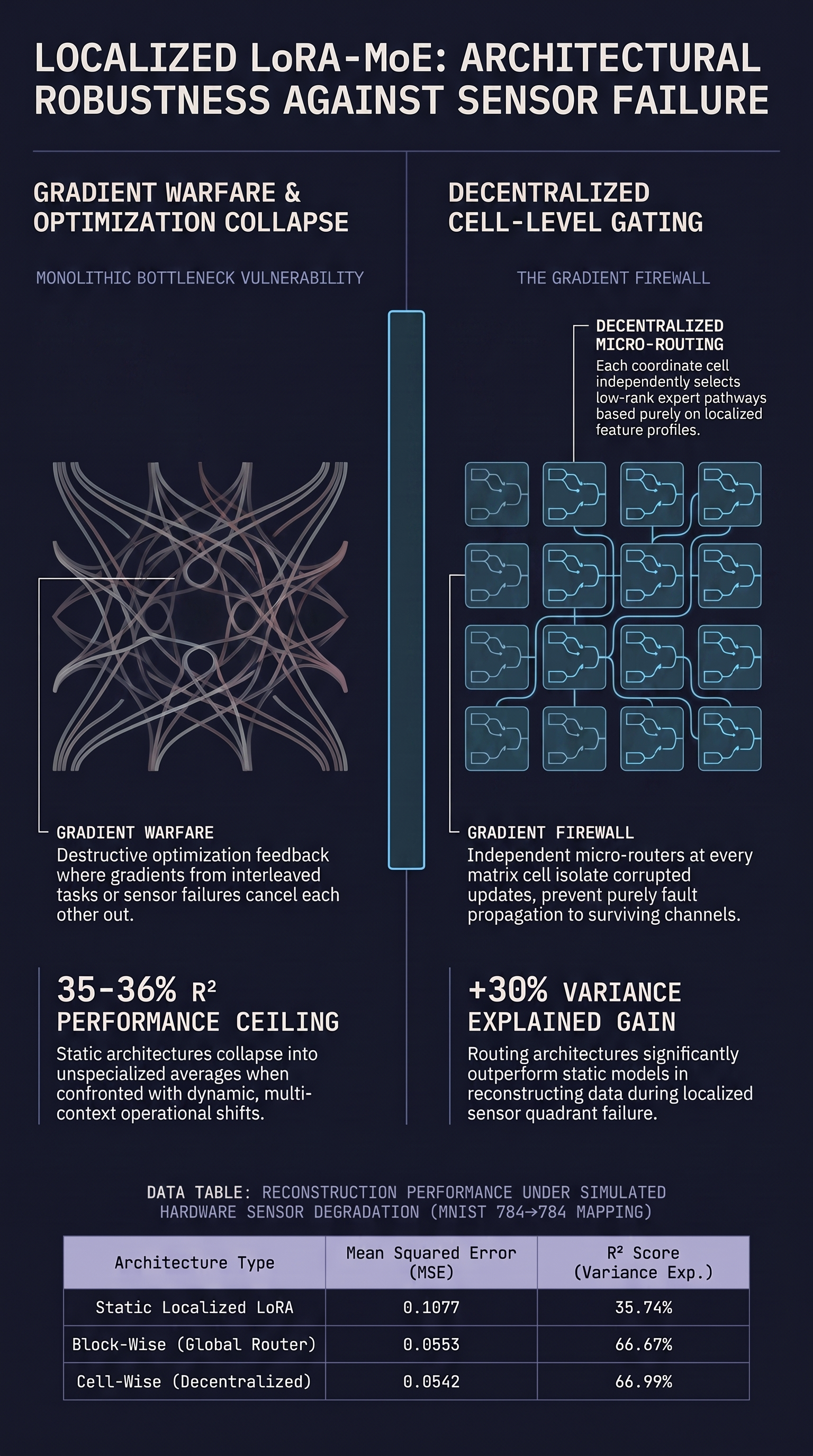
1. Introduction: The Hidden Fragility of Standard Fine-Tuning
As Large Language Models (LLMs) and perception networks expand in scale, practitioners rely heavily on Parameter-Efficient Fine-Tuning (PEFT) methods such as Low-Rank Adaptation (LoRA) for task specialization. However, Barazandeh et al. (2026) identify a structural vulnerability termed “Gradient Warfare.” This phenomenon emerges when standard LoRA—constrained by a monolithic bottleneck—encounters interleaved multi-task streams. Under these conditions, destructive optimization feedback causes adapter weights to collapse into unspecialized averages, neutralizing the efficiency benefits of the adaptation.
To mitigate this, the authors propose Localized LoRA-MoE, an architectural framework that fuses spatial blocking with dynamic, context-conditioned routing. The document reports on this proposal, which establishes a “Gradient Firewall” designed to shield models from optimization collapse. By localizing updates and introducing dynamic gating, the framework maintains structural robustness even during catastrophic operational shifts, such as hardware sensor failure.
2. The Structural Bottleneck: Why Traditional LoRA Fails
Barazandeh et al. argue that standard LoRA fails due to “Channel Dominance,” where a small subset of outlier activation channels disproportionately dictates parameter updates. Because traditional LoRA uses a singular global bottleneck, these sparse signals inject destructive entanglement across unrelated input-output pathways.
The authors characterize “Gradient Warfare” as a precise geometric conflict. When a model encounters disparate contexts (), the gradients issued for each context may oppose one another. This is represented by the negative dot product of the gradients: This conflict forces parameters to stall or collapse into a mathematical average of the two targets. According to the paper, existing static topologies (e.g., MELoRA, GraLoRA) fail during dynamic shifts for several reasons:
- Rigid Mappings: Static sub-blocks assume fixed spatial relationships, leaving them unable to adapt to dynamic task-switching.
- Optimization Deadlock: In the absence of routing, competing forward states attempt to overwrite shared updates, leading to the aforementioned geometric conflict.
- Fault Propagation: Static structures lack the means to reroute information flow during sensor degradation, allowing corrupted data to poison the entire adaptation layer.
3. Architectural Innovations: Macro vs. Micro Routing
The authors evaluate two novel paradigms to resolve these optimization deadlocks, as summarized in the following table:
| Architecture Type | Routing Mechanism | Key Advantage | Ideal Use Case |
|---|---|---|---|
| Block-Wise LoRA-MoE | Centralized Macro-Routing | High macro-cohesion via a monolithic context signal. | Uniform global semantic shifts (e.g., task switching). |
| Cell-Wise LoRA-MoE | Decentralized Micro-Routing | Independent, autonomous gating for every coordinate cell. | Spatially heterogeneous shifts (e.g., sensor failure). |
The paper identifies the Cell-Wise approach as a critical evolution in PEFT architecture. By embedding independent micro-routers into every individual coordinate cell of the matrix grid, the system grants each sub-block the autonomy to select its own expert pathway. This decentralization allows for a vast expansion in configuration space; while a global router provides configurations, the Cell-Wise router provides possible grid configurations, enabling the model to respond to local feature profiles without a single-point global coordinator.
4. Empirical Evidence: Breaking the Optimization Ceiling
The authors’ experiments demonstrate that Localized LoRA-MoE overcomes the optimization limits of static baselines across varied benchmarks.
SVD Multi-Field Interaction Simulation
In a high-dimensional simulation modeling shifting statistical environments, the Cell-Wise variant achieved a +11.48% absolute boost in R2 score over the global routing variant. This gain is attributed to the combinatorial flexibility of the decentralized model, which allowed different matrix regions to specialize in distinct domains simultaneously. These results were achieved with a negligible overhead of only 96 additional parameters.
California Housing Tabular Benchmark
On a real-world tabular dataset with uniform context shifts, the Block-Wise (99.65%) and Cell-Wise (99.51%) architectures achieved near-perfect parity. Crucially, this performance was reached at strict parameter parity, utilizing only 260 and 272 trainable parameters, respectively. This demonstrates that decentralized routing can match the efficacy of an “omniscient” global coordinator even when the task does not strictly require micro-granularity.
5. Robustness in Action: Surviving Sensor Degradation
To test architectural safety, Barazandeh et al. conducted an MNIST-based experiment simulating a localized quadrant failure (quadrant ) in a sensor array. Under standard adaptation, the corrupted data from the failed quadrant poisons the shared weights, causing a performance collapse.
The proposed “Gradient Firewall” functions by severing dependencies on the failed quadrant. The paper demonstrates that the Cell-Wise variant adopts an asymmetric off-diagonal tracking state, forcing surviving quadrants (such as and ) to cross-talk directly to reconstruct structural boundaries without the influence of the corrupted signal.
The performance metrics from Table 3 of the source highlight the framework’s robustness:
- Standard LoRA: 36.42% R2 score.
- Proposed Cell-Wise Variant: 66.99% R2 score.
This ~30% improvement in explained variance, achieved with an overhead of just 64 parameters, proves the framework’s ability to maintain perception safety despite partial hardware loss.
6. Technical Discussion: The Power of Decentralization
The paper provides a theoretical analysis of the “Containment” principle, which states that the reachable set of weight updates for a cell-wise router is a superset of those available to a block-wise router. Consequently, the authors conclude that cell-wise routing is never worse than block-wise routing at matched expert budgets.
A primary technical contribution is the Routing Jacobian. In the decentralized Cell-Wise model, the gating parameters for a specific cell influence only that cell’s output and depend only on the local input slice . This results in a block-diagonal structure in the routing Jacobian, defined by: This mathematical “hard isolation” ensures that corrupted signals or faults in one input slice cannot perturb the routing logic for the rest of the grid. This effectively localizes the “blast radius” of any data corruption. These gains are achieved with minimal parameter costs—specifically 96, 16, or 64 additional parameters in the evaluated benchmarks—preserving the strict efficiency required for PEFT applications.
7. Conclusion and Practitioner Takeaways
The research by Barazandeh et al. concludes that spatial isolation and dynamic routing are complementary philosophies. Fusing these methods allows for adaptation layers that are both parameter-efficient and structurally robust against the pressures of multi-task learning and environmental sensor degradation.
Strategic Takeaways for AI Safety Researchers:
- Granularity Matching: The granularity of a routing mechanism must match the structural heterogeneity of the task; decentralized routing is essential when different input fields require independent adaptation strategies.
- Fault Localization: Decentralization acts as a “gradient firewall” by utilizing a block-diagonal routing Jacobian, preventing the propagation of corrupted gradients from a failed sensor to surviving pathways.
- Efficiency and Robustness: High-dimensional robustness and protection against “gradient warfare” can be achieved at strict parameter parity, making decentralized routing a viable default for safety-critical perception networks.
Attribution for this architectural framework and the associated empirical evidence is to Barazandeh et al. and their investigation into localized architectural robustness.
Read the full paper on arXiv · PDF